

The DOI matches its Crossref record; 12 of the 12 references it cites were found in a registry or an index.
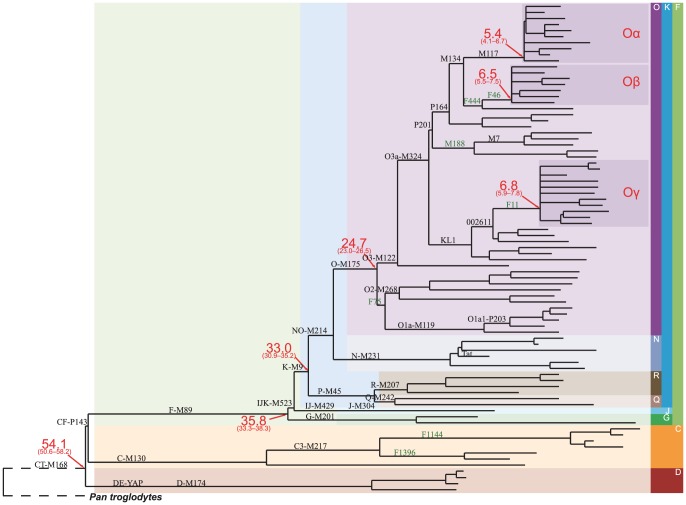
Y Chromosomes of 40% Chinese Descend from Three Neolithic Super-Grandfathers
Overview
The claims and statistics of this paper haven’t been checked yet.
Run the check — free, no account needed. It reads the open-access text and checks the sources it cites.
Integrity signals
Registry
Cites
Statistics
Figures
Verification
Claims the paper makes
The claims and statistics of this paper haven’t been checked yet.
Run the check — free, no account needed. It reads the open-access text and checks the sources it cites.
Claims other papers make about this one
Each is checked against this paper’s own text: does it say what the citing paper says it does?
In the citing paper
“Previous studies showed that Q1a1a1-M120 had migrated from north-western China to the Central Plain as nomads, and merged into the northern Han Chinese farmers at approximately 2.5–3 KYA (Zhao et al. 2010, 2014, 2015; Yan et al. 2014).”
From Dispersals of the Siberian Y-chromosome haplogroup Q in Eurasia (2018) · cites this paper as Yan et al. 2014
Self-check
Percentages, sums and reported differences re-computed from the paper’s own numbers.
The self-check needs the paper’s full text.
Citations
Cites
A map of human genome variation from population-scale sequencing.
The 1000 Genomes Project Consortium (2010) · Nature · doi:10.1038/nature09534 · Cited by 7,877
Relaxed Phylogenetics and Dating with Confidence
Drummond, A. J., Ho, S. Y. W., Phillips, M. J., & Rambaut, A. (2006) · PLoS Biology · doi:10.1371/journal.pbio.0040088 · Cited by 6,463
Inference of human population history from individual whole-genome sequences
Li, H., & Durbin, R. (2011) · Nature · doi:10.1038/nature10231 · Cited by 2,590
Self-citationInitial sequence of the chimpanzee genome and comparison with the human genome
The Chimpanzee Sequencing and Analysis Consortium (2005) · Nature · doi:10.1038/nature04072 · Cited by 2,459
Rate of de novo mutations and the importance of father’s age to disease risk
Kong, A., Frigge, M. L., Masson, G., Besenbacher, S., Sulem, P., Magnusson, G., Gudjonsson, S. A., Sigurdsson, A., Jonasdottir, A., Jonasdottir, A., et al. (2012) · Nature · doi:10.1038/nature11396 · Cited by 2,134
The diploid genome sequence of an Asian individual
Wang, J., Wang, W., Li, R., Li, Y., Tian, G., Goodman, L., Fan, W., Zhang, J., Li, J., Zhang, J., et al. (2008) · Nature · doi:10.1038/nature07484 · Cited by 924
Self-citationA Revised Timescale for Human Evolution Based on Ancient Mitochondrial Genomes
Fu, Q., Mittnik, A., Johnson, P. L. F., Bos, K., Lari, M., Bollongino, R., Sun, C., Giemsch, L., Schmitz, R., Burger, J., et al. (2013) · Current Biology · doi:10.1016/j.cub.2013.02.044 · Cited by 709
The Genetic Legacy of the Mongols
Zerjal, T., Xue, Y., Bertorelle, G., Wells, R. S., Bao, W., Zhu, S., Qamar, R., Ayub, Q., Mohyuddin, A., Fu, S., et al. (2003) · The American Journal of Human Genetics · doi:10.1086/367774 · Cited by 563
A highly annotated whole-genome sequence of a Korean individual
Kim, J.-I., Ju, Y. S., Park, H., Kim, S., Lee, S., Yi, J.-H., Mudge, J., Miller, N. A., Hong, D., Bell, C. J., et al. (2009) · Nature · doi:10.1038/nature08211 · Cited by 330
Rapid, global demographic expansions after the origins of agriculture
Gignoux, C. R., Henn, B. M., & Mountain, J. L. (2011) · Proceedings of the National Academy of Sciences · doi:10.1073/pnas.0914274108 · Cited by 267
Research works printed but not linked: 49
- LL Cavalli-Sforza, 2003, The application of molecular genetic approaches to the study of human evolution, Nat Genet, 33, 266, 10.1038/ng1113 · DOI
- Zheng H-X, Yan S, Qin Z-D, Wang Y, Tan J-Z, <etal>et al</etal>.. (2011) Major Population Expansion of East Asians Began before Neolithic Time: Evidence of mtDNA Genomes. PLoS One 6. · DOI
- L Pereira, 2005, High-resolution mtDNA evidence for the late-glacial resettlement of Europe from an Iberian refugium, Genome Res, 15, 19, 10.1101/gr.3182305 · DOI
- H Skaletsky, 2003, The male-specific region of the human Y chromosome is a mosaic of discrete sequence classes, Nature, 423, 825, 10.1038/nature01722 · DOI
- YL Xue, 2009, Human Y Chromosome Base-Substitution Mutation Rate Measured by Direct Sequencing in a Deep-Rooting Pedigree, Curr Biol, 19, 1453, 10.1016/j.cub.2009.07.032 · DOI
- MF Hammer, 2001, Hierarchical patterns of global human Y-chromosome diversity, Mol Biol Evol, 18, 1189, 10.1093/oxfordjournals.molbev.a003906 · DOI · Paper page
- L Jin, 2000, Natives or immigrants: Modern human origin in East Asia, Nat Rev Genet, 1, 126, 10.1038/35038565 · DOI
- PA Underhill, 2000, Y chromosome sequence variation and the history of human populations, Nat Genet, 26, 358, 10.1038/81685 · DOI · Paper page
- MA Jobling, 2003, The human Y chromosome: An evolutionary marker comes of age, Nat Rev Genet, 4, 598, 10.1038/nrg1124 · DOI
- TM Karafet, 2008, New binary polymorphisms reshape and increase resolution of the human Y chromosomal haplogroup tree, Genome Res, 18, 830, 10.1101/gr.7172008 · DOI · Paper page
- Consortium The Y Chromosome, 2002, A nomenclature system for the tree of human Y-chromosomal binary haplogroups, Genome Res, 12, 339, 10.1101/gr.217602 · DOI · Paper page
- YH Ke, 2001, African origin of modern humans in East Asia: A tale of 12,000 Y chromosomes, Science, 292, 1151, 10.1126/science.1060011 · DOI
- F Cruciani, 2011, A Revised Root for the Human Y Chromosomal Phylogenetic Tree: The Origin of Patrilineal Diversity in Africa, Am J Hum Genet, 88, 814, 10.1016/j.ajhg.2011.05.002 · DOI
- R Thomson, 2000, Recent common ancestry of human Y chromosomes: Evidence from DNA sequence data, Proc Natl Acad Sci USA, 97, 7360, 10.1073/pnas.97.13.7360 · DOI
- MF Hammer, 2002, The human Y chromosome haplogroup tree: Nomenclature and phylogeography of its major divisions, Annu Rev Anthropol, 31, 303, 10.1146/annurev.anthro.31.040402.085413 · DOI
- W Wei, 2013, A calibrated human Y-chromosomal phylogeny based on resequencing, Genome Res, 23, 388, 10.1101/gr.143198.112 · DOI
- S Yan, 2011, An updated tree of Y-chromosome Haplogroup O and revised phylogenetic positions of mutations P164 and PK4, Eur J Hum Genet, 19, 1013, 10.1038/ejhg.2011.64 · DOI
- AJ Drummond, 2007, BEAST: Bayesian evolutionary analysis by sampling trees, BMC Evol Biol, 7, 214, 10.1186/1471-2148-7-214 · DOI
- TM Karafet, 2010, Major East-West Division Underlies Y Chromosome Stratification across Indonesia, Mol Biol Evol, 27, 1833, 10.1093/molbev/msq063 · DOI · Paper page
- B Su, 1999, Y-chromosome evidence for a northward migration of modern humans into eastern Asia during the last Ice Age, Am J Hum Genet, 65, 1718, 10.1086/302680 · DOI
- L Barton, 2009, Agricultural origins and the isotopic identity of domestication in northern China, Proc Natl Acad Sci USA, 106, 5523, 10.1073/pnas.0809960106 · DOI
- The Institute of Archaeology Chinese Academy of Social Sciences (2010) Chinese Archaeology - Neolithic. Beijing: China Social Sciences Press.
- T Gayden, 2007, The Himalayas as a directional barrier to gene flow, Am J Hum Genet, 80, 884, 10.1086/516757 · DOI · Paper page
- H Shi, 2005, Y-chromosome evidence of southern origin of the East Asian - Specific haplogroup O3-M122, Am J Hum Genet, 77, 408, 10.1086/444436 · DOI
- YL Xue, 2006, Male demography in East Asia: A north-south contrast in human population expansion times, Genetics, 172, 2431, 10.1534/genetics.105.054270 · DOI
- J Diamond, 2003, Farmers and their languages: The first expansions, Science, 300, 597, 10.1126/science.1078208 · DOI · Paper page
- Balaresque P, Bowden GR, Adams SM, Leung H-Y, King TE, <etal>et al</etal>.. (2010) A Predominantly Neolithic Origin for European Paternal Lineages. PLoS Biol 8. · DOI · Paper page
- Y Kuroki, 2006, Comparative analysis of chimpanzee and human Y chromosomes unveils complex evolutionary pathway, Nat Genet, 38, 158, 10.1038/ng1729 · DOI
- P Soares, 2009, Correcting for Purifying Selection: An Improved Human Mitochondrial Molecular Clock, Am J Hum Genet, 84, 740, 10.1016/j.ajhg.2009.05.001 · DOI
- LA Zhivotovsky, 2004, The effective mutation rate at Y chromosome short tandem repeats, with application to human population-divergence time, Am J Hum Genet, 74, 50, 10.1086/380911 · DOI
- E Heyer, 2001, Phylogenetic and familial estimates of mitochondrial substitution rates: Study of control region mutations in deep-rooting pedigrees, Am J Hum Genet, 69, 1113, 10.1086/324024 · DOI
- D Penny, 2005, Evolutionary biology - Relativity for molecular clocks, Nature, 436, 183, 10.1038/436183a · DOI
- JF Hughes, 2005, Conservation of Y-linked genes during human evolution revealed by comparative sequencing in chimpanzee, Nature, 437, 100, 10.1038/nature04101 · DOI
- N Patterson, 2006, Genetic evidence for complex speciation of humans and chimpanzees, Nature, 441, 1103, 10.1038/nature04789 · DOI
- DM Behar, 2012, A "Copernican" Reassessment of the Human Mitochondrial DNA Tree from its Root, Am J Hum Genet, 90, 675, 10.1016/j.ajhg.2012.03.002 · DOI
- RG Roberts, 1990, Thermoluminescence Dating of a 50,000-Year-Old Human Occupation Site in Northern Australia, Nature, 345, 153, 10.1038/345153a0 · DOI · Paper page
- Z Yang, 2007, PAML 4: Phylogenetic analysis by maximum likelihood, Mol Biol Evol, 24, 1586, 10.1093/molbev/msm088 · DOI · Paper page
- X Yang, 2012, Early millet use in northern China, Proc Natl Acad Sci USA, 109, 3726, 10.1073/pnas.1115430109 · DOI
- Z Zhao, 2010, New data and new issues for the study of origin of rice agriculture in China, Archaeol Anthropol Sci, 2, 99, 10.1007/s12520-010-0028-x · DOI
- DQ Fuller, 2011, Pathways to Asian Civilizations: Tracing the Origins and Spread of Rice and Rice Cultures, Rice, 4, 78, 10.1007/s12284-011-9078-7 · DOI
- Zhang Z-H (2004) Zhongguo Xinshiqi Shidai Kaogu (Neolithic Archaeology of China). Nanjing: Nanjing University Press.
- Jiao T (2001) Gender Studies in Chinese Neolithic Archaeology. In: Arnold B, Wicker NL, editors. Gender and the archaeology of death: AltaMira Press. pp.51–61.
- RQ Li, 2009, SOAP2: an improved ultrafast tool for short read alignment, Bioinformatics, 25, 1966, 10.1093/bioinformatics/btp336 · DOI
- H Li, 2009, Fast and accurate short read alignment with Burrows-Wheeler transform, Bioinformatics, 25, 1754, 10.1093/bioinformatics/btp324 · DOI · Paper page
- H Li, 2009, The Sequence Alignment/Map format and SAMtools, Bioinformatics, 25, 2078, 10.1093/bioinformatics/btp352 · DOI · Paper page
- MA DePristo, 2011, A framework for variation discovery and genotyping using next-generation DNA sequencing data, Nat Genet, 43, 491, 10.1038/ng.806 · DOI
- A McKenna, 2010, The Genome Analysis Toolkit: A MapReduce framework for analyzing next-generation DNA sequencing data, Genome Res, 20, 1297, 10.1101/gr.107524.110 · DOI · Paper page
- SM Ahn, 2009, The first Korean genome sequence and analysis: Full genome sequencing for a socio-ethnic group, Genome Res, 19, 1622, 10.1101/gr.092197.109 · DOI
- W Ludwig, 2004, ARB: a software environment for sequence data, Nucleic Acids Res, 32, 1363, 10.1093/nar/gkh293 · DOI
Cited by
A recent bottleneck of Y chromosome diversity coincides with a global change in culture
Karmin, M., Saag, L., Vicente, M., Sayres, M. A. W., Järve, M., Talas, U. G., Rootsi, S., Ilumäe, A.-M., Mägi, R., Mitt, M., et al. (2015) · Genome Research · doi:10.1101/gr.186684.114 · Cited by 485
Wei, L.-H., Yan, S., Lu, Y., Wen, S.-Q., Huang, Y.-Z., Wang, L.-X., Li, S.-L., Yang, Y.-J., Wang, X.-F., Zhang, C., et al. (2018) · European Journal of Human Genetics · doi:10.1038/s41431-017-0012-3 · Cited by 57
Self-citationDispersals of the Siberian Y-chromosome haplogroup Q in Eurasia
Huang, Y.-Z., Pamjav, H., Flegontov, P., Stenzl, V., Wen, S.-Q., Tong, X.-Z., Wang, C.-C., Wang, L.-X., Wei, L.-H., Gao, J.-Y., et al. (2018) · Molecular Genetics and Genomics · doi:10.1007/s00438-017-1363-8 · Cited by 34
Self-citationWang, M., He, G., Zou, X., Liu, J., Ye, Z., Ming, T., Du, W., Wang, Z., & Hou, Y. (2021) · Forensic Science International: Genetics · doi:10.1016/j.fsigen.2021.102565 · Cited by 32
Whole sequence analysis indicates a recent southern origin of Mongolian Y-chromosome C2c1a1a1-M407
Huang, Y.-Z., Wei, L.-H., Yan, S., Wen, S.-Q., Wang, C.-C., Yang, Y.-J., Wang, L.-X., Lu, Y., Zhang, C., Xu, S.-H., et al. (2018) · Molecular Genetics and Genomics · doi:10.1007/s00438-017-1403-4 · Cited by 24
Self-citation
Metadata
- Authors
- Yan, S., Wang, C.-C., Zheng, H.-X., Wang, W., Qin, Z.-D., Wei, L.-H., Wang, Y., Pan, X.-D., Fu, W.-Q., He, Y.-G., Xiong, L.-J., Jin, W.-F., Li, S.-L., An, Y., Li, H., & Jin, L.
- Venue
- PLoS ONE
- Publisher
- Public Library of Science (PLoS)
- Published
- 2014-08-29
- Volume
- 9
- Issue
- 8
- Pages
- e105691
- ISSN
- 1932-6203
- PMC
- PMC4149484
- Cited by
- 99
- References
- 12
- Language
- en
About these checks
Registry, retraction, Cites and statistics results are computed, not judged, with one exception: a printed reference that no index lists is read once by a model before it counts as a citation error. Claims are extracted by a model and kept only when their quote appears verbatim in the text; each cited source is then checked, with a model’s help, for whether it says what the claim relies on. Those verdicts can be wrong — read the claim’s quote and the cited source before relying on one.
Statistics and arithmetic are recomputed, not judged.
Confidence bands are shown only for fields calibrated on our annotated test set. None is calibrated yet, so no band is shown.
What counts as a claim ›How we measure confidence ›How we check this ›
Are you an author, or do you see a problem with this page? Request a review
