

Comparison of Results from Different Imputation Techniques for Missing Data from an Anti-Obesity Drug Trial
Open accessThe DOI matches its Crossref record; 26 of the 26 references it cites were found in a registry or an index.
Abstract
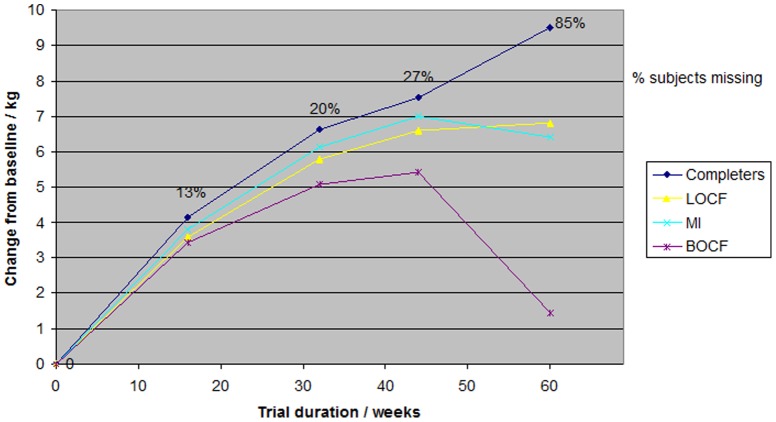
BACKGROUND: In randomised trials of medical interventions, the most reliable analysis follows the intention-to-treat (ITT) principle. However, the ITT analysis requires that missing outcome data have to be imputed. Different imputation techniques may give different results and some may lead to bias. In anti-obesity drug trials, many data are usually missing, and the most used imputation method is last observation carried forward (LOCF). LOCF is generally considered conservative, but there are more reliable methods such as multiple imputation (MI). OBJECTIVES: To compare four different methods of handling missing data in a 60-week placebo controlled anti-obesity drug trial on topiramate. METHODS: We compared an analysis of complete cases with datasets where missing body weight measurements had been replaced using three different imputation methods: LOCF, baseline carried forward (BOCF) and MI. RESULTS: 561 participants were randomised. Compared to placebo, there was a significantly greater weight loss with topiramate in all analyses: 9.5 kg (SE 1.17) in the complete case analysis (N = 86), 6.8 kg (SE 0.66) using LOCF (N = 561), 6.4 kg (SE 0.90) using MI (N = 561) and 1.5 kg (SE 0.28) using BOCF (N = 561). CONCLUSIONS: The different imputation methods gave very different results. Contrary to widely stated claims, LOCF did not produce a conservative (i.e., lower) efficacy estimate compared to MI. Also, LOCF had a lower SE than MI.
Overview
The claims and statistics of this paper haven’t been checked yet.
Free: it reads the open-access text and checks the first 5 claims that cite a source we can check. Create a free account to check every claim.
Integrity signals
Registry
Cites
Statistics
Figures



Verification
Claims the paper makes
The claims and statistics of this paper haven’t been checked yet.
Free: it reads the open-access text and checks the first 5 claims that cite a source we can check. Create a free account to check every claim.
Claims other papers make about this one
Each is checked against this paper’s own text: does it say what the citing paper says it does?
The source backs part of the claim, not all of it — or backs it for a different population, condition or comparison.
In the citing paper
“Missing data at Week 72 from three participants were imputed using the last observation carried forward method.”
From Body composition changes during weight reduction with tirzepatide in the SURMOUNT ‐1 study of adults with obesity or overweight (2025) · cites this paper as [15]
Experimental — accuracy not yet measured
Self-check
Percentages, sums and reported differences re-computed from the paper’s own numbers.
The self-check needs the paper’s full text.
Citations
Cites
Missing data: our view of the state of the art
Schafer, J. L., & Graham, J. W. (2002) · Psychological Methods · doi:10.1037/1082-989x.7.2.147 · Cited by 11,638
A test of missing completely at random for multivariate data with missing values
Little, R. J. A. (1988) · Journal of the American Statistical Association · doi:10.1080/01621459.1988.10478722 · Cited by 8,963
Sterne, J. A. C., White, I. R., Carlin, J. B., Spratt, M., Royston, P., Kenward, M. G., Wood, A. M., & Carpenter, J. R. (2009) · BMJ · doi:10.1136/bmj.b2393 · Cited by 7,299
Schafer, J. L. (1999) · Statistical Methods in Medical Research · doi:10.1177/096228029900800102 · Cited by 3,949
Review: a gentle introduction to imputation of missing values.
Donders, A. R. T., van der Heijden, G. J. M. G., Stijnen, T., & Moons, K. G. M. (2006) · Journal of Clinical Epidemiology · doi:10.1016/j.jclinepi.2006.01.014 · Cited by 2,582
Gorber, S. C., Tremblay, M., Moher, D., & Gorber, B. (2007) · Obesity Reviews · doi:10.1111/j.1467-789x.2007.00347.x · Cited by 1,945 · cited 1×
“Despite a trend that self-reported weight is underestimated [22], this strategy may still be reliable when comparing intervention and control groups, because the bias introduced is likely to be similar in both groups.”
Pi-Sunyer, F. X., Aronne, L. J., Heshmati, H. M., Devin, J., Rosenstock, J., & RIO-North America Study Group, F. T. (2006) · JAMA · doi:10.1001/jama.295.7.761 · Cited by 1,218
Missing Data in Clinical Studies
Molenberghs, G., & Kenward, M. G. (2007) · Wiley eBooks · doi:10.1002/9780470510445 · Cited by 962
Schafer, J. L. (1999) · Statistical Methods in Medical Research · doi:10.1191/096228099671525676 · Cited by 920
The use of multiple imputation for the analysis of missing data.
Sinharay, S., Stern, H. S., & Russell, D. (2001) · Psychological Methods · doi:10.1037/1082-989x.6.4.317 · Cited by 560
Cited by
Jakobsen, J. C., Gluud, C., Wetterslev, J., & Winkel, P. (2017) · BMC Medical Research Methodology · doi:10.1186/s12874-017-0442-1 · Cited by 2,747
“assumptions are often unrealistic and single imputation is therefore often a potentially biased method and should be used with great caution [5, 18, 19].”
MethodSelf-citationGeneral health checks in adults for reducing morbidity and mortality from disease
Krogsbøll, L. T., Jørgensen, K. J., & Gøtzsche, P. C. (2019) · Cochrane Database of Systematic Reviews · doi:10.1002/14651858.cd009009.pub3 · Cited by 202
Self-citationExercise for treating patellofemoral pain syndrome
van der Heijden, R. A., Lankhorst, N. E., van Linschoten, R., Bierma-Zeinstra, S. M., & van Middelkoop, M. (2015) · Cochrane Database of Systematic Reviews · doi:10.1002/14651858.cd010387.pub2 · Cited by 185
Zhang, Y., & Thorburn, P. J. (2022) · Future Generation Computer Systems · doi:10.1016/j.future.2021.09.033 · Cited by 179
Look, M., Dunn, J. P., Kushner, R. F., Cao, D., Harris, C., Gibble, T. H., Stefanski, A., & Griffin, R. (2025) · Diabetes, Obesity and Metabolism · doi:10.1111/dom.16275 · Cited by 181
“15,16 There was no multiplicity adjustment.”
The Sin of Missing Data: Is All Forgiven by Way of Imputation?
Dettori, J. R., Norvell, D. C., & Chapman, J. R. (2018) · Global Spine Journal · doi:10.1177/2192568218811922 · Cited by 108
Louie, D. R., Mortenson, W. B., Durocher, M., Schneeberg, A., Teasell, R. W., Yao, J. K., & Eng, J. J. (2021) · Journal of NeuroEngineering and Rehabilitation · doi:10.1186/s12984-021-00942-z · Cited by 94
He, Z., Du, L., Zhang, P., Zhao, R., Chen, X., & Fang, Z. (2020) · Critical Care Medicine · doi:10.1097/ccm.0000000000004644 · Cited by 39
“To reduce the impact of missing data on the model, we used the forward imputation method to fill them (8).”
MethodA randomised controlled trial of the 5:2 diet
Hájek, P., Przulj, D., Pesola, F., McRobbie, H. J., Peerbux, S., Phillips‐Waller, A., Bisal, N., & Smith, K. M. (2021) · PLoS ONE · doi:10.1371/journal.pone.0258853 · Cited by 39
“Table 2 shows the weight change in kg in the three study arms using LOCF and BOCF analyses.”
BackgroundInfluentialDavis, T. J., Firzli, T. R., Keppler, E. A. H., Richardson, M., & Bean, H. D. (2022) · Analytical Chemistry · doi:10.1021/acs.analchem.1c04093 · Cited by 31
Many Flavors of Model‐Based Meta‐Analysis: Part II – Modeling Summary Level Longitudinal Responses
Boucher, M., & Bennetts, M. (2018) · CPT Pharmacometrics & Systems Pharmacology · doi:10.1002/psp4.12299 · Cited by 31
Chan, N. P. T., Lai, A. Y. K., Choy, H. K., Cheung, Y. T. D., Wan, A., Cheng, V. Y. H., Chan, K. Y., Lau, Y. K., Yung, C. Y., Cheung, G. O. C., et al. (2022) · Frontiers in Public Health · doi:10.3389/fpubh.2022.865712 · Cited by 28
“Third, we used the last-observation-carried-forward imputation method for managing the missing data, which was a limitation because it might overestimate the precision compared to the multiple imputationmethod (48).”
MethodConsistently Modest Antidepressant Effects in Clinical Trials: the Role of Regulatory Requirements
Khan, A., Mar, K. F., & Brown, W. A. (2025) · Psychopharmacology Bulletin · doi:10.64719/pb.4412 · Cited by 26
Electronic Health Records as Source of Research Data
Wang, W., Ferrari, D., Haddon-Hill, G. W., & Ćurčin, V. (2023) · Neuromethods · doi:10.1007/978-1-0716-3195-9_11 · Cited by 41
Speyer, H., Nørgaard, H. C. B., Hjorthøj, C., Madsen, T. A., Drivsholm, S., Pisinger, C., Gluud, C., Mors, O., Krogh, J., & Nordentoft, M. (2015) · BMC Psychiatry · doi:10.1186/s12888-015-0465-2 · Cited by 20
“These methods assume that variables are missing completely at random, which is usually not the case [68], and underestimate the precision (standard error and confidence interval) [69].”
MethodJuul, S., Faltermeier, P., Petersen, J. J., Olsen, M. H., Andersen, R. K., Kamp, C. B., Siddiqui, F., Simonsen, S., Mbuagbaw, L. C. E., Thabane, L., et al. (2024) · BMC Psychiatry · doi:10.1186/s12888-024-06263-4 · Cited by 16
“These assumptions are often unrealistic and single imputation is, therefore, a potentially biased method and should be used with caution [5–7].”
Cancer patient age and family caregiver bereavement outcomes
Francis, L. E., Kypriotakis, G., O’Toole, E. E., & Rose, J. H. (2016) · Supportive Care in Cancer · doi:10.1007/s00520-016-3219-x · Cited by 14
“Mean imputation reduces the effect of independent variables, producing more conservative results [37].”
ResultKahale, L. A., Diab, B., Khamis, A. M., Chang, Y., Lopes, L. C., Agarwal, A., Li, L., Mustafa, R. A., Koujanian, S., Waziry, R., et al. (2018) · Journal of Clinical Epidemiology · doi:10.1016/j.jclinepi.2018.10.001 · Cited by 13
Tan, J., Li, N., Lan, X.-Y., Zhang, S.-M., Cui, B., Liu, L., He, X., Zeng, L., Tau, L.-Y., Zhang, H., et al. (2017) · Archives of Gerontology and Geriatrics · doi:10.1016/j.archger.2017.07.009 · Cited by 11
Missing Data Imputation: A Survey
Kelkar, B. A. (2021) · International Journal of Decision Support System Technology · doi:10.4018/ijdsst.292446 · Cited by 11
Toon, J., Bennett, S., Lavin, J., Pallister, C., & Avery, A. (2024) · Clinical Obesity · doi:10.1111/cob.12665 · Cited by 8
Are patients who return for 10-year follow-up after AIS surgery different from those who do not?
Bastrom, T. P., Howard, R., Bartley, C. E., Newton, P. O., Lenke, L. G., Sponseller, P. D., Shufflebarger, H. L., Lonner, B., Shah, S. A., Betz, R. R., et al. (2022) · Spine Deformity · doi:10.1007/s43390-021-00458-5 · Cited by 7
Muntis, F. R., IGUDESMAN, D. A., Sarteau, A. C., Thomas, J. M., Arrizon‐Ruiz, N., Hooper, J., Addala, A., Crandell, J., Riddell, M. C., Maahs, D. M., et al. (2022) · Diabetes Technology & Therapeutics · doi:10.1089/dia.2022.0253 · Cited by 8
Adapting cognitive bias modification to train healthy prospection
Namaky, N., Glenn, J. J., Eberle, J. W., & Teachman, B. A. (2021) · Behaviour Research and Therapy · doi:10.1016/j.brat.2021.103923 · Cited by 8
Evaluating a targeted support program for mental health carers: a randomised controlled trial
Fitzgeraldson, E., Fitzpatrick, S., Dizon, J., & KAY‐LAMBKIN, F. J. (2024) · Advances in Mental Health · doi:10.1080/18387357.2024.2324103 · Cited by 7
“Numerous studies have identi fi ed the validity of using MAR for most data types and in randomised controlled trials speci fi cally (Horton & Lipsitz, 2012; Jørgensen et al., 2014; Zhang et al., 2017).”
Kuo, H., Wang, K., Lee, Y., Lin, P., Liu, M., Lin, C., & Liu, L. Y. (2019) · Journal of Clinical Pharmacy and Therapeutics · doi:10.1111/jcpt.13047 · Cited by 6
Paludan‐Müller, A. S., Sharma, T., Rasmussen, K., & Gøtzsche, P. C. (2020) · International Journal of Risk & Safety in Medicine · doi:10.3233/jrs-200051 · Cited by 5
Self-citationMethodological survey of missing outcome data in an alteplase for ischemic stroke meta‐analysis
Garg, R. (2022) · Acta Neurologica Scandinavica · doi:10.1111/ane.13656 · Cited by 4
Lee, M., Rahbar, M. H., Gensler, L. S., Brown, M. A., Weisman, M. H., & Reveille, J. D. (2019) · Journal of Biopharmaceutical Statistics · doi:10.1080/10543406.2019.1684306 · Cited by 4
“MI approaches have been widely used in medical research to better understand treatment effects in clinical trials (Ayele et al. 2014; Jørgensen et al. 2014).”
MethodToon, J., Bennett, S., Lavin, J., Pallister, C., & Avery, A. (2024) · Journal of Primary Care & Community Health · doi:10.1177/21501319241291784 · Cited by 3
“Also, LOCF resulted in a lower SE than MI. 24 As this is a service evaluation of a real-life pragmatic intervention, it is inevitable that there will be cases of missing data which could arise systematically due to dropout from the program or non-systematically cases such as changes in personal circumstances, illness,…”
BackgroundInfluentialTan, E. W., Chai, S. C., Sankai, Y., Shingu, M., Razaob, N. A., & Hussain, H. (2025) · PLoS ONE · doi:10.1371/journal.pone.0322191 · Cited by 4
“This method has been proposed as a more reliable and preferred imputation strategy over the last observation carried forward (LOCF) method [35,36,39].”
Baker, F. A. (2022) · Springer eBooks · doi:10.1007/978-3-031-18085-9_9 · Cited by 5
Gudzune, K. A., Alexander, E., Tseng, E., Durkin, N., Jerome, G. J., Dalcin, A., Appel, L. J., & Clark, J. M. (2019) · Clinical Obesity · doi:10.1111/cob.12307 · Cited by 3
“Given the potential biases with a last-observation-carriedforward approach, we did not use this method.(20,21) We also examined the clinically significant weight loss threshold of achieving ≥5% weight loss at 6 and 12 months using the BOCF approach.”
MethodDIABRISK-SL trial: further consideration of age and impact of imputations
Gkioni, E., Glonti, K., Dodd, S., & Gamble, C. (2019) · BMC Medicine · doi:10.1186/s12916-019-1361-2 · Cited by 1
Aguirre, U., Aróstegui, I., Esteban, C., & Quintana, J. M. (2015) · International Journal of Statistics in Medical Research · doi:10.6000/1929-6029.2015.04.03.1 · Cited by 1
“In previous studies for handling missing data in longitudinal studies with more than two measurements, MCMC was the preferred method [26-29].”
Methodreliability of patient information in electronic systems
Alshammari, N. M. S., Alouthah, M. G. S., Alrshidi, A. S. M., Alshammari, M. F. N., Alrasheidi, B. M. H., Alshammari, M. F. N., Alsudais, A. S. A., Alsaadi, H. F. F., & Alshammari, S. N. K. (2018) · International journal of health & medical sciences · doi:10.21744/ijhms.v1n1.2272 · Cited by 2
SEGAN: A Semi-Supervised Learning Method for Missing Data Imputation
Pan, X., Wu, W., Chen, L., Li, Z., Lu, P., Cao, P., & Wu, Y. (2025) · Service Oriented Computing and Applications · doi:10.1007/s11761-025-00472-9 · Cited by 2
The effects of an educational intervention on exercise advice behaviours of Thai oncology nurses
Witwaranukool, P. (2022) · Queensland University of Technology · doi:10.5204/thesis.eprints.228685
Swanson, B. T., Hagenbruch, M., Lapaan, B., & Skipalskiy, K. (2024) · International Journal of Sports Physical Therapy · doi:10.26603/001c.95040
Salgado, D. P., Valentini, C., Naves, E. L. M., Qiao, Y., & Fallon, S. (2025) · PLoS ONE · doi:10.1371/journal.pone.0325186
“MI imputation is a modern approach that addresses missing data by creating several complete datasets and combining results [65,66].”
Metadata
- Authors
- Jørgensen, A. W., Lundstrøm, L. H., Wetterslev, J., Astrup, A., & Gøtzsche, P. C.
- Affiliations
- Rigshospitalet (DK)
- University of Copenhagen (DK)
- Corresponding author
- Gøtzsche, Peter C.
- Venue
- PLoS ONE
- Publisher
- Public Library of Science (PLoS)
- Published
- 2014-11-19
- Volume
- 9
- Issue
- 11
- Pages
- e111964
- ISSN
- 1932-6203 (ISSN-L)
- PMC
- PMC4237333
- OpenAlex
- W1963814214
- Cited by
- 40
- References
- 25
- Citations by year
- 2025: 5 · 2024: 5 · 2023: 1 · 2022: 7 · 2021: 5 · 2020: 2 · 2019: 5 · 2018: 4 · 2017: 2 · 2016: 1 · 2015: 3
- FWCI
- 2.11
- Type
- journal article
- Language
- en
- Open access
- gold
- doi.org
- Locations
- PLoS ONE (publishedVersion, cc-by)
- PubMed Central (publishedVersion, cc-by)
- PubMed (publishedVersion)
- Research at the University of Copenhagen (University of Copenhagen) (publishedVersion, other-oa)
- DOAJ (DOAJ: Directory of Open Access Journals) (submittedVersion, cc-by-sa)
- Topics
- Physical Sciences › Mathematics › Statistics and Probability › Statistical Methods and Bayesian Inference
- Physical Sciences › Mathematics › Statistics and Probability › Statistical Methods in Clinical Trials
- Physical Sciences › Mathematics › Statistics and Probability › Advanced Causal Inference Techniques
- Keywords
- missing data imputation, last observation carried forward, multiple imputation, topiramate, anti-obesity drugs, weight loss, intention-to-treat analysis, complete case analysis, body weight measurement
- MeSH terms
- Topiramate, Body Weight, Data Interpretation, Statistical, Fructose, Humans, Obesity, Treatment Outcome, Anti-Obesity Agents
About these checks
Registry, retraction, Cites and statistics results are computed, not judged, with one exception: a printed reference that no index lists is read once by a model before it counts as a citation error. Claims are extracted by a model and kept only when their quote appears verbatim in the text; each cited source is then checked, with a model’s help, for whether it says what the claim relies on. Those verdicts can be wrong — read the claim’s quote and the cited source before relying on one.
Statistics and arithmetic are recomputed, not judged.
Confidence bands are shown only for fields calibrated on our annotated test set. None is calibrated yet, so no band is shown.
What counts as a claim ›How we measure confidence ›How we check this ›
Are you an author, or do you see a problem with this page? Request a review
Data sources
Bibliographic data: Semantic Scholar, OpenAlex, Crossref.
Contains information from the Semantic Scholar Academic Graph Datasets, made available under the ODC Attribution License (ODC-BY 1.0).
Semantic Scholar’s data is described in: Kinney, R., et al. (2023). The Semantic Scholar Open Data Platform. arXiv:2301.10140.
