

The DOI matches its Crossref record; 29 of the 29 references it cites were found in a registry or an index.
When and how should multiple imputation be used for handling missing data in randomised clinical trials – a practical guide with flowcharts
Open accessAbstract
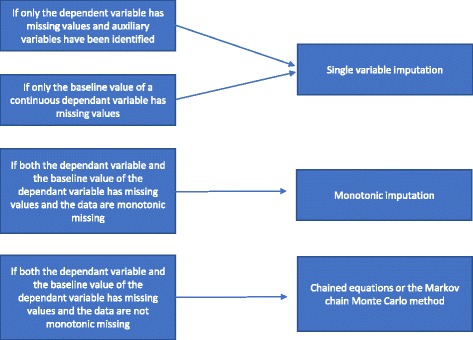
BACKGROUND: Missing data may seriously compromise inferences from randomised clinical trials, especially if missing data are not handled appropriately. The potential bias due to missing data depends on the mechanism causing the data to be missing, and the analytical methods applied to amend the missingness. Therefore, the analysis of trial data with missing values requires careful planning and attention. METHODS: The authors had several meetings and discussions considering optimal ways of handling missing data to minimise the bias potential. We also searched PubMed (key words: missing data; randomi*; statistical analysis) and reference lists of known studies for papers (theoretical papers; empirical studies; simulation studies; etc.) on how to deal with missing data when analysing randomised clinical trials. RESULTS: Handling missing data is an important, yet difficult and complex task when analysing results of randomised clinical trials. We consider how to optimise the handling of missing data during the planning stage of a randomised clinical trial and recommend analytical approaches which may prevent bias caused by unavoidable missing data. We consider the strengths and limitations of using of best-worst and worst-best sensitivity analyses, multiple imputation, and full information maximum likelihood. We also present practical flowcharts on how to deal with missing data and an overview of the steps that always need to be considered during the analysis stage of a trial. CONCLUSIONS: We present a practical guide and flowcharts describing when and how multiple imputation should be used to handle missing data in randomised clinical.
Overview
The claims and statistics of this paper haven’t been checked yet.
Free: it reads the open-access text and checks the first 5 claims that cite a source we can check. Create a free account to check every claim.
Integrity signals
Registry
Cites
Statistics
Figures

Verification
Claims the paper makes
The claims and statistics of this paper haven’t been checked yet.
Free: it reads the open-access text and checks the first 5 claims that cite a source we can check. Create a free account to check every claim.
Claims other papers make about this one
Each is checked against this paper’s own text: does it say what the citing paper says it does?
The source backs part of the claim, not all of it — or backs it for a different population, condition or comparison.
In the citing paper
“Data analyses were performed using an intent-to-treat approach.”
From Impact of acceptance and commitment therapy on physical and psychological symptoms in advanced gastrointestinal cancer patients and caregivers: Secondary results of a pilot randomized trial (2023) · cites this paper as Jakobsen et al., 2017
Experimental — accuracy not yet measuredThe source backs part of the claim, not all of it — or backs it for a different population, condition or comparison.
In the citing paper
“As for the management of missing data, if the missing data represents less than 5% of the study’s total data collected, it will be ignored. If the missing data represents more than 5% but less than 40% of the total data collected and is assumed to be randomly missing, then multiple imputation (restricted maximum likelihood estimation) will be performed using Stata 15. However, if the missing data”
From Study protocol on the efficacy of exergames-acceptance and commitment therapy program for the treatment of major depressive disorder: Comparison with acceptance and commitment therapy alone and treatment-as-usual in a multicentre randomised controlled trial (2024) · cites this paper as [47]
Experimental — accuracy not yet measuredThe source backs part of the claim, not all of it — or backs it for a different population, condition or comparison.
In the citing paper
“In the handling of missing data, if only 5% to the total data collected is missing, then this missing data will be ignored. If the missing data is around 5% to 40% and if it is assumed to be randomly missing, then multiple imputation with restricted maximum likelihood estimation will be utilized (using Stata 15).”
From Research protocol of the efficacy of probiotics for the treatment of alcohol use disorder among adult males: A comparison with placebo and acceptance and commitment therapy in a randomized controlled trial (2023) · cites this paper as [54]
Experimental — accuracy not yet measuredThe source backs part of the claim, not all of it — or backs it for a different population, condition or comparison.
In the citing paper
“To handle any missing data, if the missing data represent less than 5% of the study’s total collected data, they will be ignored. If the missing data represent more than 5% but less than 40% of the total collected and are assumed to be randomly missing, then multiple imputation (restricted maximum likelihood estimation) will be performed using Stata 15. However, if the missing data represent more”
From Acceptance and commitment therapy versus mindfulness-based stress reduction for newly diagnosed head and neck cancer patients: A randomized controlled trial assessing efficacy for positive psychology, depression, anxiety, and quality of life (2022) · cites this paper as [68]
Experimental — accuracy not yet measuredThe source backs part of the claim, not all of it — or backs it for a different population, condition or comparison.
In the citing paper
“Based on published guidelines, 33 data from participants lost to all follow‐up (n = 3) were not imputed because all missing were in the supportive therapy arm which suggests the complete case is biased toward the null”
From Retraining and control therapy for pediatric psychogenic non-epileptic seizures (2020) · cites this paper as [33]
Experimental — accuracy not yet measured
7 more claims about this paper
Create a free account to see every claim other papers make about this one.
Self-check
Percentages, sums and reported differences re-computed from the paper’s own numbers.
The self-check needs the paper’s full text.
Citations
Cites
Sterne, J. A. C., White, I. R., Carlin, J. B., Spratt, M., Royston, P., Kenward, M. G., Wood, A. M., & Carpenter, J. R. (2009) · BMJ · doi:10.1136/bmj.b2393 · Cited by 7,299 · cited 17×
“Missing data may seriously compromise inferences from randomised clinical trials, especially if missingness is not at random and if missing data are not handled appropriately [3, 4].”
BackgroundMethodInfluentialIntravenous Fluids and Acute Kidney Injury
Ding, X., Cheng, Z., & Qian, Q. (2017) · Blood Purification · doi:10.1159/000452702 · Cited by 6,827
The prevention and treatment of missing data in clinical trials
Little, R. J., D'Agostino, R., Cohen, M. L., Dickersin, K., Emerson, S. S., Farrar, J. T., Frangakis, C., Hogan, J. W., Molenberghs, G., Murphy, S. A., et al. (2012) · New England Journal of Medicine · doi:10.1056/nejmsr1203730 · Cited by 1,884 · cited 4×
“Sensitivity analyses may show how assumptions, different from those made in the primary analysis influence the results obtained [3, 6].”
BackgroundInfluentialHydroxyethyl Starch 130/0.42 versus Ringer's Acetate in Severe Sepsis
Perner, A., Haase, N., Guttormsen, A. B., Tenhunen, J., Klemenzson, G., Åneman, A., Madsen, K. R., Møller, M. H., Elkjær, J. M., Poulsen, L. M., et al. (2012) · New England Journal of Medicine · doi:10.1056/nejmoa1204242 · Cited by 1,813 · cited 1×
“Best-worst and worst-best case sensitivity analyses [24, 25] may be used if in doubt: first a ‘best-worst-case’ scenario dataset is generated where it is assumed that all participants lost to follow-up in one group (referred to as group 1) have had a beneficial outcome (for example, had no serious adverse event); and…”
MethodSelf-citationIndustry sponsorship and research outcome
Lundh, A., Lexchin, J., Mintzes, B., Schroll, J. B., & Bero, L. (2017) · Cochrane Database of Systematic Reviews · doi:10.1002/14651858.mr000033.pub3 · Cited by 1,697
Jakobsen, J. C., Wetterslev, J., Winkel, P., Lange, T., & Gluud, C. (2014) · BMC Medical Research Methodology · doi:10.1186/1471-2288-14-120 · Cited by 704 · cited 5×
“Then a ‘worst-best-case’ scenario dataset is generated where it is assumed that all participants lost to follow-up in group 1 have had a harmful outcome; and that all those lost to follow-up in group 2 have had a beneficial outcome [23, 24].”
BackgroundMethodInfluentialSelf-citationHorton, N. J., & Lipsitz, S. R. (2001) · The American Statistician · doi:10.1198/000313001317098266 · Cited by 600 · cited 1×
“Five imputed datasets have traditionally been suggested to be sufficient on theoretical grounds, but 50 datasets (or more) seem preferable to reduce sampling variability from the imputation process [4, 21, 22].”
BackgroundHróbjartsson, A., Thomsen, A. S. S., Emanuelsson, F., Tendal, B., Hilden, J., Boutron, I., Ravaud, P., & Brorson, S. (2013) · Canadian Medical Association Journal · doi:10.1503/cmaj.120744 · Cited by 527
Hrobjartsson, A., Thomsen, A. S. S., Emanuelsson, F., Tendal, B., Hilden, J., Boutron, I., Ravaud, P., & Brorson, S. (2012) · BMJ · doi:10.1136/bmj.e1119 · Cited by 483
Hróbjartsson, A., Emanuelsson, F., Skou Thomsen, A. S., Hilden, J., & Brorson, S. (2014) · International Journal of Epidemiology · doi:10.1093/ije/dyu115 · Cited by 462
Research works printed but not linked: 2
- StataCorp. Stata: release 14. Statistical software. College Station, TX: StataCorp LP; 2015.
- Allison PD. Handling missing data by maximum likelihood, statistical horizons. In: SAS global forum 2012 statistics and data analysis; 2012.
Cited by
Reporting animal research: Explanation and elaboration for the ARRIVE guidelines 2.0
Percie du Sert, N., Ahluwalia, A., Alam, S., Avey, M. T., Baker, M., Browne, W. J., Clark, A., Cuthill, I. C., Dirnagl, U., Emerson, M., et al. (2020) · PLOS Biology · doi:10.1371/journal.pbio.3000411 · Cited by 2,677
“It is also important to consider and justify analysis methods that account for missing data [55,56].”
BackgroundThe proportion of missing data should not be used to guide decisions on multiple imputation
Madley-Dowd, P., Hughes, R., Tilling, K., & Heron, J. (2019) · Journal of Clinical Epidemiology · doi:10.1016/j.jclinepi.2019.02.016 · Cited by 1,053
“These findings provide an example of valid estimates from properly specified MI at much larger proportions of missing data than current guidance [19] advises.”
BackgroundHypothermia versus Normothermia after Out-of-Hospital Cardiac Arrest
Dankiewicz, J., Cronberg, T., Lilja, G., Jakobsen, J. C., Levin, H., Ullén, S., Rylander, C., Wise, M. P., Oddo, M., Cariou, A., et al. (2021) · New England Journal of Medicine · doi:10.1056/nejmoa2100591 · Cited by 993
Self-citationThe SOFA score—development, utility and challenges of accurate assessment in clinical trials
Lambden, S., Laterre, P. F., Levy, M. M., & Francois, B. (2019) · Critical Care · doi:10.1186/s13054-019-2663-7 · Cited by 979
Rettie, H., & Daniels, J. (2021) · American Psychologist · doi:10.1037/amp0000710 · Cited by 526
Metadata
- Authors
- Jakobsen, J. C., Gluud, C., Wetterslev, J., & Winkel, P.
- Affiliations
- Copenhagen University Hospital (DK)
- Corresponding author
- Jakobsen, Janus Christian
- Venue
- BMC Medical Research Methodology
- Published
- 2017-12
- Volume
- 17
- Issue
- 1
- Pages
- 162-162
- ISSN
- 1471-2288 (ISSN-L)
- PMC
- PMC5717805
- OpenAlex
- W2772803673
- Semantic Scholar
- 601b9d1445292bcdfd372c11b5a2eb752d7cf39e
- Cited by
- 2,747
- References
- 29
- Citations by year
- 2026: 287 · 2025: 433 · 2024: 455 · 2023: 443 · 2022: 468 · 2021: 361 · 2020: 205 · 2019: 78 · 2018: 15 · 2017: 1
- FWCI
- 56.41
- Type
- journal article
- Language
- en
- Open access
- gold
- doi.org
- Licence
- cc-by
- Locations
- BMC Medical Research Methodology (publishedVersion, cc-by)
- Europe PMC (PubMed Central) (publishedVersion, cc-by)
- PubMed Central (publishedVersion, cc-by)
- PubMed (publishedVersion)
- DOAJ (DOAJ: Directory of Open Access Journals) (submittedVersion, cc-by-sa)
- Funders
- Copenhagen Trial Unit, Centre for Clinical Intervention Research
- Topics
- Physical Sciences › Mathematics › Statistics and Probability › Statistical Methods and Bayesian Inference
- Physical Sciences › Mathematics › Statistics and Probability › Statistical Methods in Clinical Trials
- Social Sciences › Decision Sciences › Statistics, Probability and Uncertainty › Meta-analysis and systematic reviews
- Keywords
- missing data, multiple imputation, randomized controlled trials, full information maximum likelihood, missing data mechanisms
- MeSH terms
- Data Accuracy, Data Interpretation, Statistical, Humans, Models, Statistical, Randomized Controlled Trials as Topic
About these checks
Registry, retraction, Cites and statistics results are computed, not judged, with one exception: a printed reference that no index lists is read once by a model before it counts as a citation error. Claims are extracted by a model and kept only when their quote appears verbatim in the text; each cited source is then checked, with a model’s help, for whether it says what the claim relies on. Those verdicts can be wrong — read the claim’s quote and the cited source before relying on one.
Statistics and arithmetic are recomputed, not judged.
Confidence bands are shown only for fields calibrated on our annotated test set. None is calibrated yet, so no band is shown.
What counts as a claim ›How we measure confidence ›How we check this ›
Are you an author, or do you see a problem with this page? Request a review
How to cite
Cite CoChat for the checks on this page, and the paper for its own findings.
- This page
- CoChat. (2026). Citation check: When and how should multiple imputation be used for handling missing data in randomised clinical trials – a practical guide with flowcharts. https://app.cochat.ai/papers/10.1186/s12874-017-0442-1
- The paper
- Jakobsen, J. C., Gluud, C., Wetterslev, J., & Winkel, P. (2017). When and how should multiple imputation be used for handling missing data in randomised clinical trials – a practical guide with flowcharts. BMC Medical Research Methodology. https://doi.org/10.1186/s12874-017-0442-1
Data sources
Bibliographic data: Semantic Scholar, OpenAlex, Crossref.
Contains information from the Semantic Scholar Academic Graph Datasets, made available under the ODC Attribution License (ODC-BY 1.0).
Semantic Scholar’s data is described in: Kinney, R., et al. (2023). The Semantic Scholar Open Data Platform. arXiv:2301.10140.
