

Altered Fronto-Striatal Fiber Topography and Connectivity in Obsessive-Compulsive Disorder
Open accessThe DOI matches its Crossref record; 61 of the 61 references it cites were found in a registry or an index.
Abstract
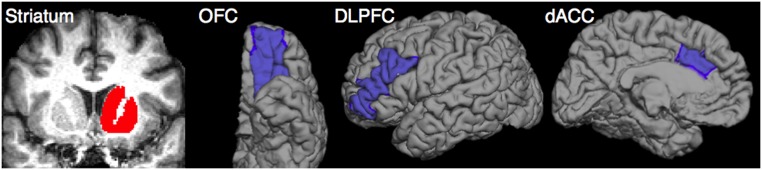
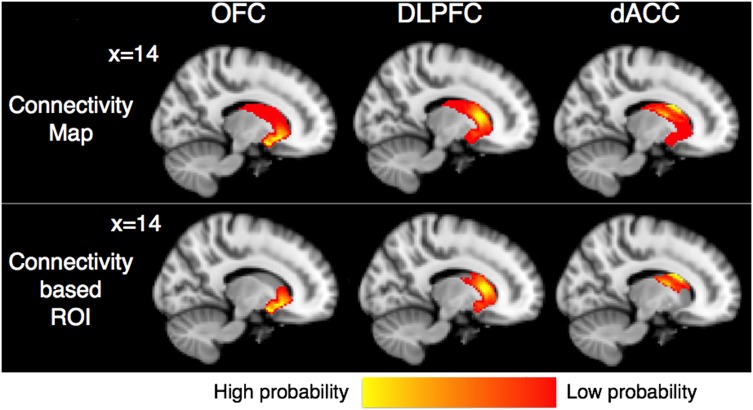
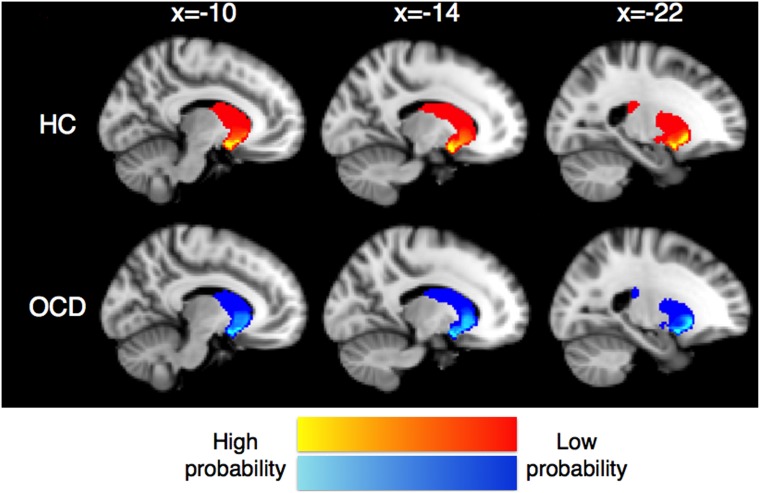
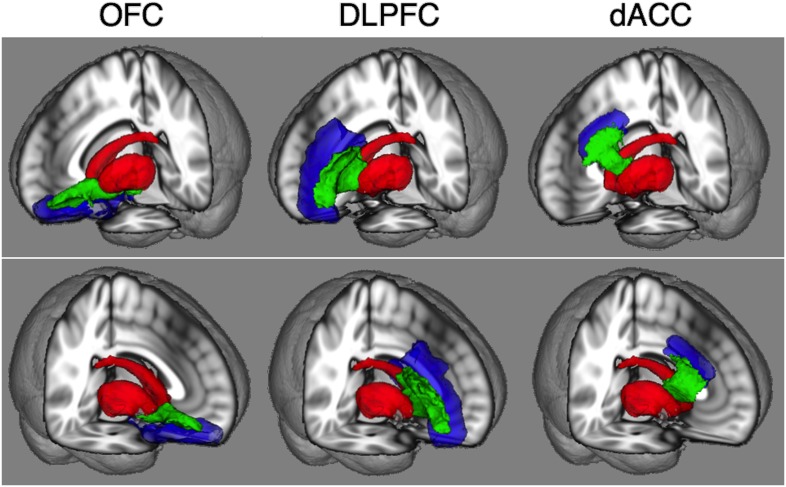
Fronto-striatal circuits are hypothesized to be involved in the pathophysiology of obsessive-compulsive disorder (OCD). Within this circuitry, ventral frontal regions project fibers to the ventral striatum (VS) and dorsal frontal regions to the dorsal striatum. Resting state fMRI research has shown higher functional connectivity between the orbitofrontal cortex (OFC) and the dorsal part of the VS in OCD patients compared to healthy controls (HC). Therefore, we hypothesized that in OCD the OFC predominantly project fibers to the more dorsal part of the VS, and that the structural connectivity between the OFC and VS is higher compared to HC. A total of 20 non-medicated OCD patients and 20 HC underwent diffusion-weighted imaging. Connectivity-based parcellation analyses were performed with the striatum as seed region and the OFC, dorsolateral prefrontal cortex, and dorsal anterior cingulate cortex as target regions. Obtained connectivity maps for each frontal region of interest (ROI) were normalized into standard space, and Z-component (dorsal-ventral) coordinate of center-of-gravity (COG) were compared between two groups. Probabilistic tractography was performed to investigate diffusion indices of fibers between the striatum and frontal ROIs. COG Z-component coordinates of connectivity maps for OFC ROI were located in the more dorsal part of the VS in OCD patients compared to HC. Fractional anisotropy of fibers between the OFC and the striatum was higher in OCD patients compared to HC. Part of the pathophysiology of OCD might be understood by altered topography and structural connectivity of fibers between the OFC and the striatum.
Overview
The claims and statistics of this paper haven’t been checked yet.
Free: it reads the open-access text and checks the first 5 claims that cite a source we can check. Create a free account to check every claim.
Integrity signals
Registry
Cites
Statistics
Figures
Verification
Claims the paper makes
The claims and statistics of this paper haven’t been checked yet.
Free: it reads the open-access text and checks the first 5 claims that cite a source we can check. Create a free account to check every claim.
Claims other papers make about this one
Each is checked against this paper’s own text: does it say what the citing paper says it does?
The source backs part of the claim, not all of it — or backs it for a different population, condition or comparison.
In the citing paper
“As assessed by diffusion-weighted imaging, patients with OCD also have increased connectivity between the VS and OFC (Nakamae et al., 2014)”
From A framework for understanding the emerging role of corticolimbic-ventral striatal networks in OCD-associated repetitive behaviors (2015) · cites this paper as Nakamae et al., 2014
Experimental — accuracy not yet measuredIn the citing paper
“reports of increased structural and functional connectivity between mOFC and VS are of particular interest (Sakai et al., 2011; Nakamae et al., 2014)”
From A framework for understanding the emerging role of corticolimbic-ventral striatal networks in OCD-associated repetitive behaviors (2015) · cites this paper as Nakamae et al., 2014
In the citing paper
“Importantly, obsessions and compulsions represent dysfunctional cognitive and motor processes that become repetitive and disturbing; it is suggested that hyperactivation within CSTC circuits and changes to CSTC topography may underlie such ritualistic thoughts and behaviors (Graybiel and Rauch, 2000; Nakamae et al., 2014).”
From Cortico-striatal-thalamic loop circuits of the salience network: A central pathway in psychiatric disease and treatment (2016) · cites this paper as Nakamae et al., 2014
Self-check
Percentages, sums and reported differences re-computed from the paper’s own numbers.
The self-check needs the paper’s full text.
Citations
Cites
Hamilton, M. (1960) · Journal of Neurology, Neurosurgery & Psychiatry · doi:10.1136/jnnp.23.1.56 · Cited by 32,817 · cited 1×
“All patients were tested with the Yale-Brown Obsessive-Compulsive Scale (Y-BOCS) to assess the severity of OCD symptoms [30], the 17-item Hamilton Depression Rating Scale (HDRS) to assess the severity of depression [31], and the Hamilton Anxiety Rating Scale (HARS) to assess the severity of anxiety [32], Patients who…”
MethodDesikan, R. S., Ségonne, F., Fischl, B., Quinn, B. T., Dickerson, B. C., Blacker, D., Buckner, R. L., Dale, A. M., Maguire, R. P., Hyman, B. T., et al. (2006) · NeuroImage · doi:10.1016/j.neuroimage.2006.01.021 · Cited by 13,324 · cited 1×
“[34,35] In brief, the processing stream included affine transformation of each subject’s native brain to the MNI305 atlas, removal of non-brain tissue, volumetric subcortical labeling [36], and surface based segmentation of grey matter and white matter tissue [37,38].”
MethodJenkinson, M., Bannister, P., Brady, M., & Smith, S. (2002) · NeuroImage · doi:10.1006/nimg.2002.1132 · Cited by 11,888
The assessment of anxiety states by rating
HAMILTON, M. (1959) · British Journal of Medical Psychology · doi:10.1111/j.2044-8341.1959.tb00467.x · Cited by 11,455 · cited 1×
“All patients were tested with the Yale-Brown Obsessive-Compulsive Scale (Y-BOCS) to assess the severity of OCD symptoms [30], the 17-item Hamilton Depression Rating Scale (HDRS) to assess the severity of depression [31], and the Hamilton Anxiety Rating Scale (HARS) to assess the severity of anxiety [32], Patients who…”
MethodCortical Surface-Based Analysis
Dale, A. M., Fischl, B., & Sereno, M. I. (1999) · NeuroImage · doi:10.1006/nimg.1998.0395 · Cited by 10,910
Fischl, B., Salat, D. H., Busa, E., Albert, M., Dieterich, M., Haselgrove, C., van der Kouwe, A., Killiany, R., Kennedy, D., Klaveness, S., et al. (2002) · Neuron · doi:10.1016/s0896-6273(02)00569-x · Cited by 8,610
The Yale-Brown Obsessive Compulsive Scale: I. Development, Use, and Reliability
Goodman, W. K. (1989) · Archives of General Psychiatry · doi:10.1001/archpsyc.1989.01810110048007 · Cited by 7,712 · cited 1×
“All patients were tested with the Yale-Brown Obsessive-Compulsive Scale (Y-BOCS) to assess the severity of OCD symptoms [30], the 17-item Hamilton Depression Rating Scale (HDRS) to assess the severity of depression [31], and the Hamilton Anxiety Rating Scale (HARS) to assess the severity of anxiety [32], Patients who…”
MethodCortical Surface-Based Analysis
Fischl, B., Sereno, M. I., & Dale, A. M. (1999) · NeuroImage · doi:10.1006/nimg.1998.0396 · Cited by 6,147 · cited 1×
“[34,35] In brief, the processing stream included affine transformation of each subject’s native brain to the MNI305 atlas, removal of non-brain tissue, volumetric subcortical labeling [36], and surface based segmentation of grey matter and white matter tissue [37,38].”
MethodThe reward circuit: linking primate anatomy and human imaging
Haber, S. N., & Knutson, B. (2010) · Neuropsychopharmacology · doi:10.1038/npp.2009.129 · Cited by 3,718
Probabilistic diffusion tractography with multiple fibre orientations: What can we gain?
Behrens, T. E. J., Berg, H. J., Jbabdi, S., Rushworth, M. F. S., & Woolrich, M. W. (2007) · NeuroImage · doi:10.1016/j.neuroimage.2006.09.018 · Cited by 3,471 · cited 1×
“graphy, probability distributions on 2 fiber directions were modeled at each voxel using FSL’s BedpostX program, based on a multifiber diffusion model [39].”
Method
Research works printed but not linked: 1
- First MB, Spizer RL, M G, J.B.W W (1997) Structures Clinical Interview for DSM-IV Axis I Disorders - Patient Edition (SCID-I/P, Version 2.0-7/97 revision). New York: Biometrics Research Department, New York State Psychiatric Institute.
Cited by
Peters, S. K., Dunlop, K., & Downar, J. (2016) · Frontiers in Systems Neuroscience · doi:10.3389/fnsys.2016.00104 · Cited by 611
New Oxford Textbook of Psychiatry
(2020) · doi:10.1093/med/9780198713005.001.0001 · Cited by 128
Wood, J., & Ahmari, S. E. (2015) · Frontiers in Systems Neuroscience · doi:10.3389/fnsys.2015.00171 · Cited by 85
“Because this review focuses on interregional communication with the VS, reports of increased structural and functional connectivity between mOFC and VS are of particular interest (Sakai et al., 2011; Nakamae et al., 2014).”
BackgroundNucleus Accumbens Cell Type- and Input-Specific Suppression of Unproductive Reward Seeking
Lafferty, C. K., Yang, A. K., Mendoza, J. A., & Britt, J. P. (2020) · Cell Reports · doi:10.1016/j.celrep.2020.02.095 · Cited by 82
Strengthened Inputs from Secondary Motor Cortex to Striatum in a Mouse Model of Compulsive Behavior
Corbit, V. L., Manning, E. E., Gittis, A. H., & Ahmari, S. E. (2019) · The Journal of Neuroscience · doi:10.1523/jneurosci.1728-18.2018 · Cited by 80
“, 2013), studies demonstrating aberrant activity in corticostriatal circuits in OCD patients (Chamberlain et al., 2008; Menzies et al., 2008; Harrison et al., 2009; Del Casale et al., 2011; Figee et al., 2013; Nakamae et al., 2014) suggest that cortical regions may be useful targets for noninvasive neurostimulation vi…”
BackgroundA Neural Marker of Obsessive-Compulsive Disorder from Whole-Brain Functional Connectivity
Takagi, Y., Sakai, Y., Lisi, G., Yahata, N., Abe, Y., Nishida, S., Nakamae, T., Morimoto, J., Kawato, M., Narumoto, J., et al. (2017) · Scientific Reports · doi:10.1038/s41598-017-07792-7 · Cited by 71
Self-citationInnocenti, G. M., Dyrby, T. B., Andersen, K. W., Rouiller, E. M., & Caminiti, R. (2016) · Cerebral Cortex · doi:10.1093/cercor/bhw161 · Cited by 53
“2013; Znamenskiy and Zador 2013; Reig and Silberberg 2014) also related to their role in psychosis (Koch et al. 2014; Burguière et al. 2014; Nakamae et al. 2014), we reinvestigated the crossed cortico-striatal connections using modern histological tract tracing in the monkey as well as diffusion tractography (DT) in m…”
Jakabek, D., Power, B., Macfarlane, M. D., Walterfang, M., Velakoulis, D., van Westen, D., Lätt, J., Nilsson, M., Looi, J. C., & Santillo, A. F. (2018) · Human Brain Mapping · doi:10.1002/hbm.24233 · Cited by 43
“Moreover, obtained DTI metrics are comparable to frontal probabilistic tractography in other conditions (Nakamae et al., 2014).”
ResultCyr, M., Pagliaccio, D., Yanes-Lukin, P. K., Fontaine, M., Rynn, M. A., & Marsh, R. (2020) · Neuropsychopharmacology · doi:10.1038/s41386-020-0613-3 · Cited by 43
Witte, N. A. J. D., & Mueller, S. C. (2016) · Brain Imaging and Behavior · doi:10.1007/s11682-016-9642-2 · Cited by 39
“Since there is no consensus about the optimal threshold, a relative threshold of 15 % of the maximum value was used to account for individual differences as well as to be stringent enough to optimize tract quality (see also Bennett et al. 2011; Nakamae et al. 2014; Khalsa et al. 2013).”
MethodAbnormal resting-state brain activities in patients with first-episode obsessive-compulsive disorder
Niu, Q., Yang, L., Song, X., Chu, C., Liu, H., Zhang, L., Li, Y., Zhang, X., Cheng, J., & Li, Y. (2017) · Neuropsychiatric Disease and Treatment · doi:10.2147/ndt.s117510 · Cited by 42
“30 Ahmari et al also demonstrated that acute OFC-ventromedial striatum stimulation did not produce repetitive behaviors, but generates a progressive increase in grooming, a mouse behavior related to OCD.”
InfluentialPerera, M. P. N., Gotsis, E. S., Bailey, N. W., Fitzgibbon, B. M., & Fitzgerald, P. B. (2024) · Cerebral Cortex · doi:10.1093/cercor/bhae327 · Cited by 34
Kamaradova, D., Prasko, J., Taborsky, J., Grambal, A., Latalova, K., Hajda, M., Ociskova, M., Brunovsky, M., & Hlustik, P. (2016) · Neuropsychiatric Disease and Treatment · doi:10.2147/ndt.s93040 · Cited by 27
“15,16,18,20 32 Theta activity is assumed to depend on current behavior, and to be present during rapid eye movement sleep, and hippocampus regulates information transmission.”
Hong, J. S., Kim, S. M., Aboujaoude, E., & Han, D. H. (2018) · Games for Health Journal · doi:10.1089/g4h.2017.0158 · Cited by 21
Zhang, Z., Fan, Q., Zhu, Y., Tan, L., Chen, Y., Gao, R., Zhang, H., Li, Y., & Xiao, Z. (2017) · Neuroscience Letters · doi:10.1016/j.neulet.2017.06.026 · Cited by 20
“Cortico–striato–thalamo–cortical (CSTC) circuit has been implicated in OCD pathophysiology by converging findings from a number of neuroimaging studies [4-7].”
BackgroundBowen, Z., Changlian, T., Liu, Q., Peng, W., Yang, H., Zhaoxia, L., Feng, L., Liu, J., Xiongzhao, Z., & Mingtian, Z. (2021) · Frontiers in Psychiatry · doi:10.3389/fpsyt.2021.674568 · Cited by 21
Park, H., Kim, M., Kwak, Y. B., Cho, K. I. K., Lee, J., Moon, S., Lho, S. K., & Kwon, J. S. (2022) · Molecular Psychiatry · doi:10.1038/s41380-022-01588-6 · Cited by 23
“used probabilistic tractography and observed higher FA in orbitofronto-striatal connections in patients with OCD, showing possible WM abnormalities in cortico-striatal circuitry [37].”
BackgroundA detailed spatiotemporal atlas of the white matter tracts for the fetal brain
Calixto, C. A., Soldatelli, M. D., Jaimes, C. E., Pierotich, L., Warfield, S. K., Gholipour, A., & Karimi, D. (2024) · Proceedings of the National Academy of Sciences · doi:10.1073/pnas.2410341121 · Cited by 22
Watanabe, A., Nakamae, T., Sakai, Y., Nishida, S., Abe, Y., Yamada, K., Yokota, I., & Narumoto, J. (2018) · Neuropsychiatric Disease and Treatment · doi:10.2147/ndt.s164058 · Cited by 21
Self-citationBrain Entropy Study on Obsessive-Compulsive Disorder Using Resting-State fMRI
Jiang, X., Li, X., Xing, H., Huang, X., Xu, X. Y., & Li, J. (2021) · Frontiers in Psychiatry · doi:10.3389/fpsyt.2021.764328 · Cited by 14
A mathematical model of reward and executive circuitry in obsessive compulsive disorder
Rǎdulescu, A., & Marra, R. (2016) · Journal of Theoretical Biology · doi:10.1016/j.jtbi.2016.11.025 · Cited by 15
Neural dynamics in co-morbid schizophrenia and OCD: A computational approach
Szalisznyó, K., Silverstein, D. N., & Tóth, J. (2019) · Journal of Theoretical Biology · doi:10.1016/j.jtbi.2019.01.038 · Cited by 11
Calabrese, J. R., Goetschius, L. G., Murray, L., Kaplan, M. R., Lopez‐Duran, N. L., Mitchell, C. M., Hyde, L. W., & Monk, C. S. (2022) · Brain Research · doi:10.1016/j.brainres.2022.147803 · Cited by 11
Komaitis, S., Koutsarnakis, C., Lani, E., Κalamatianos, T., Drosos, E., Skandalakis, G. P., Liakos, F., Liouta, E., Kalyvas, A., & Stranjalis, G. (2021) · Journal of neurosurgery · doi:10.3171/2020.7.jns201287 · Cited by 7
A mathematical model of reward and executive circuitry in obsessive compulsive disordePreprint
Rǎdulescu, A., & Marra, R. (2015) · arXiv (Cornell University) · doi:10.48550/arxiv.1512.05007 · Cited by 3
5HT2A Receptor Antagonist Treatment for Repetitive Behaviors and Restricted Interests in BTBR Mice
Amodeo, D. A. (2015) · Figshare
Basic mechanisms of, and treatment planning/targets for, obsessive–compulsive disorder
Burguière, E., & Mallet, L. (2020) · doi:10.1093/med/9780198713005.003.0094
Bation, R. (2018) · theses.fr (ABES) · doi:10.70675/3c89240bzc242z45f4z9247z73969c8af558 · Cited by 1
Metadata
- Authors
- Nakamae, T., Sakai, Y., Abe, Y., Nishida, S., Fukui, K., Yamada, K., Kubota, M., Denys, D., & Narumoto, J.
- Affiliations
- Kyoto Prefectural University of Medicine (JP)
- Kyoto University (JP)
- Netherlands Institute for Neuroscience (NL)
- Corresponding author
- Nakamae, Takashi
- ORCID
- Venue
- PLoS ONE
- Publisher
- Public Library of Science (PLoS)
- Published
- 2014-11-06
- Volume
- 9
- Issue
- 11
- Pages
- e112075
- ISSN
- 1932-6203 (ISSN-L)
- PMC
- PMC4222976
- OpenAlex
- W2042969229
- Cited by
- 28
- References
- 61
- Citations by year
- 2024: 2 · 2022: 2 · 2021: 3 · 2020: 4 · 2019: 2 · 2018: 4 · 2017: 3 · 2016: 5 · 2015: 3
- FWCI
- 4.33
- Type
- journal article
- Language
- en
- Open access
- gold
- doi.org
- Locations
- PLoS ONE (publishedVersion, cc-by)
- Europe PMC (PubMed Central) (publishedVersion, cc-by)
- PubMed Central (publishedVersion, cc-by)
- PubMed (publishedVersion)
- KNAW Research Portal (The Royal Netherlands Academy of Arts and Sciences) (publishedVersion, other-oa)
- Data Archiving and Networked Services (DANS) (submittedVersion)
- Data Archiving and Networked Services (DANS) (submittedVersion, other-oa)
- DOAJ (DOAJ: Directory of Open Access Journals) (submittedVersion, cc-by-sa)
- Figshare (submittedVersion, cc-by)
- Pure Amsterdam UMC (submittedVersion)
- Funders
- Ministry of Education, Culture, Sports, Science and Technology
- SENSHIN Medical Research Foundation
- Japan Society for the Promotion of Science (23591724, 26461753, 24791223)
- Topics
- Social Sciences › Psychology › Clinical Psychology › Obsessive-Compulsive Spectrum Disorders
- Health Sciences › Medicine › Radiology, Nuclear Medicine and Imaging › Advanced Neuroimaging Techniques and Applications
- Life Sciences › Neuroscience › Cognitive Neuroscience › Neural and Behavioral Psychology Studies
- Keywords
- obsessive-compulsive disorder, frontostriatal circuits, orbitofrontal cortex, ventral striatum, dorsal striatum, structural connectivity, center of gravity, fractional anisotropy, connectivity-based parcellation, dorsolateral prefrontal cortex, dorsal anterior cingulate cortex, probabilistic tractography
- MeSH terms
- Adult, Brain, Female, Humans, Magnetic Resonance Imaging, Male, Obsessive-Compulsive Disorder, Regression Analysis, Case-Control Studies, Prefrontal Cortex, Ventral Striatum
About these checks
Registry, retraction, Cites and statistics results are computed, not judged, with one exception: a printed reference that no index lists is read once by a model before it counts as a citation error. Claims are extracted by a model and kept only when their quote appears verbatim in the text; each cited source is then checked, with a model’s help, for whether it says what the claim relies on. Those verdicts can be wrong — read the claim’s quote and the cited source before relying on one.
Statistics and arithmetic are recomputed, not judged.
Confidence bands are shown only for fields calibrated on our annotated test set. None is calibrated yet, so no band is shown.
What counts as a claim ›How we measure confidence ›How we check this ›
Are you an author, or do you see a problem with this page? Request a review
Data sources
Bibliographic data: Semantic Scholar, OpenAlex, Crossref.
Contains information from the Semantic Scholar Academic Graph Datasets, made available under the ODC Attribution License (ODC-BY 1.0).
Semantic Scholar’s data is described in: Kinney, R., et al. (2023). The Semantic Scholar Open Data Platform. arXiv:2301.10140.
