

The DOI matches its Crossref record; 82 of the 82 references it cites were found in a registry or an index.
The Effects of Lifestyle Interventions on (Long-Term) Weight Management, Cardiometabolic Risk and Depressive Symptoms in People with Psychotic Disorders: A Meta-Analysis
Open accessAbstract
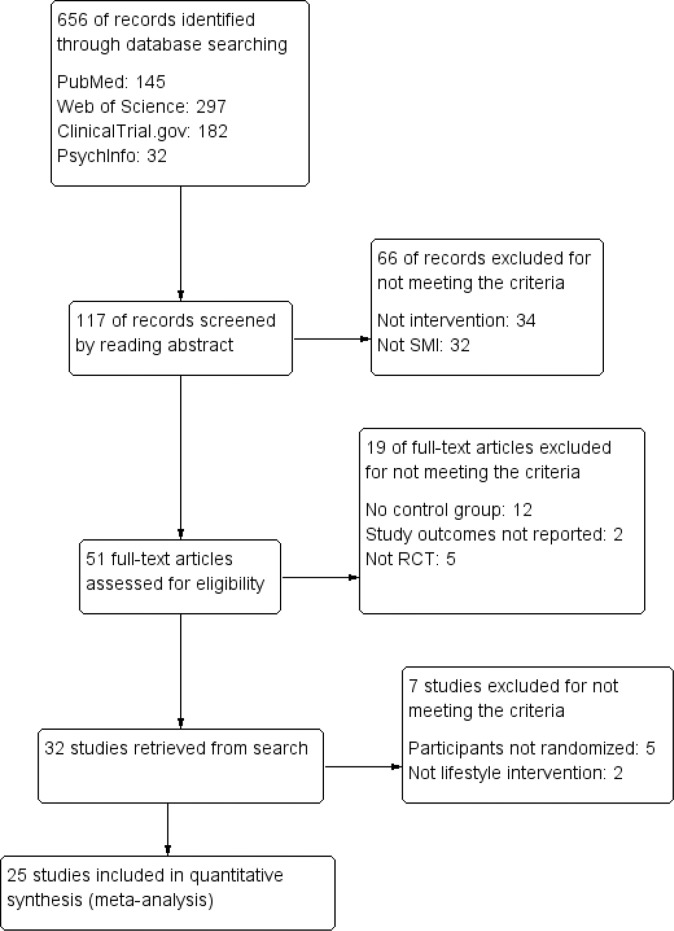
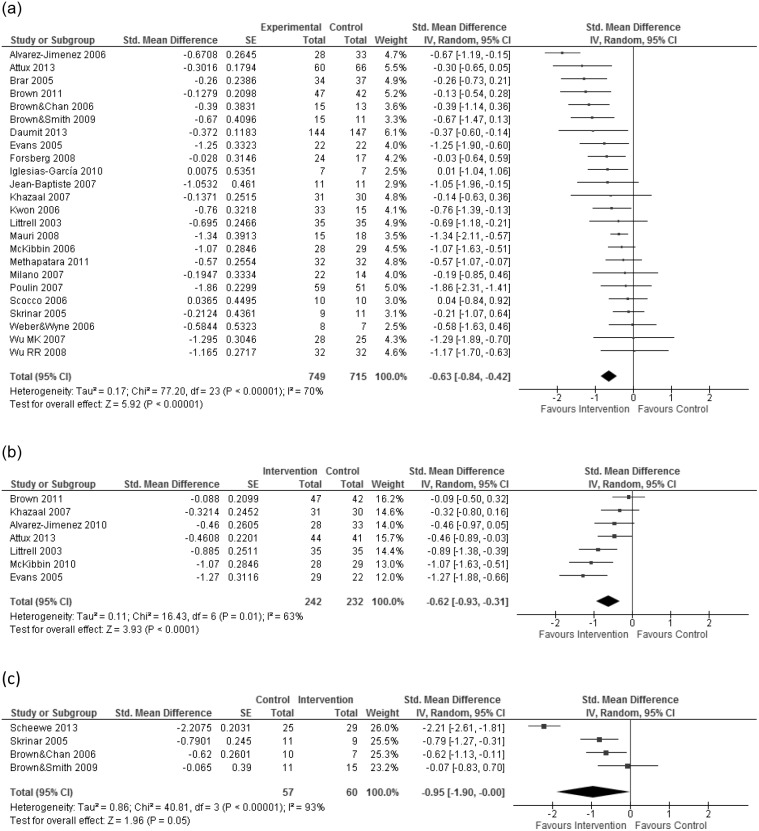
AIMS: The aim of this study was to estimate the effects of lifestyle interventions on bodyweight and other cardiometabolic risk factors in people with psychotic disorders. Additionally, the long-term effects on body weight and the effects on depressive symptoms were examined. MATERIAL AND METHODS: We searched four databases for randomized controlled trials (RCTs) that compared lifestyle interventions to control conditions in patients with psychotic disorders. Lifestyle interventions were aimed at weight loss or weight gain prevention, and the study outcomes included bodyweight or metabolic parameters. RESULTS: The search resulted in 25 RCTs -only 4 were considered high quality- showing an overall effect of lifestyle interventions on bodyweight (effect size (ES) = -0.63, p<0.0001). Lifestyle interventions were effective in both weight loss (ES = -0.52, p<0.0001) and weight-gain-prevention (ES = -0.84, p = 0.0002). There were significant long-term effects, two to six months post-intervention, for both weight-gain-prevention interventions (ES = -0.85, p = 0.0002) and weight loss studies (ES = -0.46, p = 0.02). Up to ten studies reported on cardiometabolic risk factors and showed that lifestyle interventions led to significant improvements in waist circumference, triglycerides, fasting glucose and insulin. No significant effects were found for blood pressure and cholesterol levels. Four studies reported on depressive symptoms and showed a significant effect (ES = -0.95, p = 0.05). CONCLUSION: Lifestyle interventions are effective in treating and preventing obesity, and in reducing cardiometabolic risk factors. However, the quality of the studies leaves much to be desired.
Overview
The claims and statistics of this paper haven’t been checked yet.
Run the check — free, no account needed. It reads the open-access text and checks the sources it cites.
Integrity signals
Registry
Cites
Statistics
Figures
Verification
Claims the paper makes
The claims and statistics of this paper haven’t been checked yet.
Run the check — free, no account needed. It reads the open-access text and checks the sources it cites.
Claims other papers make about this one
Each is checked against this paper’s own text: does it say what the citing paper says it does?
In the citing paper
“Interventions with long-term follow-up are also warranted, since there are no reasons to believe that changes in metabolic risk factors occur faster in patients with severe mental disorders than the general population 18 .”
In the citing paper
“Weight reduction is the most used outcome [46][47][48][49][50][51][52][53][54][55] and the evidence is reported to be favourable 17 , although long-term trials are missing 18 .”
Self-check
Percentages, sums and reported differences re-computed from the paper’s own numbers.
The self-check needs the paper’s full text.
Citations
Cites
Diagnostic and Statistical Manual of Mental Disorders
American Psychiatric Association (2013) · doi:10.1176/appi.books.9780890425596 · Cited by 116,369
Diagnostic and Statistical Manual of Mental Disorders
Williams, J. B. W., & First, M. B. (2013) · Oxford University Press eBooks · doi:10.1093/acrefore/9780199975839.013.104 · Cited by 109,845
Preferred Reporting Items for Systematic Reviews and Meta-Analyses: the PRISMA statement
Moher, D., Liberati, A., Tetzlaff, J., Altman, D. G., & for the PRISMA Group (2009) · BMJ · doi:10.1136/bmj.b2535 · Cited by 83,823
Measuring inconsistency in meta-analyses
Higgins, J. P. T., Thompson, S. G., Deeks, J. J., & Altman, D. G. (2003) · BMJ · doi:10.1136/bmj.327.7414.557 · Cited by 63,139 · cited 2×
“Heterogeneity, characterized by the I 2 statistic, is considered low when I 2 # 25% and high when I 2 $ 75% [32].”
Bias in meta-analysis detected by a simple, graphical test
Egger, M., Smith, G. D., Schneider, M., & Minder, C. (1997) · BMJ · doi:10.1136/bmj.315.7109.629 · Cited by 56,722 · cited 1×
“Funnel plots were checked for asymmetry and Eggers’ tests were performed for each outcome to rule out publication bias [37].”
Preferred Reporting Items for Systematic Reviews and Meta-Analyses: The PRISMA Statement
Moher, D., Liberati, A., Tetzlaff, J., & Altman, D. G. (2009) · Journal of Clinical Epidemiology · doi:10.1016/j.jclinepi.2009.06.005 · Cited by 19,575
Preferred reporting items for systematic reviews and meta-analyses: The PRISMA statement
Moher, D., Liberati, A., Tetzlaff, J., & Altman, D. G. (2010) · International Journal of Surgery · doi:10.1016/j.ijsu.2010.02.007 · Cited by 12,156
Role of Insulin Resistance in Human Disease
Reaven, G. M. (1988) · Diabetes · doi:10.2337/diab.37.12.1595 · Cited by 12,154
Actual causes of death in the United States
McGinnis, J. M. (1993) · JAMA: The Journal of the American Medical Association · doi:10.1001/jama.1993.03510180077038 · Cited by 5,480
The combination of estimates from different experiments
Cochran, W. G. (1954) · Biometrics · doi:10.2307/3001666 · Cited by 5,380
Research works printed but not linked: 2
- Zukley LM (2008) The effects of a structured lifestyle intervention program in conjunction with dietary supplementation on weight loss and risk factors for the metabolic syndrome. Dissertation Abstracts International: Section B: The Sciences and Engineering 68.
- Yalom ID, Leszcz M (2005) The theory and practice of group psychotherapy (5th ed.). New York, NY US: Basic Books.
Cited by
Sorted by citations
Items 101–129 of 129
MacPhee, M., Howe, J., Habib, H., Piwowarczyk, E., Wong, G., Ahern, A. L., Birdi, G. K., Higgs, S., Oduola, S., Kenny, A., et al. (2025) · Obesity Reviews · doi:10.1111/obr.13962 · Cited by 3
Šoher, L., Stokanović, M. C., Prša, S., Miškulin, M., & Kenjeric, D. C. (2023) · Nutrients · doi:10.3390/nu16010143 · Cited by 1
“The prevalence of obesity in this population is 41–50% [5].”
BackgroundŠoher, L., Stokanović, M. C., Prša, S., & Kenjeric, D. C. (2024) · Nutrients · doi:10.3390/nu16223922 · Cited by 1
“On the other hand, the demonstrated reduction in fat and saturated fat intake could potentially lower health risks in this population [3].”
InfluentialBlomqvist, M., Ivarsson, A., Carlsson, I., Sandgren, A., & Jormfeldt, H. (2023) · Issues in Mental Health Nursing · doi:10.1080/01612840.2023.2212771 · Cited by 1
“A meta-analysis of effects of a lifestyle intervention on weight management and reducing cardiometabolic risk has showed to be effective among people with psychotic disorders (Bruins et al., 2014).”
BackgroundSchizophrenia and Related Psychoses
(2025) · Wiley eBooks · doi:10.1002/9781119870203.mpg001.pub2 · Cited by 2
Diabetes mellitus bij patiënten met ernstige psychische aandoeningen
Oud, M. (2015) · Bijblijven · doi:10.1007/s12414-015-0013-5
James Foulis Duncan (1812–1895)
Kelly, B. D. (2017) · The British Journal of Psychiatry · doi:10.1192/bjp.bp.116.190538
Borich, A. (2017) · Otago University Research Archive (University of Otago)
Atividade física e o primeiro episódio psicótico
Gouveia, R. I. (2018) · doi:10.11606/d.22.2018.tde-27112017-213519
Qureshi, N. A., & Alahmari, Y. S. (2018) · Journal of Complementary and Alternative Medical Research · doi:10.9734/jocamr/2018/45315
“Antipsychotics and antidepressants have the greatest potential to increase weight among patients with schizophrenia-spectrum conditions and mood disorders [1-3,5-7,12,13,81,121,126-128].”
BackgroundEffectiveness of interventions to support weight loss in adults taking antipsychotics: a review
Ayodele, D., & Oates, J. (2019) · British Journal of Mental Health Nursing · doi:10.12968/bjmh.2019.8.2.88
Hahn, L. A. (2017) · Adelaide Research & Scholarship (AR&S) (University of Adelaide)
Cardiovascular Manifestations in Schizophrenia
Calorio, F., Catania, C. G., & Rocchetti, M. (2020) · Springer eBooks · doi:10.1007/978-3-030-28008-6_24
Antipsychotics, Weight Gain and Metabolic Risk
Cooper, S. J., & Reynolds, G. P. (2020) · Cambridge University Press eBooks · doi:10.1017/9781911623465.023
Empfohlene psychosoziale Therapien bei schweren psychischen Erkrankungen
Gühne, U., Weinmann, S., Becker, T. M., & Riedel-Heller, S. G. (2020) · InFo Neurologie + Psychiatrie · doi:10.1007/s15005-020-1327-0
“Möglicherweise sind die Effekte bei einer präventiven Ausrichtung der Interventionen stärker [36, 39].”
BackgroundHerstelgericht ondersteunen van het dagelijks functioneren
Wunderink, C., & van der Meer, E. M. (2021) · Bohn Stafleu van Loghum eBooks · doi:10.1007/978-90-368-2586-3_18
Mohanty, K., Muliyala, K. P., Gandhi, S., & Thirthalli, J. (2021) · Indian Journal of Psychological Medicine · doi:10.1177/02537176211021283
Psychosoziale Therapien bei schwer psychisch kranken Menschen
Gühne, U., & Riedel-Heller, S. G. (2021) · NeuroTransmitter · doi:10.1007/s15016-021-9194-6
Cardiovascular Manifestations in Schizophrenia
Calorio, F., Catania, C. G., & Rocchetti, M. (2020) · Springer eBooks · doi:10.1007/978-3-319-90305-7_24-1
Leefstijlinterventies en ernstige problematiek
van Loghum, B. S. (2015) · Psychopraktijk · doi:10.1007/s13170-015-0036-8
Targeting Metabolic Abnormalities in Mental Health Prevention Strategies
Schimmenti, S., Maselli, F. M. C., & Tosato, S. (2022) · Springer eBooks · doi:10.1007/978-3-030-97906-5_13
Ghanem, Y., Almarshedi, A. A., Adam, M. A. A., Eid, M., Karaliūnienė, R., Philip, S., & Hayek, S. E. (2024) · Nutritional neurosciences · doi:10.1007/978-981-97-2681-3_12
MacPhee, M., Howe, J., Habib, H., Piwowarczyk, E., Wong, G., Ahern, A. L., Birdi, G. K., Higgs, S., Oduola, S., Kenny, A., et al. (2024) · medRxiv · doi:10.1101/2024.07.25.24310979
Mucheru, D., Ashby, S., Hanlon, M.-C., McEvoy, M., & MacDonald‐Wicks, L. K. (2020) · Figshare · doi:10.6084/m9.figshare.12799050
Pape, L. M., Adriaanse, M. C., Kol, J., van Straten, A., & van Meijel, B. (2022) · Figshare · doi:10.6084/m9.figshare.19596228
Abdullah, S., Mukaetova-Ladinska, E. B., Samad, S., & Subramaniam, H. (2026) · BJPsych Bulletin · doi:10.1192/bjb.2026.10216
Hunger pain and its reduction; qualitative insight from people with schizophrenia on semaglutide
Rasmussen, B. S., Simonÿ, C., Poulsen, M. L., Uhrenholt, N. G., Lundberg, B., Rønne, S. T., Uhrenholt, P. G., Gæde, P., & Arnfred, S. (2026) · International Journal of Qualitative Studies on Health and Well-Being · doi:10.1080/17482631.2026.2717809
“Meta-analytic evidence suggests modest improvements in some cardiometabolic markers and in depressive symptoms in people with psychotic disorders (Bruins et al., 2014).”
Çalışkan, M. B., & Dişsiz, M. (2026) · Journal of Psychosocial Nursing and Mental Health Services · doi:10.3928/02793695-20260825-01
Metadata
- Authors
- Bruins, J., Jörg, F., Bruggeman, R., Slooff, C., Corpeleijn, E., & Pijnenborg, M.
- Affiliations
- University Medical Center Groningen (NL)
- Corresponding author
- Bruins, Jojanneke
- Venue
- PLoS ONE
- Publisher
- Public Library of Science (PLoS)
- Published
- 2014-12-04
- Volume
- 9
- Issue
- 12
- Pages
- e112276
- ISSN
- 1932-6203 (ISSN-L)
- PMC
- PMC4256304
- OpenAlex
- W2118574085
- Cited by
- 129
- References
- 81
- Citations by year
- 2026: 4 · 2025: 6 · 2024: 8 · 2023: 9 · 2022: 10 · 2021: 13 · 2020: 16 · 2019: 15 · 2018: 16 · 2017: 18 · 2016: 8 · 2015: 6
- FWCI
- 1.47
- Type
- journal article
- Language
- en
- Open access
- gold
- doi.org
- Locations
- PLoS ONE (publishedVersion, cc-by)
- PubMed Central (publishedVersion, cc-by)
- PubMed (publishedVersion)
- RePEc: Research Papers in Economics (submittedVersion)
- DOAJ (DOAJ: Directory of Open Access Journals) (submittedVersion)
- Figshare (submittedVersion, cc-by)
- University of Groningen research database (University of Groningen / Centre for Information Technology) (submittedVersion, cc-by)
- Funders
- Eli Lilly and Company
- Topics
- Health Sciences › Medicine › Psychiatry and Mental health › Schizophrenia research and treatment
- Health Sciences › Medicine › Public Health, Environmental and Occupational Health › Obesity, Physical Activity, Diet
- Social Sciences › Psychology › Clinical Psychology › Eating Disorders and Behaviors
- Keywords
- lifestyle intervention, psychosis, weight management, weight loss, weight gain prevention, cardiometabolic risk, depressive symptoms, obesity, waist circumference, triglycerides, fasting blood glucose, insulin, blood pressure, cholesterol
- MeSH terms
- Blood Pressure, Body Weight, Depression, Humans, Insulin Resistance, Life Style, Obesity, Psychotic Disorders, Risk Factors, Weight Loss, Exercise, Body Mass Index
About these checks
Registry, retraction, Cites and statistics results are computed, not judged, with one exception: a printed reference that no index lists is read once by a model before it counts as a citation error. Claims are extracted by a model and kept only when their quote appears verbatim in the text; each cited source is then checked, with a model’s help, for whether it says what the claim relies on. Those verdicts can be wrong — read the claim’s quote and the cited source before relying on one.
Statistics and arithmetic are recomputed, not judged.
Confidence bands are shown only for fields calibrated on our annotated test set. None is calibrated yet, so no band is shown.
What counts as a claim ›How we measure confidence ›How we check this ›
Are you an author, or do you see a problem with this page? Request a review
