

Leucocyte Telomere Length and Risk of Type 2 Diabetes Mellitus: New Prospective Cohort Study and Literature-Based Meta-Analysis
Open accessThe DOI matches its Crossref record; 51 of the 51 references it cites were found in a registry or an index.
Abstract
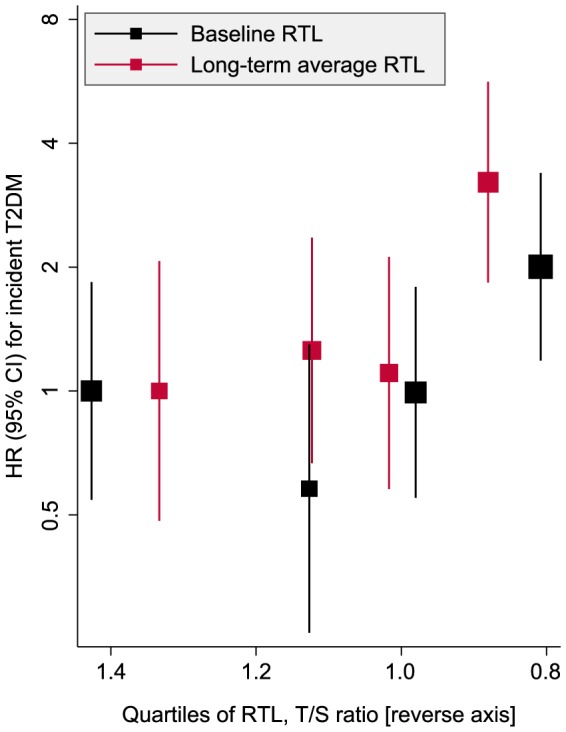
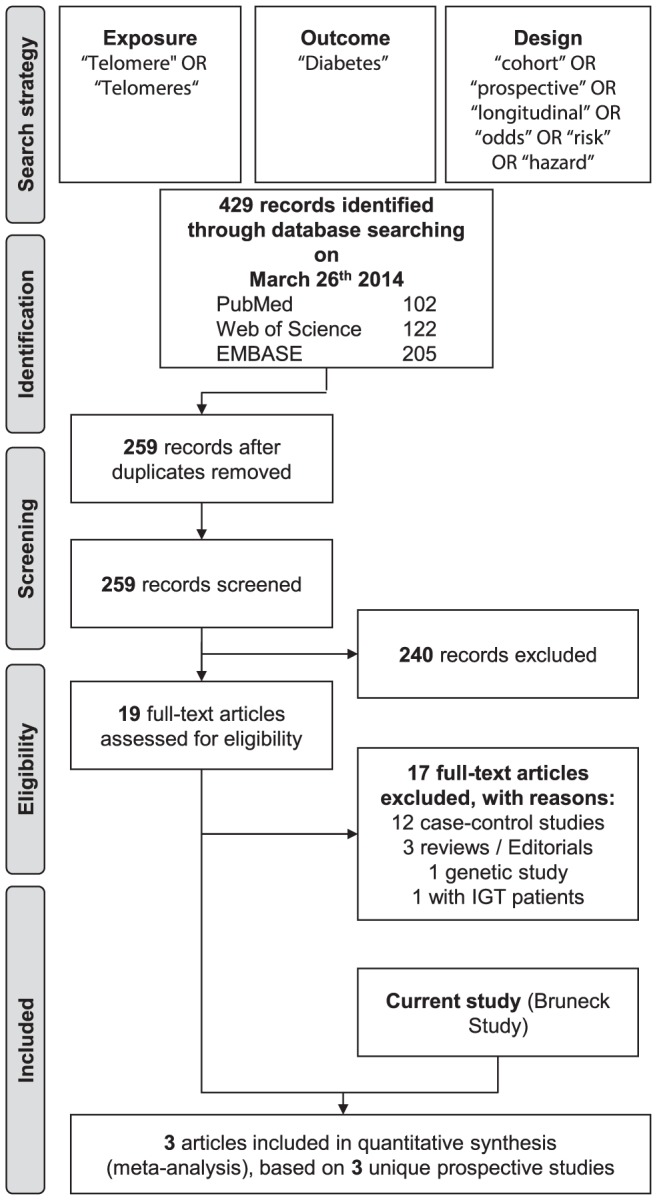
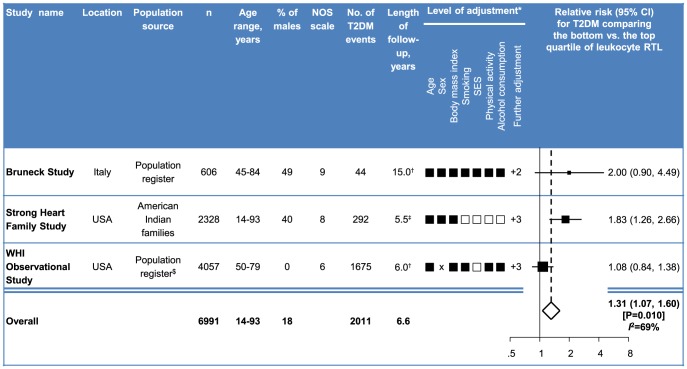
BACKGROUND: Short telomeres have been linked to various age-related diseases. We aimed to assess the association of telomere length with incident type 2 diabetes mellitus (T2DM) in prospective cohort studies. METHODS: Leucocyte relative telomere length (RTL) was measured using quantitative polymerase chain reaction in 684 participants of the prospective population-based Bruneck Study (1995 baseline), with repeat RTL measurements performed in 2005 (n = 558) and 2010 (n = 479). Hazard ratios for T2DM were calculated across quartiles of baseline RTL using Cox regression models adjusted for age, sex, body-mass index, smoking, socio-economic status, physical activity, alcohol consumption, high-density lipoprotein cholesterol, log high-sensitivity C-reactive protein, and waist-hip ratio. Separate analyses corrected hazard ratios for within-person variability using multivariate regression calibration of repeated measurements. To contextualise findings, we systematically sought PubMed, Web of Science and EMBASE for relevant articles and pooled results using random-effects meta-analysis. RESULTS: Over 15 years of follow-up, 44 out of 606 participants free of diabetes at baseline developed incident T2DM. The adjusted hazard ratio for T2DM comparing the bottom vs. the top quartile of baseline RTL (i.e. shortest vs. longest) was 2.00 (95% confidence interval: 0.90 to 4.49; P = 0.091), and 2.31 comparing the bottom quartile vs. the remainder (1.21 to 4.41; P = 0.011). The corresponding hazard ratios corrected for within-person RTL variability were 3.22 (1.27 to 8.14; P = 0.014) and 2.86 (1.45 to 5.65; P = 0.003). In a random-effects meta-analysis of three prospective cohort studies involving 6,991 participants and 2,011 incident T2DM events, the pooled relative risk was 1.31 (1.07 to 1.60; P = 0.010; I2 = 69%). CONCLUSIONS/INTERPRETATION: Low RTL is independently associated with the risk of incident T2DM. To avoid regression dilution biases in observed associations of RTL with disease risk, future studies should implement methods correcting for within-person variability in RTL. The causal role of short telomeres in T2DM development remains to be determined.
Overview
The claims and statistics of this paper haven’t been checked yet.
Free: it reads the open-access text and checks the first 5 claims that cite a source we can check. Create a free account to check every claim.
Integrity signals
Registry
Cites
Statistics
Figures
Verification
Claims the paper makes
The claims and statistics of this paper haven’t been checked yet.
Free: it reads the open-access text and checks the first 5 claims that cite a source we can check. Create a free account to check every claim.
Claims other papers make about this one
Each is checked against this paper’s own text: does it say what the citing paper says it does?
The cited source says what the claim attributes to it.
In the citing paper
“Short LTL in humans has been associated with serious medical illnesses with some consistency according to metaanalyses, including cardiovascular disease, diabetes, and cancer (D'Mello et al., 2014; Weischer et al., 2012 Willeit et al, 2014; Wentzensen et al, 2011).”
From Psychiatric disorders and leukocyte telomere length: Underlying mechanisms linking mental illness with cellular aging (2015) · cites this paper as Willeit et al, 2014
The cited source says what the claim attributes to it.
In the citing paper
“In addition to psychiatric and substance-related comorbidities, many serious comorbid medical illnesses may also be associated with decreased LTL (D'Mello et al., 2014; Weischer et al., 2012 Willeit et al, 2014; Wentzensen et al, 2011), and presumably this is independent of the effect of the psychiatric diagnosis.”
From Psychiatric disorders and leukocyte telomere length: Underlying mechanisms linking mental illness with cellular aging (2015) · cites this paper as Willeit et al, 2014
In the citing paper
“Both diseases were shown to be significantly more likely to occur in patients with shorter initial telomere lengths.”
From Markers of cellular senescence. Telomere shortening as a marker of cellular senescence (2016) · cites this paper as [55]
Self-check
Percentages, sums and reported differences re-computed from the paper’s own numbers.
The self-check needs the paper’s full text.
Citations
Cites
Measuring inconsistency in meta-analyses
Higgins, J. P. T., Thompson, S. G., Deeks, J. J., & Altman, D. G. (2003) · BMJ · doi:10.1136/bmj.327.7414.557 · Cited by 63,139 · cited 1×
“Heterogeneity between studies was quantified using the I(2) statistic and tested by a standard x(2) test [42].”
MethodBias in meta-analysis detected by a simple, graphical test
Egger, M., Smith, G. D., Schneider, M., & Minder, C. (1997) · BMJ · doi:10.1136/bmj.315.7109.629 · Cited by 56,722 · cited 1×
“Potential publication and small-study bias was formally assessed using Egger’s test [43].”
MethodA new mathematical model for relative quantification in real-time RT-PCR
Pfaffl, M. W. (2001) · Nucleic Acids Research · doi:10.1093/nar/29.9.e45 · Cited by 34,610
Friedewald, W. T., Levy, R. I., & Fredrickson, D. S. (1972) · Clinical Chemistry · doi:10.1093/clinchem/18.6.499 · Cited by 32,423 · cited 1×
“LDL cholesterol was estimated using the Friedewald equation [33].”
Method(2014) · Medical Entomology and Zoology · Cited by 17,633
Antihyperlipidemic and Biochemical Activities of Mcy Protein in Streptozotocin Induced Diabetic Rats
Marella, S., Maddirela, D. R., Badri, K. R., Jyothi Kumar, M. V., & Chippada, A. (2015) · Cellular Physiology and Biochemistry · doi:10.1159/000373954 · Cited by 5,938
The limited in vitro lifetime of human diploid cell strains
Hayflick, L. (1965) · Experimental Cell Research · doi:10.1016/0014-4827(65)90211-9 · Cited by 5,876 · cited 2×
“Telomeres shorten with each cellular division, accelerated by inflammation and oxidative stress, and, below a critical length, the apoptotic programme of the cell is induced [1,3].”
BackgroundA short questionnaire for the measurement of habitual physical activity in epidemiological studies
Baecke, J., Burema, J., & Frijters, J. (1982) · The American Journal of Clinical Nutrition · doi:10.1093/ajcn/36.5.936 · Cited by 3,945 · cited 1×
“Physical activity was assessed using the validated Baeke Score [30].”
MethodFollow-up report on the diagnosis of diabetes mellitus
The Expert Committee on the Diagnosis and Classification of Diabetes Mellitus* (2003) · Diabetes Care · doi:10.2337/diacare.26.11.3160 · Cited by 3,784 · cited 1×
“$7 mmol/l) or when the subjects had a clinical diagnosis of T2DM and received anti-diabetic treatment [37].”
BackgroundStructure and function of telomeres
Blackburn, E. H. (1991) · Nature · doi:10.1038/350569a0 · Cited by 3,596
Cited by
Items 201–209 of 209
The significance of telomeres in clinical practice
Baliou, S., Fragkiadaki, P., Alegakis, A. K., Vakonaki, E., & Tsatsakis, A. M. (2025) · Public Health Toxicology · doi:10.18332/pht/205879
Feng, B., Yang, R., Wang, G. R., Hu, Q., & Zhao, C. (2025) · medRxiv · doi:10.1101/2025.07.14.25331527
Telomere length and cardiovascular mortality: a multistate competing risk analysis
Kodali, H., Borrell, L. N., Valeri, L., Jones, H. E., & Wyka, K. (2025) · Annals of Epidemiology · doi:10.1016/j.annepidem.2025.07.039
Lee, M., Saha, A., Sundaram, R., Albert, P. S., & Zhao, S. (2024) · Figshare · doi:10.6084/m9.figshare.25844357
Kodali, H., & Borrell, L. N. (2026) · The American Journal of the Medical Sciences · doi:10.1016/j.amjms.2026.03.005
Type 2 Diabetes From the Perspective of Telomere Biology
Cao, H., Feng, H., Shen, Z., & Huang, Y. (2026) · Endocrinology Diabetes & Metabolism · doi:10.1002/edm2.70137
Daredia, S., Khodasevich, D., Bozack, A. K., de la Rosa, R., Kogut, K. R., Holland, N., Eskenazi, B., DEARDORFF, J., & Cárdenas, A. (2026) · Epigenomics · doi:10.1080/17501911.2026.2694424
“At the cellular level, sustained childhood trauma has been linked to accelerated leukocyte telomere shortening [15], a hallmark of biological aging associated with earlier stroke, myocardial infarction, and type 2 diabetes [16,17].”
Feng, B., Yang, R., Wang, G., Hu, Q., & Zhao, C. (2026) · Annals of Human Genetics · doi:10.1111/ahg.70057
Telomeric autophagy in human health, aging, and diseases
Li, X., & Wu, X. (2026) · Frontiers in Molecular Biosciences · doi:10.3389/fmolb.2026.1922188
“…1.11–1.50) for shortened telomeres, falling to 1.12 (1.00–1.25) once the three cohorts responsible for the heterogeneity were removed (Zhao et al., 2013); pooling three prospective cohorts (6,991 participants, 2,011 incident events) gave a relative risk of 1.31 (1.07–1.60) (Willeit et al., 2014).”
Influential
Metadata
- Authors
- Willeit, P., Raschenberger, J., Heydon, E. E., Tsimikas, S., Haun, M., Mayr, A., Weger, S., Witztum, J. L., Butterworth, A. S., Willeit, J., Kronenberg, F., & Kiechl, S.
- Affiliations
- Innsbruck Medical University (AT)
- University of Cambridge (GB)
- University of California San Diego (US)
- Krankenhaus Bruneck (IT)
- Corresponding author
- Willeit, Peter
- Kiechl, Stefan
- ORCID
- Venue
- PLoS ONE
- Publisher
- Public Library of Science (PLoS)
- Published
- 2014-11-12
- Volume
- 9
- Issue
- 11
- Pages
- e112483
- ISSN
- 1932-6203 (ISSN-L)
- PMC
- PMC4229188
- OpenAlex
- W2129880677
- Cited by
- 211
- References
- 51
- Citations by year
- 2026: 7 · 2025: 9 · 2024: 11 · 2023: 15 · 2022: 12 · 2021: 19 · 2020: 21 · 2019: 27 · 2018: 26 · 2017: 17 · 2016: 33 · 2015: 13
- FWCI
- 13.83
- Type
- journal article
- Language
- en
- Open access
- gold
- doi.org
- Locations
- PLoS ONE (publishedVersion, cc-by)
- Europe PMC (PubMed Central) (publishedVersion, cc-by)
- PubMed Central (publishedVersion, cc-by)
- PubMed (publishedVersion)
- RePEc: Research Papers in Economics (submittedVersion)
- DOAJ (DOAJ: Directory of Open Access Journals) (submittedVersion, cc-by-sa)
- Figshare (submittedVersion, cc-by)
- Funders
- National Institute for Health and Care Research (NF-SI-0512-10165)
- British Heart Foundation (RG/08/014/24067)
- Landes Tirols
- Provincia autonoma di Bolzano - Alto Adige
- Medical Research Council (MR/L003120/1)
- Topics
- Life Sciences › Biochemistry, Genetics and Molecular Biology › Cell Biology › Telomeres, Telomerase, and Senescence
- Life Sciences › Biochemistry, Genetics and Molecular Biology › Genetics › Genetic Associations and Epidemiology
- Health Sciences › Medicine › Endocrinology, Diabetes and Metabolism › Adipokines, Inflammation, and Metabolic Diseases
- Keywords
- type 2 diabetes, leukocyte telomere length, diabetes risk, regression dilution bias, within-person variability, Bruneck Study, age-related diseases
- MeSH terms
- Adult, Age Factors, Aged, Alcohol Drinking, C-Reactive Protein, Diabetes Mellitus, Type 2, Female, Humans, Leukocytes, Cholesterol, HDL, Male, Middle Aged, Motor Activity, Prospective Studies, Risk Factors, Sex Factors, Social Class, Body Mass Index, Proportional Hazards Models, Telomere, Waist-Hip Ratio, Telomere Shortening
About these checks
Registry, retraction, Cites and statistics results are computed, not judged, with one exception: a printed reference that no index lists is read once by a model before it counts as a citation error. Claims are extracted by a model and kept only when their quote appears verbatim in the text; each cited source is then checked, with a model’s help, for whether it says what the claim relies on. Those verdicts can be wrong — read the claim’s quote and the cited source before relying on one.
Statistics and arithmetic are recomputed, not judged.
Confidence bands are shown only for fields calibrated on our annotated test set. None is calibrated yet, so no band is shown.
What counts as a claim ›How we measure confidence ›How we check this ›
Are you an author, or do you see a problem with this page? Request a review
Data sources
Bibliographic data: Semantic Scholar, OpenAlex, Crossref.
Contains information from the Semantic Scholar Academic Graph Datasets, made available under the ODC Attribution License (ODC-BY 1.0).
Semantic Scholar’s data is described in: Kinney, R., et al. (2023). The Semantic Scholar Open Data Platform. arXiv:2301.10140.
