

The DOI matches its Crossref record; 38 of the 39 references it cites were found in a registry or an index.
The Efficacy and Safety of Selective H1-Antihistamine versus Leukotriene Receptor Antagonist for Seasonal Allergic Rhinitis: A Meta-Analysis
Open accessAbstract
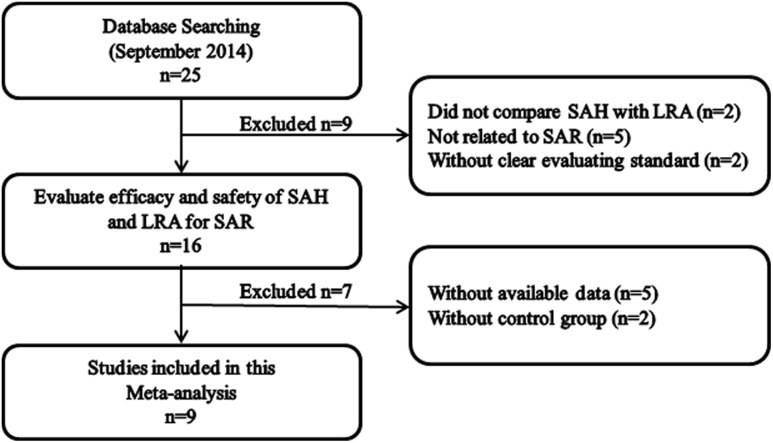
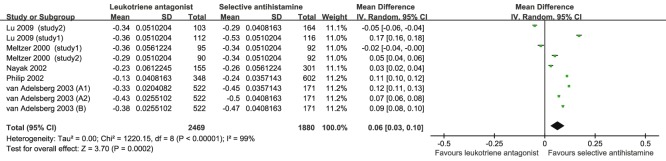
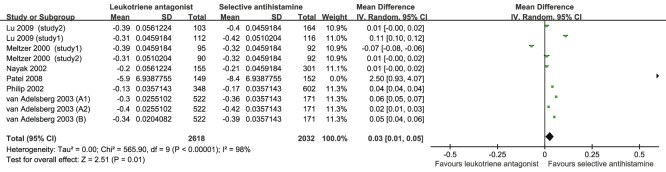
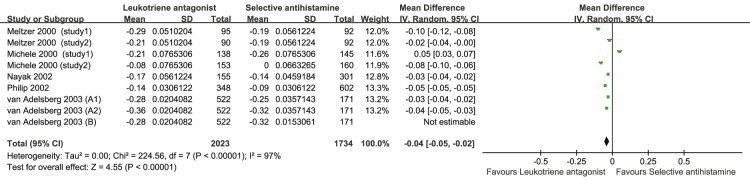
BACKGROUND: Both selective H1-antihistamine (SAH) and leukotriene receptor antagonist (LTRA) have been shown to be effective in treating patients with seasonal allergic rhinitis (SAR), but it is still uncertain which treatment option is optimal. This meta-analysis was aimed to compare the efficacy and safety of SAH and LTRA for SAR. MATERIALS AND METHODS: PubMed, EMBASE and the Cochrane Library were searched for all eligible studies that compared the efficacy and safety of SAH and LTRA for SAR up to September 7, 2014. The pooled mean difference (MD), odd ratios (ORs) and 95% confidence intervals (95% CIs) were calculated using a fixed- or random-effects model. RESULTS: Nine studies with 5781 SAR patients were included. The results showed that SAH is superior to LTRA in terms of the daytime eye symptoms score (DESS) and composite symptoms score (CSS) for SAR (MD = 0.06, 95% CI, 0.03 to 0.10, P = 0.000, I2 = 99%; MD = 0.03, 95% CI, 0.01 to 0.05, P = 0.010, I2 = 98%), whereas LTRA overmatched SAH with respect to the night-time symptoms score (NSS) (MD = -0.04, 95% CI, -0.05 to -0.02, P = 0.000, I2 = 97%). Additionally, the results of subgroup analysis indicated that the dose, duration and gender of the patients might impact the comparisons of the effects of SAH and LTRA on their efficacy for SAR. CONCLUSION: This meta-analysis suggested that SAH and LTRA have similar effects and safety for SAR, but SAH is more appropriate for daytime nasal symptoms (congestion, rhinorrhea, pruritus and sneezing), while LTRA is better suited for nighttime symptoms (difficulty going to sleep, nighttime awakenings, and nasal congestion on awakening), respectively. Meanwhile, the dose, duration and gender of patients may influence the anti-SAR effects of SAH and LTRA.
Overview
The claims and statistics of this paper haven’t been checked yet.
Run the check — free, no account needed. It reads the open-access text and checks the sources it cites.
Integrity signals
Registry
Cites
Statistics
Figures
Verification
Claims the paper makes
The claims and statistics of this paper haven’t been checked yet.
Run the check — free, no account needed. It reads the open-access text and checks the sources it cites.
Claims other papers make about this one
Each is checked against this paper’s own text: does it say what the citing paper says it does?
The source backs part of the claim, not all of it — or backs it for a different population, condition or comparison.
In the citing paper
“Antileukotrienes have been shown to be more effective than anti-H 1 against the nocturnal symptoms of AR (including NO) but not against diurnal symptoms [153].”
From Position Paper on Nasal Obstruction: Evaluation and Treatment (2018) · cites this paper as [153]
Experimental — accuracy not yet measured
Self-check
Percentages, sums and reported differences re-computed from the paper’s own numbers.
The self-check needs the paper’s full text.
Citations
Cites
Simons, F. E. R. (2004) · New England Journal of Medicine · doi:10.1056/nejmra033121 · Cited by 697
Burden of allergic rhinitis: Results from the Pediatric Allergies in America survey
Meltzer, E. O., Blaiss, M. S., Derebery, M. J., Mahr, T. A., Gordon, B. R., Sheth, K. K., Simmons, A. L., Wingertzahn, M. A., & Boyle, J. M. (2009) · Journal of Allergy and Clinical Immunology · doi:10.1016/j.jaci.2009.05.013 · Cited by 553
Histamine and H1-antihistamines: Celebrating a century of progress
Simons, F. E. R., & Simons, K. J. (2011) · Journal of Allergy and Clinical Immunology · doi:10.1016/j.jaci.2011.09.005 · Cited by 541
Regulation of the immune response and inflammation by histamine and histamine receptors
O’Mahony, L., Akdis, M., & Akdis, C. A. (2011) · Journal of Allergy and Clinical Immunology · doi:10.1016/j.jaci.2011.06.051 · Cited by 313
Meltzer, E. O., Malmstrom, K., Lu, S., Prenner, B. M., Wei, L. X., Weinstein, S. F., Wolfe, J. D., & Reiss, T. F. (2000) · Journal of Allergy and Clinical Immunology · doi:10.1067/mai.2000.106040 · Cited by 308
Philip, G., Malmström, K., Hampel, F. C., Weinstein, S. F., LaForce, C., Ratner, P. H., Malice, M., Reiss, T. F., & for the Montelukast Spring Rhinitis Study Group (2002) · Clinical & Experimental Allergy · doi:10.1046/j.1365-2222.2002.01422.x · Cited by 241
Nayak, A. S., Philip, G., Lu, S., Malice, M., & Reiss, T. F. (2002) · Annals of Allergy Asthma & Immunology · doi:10.1016/s1081-1206(10)61891-1 · Cited by 202
Cysteinyl Leukotrienes and Their Receptors; Emerging Concepts
Kanaoka, Y., & Boyce, J. A. (2014) · Allergy Asthma and Immunology Research · doi:10.4168/aair.2014.6.4.288 · Cited by 129
Montelukast improves symptoms of seasonal allergic rhinitis over a 4‐week treatment period
van Adelsberg, J., Philip, G., Pedinoff, A., Meltzer, E. O., Ratner, P. H., Menten, J., Reiss, T. F., & for the Montelukast Fall Rhinitis Study Group (2003) · Allergy · doi:10.1046/j.1398-9995.2003.00261.x · Cited by 125
van Adelsberg, J., Philip, G., LaForce, C., Weinstein, S. F., Menten, J., Malice, M., & Reiss, T. F. (2003) · Annals of Allergy Asthma & Immunology · doi:10.1016/s1081-1206(10)62144-8 · Cited by 120
Cited by
International consensus statement on allergy and rhinology: Allergic rhinitis – 2023
Wise, S. K., Damask, C., Roland, L. T., Ebert, C., Levy, J. M., Lin, S., Luong, A., Rodriguez, K., Sedaghat, A. R., Toskala, E., et al. (2023) · International Forum of Allergy & Rhinology · doi:10.1002/alr.23090 · Cited by 507
Chinese Society of Allergy Guidelines for Diagnosis and Treatment of Allergic Rhinitis
Cheng, L., Chen, J., Fu, Q., He, S., Li, H., Liu, Z., Tan, G., Tao, Z., Wang, D., Wen, W., et al. (2018) · Allergy, Asthma & Immunology Research · doi:10.4168/aair.2018.10.4.300 · Cited by 361
Self-citationThe Role of Leukotrienes as Potential Therapeutic Targets in Allergic Disorders
Jo‐Watanabe, A., Okuno, T., & Yokomizo, T. (2019) · International Journal of Molecular Sciences · doi:10.3390/ijms20143580 · Cited by 158
Combined allergic rhinitis and asthma syndrome (CARAS)
Ferreira, L. K. D. P., Ferreira, L. A. M. P., Monteiro, T. M., Bezerra, G. C., Bernardo, L. R., & Piuvezam, M. R. (2019) · International Immunopharmacology · doi:10.1016/j.intimp.2019.105718 · Cited by 130
IV Brazilian Consensus on Rhinitis – an update on allergic rhinitis
Sakano, E., Sarinho, E. S. C., Cruz, Á. A., Pastorino, A. C., Tamashiro, E., Kuschnir, F. C., Castro, F. F. M., Romano, F. R., Wandalsen, G. F., Chong‐Neto, H. J., et al. (2017) · Brazilian Journal of Otorhinolaryngology · doi:10.1016/j.bjorl.2017.10.006 · Cited by 86
Metadata
- Authors
- Xu, Y., Zhang, J., & Wang, J.
- Affiliations
- Renmin Hospital of Wuhan University (CN)
- Corresponding author
- Xu, Yu
- Venue
- PLoS ONE
- Publisher
- Public Library of Science (PLoS)
- Published
- 2014-11-10
- Volume
- 9
- Issue
- 11
- Pages
- e112815
- ISSN
- 1932-6203 (ISSN-L)
- PMC
- PMC4226613
- OpenAlex
- W2058932654
- Cited by
- 30
- References
- 39
- Citations by year
- 2026: 1 · 2024: 3 · 2023: 3 · 2022: 5 · 2021: 4 · 2020: 1 · 2019: 2 · 2018: 5 · 2017: 1 · 2016: 2 · 2015: 2
- FWCI
- 0.22
- Type
- journal article
- Language
- en
- Open access
- gold
- doi.org
- Locations
- PLoS ONE (publishedVersion, cc-by)
- Europe PMC (PubMed Central) (publishedVersion, cc-by)
- PubMed Central (publishedVersion, cc-by)
- PubMed (publishedVersion)
- RePEc: Research Papers in Economics (submittedVersion)
- DOAJ (DOAJ: Directory of Open Access Journals) (submittedVersion)
- Figshare (submittedVersion, cc-by)
- Topics
- Health Sciences › Medicine › Immunology and Allergy › Allergic Rhinitis and Sensitization
- Health Sciences › Medicine › Pulmonary and Respiratory Medicine › Asthma and respiratory diseases
- Life Sciences › Immunology and Microbiology › Immunology › Mast cells and histamine
- Keywords
- allergic rhinitis, leukotriene receptor antagonists, antihistamine efficacy, drug safety, nocturnal symptoms, dose and duration effects, gender differences
- MeSH terms
- Adult, Dose-Response Relationship, Drug, Drug Administration Schedule, Female, Rhinitis, Allergic, Seasonal, Histamine H1 Antagonists, Humans, Male, Sex Factors, Databases, Bibliographic, Anti-Allergic Agents, Leukotriene Antagonists
About these checks
Registry, retraction, Cites and statistics results are computed, not judged, with one exception: a printed reference that no index lists is read once by a model before it counts as a citation error. Claims are extracted by a model and kept only when their quote appears verbatim in the text; each cited source is then checked, with a model’s help, for whether it says what the claim relies on. Those verdicts can be wrong — read the claim’s quote and the cited source before relying on one.
Statistics and arithmetic are recomputed, not judged.
Confidence bands are shown only for fields calibrated on our annotated test set. None is calibrated yet, so no band is shown.
What counts as a claim ›How we measure confidence ›How we check this ›
Are you an author, or do you see a problem with this page? Request a review
Data sources
Bibliographic data: Semantic Scholar, OpenAlex, Crossref.
Contains information from the Semantic Scholar Academic Graph Datasets, made available under the ODC Attribution License (ODC-BY 1.0).
Semantic Scholar’s data is described in: Kinney, R., et al. (2023). The Semantic Scholar Open Data Platform. arXiv:2301.10140.
