

The DOI matches its Crossref record; 58 of the 58 references it cites were found in a registry or an index.
MicroRNA 21 Is a Homeostatic Regulator of Macrophage Polarization and Prevents Prostaglandin E2-Mediated M2 Generation
Open accessAbstract
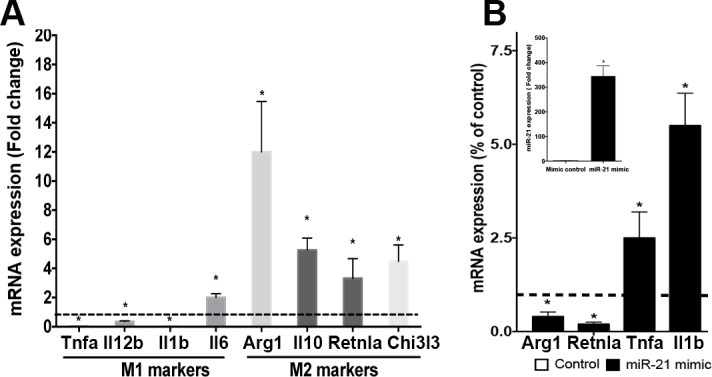
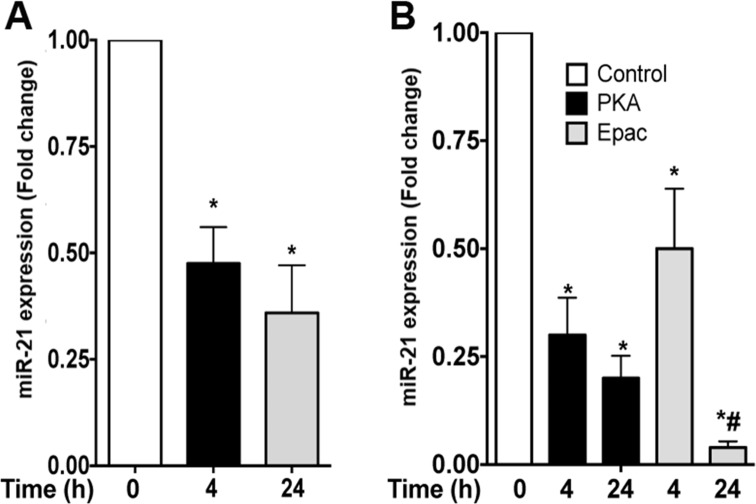
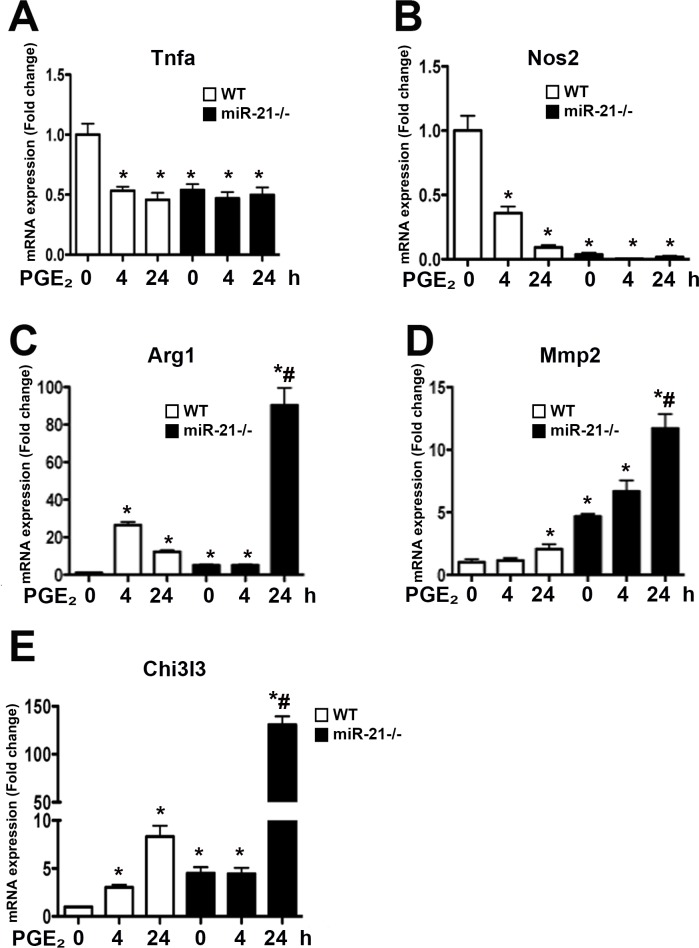
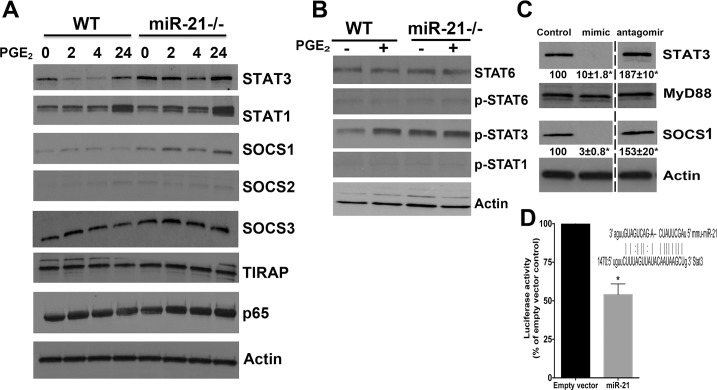
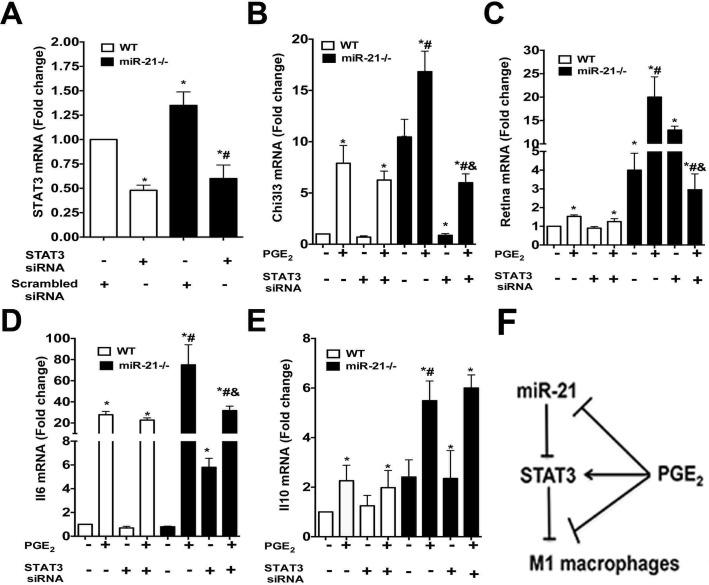
Macrophages dictate both initiation and resolution of inflammation. During acute inflammation classically activated macrophages (M1) predominate, and during the resolution phase alternative macrophages (M2) are dominant. The molecular mechanisms involved in macrophage polarization are understudied. MicroRNAs are differentially expressed in M1 and M2 macrophages that influence macrophage polarization. We identified a role of miR-21 in macrophage polarization, and found that cross-talk between miR-21 and the lipid mediator prostaglandin E2 (PGE2) is a determining factor in macrophage polarization. miR-21 inhibition impairs expression of M2 signature genes but not M1 genes. PGE2 and its downstream effectors PKA and Epac inhibit miR-21 expression and enhance expression of M2 genes, and this effect is more pronounced in miR-21-/- cells. Among potential targets involved in macrophage polarization, we found that STAT3 and SOCS1 were enhanced in miR-21-/- cells and further enhanced by PGE2. We found that STAT3 was a direct target of miR-21 in macrophages. Silencing the STAT3 gene abolished PGE2-mediated expression of M2 genes in miR-21-/- macrophages. These data shed light on the molecular brakes involved in homeostatic macrophage polarization and suggest new therapeutic strategies to prevent inflammatory responses.
Overview
The claims and statistics of this paper haven’t been checked yet.
Run the check — free, no account needed. It reads the open-access text and checks the sources it cites.
Integrity signals
Registry
Cites
Statistics
Figures
Verification
Claims the paper makes
The claims and statistics of this paper haven’t been checked yet.
Run the check — free, no account needed. It reads the open-access text and checks the sources it cites.
Claims other papers make about this one
Each is checked against this paper’s own text: does it say what the citing paper says it does?
The cited source doesn’t support the claim as written.
In the citing paper
“The pro-inflammatory phenotype is also induced by prostaglandin E2 (PGE2) which inhibits miR-21a, responsible for regulation STAT3, thus preventing the switch from M1 to M2 macrophages [118].”
From MicroRNAs as Regulators of Phagocytosis (2022) · cites this paper as [118]
Checked by a reasoning model — may be wrong.
Experimental — accuracy not yet measured
Self-check
Percentages, sums and reported differences re-computed from the paper’s own numbers.
The self-check needs the paper’s full text.
Citations
Cites
1 retracted
RETRACTED: Suppressors of Cytokine Signaling 2 and 3 Diametrically Control Macrophage Polarization
Spence, S., Fitzsimons, A., Boyd, C. R., Kessler, J., Fitzgerald, D. C., Elliott, J., Gabhann, J. N., Smith, S., Sica, A., Hams, E., et al. (2012) · Immunity · doi:10.1016/j.immuni.2012.09.013 · Cited by 96
RetractedExploring the full spectrum of macrophage activation
Mosser, D. M., & Edwards, J. P. (2008) · Nature Reviews Immunology · doi:10.1038/nri2448 · Cited by 9,144
Protective and pathogenic functions of macrophage subsets
Murray, P. J., & Wynn, T. A. (2011) · Nature Reviews Immunology · doi:10.1038/nri3073 · Cited by 5,269
Transcriptional regulation of macrophage polarization: enabling diversity with identity
Lawrence, T., & Natoli, G. (2011) · Nature Reviews Immunology · doi:10.1038/nri3088 · Cited by 2,284
Galli, S. J., Borregaard, N., & Wynn, T. A. (2011) · Nature Immunology · doi:10.1038/ni.2109 · Cited by 1,055
Sheedy, F. J., Palsson-McDermott, E., Hennessy, E. J., Martin, C., O'Leary, J. J., Ruan, Q., Johnson, D. S., Chen, Y., & O'Neill, L. A. J. (2010) · Nature Immunology · doi:10.1038/ni.1828 · Cited by 1,005
MicroRNAs: the fine-tuners of Toll-like receptor signalling
O'Neill, L. A. J., Sheedy, F. J., & McCoy, C. E. (2011) · Nature reviews. Immunology · doi:10.1038/nri2957 · Cited by 881
Biochemical and functional characterization of three activated macrophage populations
Edwards, J. P., Zhang, X., Frauwirth, K. A., & Mosser, D. M. (2006) · Journal of Leukocyte Biology · doi:10.1189/jlb.0406249 · Cited by 863
Iliopoulos, D., Jaeger, S. A., Hirsch, H. A., Bulyk, M. L., & Struhl, K. (2010) · Molecular Cell · doi:10.1016/j.molcel.2010.07.023 · Cited by 830
Mauer, J., Chaurasia, B., Goldau, J., Vogt, M. C., Ruud, J., Nguyen, K. D., Theurich, S., Hausen, A. C., Schmitz, J., Brönneke, H. S., et al. (2014) · Nature Immunology · doi:10.1038/ni.2865 · Cited by 727
Cited by
Sorted by citations
Bartel, D. P. (2018) · Cell · doi:10.1016/j.cell.2018.03.006 · Cited by 3,751
Murray, P. J. (2017) · Annual Review of Physiology · doi:10.1146/annurev-physiol-022516-034339 · Cited by 2,981
Diversity, Mechanisms, and Significance of Macrophage Plasticity
Locati, M., Curtale, G., & Mantovani, A. (2020) · Annual Review of Pathology: Mechanisms of Disease · doi:10.1146/annurev-pathmechdis-012418-012718 · Cited by 2,199
MicroRNA Regulation of Atherosclerosis
Feinberg, M. W., & Moore, K. J. (2016) · Circulation Research · doi:10.1161/circresaha.115.306300 · Cited by 638
Essandoh, K., Li, Y., Huo, J., & Fan, G. (2016) · Shock · doi:10.1097/shk.0000000000000604 · Cited by 611
Metadata
- Authors
- Wang, Z., Brandt, S., Medeiros, A., Wang, S., Wu, H., Dent, A., & Serezani, C. H.
- Affiliations
- Indiana University School of Medicine (US)
- Corresponding author
- Serezani, C. Henrique
- Venue
- PLOS ONE
- Publisher
- Public Library of Science (PLoS)
- Published
- 2015-02-23
- Volume
- 10
- Issue
- 2
- Pages
- e0115855
- ISSN
- 1932-6203 (ISSN-L)
- PMC
- PMC4338261
- OpenAlex
- W2015054805
- Cited by
- 169
- References
- 58
- Citations by year
- 2026: 7 · 2025: 9 · 2024: 12 · 2023: 6 · 2022: 22 · 2021: 23 · 2020: 18 · 2019: 17 · 2018: 14 · 2017: 15 · 2016: 9 · 2015: 3
- FWCI
- 6.74
- Type
- journal article
- Language
- en
- Open access
- gold
- doi.org
- Licence
- Locations
- PLoS ONE (publishedVersion, cc-by)
- Europe PMC (PubMed Central) (publishedVersion, cc-by)
- PubMed Central (publishedVersion, cc-by)
- PubMed (publishedVersion)
- Acervo Digital da Universidade Estadual Paulista (Universidade Estadual Paulista) (submittedVersion, other-oa)
- Americanae (AECID Library) (submittedVersion, other-oa)
- DOAJ (DOAJ: Directory of Open Access Journals) (submittedVersion, cc-by-sa)
- LA Referencia (Red Federada de Repositorios Institucionales de Publicaciones Científicas) (submittedVersion, other-oa)
- IUScholarWorks (Indiana University) (submittedVersion)
- PMC
- Funders
- Ralph W. and Grace M. Showalter Research Trust Fund
- National Institutes of Health (HL-103777-01, HL-124159-01, HL-103777)
- National Heart, Lung, and Blood Institute (HL-124159-01, HL10377701, K99HL103777, R01HL124159, R00HL103777)
- National Institute of Allergy and Infectious Diseases (R21AI079349, T32AI060519)
- Topics
- Life Sciences › Immunology and Microbiology › Immunology › Immune cells in cancer
- Life Sciences › Biochemistry, Genetics and Molecular Biology › Cancer Research › MicroRNA in disease regulation
- Life Sciences › Immunology and Microbiology › Immunology › Macrophage Migration Inhibitory Factor
- Keywords
- miR-21, macrophage polarization, M2 macrophages, prostaglandin E2, STAT3, SOCS1, protein kinase A, Epac, inflammation resolution, microRNA regulation, M1 macrophages
- MeSH terms
- Suppressor of Cytokine Signaling 1 Protein, Acetylcysteine, Animals, Erythromycin, Female, Homeostasis, Macrophage Activation, Macrophages, Dinoprostone, Cell Polarity, Cyclic AMP-Dependent Protein Kinases, Mice, Knockout, Gene Silencing, MicroRNAs, STAT3 Transcription Factor, Suppressor of Cytokine Signaling Proteins, Mice
About these checks
Registry, retraction, Cites and statistics results are computed, not judged, with one exception: a printed reference that no index lists is read once by a model before it counts as a citation error. Claims are extracted by a model and kept only when their quote appears verbatim in the text; each cited source is then checked, with a model’s help, for whether it says what the claim relies on. Those verdicts can be wrong — read the claim’s quote and the cited source before relying on one.
Statistics and arithmetic are recomputed, not judged.
Confidence bands are shown only for fields calibrated on our annotated test set. None is calibrated yet, so no band is shown.
What counts as a claim ›How we measure confidence ›How we check this ›
Are you an author, or do you see a problem with this page? Request a review
