

The DOI matches its Crossref record; 17 of the 19 references it cites were found in a registry or an index, and 1 are not checked yet.
Patterns and Emerging Trends in Global Ocean Health
Open accessAbstract
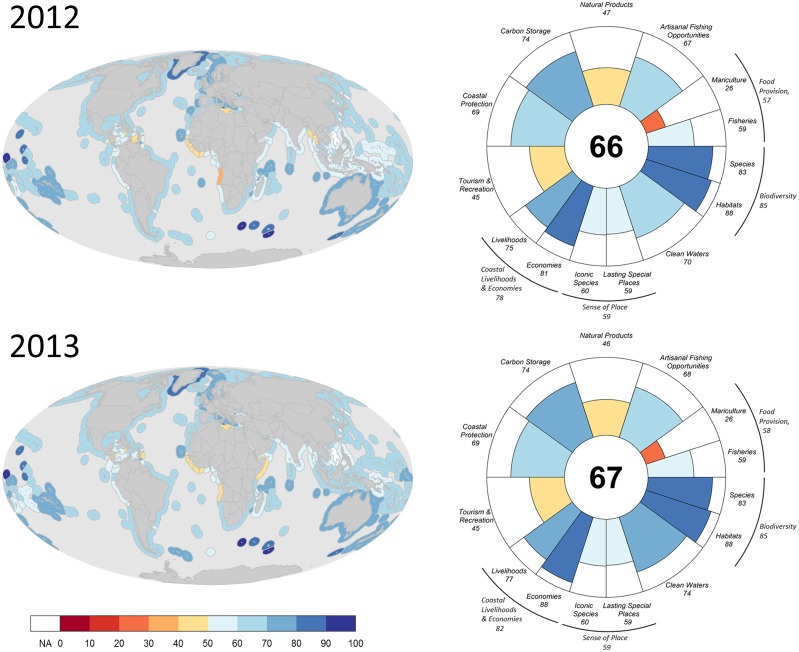
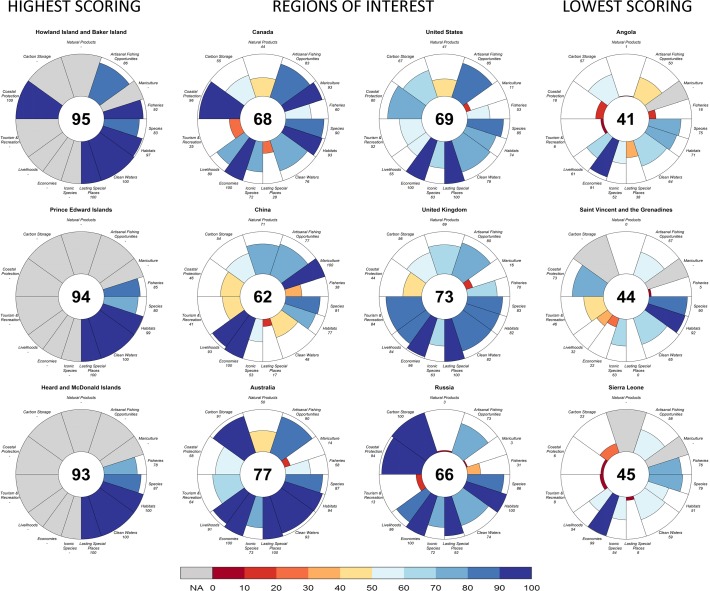
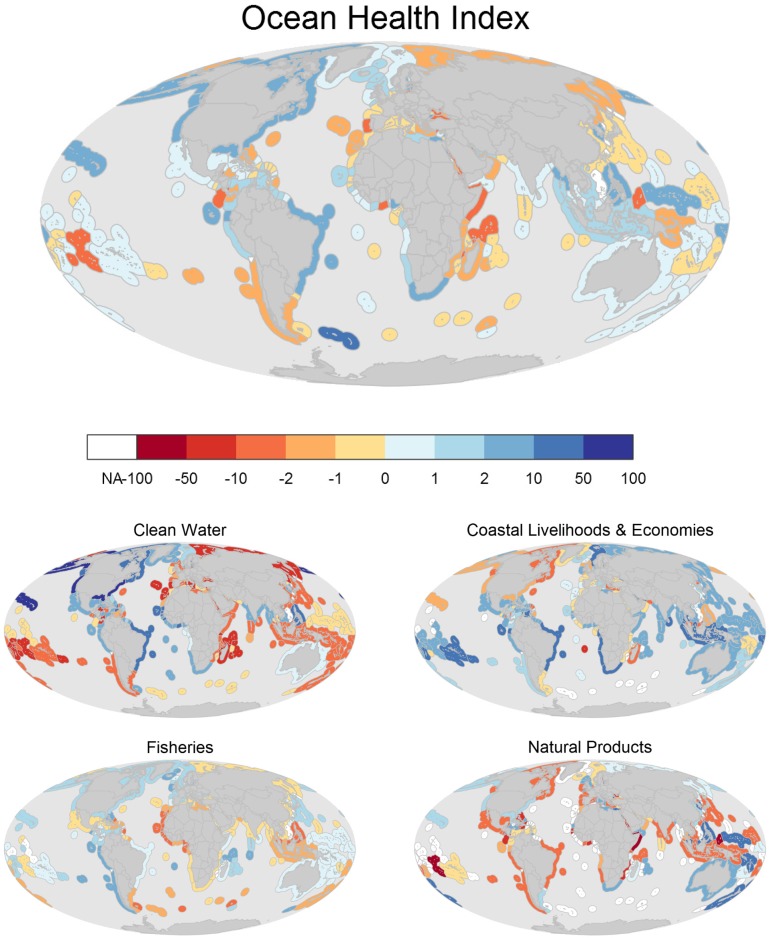
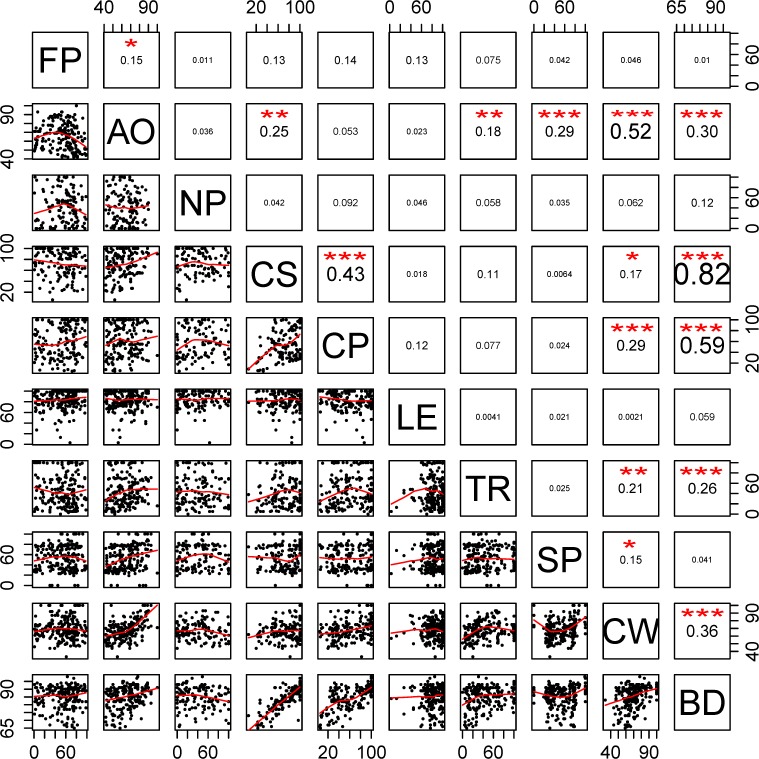
International and regional policies aimed at managing ocean ecosystem health need quantitative and comprehensive indices to synthesize information from a variety of sources, consistently measure progress, and communicate with key constituencies and the public. Here we present the second annual global assessment of the Ocean Health Index, reporting current scores and annual changes since 2012, recalculated using updated methods and data based on the best available science, for 221 coastal countries and territories. The Index measures performance of ten societal goals for healthy oceans on a quantitative scale of increasing health from 0 to 100, and combines these scores into a single Index score, for each country and globally. The global Index score improved one point (from 67 to 68), while many country-level Index and goal scores had larger changes. Per-country Index scores ranged from 41-95 and, on average, improved by 0.06 points (range -8 to +12). Globally, average scores increased for individual goals by as much as 6.5 points (coastal economies) and decreased by as much as 1.2 points (natural products). Annual updates of the Index, even when not all input data have been updated, provide valuable information to scientists, policy makers, and resource managers because patterns and trends can emerge from the data that have been updated. Changes of even a few points indicate potential successes (when scores increase) that merit recognition, or concerns (when scores decrease) that may require mitigative action, with changes of more than 10-20 points representing large shifts that deserve greater attention. Goal scores showed remarkably little covariance across regions, indicating low redundancy in the Index, such that each goal delivers information about a different facet of ocean health. Together these scores provide a snapshot of global ocean health and suggest where countries have made progress and where a need for further improvement exists.
Overview
The claims and statistics of this paper haven’t been checked yet.
Run the check — free, no account needed. It reads the open-access text and checks the sources it cites.
Integrity signals
Registry
Cites
Statistics
Figures
Verification
Claims the paper makes
The claims and statistics of this paper haven’t been checked yet.
Run the check — free, no account needed. It reads the open-access text and checks the sources it cites.
Claims other papers make about this one
Each is checked against this paper’s own text: does it say what the citing paper says it does?
The check wasn’t confident either way, so it gives no verdict — never disputed.
In the citing paper
“66% of ocean surface is experiencing increasing cumulative impacts ( 20 )”
From Pervasive human-driven decline of life on Earth points to the need for transformative change (2019) · cites this paper as [20]
Experimental — accuracy not yet measured
Self-check
Percentages, sums and reported differences re-computed from the paper’s own numbers.
The self-check needs the paper’s full text.
Citations
Cites
The United Nations Development Programme
Oestreich, J. E. (2017) · Oxford University Press eBooks · doi:10.1093/acprof:oso/9780190637347.003.0003 · Cited by 4,875
Population diversity and the portfolio effect in an exploited species
Schindler, D. E., Hilborn, R., Chasco, B., Boatright, C. P., Quinn, T. P., Rogers, L. A., & Webster, M. S. (2010) · Nature · doi:10.1038/nature09060 · Cited by 1,605
An index to assess the health and benefits of the global ocean
Halpern, B. S., Longo, C., Hardy, D. R., McLeod, K. L., Samhouri, J. F., Katona, S. K., Kleisner, K. M., Lester, S. E., O’Leary, J. K., Ranelletti, M., et al. (2012) · Nature · doi:10.1038/nature11397 · Cited by 965
Self-citationStatus and Solutions for the World’s Unassessed Fisheries
Costello, C., Ovando, D., Hilborn, R., Gaines, S. D., Deschenes, O., & Lester, S. E. (2012) · Science · doi:10.1126/science.1223389 · Cited by 796
World Development Indicators 2013
Bank, W. (2013) · doi:10.1596/978-0-8213-9824-1 · Cited by 724
Warfare in Biodiversity Hotspots
Hanson, T. R., Brooks, T. M., da Fonseca, G. A. B., Hoffmann, M., Lamoreux, J. F., Machlis, G. E., Mittermeier, C. G., Mittermeier, R. A., & Pilgrim, J. D. (2009) · Conservation Biology · doi:10.1111/j.1523-1739.2009.01166.x · Cited by 382
A simple method for estimating MSY from catch and resilience
Martell, S. J. D., & Froese, R. (2012) · Fish and Fisheries · doi:10.1111/j.1467-2979.2012.00485.x · Cited by 328
Food security implications of global marine catch losses due to overfishing
Srinivasan, U. T., Cheung, W. W. L., Watson, R., & Sumaila, U. R. (2010) · Journal of Bioeconomics · doi:10.1007/s10818-010-9090-9 · Cited by 220
Marine Strategy Framework Directive
Froese, R. (2013) · Cited by 174
Sea sick? Setting targets to assess ocean health and ecosystem services
Samhouri, J. F., Lester, S. E., Selig, E. R., Halpern, B. S., Fogarty, M. J., Longo, C., & McLeod, K. L. (2012) · Ecosphere · doi:10.1890/es11-00366.1 · Cited by 110
Self-citation
Research works printed but not linked: 1
- BS Halpern, 2013, Reply to Branch et al, Nature, 495, E7
Cited by
Sorted by citations
Pervasive human-driven decline of life on Earth points to the need for transformative change
Díaz, S., Settele, J., Brondízio, E. S., Ngo, H. T., Agard, J., Arneth, A., Balvanera, P., Brauman, K. A., Butchart, S. H. M., Chan, K. M. A., et al. (2019) · Science · doi:10.1126/science.aax3100 · Cited by 2,926
Global patterns in mangrove soil carbon stocks and losses
Atwood, T. B., Connolly, R. M., Almahasheer, H., Carnell, P. E., Duarte, C. M., Ewers Lewis, C. J., Irigoien, X., Kelleway, J. J., Lavery, P. S., Macreadie, P. I., et al. (2017) · Nature Climate Change · doi:10.1038/nclimate3326 · Cited by 706
Underestimating the Challenges of Avoiding a Ghastly Future
Bradshaw, C. J. A., Ehrlich, P. R., Beattie, A. J., Ceballos, G., Crist, E. L., Diamond, J., Dirzo, R., Ehrlich, A. H., Harte, J., Harte, M. E., et al. (2021) · Frontiers in Conservation Science · doi:10.3389/fcosc.2020.615419 · Cited by 591
Environmental sustainability: challenges and viable solutions
Arora, N. K., Fatima, T., Mishra, I., Verma, M., Mishra, J., & Mishra, V. K. (2018) · Environmental Sustainability · doi:10.1007/s42398-018-00038-w · Cited by 367
Overview of Integrative Assessment of Marine Systems: The Ecosystem Approach in Practice
Borja, Á., Elliott, M., Andersen, J. H., Berg, T., Carstensen, J., Halpern, B. S., Heiskanen, A., Korpinen, S., Lowndes, J. S., Martin, G., et al. (2016) · Frontiers in Marine Science · doi:10.3389/fmars.2016.00020 · Cited by 345
Self-citation
Metadata
- Authors
- Halpern, B. S., Longo, C., Lowndes, J. S. S., Best, B. D., Frazier, M., Katona, S. K., Kleisner, K. M., Rosenberg, A. A., Scarborough, C., & Selig, E. R.
- Affiliations
- University of California, Santa Barbara (US)
- National Center for Ecological Analysis and Synthesis (US)
- Duke University (US)
- Conservation International (US)
- University of British Columbia (CA)
- Union of Concerned Scientists (US)
- Corresponding author
- Halpern, Benjamin S.
- ORCID
- Venue
- PLOS ONE
- Publisher
- Public Library of Science (PLoS)
- Published
- 2015-03-16
- Volume
- 10
- Issue
- 3
- Pages
- e0117863
- ISSN
- 1932-6203 (ISSN-L)
- PMC
- PMC4361765
- OpenAlex
- W2163939760
- Cited by
- 139
- References
- 19
- Citations by year
- 2026: 7 · 2025: 11 · 2024: 14 · 2023: 15 · 2022: 10 · 2021: 16 · 2020: 10 · 2019: 14 · 2018: 12 · 2017: 15 · 2016: 8 · 2015: 6
- FWCI
- 38.51
- Type
- journal article
- Language
- en
- Open access
- gold
- doi.org
- Licence
- Locations
- PLoS ONE (publishedVersion, cc-by)
- Europe PMC (PubMed Central) (publishedVersion, cc-by)
- PubMed Central (publishedVersion, cc-by)
- PubMed (publishedVersion)
- DOAJ (DOAJ: Directory of Open Access Journals) (submittedVersion, cc-by-sa)
- eScholarship (California Digital Library) (submittedVersion)
- eScholarship (California Digital Library) (submittedVersion, cc-by)
- Funders
- David and Lucile Packard Foundation
- Oak Foundation
- National Geographic Society
- Topics
- Physical Sciences › Environmental Science › Management, Monitoring, Policy and Law › Coastal and Marine Management
- Physical Sciences › Environmental Science › Management, Monitoring, Policy and Law › Sustainable Development and Environmental Policy
- Life Sciences › Agricultural and Biological Sciences › Aquatic Science › Marine and fisheries research
- Keywords
- Ocean Health Index, ocean health, marine ecosystem health, coastal countries, marine policy, coastal economy, natural products
- MeSH terms
- Conservation of Natural Resources, Fisheries, Oceans and Seas, Ecosystem, Internationality, Ecological and Environmental Phenomena
About these checks
Registry, retraction, Cites and statistics results are computed, not judged, with one exception: a printed reference that no index lists is read once by a model before it counts as a citation error. Claims are extracted by a model and kept only when their quote appears verbatim in the text; each cited source is then checked, with a model’s help, for whether it says what the claim relies on. Those verdicts can be wrong — read the claim’s quote and the cited source before relying on one.
Statistics and arithmetic are recomputed, not judged.
Confidence bands are shown only for fields calibrated on our annotated test set. None is calibrated yet, so no band is shown.
What counts as a claim ›How we measure confidence ›How we check this ›
Are you an author, or do you see a problem with this page? Request a review
