

ADCY5 Gene Expression in Adipose Tissue Is Related to Obesity in Men and Mice
Open accessThe DOI matches its Crossref record; 25 of the 25 references it cites were found in a registry or an index.
Abstract
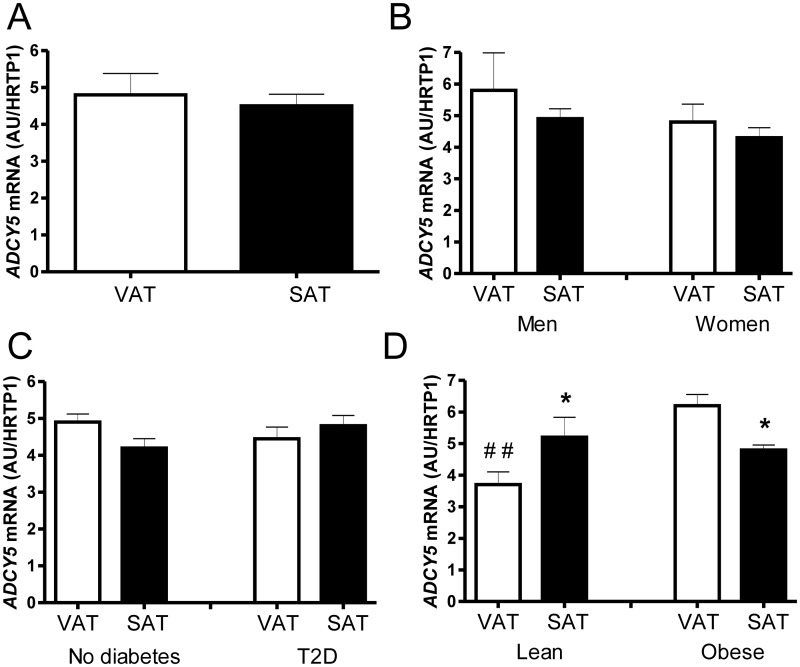
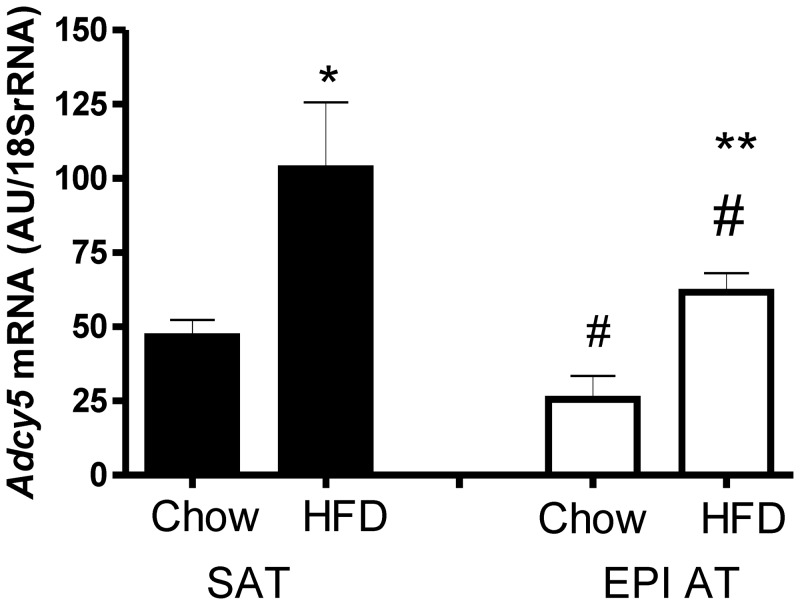
Genome wide association studies revealed an association of the single nucleotide polymorphism rs11708067 within the ADCY5 gene--encoding adenylate cyclase 5--with increased type 2 diabetes (T2D) risk and higher fasting glucose. However, it remains unclear whether the association between ADCY5 variants and glycemic traits may involve adipose tissue (AT) related mechanisms. We therefore tested the hypothesis that ADCY5 mRNA expression in human and mouse AT is related to obesity, fat distribution, T2D in humans and high fat diet (HFD) in mice. We measured ADCY5 mRNA expression in paired samples of visceral and subcutaneous adipose tissue from 244 individuals with a wide range of body weight and parameters of hyperglycemia, which have been genotyped for rs11708067. In addition, AT ADCY5 mRNA was assessed in C57BL/6NTac which underwent a 10 weeks standard chow (n = 6) or high fat diet (HFD, n = 6). In humans, visceral ADCY5 expression is significantly higher in obese compared to lean individuals. ADCY5 expression correlates with BMI, body fat mass, circulating leptin, fat distribution, waist and hip circumference, but not with fasting plasma glucose and HbA1c. Adcy5 expression in mouse AT is significantly higher after a HFD compared to chow (p<0.05). Importantly, rs11708067 is not associated with ADCY5 mRNA expression levels in either fat depot in any of the genetic models tested. Our results suggest that changes in AT ADCY5 expression are related to obesity and fat distribution, but not with impaired glucose metabolism and T2D. However, altered ADCY5 expression in AT does not seem to be the mechanism underlying the association between rs11708067 and increased T2D risk.
Overview
The claims and statistics of this paper haven’t been checked yet.
Free: it reads the open-access text and checks the first 5 claims that cite a source we can check. Create a free account to check every claim.
Integrity signals
Registry
Cites
Statistics
Figures
Verification
Claims the paper makes
The claims and statistics of this paper haven’t been checked yet.
Free: it reads the open-access text and checks the first 5 claims that cite a source we can check. Create a free account to check every claim.
Claims other papers make about this one
Each is checked against this paper’s own text: does it say what the citing paper says it does?
The source backs part of the claim, not all of it — or backs it for a different population, condition or comparison.
In the citing paper
“Human ADCY5 polymorphisms have been associated with metabolic diseases including diabetes and obesity”
From Physiological roles of mammalian transmembrane adenylyl cyclase isoforms (2022) · cites this paper as [174]
Experimental — accuracy not yet measured
Self-check
Percentages, sums and reported differences re-computed from the paper’s own numbers.
The self-check needs the paper’s full text.
Citations
Cites
The metabolic phenotype in obesity: Fat mass, body fat distribution, and adipose tissue function
Goossens, G. H. (2017) · Obesity Facts · doi:10.1159/000471488 · Cited by 8,481
New genetic loci implicated in fasting glucose homeostasis and their impact on type 2 diabetes risk
DIAGRAM Consortium, Dupuis, J., GIANT Consortium, Global BPgen Consortium, Anders Hamsten on behalf of Procardis Consortium, the MAGIC investigators, Langenberg, C., Prokopenko, I., Saxena, R., Soranzo, N., et al. (2010) · Nature Genetics · doi:10.1038/ng.520 · Cited by 2,166 · cited 4×
“rs11708076, rs9883204) were associated with T2D [1], decreased pancreatic islet ADCY5 expression [2], gestational diabetes [4], and lower birth weight [3, 19, 20].”
InfluentialKlöting, N., Fasshauer, M., Dietrich, A., Kovacs, P., Schön, M. R., Kern, M., Stumvoll, M., & Blüher, M. (2010) · American Journal of Physiology-Endocrinology and Metabolism · doi:10.1152/ajpendo.00586.2009 · Cited by 856 · cited 2×
“Histologic analyses and measurement of macrophage count in adipose tissue was performed as previously described [17, 18].”
MethodSelf-citationPlasma Visfatin Concentrations and Fat Depot–Specific mRNA Expression in Humans
Berndt, J., Klöting, N., Kralisch, S., Kovacs, P., Fasshauer, M., Schön, M. R., Stumvoll, M., & Blüher, M. (2005) · Diabetes · doi:10.2337/diabetes.54.10.2911 · Cited by 724 · cited 1×
“Abdominal visceral and subcutaneous fat areas were calculated using computed tomography (CT) or MRI scans at the level of L4–L5 as previously described [14, 15].”
MethodSelf-citationHarman-Boehm, I., Blüher, M., Redel, H., Sion-Vardy, N., Ovadia, S., Avinoach, E., Shai, I., Klöting, N., Stumvoll, M., Bashan, N., et al. (2007) · The Journal of Clinical Endocrinology & Metabolism · doi:10.1210/jc.2006-1811 · Cited by 574 · cited 1×
“Histologic analyses and measurement of macrophage count in adipose tissue was performed as previously described [17, 18].”
MethodAdipose tissue dysfunction contributes to obesity related metabolic diseases
Blüher, M. (2013) · Best Practice & Research Clinical Endocrinology & Metabolism · doi:10.1016/j.beem.2013.02.005 · Cited by 408 · cited 1×
“Adipose tissue mass, distribution and function are closely related to longevity [12] and the individual risk to develop metabolic diseases including T2D [13].”
Self-citationKlöting, N., Graham, T. E., Berndt, J., Kralisch, S., Kovacs, P., Wason, C. J., Fasshauer, M., Schön, M. R., Stumvoll, M., Blüher, M., et al. (2007) · Cell Metabolism · doi:10.1016/j.cmet.2007.06.002 · Cited by 406 · cited 1×
“Abdominal visceral and subcutaneous fat areas were calculated using computed tomography (CT) or MRI scans at the level of L4–L5 as previously described [14, 15].”
MethodSelf-citationTissue specificity and physiological relevance of various isoforms of adenylyl cyclase
Defer, N., Best-Belpomme, M., & Hanoune, J. (2000) · American Journal of Physiology-Renal Physiology · doi:10.1152/ajprenal.2000.279.3.f400 · Cited by 389 · cited 3×
“cAMP itself plays an important role in glycogen, sugar and lipid metabolism by intracellular signal transduction [6].”
InfluentialEarly programming of glucose–insulin metabolism
OZANNE, S., & HALES, C. (2002) · Trends in Endocrinology and Metabolism · doi:10.1016/s1043-2760(02)00666-5 · Cited by 319
Variants in ADCY5 and near CCNL1 are associated with fetal growth and birth weight
The Genetic Investigation of ANthropometric Traits (GIANT) Consortium, Freathy, R. M., The Meta-Analyses of Glucose and Insulin-related traits Consortium (MAGIC), The Wellcome Trust Case Control Consortium (WTCCC), the Early Growth Genetics (EGG) Consortium, Mook-Kanamori, D. O., Sovio, U., Prokopenko, I., Timpson, N. J., Berry, D. J., et al. (2010) · Nature Genetics · doi:10.1038/ng.567 · Cited by 255 · cited 1×
“rs11708076, rs9883204) were associated with T2D [1], decreased pancreatic islet ADCY5 expression [2], gestational diabetes [4], and lower birth weight [3, 19, 20].”
Cited by
Dessauer, C. W., Watts, V. J., Ostrom, R. S., Conti, M., Dove, S., & Seifert, R. (2017) · Pharmacological Reviews · doi:10.1124/pr.116.013078 · Cited by 201
“Numerous studies have linked ADCY5 gene polymorphisms to altered glucose metabolism, diabetes, and obesity (Barker et al., 2011; Rees et al., 2011; Wagner et al., 2011; Windholz et al., 2011; Holstein et al., 2013; Ng et al., 2013; Hodson et al., 2014; Knigge et al., 2015).”
BackgroundPhysiological roles of mammalian transmembrane adenylyl cyclase isoforms
Ostrom, K. F., LaVigne, J. E., Brust, T. F., Seifert, R., Dessauer, C. W., Watts, V. J., & Ostrom, R. S. (2022) · Physiological Reviews · doi:10.1152/physrev.00013.2021 · Cited by 131
Genome-wide discovery of genetic loci that uncouple excess adiposity from its comorbidities
Huang, L. O., Rauch, A., Mazzaferro, E., Preuss, M. H., Carobbio, S., Bayrak, Ç. S., Chami, N., Wang, Z., Schick, U. M., Yang, N. Y., et al. (2021) · Nature Metabolism · doi:10.1038/s42255-021-00346-2 · Cited by 128
Han, Z., Zhang, Y., Wang, P., Tang, Q., & Zhang, K. (2021) · Briefings in Bioinformatics · doi:10.1093/bib/bbab110 · Cited by 63
“Studies have shown that ADCY5 gene expression in adipose tissue is related to obesity in human [35].”
BackgroundHe, C., Yang, Z., Cheng, D., Xie, C., Zhu, Y., Ge, Z., Luo, Z., & Lü, N. (2016) · EBioMedicine · doi:10.1016/j.ebiom.2016.09.010 · Cited by 52
“The waist circumference was measured at the midpoint between the lower ribs and iliac crest with a measuring tape by two investigators who were blinded as to which group the animal has been assigned (Knigge et al., 2015; Zhang et al., 2007).”
Method
Metadata
- Authors
- Knigge, A., Klöting, N., Schön, M. R., Dietrich, A., Fasshauer, M., Gärtner, D., Lohmann, T., Dreßler, M., Stumvoll, M., Kovacs, P., & Blüher, M.
- Affiliations
- Leipzig University (DE)
- IFB Adiposity Diseases (DE)
- Städtisches Klinikum Karlsruhe (DE)
- Städtisches Klinikum Dresden (DE)
- Corresponding author
- Blüher, Matthias
- Venue
- PLOS ONE
- Publisher
- Public Library of Science (PLoS)
- Published
- 2015-03-20
- Volume
- 10
- Issue
- 3
- Pages
- e0120742
- ISSN
- 1932-6203 (ISSN-L)
- PMC
- PMC4368112
- OpenAlex
- W2017654715
- Cited by
- 24
- References
- 25
- Citations by year
- 2025: 3 · 2024: 1 · 2023: 2 · 2021: 9 · 2020: 1 · 2019: 2 · 2017: 3 · 2016: 2 · 2015: 1
- FWCI
- 1.57
- Type
- journal article
- Language
- en
- Open access
- gold
- doi.org
- Licence
- Locations
- PLoS ONE (publishedVersion, cc-by)
- Europe PMC (PubMed Central) (publishedVersion, cc-by)
- PubMed Central (publishedVersion, cc-by)
- PubMed (publishedVersion)
- DOAJ (DOAJ: Directory of Open Access Journals) (submittedVersion, cc-by-sa)
- Qucosa (Saxon State and University Library Dresden) (submittedVersion, other-oa)
- Funders
- Deutsche Forschungsgemeinschaft
- Bundesministerium für Bildung und Forschung (FKZ 01GI1128, 01GI1128)
- Deutsche Diabetes Gesellschaft
- Topics
- Health Sciences › Medicine › Endocrinology, Diabetes and Metabolism › Adipokines, Inflammation, and Metabolic Diseases
- Health Sciences › Medicine › Physiology (medical) › Adipose Tissue and Metabolism
- Life Sciences › Biochemistry, Genetics and Molecular Biology › Genetics › Genetic Associations and Epidemiology
- Keywords
- ADCY5, adipose tissue gene expression, obesity, type 2 diabetes, single nucleotide polymorphisms, visceral adipose tissue, subcutaneous adipose tissue, body fat distribution, high-fat diet, leptin, glycemic traits, C57BL/6NTac mice
- MeSH terms
- Adenylyl Cyclases, Adipose Tissue, Animals, Female, Glucose, Humans, Inflammation, Insulin, Male, Mice, Inbred C57BL, Middle Aged, Obesity, RNA, Messenger, Gene Expression Regulation, Enzymologic, Quantitative Trait, Heritable, Genetic Predisposition to Disease, Polymorphism, Single Nucleotide, Adiposity, Diet, High-Fat
About these checks
Registry, retraction, Cites and statistics results are computed, not judged, with one exception: a printed reference that no index lists is read once by a model before it counts as a citation error. Claims are extracted by a model and kept only when their quote appears verbatim in the text; each cited source is then checked, with a model’s help, for whether it says what the claim relies on. Those verdicts can be wrong — read the claim’s quote and the cited source before relying on one.
Statistics and arithmetic are recomputed, not judged.
Confidence bands are shown only for fields calibrated on our annotated test set. None is calibrated yet, so no band is shown.
What counts as a claim ›How we measure confidence ›How we check this ›
Are you an author, or do you see a problem with this page? Request a review
Data sources
Bibliographic data: Semantic Scholar, OpenAlex, Crossref.
Contains information from the Semantic Scholar Academic Graph Datasets, made available under the ODC Attribution License (ODC-BY 1.0).
Semantic Scholar’s data is described in: Kinney, R., et al. (2023). The Semantic Scholar Open Data Platform. arXiv:2301.10140.
