

The Effects of Extraversion, Social Support on the Posttraumatic Stress Disorder and Posttraumatic Growth of Adolescent Survivors of the Wenchuan Earthquake
Open accessThe DOI matches its Crossref record; 73 of the 74 references it cites were found in a registry or an index.
Abstract
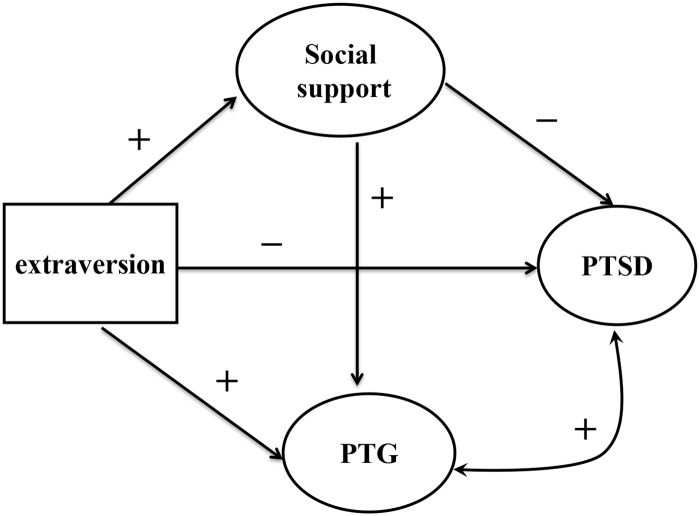
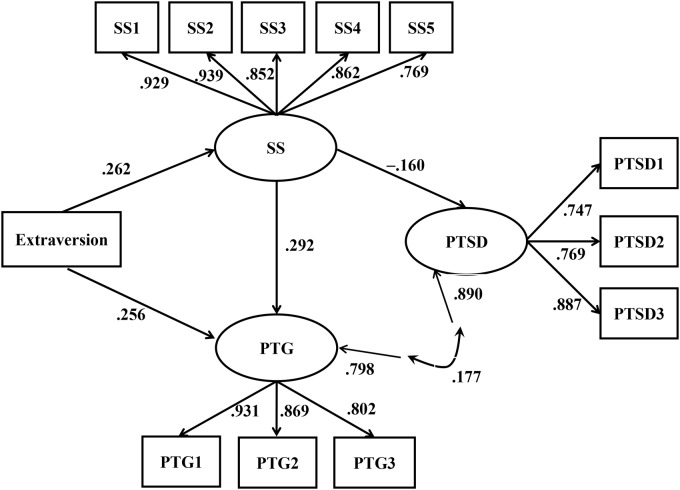
OBJECTIVE: The aim of this study was to examine the relationships among extraversion, social support, posttraumatic stress disorder and posttraumatic growth among adolescent survivors of the Wenchuan earthquake. METHODS: Six hundred thirty-eight participants were selected from the survivors of the 2008 Wenchuan earthquake. Participants completed four main questionnaires, including the Extraversion Subscale, the Social Support Scale, the Child PTSD Symptom Scale, and the Posttraumatic Growth Inventory. RESULTS: A bivariate correlation analysis revealed significant correlations among extraversion, social support, posttraumatic stress disorder and posttraumatic growth. Extraversion had significant indirect effects on posttraumatic stress disorder (β = -.037, p < .01) and posttraumatic growth (β = .077, p < .001) through social support. The results also indicated that extraversion had a significant direct effect on posttraumatic growth and a nonsignificant direct effect on posttraumatic stress disorder. CONCLUSIONS: Social support fully mediates the relationship between extraversion and posttraumatic stress disorder and partially mediates the relationship between extraversion and posttraumatic growth. Psychological interventions and care for survivors of the earthquake should include the various functions and sources of social support and how they serve to benefit individuals.
Overview
The claims and statistics of this paper haven’t been checked yet.
Free: it reads the open-access text and checks the first 5 claims that cite a source we can check. Create a free account to check every claim.
Integrity signals
Registry
Cites
Statistics
Figures
Verification
Claims the paper makes
The claims and statistics of this paper haven’t been checked yet.
Free: it reads the open-access text and checks the first 5 claims that cite a source we can check. Create a free account to check every claim.
Self-check
Percentages, sums and reported differences re-computed from the paper’s own numbers.
The self-check needs the paper’s full text.
Citations
Cites
Diagnostic and Statistical Manual of Mental Disorders
Williams, J. B. W., & First, M. (2013) · Encyclopedia of Social Work · doi:10.1093/acrefore/9780199975839.013.104 · Cited by 109,519
Confidence Limits for the Indirect Effect: Distribution of the Product and Resampling Methods
MacKinnon, D. P., Lockwood, C. M., & Williams, J. (2004) · Multivariate Behavioral Research · doi:10.1207/s15327906mbr3901_4 · Cited by 7,806 · cited 1×
“Because bias-corrected bootstrapping has greater statistical power to detect mediation effects than other forms of mediation analyses [65], we used a bias-corrected bootstrap estimation with a 95% confidence interval to determine the significance of the indirect effects.”
MethodTARGET ARTICLE: "Posttraumatic Growth: Conceptual Foundations and Empirical Evidence"
Tedeschi, R. G., & Calhoun, L. G. (2004) · Psychological Inquiry · doi:10.1207/s15327965pli1501_01 · Cited by 7,154
The posttraumatic growth inventory: measuring the positive legacy of trauma
Tedeschi, R. G., & Calhoun, L. G. (1996) · Journal of Traumatic Stress · doi:10.1002/jts.2490090305 · Cited by 7,061 · cited 1×
“The original PTGI developed by Tedeschi and Calhoun consisted of 21 items covering five subscales [4]: personal strength, new possibilities, the ability to relate to others, appreciation of life, and spiritual change.”
MethodMeta-analysis of risk factors for posttraumatic stress disorder in trauma-exposed adults
Brewin, C. R., Andrews, B., & Valentine, J. D. (2000) · Journal of Consulting and Clinical Psychology · doi:10.1037/0022-006x.68.5.748 · Cited by 5,243
Predictors of posttraumatic stress disorder and symptoms in adults: a meta-analysis
Ozer, E. J., Best, S. R., Lipsey, T. L., & Weiss, D. S. (2003) · Psychological Bulletin · doi:10.1037/0033-2909.129.1.52 · Cited by 3,322
A Brief Guide to Structural Equation Modeling
Weston, R., & Gore, P. A. (2006) · The Counseling Psychologist · doi:10.1177/0011000006286345 · Cited by 2,718 · cited 2×
“The degree of model fit was assessed using the following fit indices [64]: the chi-square statistic, the root mean squared error of approximation (RMSEA), the comparative fit index (CFI), and the standardized root mean square residual (SRMR).”
MethodChildren's perceptions of the personal relationships in their social networks.
Furman, W., & Buhrmester, D. (1985) · Developmental Psychology · doi:10.1037//0012-1649.21.6.1016 · Cited by 2,338
Positive change following trauma and adversity: A review
Linley, P. A., & Joseph, S. (2004) · Journal of Traumatic Stress · doi:10.1023/b:jots.0000014671.27856.7e · Cited by 2,260
A meta-analytic review of benefit finding and growth.
Helgeson, V. S., Reynolds, K. A., & Tomich, P. L. (2006) · Journal of Consulting and Clinical Psychology · doi:10.1037/0022-006x.74.5.797 · Cited by 1,864
Research works printed but not linked: 4
- 24. Park CL. The notion of growth following stressful life experiences: Problems and prospects. Psychol Inq. 2004; 15: 69-76.
- 53. Zhou H, Niu L, Zou H. A development study on the five-factor personality questionnaire for middle school students. Psychol Dev Educ. 2000; 16: 48-54.
- 54. Lei L, Yang Y, Liu M. The Relationship between adolescents' neuroticism, internet service preference, and internet addiction. Acta Psychol Sin. 2006; 38: 375-381.
- 61. Hou Z, Zhou X, Chen J, Zhu l, Ni J, Chen S. The influencing factors of PTSD and PTG among teachers after Wenchuan earthquake: Perspectives from before, during and after disaster. Psycholl Dev Edu. 2014; 30: 82-89.
Cited by
Items 101–112 of 112
Wang, T., Yuan, X., Yang, J., Li, X., Yao, Q., Ye, T., Huang, Y., Lan, J., Zhang, X., Luo, J., et al. (2024) · Research Square · doi:10.21203/rs.3.rs-4789848/v1
YIKICI DEPREMLERDE MADALYONUN DİĞER YÜZÜ: TRAVMA SONRASI BÜYÜME
Nalbantoğlu, İ., & Artan, T. (2025) · Pamukkale University Journal of Social Sciences Institute · doi:10.30794/pausbed.1559479
Norfleet, M. (2021) · Pepperdine Digital Commons (Pepperdine University) · Cited by 1
Posttraumatic Growth in Sierra Leone : A mixed methods study
Steidl, A. (2019) · Digital Library of the University of Innsbruck (University of Innsbruck)
Skan, R. (2024) · UCL Discovery (University College London)
Haväng, I., & Huovilainen, M. (2021) · Lund University Publications Student Papers (Lund University)
What Makes Them Happy? The Determinant Factors of Happiness Among Communities in an Endemic Phase
Radzi, N. A. M., Saidi, N. A., & Olaleye, B. R. (2026) · Health & Social Care in the Community · doi:10.1155/hsc/4448318 · Cited by 1
DINAMIKA POSTTRAUMATIC GROWTH PEREMPUAN PENYINTAS KEKERASAN SEKSUAL
Azzahra, N. :. 2. Y. (2026) · Digital Library UIN Sunan Kalijaga (Sunan Kalijaga State Islamic University)
Kara, R., Manav, G., Öztürk, P. Ç., Doğan, E., & Muslu, G. K. (2026) · Journal of Health Psychology · doi:10.1177/13591053261473251
Social Support with Post-Traumatic Growth among Trauma Survivors: A Systematic Review
Aditya, M. F., Mustikasari, M., Chandra, Y. A., & Putri, Y. S. E. (2025) · Indonesian Journal of Global Health Research · doi:10.37287/ijghr.v7i4.6319 · Cited by 1
Arslan, S. C., Altun, H., Soylu, S., Daş, K. Y., Demir, E., Taş, F. D., Islah, E. M., Gürbüz, A. A., & Doğaner, A. (2026) · Current Psychology · doi:10.1007/s12144-026-10135-3
“…are inconsistent: several studies of adolescent earthquake survivors report that higher social support is associated with lower PTSD severity (Jia et al., 2015; Liu et al., 2009; Ma et al., 2011 ; Xu & Ou, 2014), whereas others find no significant association (Wang et al., 2018; Zhou et al.,…”
Kıyak, S., Yücel, M. N., Traş, Z., & Hamarta, E. (2026) · MANAS Sosyal Araştırmalar Dergisi · doi:10.33206/mjss.1888160
Metadata
- Authors
- Jia, X., Ying, L., Zhou, X., Wu, X., & Lin, C.
- Affiliations
- Beijing Normal University (CN)
- Zhejiang Sci-Tech University (CN)
- Corresponding author
- Lin, Chongde
- Venue
- PLOS ONE
- Publisher
- Public Library of Science (PLoS)
- Published
- 2015-03-27
- Volume
- 10
- Issue
- 3
- Pages
- e0121480
- ISSN
- 1932-6203 (ISSN-L)
- PMC
- PMC4376870
- OpenAlex
- W1984765952
- Cited by
- 100
- References
- 74
- Citations by year
- 2026: 3 · 2025: 6 · 2024: 9 · 2023: 8 · 2022: 10 · 2021: 12 · 2020: 22 · 2019: 5 · 2018: 10 · 2017: 10 · 2016: 5
- FWCI
- 10.33
- Type
- journal article
- Language
- en
- Open access
- gold
- doi.org
- Licence
- Locations
- PLoS ONE (publishedVersion, cc-by)
- Europe PMC (PubMed Central) (publishedVersion, cc-by)
- PubMed Central (publishedVersion, cc-by)
- PubMed (publishedVersion)
- DOAJ (DOAJ: Directory of Open Access Journals) (submittedVersion, cc-by-sa)
- Topics
- Social Sciences › Psychology › Clinical Psychology › Posttraumatic Stress Disorder Research
- Social Sciences › Psychology › Clinical Psychology › Resilience and Mental Health
- Social Sciences › Psychology › Clinical Psychology › Grief, Bereavement, and Mental Health
- Keywords
- extraversion, social support, post-traumatic stress disorder, posttraumatic growth, adolescents, earthquake survivors, Wenchuan earthquake, mediation, personality traits
- MeSH terms
- Adolescent, Child, Extraversion, Psychological, Female, Humans, Male, Personality Inventory, Surveys and Questionnaires, Risk Factors, Social Support, Stress Disorders, Post-Traumatic, Survivors, Earthquakes
About these checks
Registry, retraction, Cites and statistics results are computed, not judged, with one exception: a printed reference that no index lists is read once by a model before it counts as a citation error. Claims are extracted by a model and kept only when their quote appears verbatim in the text; each cited source is then checked, with a model’s help, for whether it says what the claim relies on. Those verdicts can be wrong — read the claim’s quote and the cited source before relying on one.
Statistics and arithmetic are recomputed, not judged.
Confidence bands are shown only for fields calibrated on our annotated test set. None is calibrated yet, so no band is shown.
What counts as a claim ›How we measure confidence ›How we check this ›
Are you an author, or do you see a problem with this page? Request a review
Data sources
Bibliographic data: Semantic Scholar, OpenAlex, Crossref.
Contains information from the Semantic Scholar Academic Graph Datasets, made available under the ODC Attribution License (ODC-BY 1.0).
Semantic Scholar’s data is described in: Kinney, R., et al. (2023). The Semantic Scholar Open Data Platform. arXiv:2301.10140.
