

Psychological well‐being and the human conserved transcriptional response to adversity
Open accessThe DOI matches its Crossref record; 47 of the 48 references it cites were found in a registry or an index.
Abstract
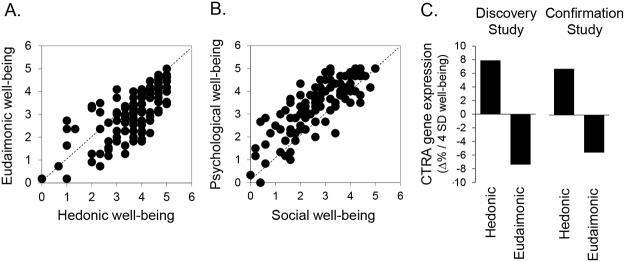
Research in human social genomics has identified a conserved transcriptional response to adversity (CTRA) characterized by up-regulated expression of pro-inflammatory genes and down-regulated expression of Type I interferon- and antibody-related genes. This report seeks to identify the specific aspects of positive psychological well-being that oppose such effects and predict reduced CTRA gene expression. In a new confirmation study of 122 healthy adults that replicated the approach of a previously reported discovery study, mixed effect linear model analyses identified a significant inverse association between expression of CTRA indicator genes and a summary measure of eudaimonic well-being from the Mental Health Continuum - Short Form. Analyses of a 2- representation of eudaimonia converged in finding correlated psychological and social subdomains of eudaimonic well-being to be the primary carriers of CTRA associations. Hedonic well-being showed no consistent CTRA association independent of eudaimonic well-being, and summary measures integrating hedonic and eudaimonic well-being showed less stable CTRA associations than did focal measures of eudaimonia (psychological and social well-being). Similar results emerged from analyses of pooled discovery and confirmation samples (n = 198). Similar results also emerged from analyses of a second new generalization study of 107 healthy adults that included the more detailed Ryff Scales of Psychological Well-being and found this more robust measure of eudaimonic well-being to also associate with reduced CTRA gene expression. Five of the 6 major sub-domains of psychological well-being predicted reduced CTRA gene expression when analyzed separately, and 3 remained distinctively prognostic in mutually adjusted analyses. All associations were independent of demographic characteristics, health-related confounders, and RNA indicators of leukocyte subset distribution. These results identify specific sub-dimensions of eudaimonic well-being as promising targets for future interventions to mitigate CTRA gene expression, and provide no support for any independent favorable contribution from hedonic well-being.
Overview
The claims and statistics of this paper haven’t been checked yet.
Free: it reads the open-access text and checks the first 5 claims that cite a source we can check. Create a free account to check every claim.
Integrity signals
Registry
Cites
Statistics
Figures
Verification
Claims the paper makes
The claims and statistics of this paper haven’t been checked yet.
Free: it reads the open-access text and checks the first 5 claims that cite a source we can check. Create a free account to check every claim.
Claims other papers make about this one
Each is checked against this paper’s own text: does it say what the citing paper says it does?
The cited source says what the claim attributes to it.
In the citing paper
“Frederickson et al 110 reported that individuals with high psychological wellbeing presented reduced CTRA gene expression, which introduces a potential protective role for psychological well-being in a number of medical disorders.”
From The pursuit of euthymia (2020) · cites this paper as [110]
Self-check
Percentages, sums and reported differences re-computed from the paper’s own numbers.
The self-check needs the paper’s full text.
Citations
Cites
Happiness is everything, or is it? Explorations on the meaning of psychological well-being.
Ryff, C. D. (1989) · Journal of Personality and Social Psychology · doi:10.1037/0022-3514.57.6.1069 · Cited by 14,847
A Caution Regarding Rules of Thumb for Variance Inflation Factors
O’brien, R. M. (2007) · Quality & Quantity · doi:10.1007/s11135-006-9018-6 · Cited by 11,217
The structure of psychological well-being revisited.
Ryff, C. D., & Keyes, C. L. M. (1995) · Journal of Personality and Social Psychology · doi:10.1037//0022-3514.69.4.719 · Cited by 10,285
Applied Linear Statistical Models
Ziegel, E. R., Neter, J., Wasserman, W., & Kutner, M. (1992) · Technometrics · doi:10.2307/1269588 · Cited by 9,907
Applied Linear Statistical Models.
Lorenz, F., Neter, J., Wasserman, W., & Kutner, M. H. (1986) · Journal of the American Statistical Association · doi:10.2307/2289108 · Cited by 5,565
The mental health continuum: from languishing to flourishing in life.
Keyes, C. L. M. (2002) · Journal of Health and Social Behavior · doi:10.2307/3090197 · Cited by 5,133 · cited 1×
“An alternative conceptual approach does not seek to distinguish among sub-domains of well-being but instead integrates measures of hedonic, psychological, and social well-being into a single overall categorical assessment of flourishing mental health [10, 15, 19].”
BackgroundKnow thyself and become what you are: a eudaimonic approach to psychological well-being
Ryff, C. D., & Singer, B. H. (2008) · Journal of Happiness Studies · doi:10.1007/s10902-006-9019-0 · Cited by 3,149 · cited 3×
“Other theorists have conceptualized eudaimonia predominately in terms of psychological well-being [17, 21–24], suggesting that it may be theoretically and psychometrically appropriate to consider psychological well-being separately from social well-being.”
BackgroundMethodResultGeneralized, Linear, and Mixed Models
McCulloch, C. E., & Searle, S. R. (2000) · Wiley Series in Probability and Statistics · doi:10.1002/0471722073 · Cited by 2,994
Psychological Well-Being Revisited: Advances in the Science and Practice of Eudaimonia
Ryff, C. D. (2014) · Psychotherapy and Psychosomatics · doi:10.1159/000353263 · Cited by 2,976 · cited 5×
“This approach is also consistent with findings from the generalization study, in which more robust and detailed measures of eudaimonia were available in the Ryff-PWB scales [17, 37] and results again found robust CTRA associations with the overall 6-d eudaimonia space as well as with the 1-d summary score.”
MethodResultInfluentialKeyes, C. L. M. (1998) · Social Psychology Quarterly · doi:10.2307/2787065 · Cited by 2,924 · cited 1×
“In the conceptual model underpinning the MHC-SF, eudaimonic well-being is comprised of distinct dimensions of psychological well-being and social well-being [12, 15].”
Method
Research works printed but not linked: 1
- National Research Council (2013) Subjective Well-Being: Measuring Happiness, Suffering, and Other Dimensions of Experience, Panel on Measuring Subjective Well-Being in a Policy-Relevant Framework. 24432436
Cited by
Items 101–200 of 205
Educational disparities in 20-year trajectories of psychological well-being in a national sample
Boylan, J. M., Choi, J. H., Kirsch, J. A., & Ryff, C. D. (2025) · Scientific Reports · doi:10.1038/s41598-025-95058-y · Cited by 16
Guiding Principles for the Practice of Integrative Physical Therapy
Justice, C., Sullivan, M. B., Demark, C. B. V., Davis, C. M., & Erb, M. (2023) · Physical Therapy · doi:10.1093/ptj/pzad138 · Cited by 19
Abdurachman, A., & Herawati, N. (2018) · Europe PMC (PubMed Central) · doi:10.2101/ajid.12v1s.7 · Cited by 11
Ghazal, L. V., Cole, S. W., Salsman, J. M., Wagner, L. I., Duan, F., Gareen, I. F., Lux, L., Parsons, S. K., Cheung, C. K., Loeb, D. M., et al. (2022) · JCO Precision Oncology · doi:10.1200/po.21.00462 · Cited by 11
Self-citationEustress, distress, and oxidative stress: Promising pathways for mind-body medicine
Aschbacher, K., & Mason, A. E. (2019) · Elsevier eBooks · doi:10.1016/b978-0-12-818606-0.00029-8 · Cited by 12
Garland, E. L., Farb, N. A. S., Goldin, P. R., & Fredrickson, B. L. (2017) · MindRxiv (OSF Preprints) · doi:10.31231/osf.io/ea2q4 · Cited by 11
Self-citationAffective reactivity to daily stressors and immune cell gene expression in the MIDUS study
Apsley, A. T., Lee, S. A., Bhat, A. C., Rush, J., Almeida, D. M., Cole, S. W., & Shalev, I. (2023) · Brain Behavior and Immunity · doi:10.1016/j.bbi.2023.09.025 · Cited by 13
Self-citationGenes, Environments and Core Features of Eudaimonic Wellbeing
Røysamb, E., & Nes, R. B. (2016) · International handbooks of quality-of-life · doi:10.1007/978-3-319-42445-3_16 · Cited by 17
Colditz, I. G. (2021) · Frontiers in Animal Science · doi:10.3389/fanim.2021.652306 · Cited by 10
Taylor, M. R., Scott, S., Steineck, A., & Rosenberg, A. R. (2021) · Journal of Pain and Symptom Management · doi:10.1016/j.jpainsymman.2021.04.015 · Cited by 10
Working with psychology journal editors to correct problems in the scientific literature.
Friedman, H. L., MacDonald, D. A., & Coyne, J. C. (2020) · Canadian Psychology/Psychologie canadienne · doi:10.1037/cap0000248 · Cited by 10
What Makes a Purpose “Worth Having”?
Bronk, K. C., & Damon, W. (2021) · Human Development · doi:10.1159/000515949 · Cited by 8
Resting Parasympathetic Nervous System Activity is Associated with Greater Antiviral Gene Expression
Rahal, D., Tashjian, S. M., Karan, M., Eisenberger, N. I., Galván, A., Fuligni, A. J., Hastings, P. D., & Cole, S. W. (2021) · Brain Behavior and Immunity · doi:10.1016/j.bbi.2021.08.229 · Cited by 8
Self-citationGene expression shifts in yellow-bellied marmots prior to natal dispersal
Armenta, T. C., Cole, S. W., Geschwind, D. H., Blumstein, D. T., & Wayne, R. K. (2018) · Behavioral Ecology · doi:10.1093/beheco/ary175 · Cited by 7
Self-citationSocial network position and the Conserved Transcriptional Response to Adversity in older Koreans
Lee, S., Cole, S. W., Choi, I., Sung, K., Kim, S., Youm, Y., & Chey, J. (2023) · Psychoneuroendocrinology · doi:10.1016/j.psyneuen.2023.106342 · Cited by 7
Self-citationThe Psychology of Positivity at Work
Green, S., McQuaid, M., Purtell, A., & Dulagil, A. (2016) · doi:10.1002/9781118977620.ch2 · Cited by 6
D’Acquisto, F. (2016) · Current Opinion in Pharmacology · doi:10.1016/j.coph.2016.07.008 · Cited by 6
Scientific and Ethical Mandates in the Study of Purpose
Bronk, K. C., & Damon, W. (2022) · Human Development · doi:10.1159/000524601 · Cited by 5
Psychological well‐being and salivary markers of inflammation: The moderating effect of age
Lee, S., Chey, J., Ahn, W., Woo, C., Youm, Y., Kim, H., Oh, N., Park, H.-Y., Gim, S., Lee, E., et al. (2022) · Applied Psychology Health and Well-Being · doi:10.1111/aphw.12389 · Cited by 7
The Integrative Science of Eudaimonic Wellbeing: Past Progress and the Road Ahead
Ryff, C. D. (2023) · Oxford University Press eBooks · doi:10.1093/oso/9780197567579.003.0002 · Cited by 9
Ohnishi, J., Ayuzawa, S., Nakamura, S., Sakamoto, S., Hori, M., Sasaoka, T., Takimoto‐Ohnishi, E., Tanatsugu, M., & Murakami, K. (2017) · Human Genomics · doi:10.1186/s40246-017-0117-3 · Cited by 7
Purpose Should Be in the Eye of the Holder, Not the Researcher
Hill, P., & Pfund, G. N. (2022) · Human Development · doi:10.1159/000524611 · Cited by 4
Reed, B., Hu, S., & Tugade, M. M. (2017) · Revue québécoise de psychologie · doi:10.7202/1040768ar · Cited by 11
Brooks, J. L., Berry, D. C., Currin, E. G., Ledford, A., Knafl, G. J., Fredrickson, B. L., Beeber, L. S., Peden, D. B., & Corbie-Smith, G. M. (2019) · Research in Nursing & Health · doi:10.1002/nur.21944 · Cited by 5
Self-citationWalker, J. A. (2016) · PeerJ · doi:10.7717/peerj.2575 · Cited by 4
Nickerson, C. A. E. (2017) · Collabra Psychology · doi:10.1525/collabra.81 · Cited by 4
Mihara, K., Okamura, H., Shoji, Y., Tashiro, K., Kinoshita, Y., & Tsuda, A. (2020) · Sustainability · doi:10.3390/su12114497 · Cited by 4
Nelson, S. K., & Schmitt, J. (2022) · Elsevier eBooks · doi:10.1016/b978-0-323-91497-0.00091-6 · Cited by 8
Guimond, A., Ke, S., Tworoger, S. S., Huang, T., Chan, A. T., Kubzansky, L. D., & Liu, Y. (2024) · Psychosomatic Medicine · doi:10.1097/psy.0000000000001278 · Cited by 5
Purpose in life and c-reactive protein: An individual-participant meta-analysis of >50,000 adults
Sutin, A. R., Luchetti, M., Stéphan, Y., & Terracciano, A. (2025) · Psychoneuroendocrinology · doi:10.1016/j.psyneuen.2025.107614 · Cited by 4
Zammatteo, N., & Botman, M. (2018) · European Journal of Trauma & Dissociation · doi:10.1016/j.ejtd.2018.06.003 · Cited by 5
Presleep focusing on positive spontaneous thoughts enhanced the possibility of dreaming of them
Wang, J., Song, B., Feng, X., Shen, H., & Liu, R. (2022) · Frontiers in Psychology · doi:10.3389/fpsyg.2022.1042857 · Cited by 7
Hobbs, K. A., Mann, F. D., Cole, S. W., & Krueger, R. F. (2020) · Personality and Individual Differences · doi:10.1016/j.paid.2020.109908 · Cited by 3
Self-citationGalanakis, M., Kyriazos, T., Stalikas, A., & Tsoli, S. (2020) · Psychology the Journal of the Hellenic Psychological Society · doi:10.12681/psy_hps.25373 · Cited by 5
Martínez, R. S. (2017) · Anuario de Psicología/The UB Journal of Psychology · doi:10.1016/j.anpsic.2017.05.001 · Cited by 11
Goldwater, D. S., Leng, M., Karlamangla, A. S., Seeman, T. E., Elashoff, D. A., Wanagat, J., Reuben, D. B., Lindman, B. R., & Cole, S. W. (2021) · BMC Cardiovascular Disorders · doi:10.1186/s12872-021-02186-0 · Cited by 3
Self-citationMoore, K. (2019) · Springer eBooks · doi:10.1007/978-3-030-15643-5_3 · Cited by 3
Positive Human Health, Positive Mental Health, Resilience and Their Psychosomatic Underpinnings
Ruini, C. (2017) · Springer eBooks · doi:10.1007/978-3-319-52112-1_2 · Cited by 3
Meaningful Aging via Lifelong Growth and Development
Ryff, C. D. (2024) · Studies in humanism and atheism · doi:10.1007/978-3-031-55806-1_2 · Cited by 5
Shen, J., Guan, Y., Boyle, J., Fuemmeler, B. F., & Zhao, H. (2025) · Breast Cancer Research · doi:10.1186/s13058-025-02146-y · Cited by 3
Folorunso, O. O., Ojo, T. O., Akinsulore, A., & Inyangudo, G. N. (2025) · BMC Public Health · doi:10.1186/s12889-025-25702-9 · Cited by 5
Harvey, A. R. (2023) · Brain Behavior & Immunity - Health · doi:10.1016/j.bbih.2022.100586 · Cited by 6
Positive Affect Predicted Death Anxiety in Health Workers during the Covid-19 Pandemic
Ruini, C. (2023) · Psychology & Psychological Research International Journal · doi:10.23880/pprij-16000364 · Cited by 5
Social genomics, cognition, and well‐being during the COVID‐19 pandemic
Bateman, J. R., Krishnamurthy, S., Quillen, E. E., Waugh, C. E., Kershaw, K. N., Lockhart, S. N., Hughes, T. M., Seeman, T. E., Cole, S. W., & Craft, S. (2024) · Alzheimer s & Dementia Diagnosis Assessment & Disease Monitoring · doi:10.1002/dad2.70004 · Cited by 3
Self-citationLazard, A. J., Vereen, R. N., Zhou, J., Nichols, H. B., Pulido, M., Swift, C., Dasgupta, N., & Fredrickson, B. L. (2024) · JMIR Cancer · doi:10.2196/48627 · Cited by 2
Self-citationRetractedSelective Data Analysis in Brown et al.'s Continued Critical Reanalysis
Fredrickson, B. L. (2016) · PLoS ONE · doi:10.1371/journal.pone.0160565 · Cited by 2
Self-citationThe Importance of Psychoneuroimmunology for Social Workers
Littrell, J. L. (2018) · Families in Society The Journal of Contemporary Social Services · doi:10.1177/1044389418802515 · Cited by 3
Why the Easterlin Paradox? The Scitovsky Hypothesis
Pugno, M. (2019) · Springer eBooks · doi:10.1007/978-3-030-15835-4_7 · Cited by 4
Youth Purpose: A Translational Research Agenda
Bronk, K. C., & Mitchell, C. (2020) · Springer eBooks · doi:10.1007/978-3-030-52078-6_13 · Cited by 4
Bronk, K. C., Giesemann, X., Donaldson, R., & Mitchell, C. (2022) · Applied Developmental Science · doi:10.1080/10888691.2022.2026774 · Cited by 4
Behavior Genetics Association 47th Annual Meeting Abstracts
Verweij, K. J. H., Treur, J. L., Vreeker, A., Abdellaoui, A., Hottenga, J., Willemsen, G. A. H. M., Brunt, T. M., Boomsma, D. I., & Vink, J. M. (2017) · Behavior Genetics · doi:10.1007/s10519-017-9879-6 · Cited by 3
Welfare of Beef Cattle in Intensive Systems
Salvin, H. E., Schwartzkopf-Genswein, K. S., Lee, C., & Colditz, I. G. (2023) · Animal welfare · doi:10.1007/978-3-031-21020-4_7 · Cited by 5
Stress-related gene regulation: Do isolated and connected individuals differ?
Yang, Y. S., Wynn, J. K., Cole, S. W., & Green, M. F. (2024) · Brain Behavior and Immunity · doi:10.1016/j.bbi.2024.06.013 · Cited by 2
Self-citationSinn, Gesundheit und Krankheit
Schnell, T. (2020) · Springer eBooks · doi:10.1007/978-3-662-61120-3_11 · Cited by 2
Positive social relations, loneliness, and immune system gene regulation
Lee, S., Chey, J., Choi, I., Youm, Y., & Cole, S. W. (2025) · Annals of the New York Academy of Sciences · doi:10.1111/nyas.15372 · Cited by 1
Self-citationImpact of telematic dining on psychological well-being and quality of life
Şengül, S., DİŞSİZ, S. U., & Çakır, M. U. (2025) · International Journal of Spa and Wellness · doi:10.1080/24721735.2025.2537481 · Cited by 1
Positive Emotions: Key Scientific Contributions and the Stories Behind Them
Fredrickson, B. L. (2025) · doi:10.1093/9780197754825.001.0001 · Cited by 3
Self-citationYoga and Polyvagal Theory: Effects and Applications for Well-Being
Sullivan, M. B. (2020) · Advances in medical diagnosis, treatment, and care (AMDTC) book series · doi:10.4018/978-1-7998-3254-6.ch022 · Cited by 1
Social Genomics and Cancer: Neural Regulation of the Cancer Genome
Knight, J. M., & Cole, S. W. (2022) · Springer eBooks · doi:10.1007/978-3-030-85702-8_21 · Cited by 3
Self-citationSpirituality and Happiness: A Neuroscientific Perspective
Arora, R., & Mandal, M. K. (2023) · Springer eBooks · doi:10.1007/978-981-99-3493-5_2 · Cited by 3
Mihara, K. (2022) · Stress Science Research · doi:10.5058/stresskagakukenkyu.2022008 · Cited by 1
السلوك الإيجابي والتنظيم الانفعالي بصفتهما منبئيْن بالرفاهية النفسية لدى طلبة الجامعات الفلسطينية
السعدي, ر. ع., & عساف, م. م. ا. (2023) · Journal of Educational Sciences – Qatar University · doi:10.29117/jes.2023.0128 · Cited by 2
Sinn, Gesundheit und Krankheit
Schnell, T. (2016) · Springer eBooks · doi:10.1007/978-3-662-48922-2_10 · Cited by 1
New Applications of Well-Being Therapy
Benasi, G., Guidi, J., Rafanelli, C., & Fava, G. A. (2019) · RIVISTA SPERIMENTALE DI FRENIATRIA · doi:10.3280/rsf2019-001006 · Cited by 2
Fava, G. A., & Guidi, J. (2020) · Ärztliche Psychotherapie · doi:10.21706/aep-15-3-149 · Cited by 1
Wederkerige interacties tussen chronische stress en het neuro-endocriene en immuunsysteem
Moss, S. C., Drexhage, H. A., & Rutten, S. (2021) · Bohn Stafleu van Loghum eBooks · doi:10.1007/978-90-368-2683-9_2 · Cited by 1
Brown, N. (2019) · University of Groningen research database (University of Groningen / Centre for Information Technology) · doi:10.33612/diss.99196913 · Cited by 2
The Opposing Effect of Hedonic and Eudaimonic Happiness on Gene Expression is Correlated NoisePreprint
Walker, J. A. (2016) · bioRxiv (Cold Spring Harbor Laboratory) · doi:10.1101/044917
Jackson-Smith, P. A., Sirgy, M. J., & Medley, G. D. (2018) · Advances in psychology, mental health, and behavioral studies (APMHBS) book series · doi:10.4018/978-1-5225-5918-4.ch007 · Cited by 6
D’Acquisto, F. (2019) · Frontiers in Education · doi:10.3389/feduc.2019.00062
عبدالله, أ. ع. ا. (2015) · مجلة الإرشاد النفسی · doi:10.21608/cpc.2015.48996
Clark, J. (2017) · Springer eBooks · doi:10.1007/978-3-319-28099-8_1438-1
Burel, N. (2019) · Dunod eBooks · doi:10.3917/dunod.marti.2019.01.0217
Santarpia, A. (2020) · Dunod eBooks · doi:10.3917/dunod.santa.2020.01.0223
Competence to thrive: resilience as an indicator of positive health and positive welfare in animalsPreprint
Colditz, I. G. (2022) · doi:10.31234/osf.io/w6a3k
Jackson-Smith, P. A., Sirgy, M. J., & Medley, G. D. (2021) · IGI Global eBooks · doi:10.4018/978-1-7998-8544-3.ch003 · Cited by 2
Clark, J. (2020) · Springer eBooks · doi:10.1007/978-3-319-24612-3_1438
Nonconceptual Mindfulness: Navigating Crisis Preparedness for Crisis Management
Vu, M. C., & Nguyen, L. A. (2022) · Palgrave studies in workplace spirituality and fulfillment · doi:10.1007/978-3-031-09540-5_2
Mendes, W. B. (2024) · Cambridge University Press eBooks · doi:10.1017/9781009170123.019
The Role of the Immune System in Creating Depression, Post-traumatic-Stress-Disorder, and Psychosis
Littrell, J. L. (2024) · Integrated science · doi:10.1007/978-3-031-72079-6_2 · Cited by 1
Sinn, Gesundheit und Krankheit
Schnell, T. (2025) · Springer eBooks · doi:10.1007/978-3-662-70097-6_12
Erster Impuls: Führung ist Beziehungsgestaltung
Ahrendt, B., Bürklin, N., & Ostberg, P. M. (2025) · Springer eBooks · doi:10.1007/978-3-662-71109-5_2
Parasympathetic nervous activity and CTRA gene expression among healthy young adults in Japan
Murakami, Y., Hashimoto, T., & Cole, S. W. (2025) · Brain Behavior & Immunity - Health · doi:10.1016/j.bbih.2025.101040
Self-citationFredrickson, B. L. (2025) · Oxford University Press eBooks · doi:10.1093/9780197754825.002.0007
Self-citationCameron, B. K. (2025) · Oxford University Press eBooks · doi:10.1093/9780197754825.002.0006
Change that Lasts: Origins of the Upward Spiral Theory of Lifestyle Change
Fredrickson, B. L. (2025) · Oxford University Press eBooks · doi:10.1093/9780197754825.003.0003
Self-citationEffect or Function? Origins of the Broaden-and-Build Theory
Fredrickson, B. L. (2025) · Oxford University Press eBooks · doi:10.1093/9780197754825.003.0002
Self-citationFredrickson, B. L. (2025) · Oxford University Press eBooks · doi:10.1093/9780197754825.002.0008
Self-citationFollow the Data: Where Positivity and Meaning Meet
Fredrickson, B. L. (2025) · Oxford University Press eBooks · doi:10.1093/9780197754825.003.0004
Self-citationFeeling as One: Origins of the Positivity Resonance Theory
Fredrickson, B. L. (2025) · Oxford University Press eBooks · doi:10.1093/9780197754825.003.0005
Self-citationFredrickson, B. L. (2025) · Oxford University Press eBooks · doi:10.1093/9780197754825.003.0001
Self-citationFredrickson, B. L. (2025) · Oxford University Press eBooks · doi:10.1093/9780197754825.002.0005
Self-citationLinking Life Aspirations to Functional Medical Conditions: A Goal Contents Theory Perspective
Neufeld, A., & Bradshaw, E. L. (2025) · International Journal of Environmental Research and Public Health · doi:10.3390/ijerph22101582
An extraverted behavior intervention improves immune gene expression
Martinez, R. L., Lyubomirsky, S., & Cole, S. W. (2026) · Brain Behavior and Immunity · doi:10.1016/j.bbi.2026.106299 · Cited by 2
Self-citationBritten, K., Lipsyc-Sharf, M. D., Yang, E. H., McCloskey, S., Sedrak, M. S., Teshome, M. K., LaBarbera, J., Bardia, A., & McAndrew, N. P. (2026) · npj Breast Cancer · doi:10.1038/s41523-025-00883-z · Cited by 1
Entrepreneur’s Attitude Towards Health: between Denial, Breakdown, Awareness, and Action
Heichelbech, S., & Paraschiv, C. (2022) · Revue de l’Entrepreneuriat · doi:10.3917/e.entre.hs2.0033
Self-Determination, Perceived Risk, and Well-Being in Continued Use of Self-Service Kiosks
Yim, H., Jiang, L., An, S., & Eck, T. (2026) · Sustainability · doi:10.3390/su18073387
Metadata
- Authors
- Fredrickson, B. L., Grewen, K. M., Algoe, S. B., Firestine, A. M., Arevalo, J. M. G., Ma, J., & Cole, S. W.
- Affiliations
- University of North Carolina at Chapel Hill (US)
- University of California, Los Angeles (US)
- Corresponding author
- Fredrickson, Barbara L.
- ORCID
- Venue
- PLOS ONE
- Publisher
- Public Library of Science (PLoS)
- Published
- 2015-03-26
- Volume
- 10
- Issue
- 3
- Pages
- e0121839
- ISSN
- 1932-6203 (ISSN-L)
- PMC
- PMC4374902
- OpenAlex
- W2037006255
- Cited by
- 205
- References
- 48
- Citations by year
- 2026: 8 · 2025: 20 · 2024: 7 · 2023: 18 · 2022: 20 · 2021: 19 · 2020: 25 · 2019: 24 · 2018: 17 · 2017: 18 · 2016: 25 · 2015: 4
- FWCI
- 34.91
- Type
- journal article
- Language
- en
- Update notices
- correction (2016-06-03)
- Open access
- gold
- doi.org
- Licence
- Locations
- PLoS ONE (publishedVersion, cc-by)
- Europe PMC (PubMed Central) (publishedVersion, cc-by)
- PubMed Central (publishedVersion, cc-by)
- PubMed (publishedVersion)
- Carolina Digital Repository (University of North Carolina at Chapel Hill) (submittedVersion)
- RePEc: Research Papers in Economics (submittedVersion)
- DOAJ (DOAJ: Directory of Open Access Journals) (submittedVersion, cc-by-sa)
- Figshare (submittedVersion, cc-by)
- UNC Libraries
- Funders
- National Institutes of Health
- National Institute on Aging (P30AG107265)
- National Cancer Institute (R01CA116778)
- National Institute of Nursing Research (R01NR012899)
- Common Fund
- Topics
- Social Sciences › Psychology › Social Psychology › Psychological Well-being and Life Satisfaction
- Life Sciences › Neuroscience › Behavioral Neuroscience › Stress Responses and Cortisol
- Life Sciences › Neuroscience › Biological Psychiatry › Tryptophan and brain disorders
- Keywords
- conserved transcriptional response to adversity, eudaimonic well-being, psychological well-being, hedonic well-being, gene expression, pro-inflammatory genes, social genomics, Mental Health Continuum-Short Form, Ryff scale, psychological resilience
- MeSH terms
- Female, Gene Expression Regulation, Humans, Male, Middle Aged, Stress, Psychological, Transcription, Genetic, Reproducibility of Results
About these checks
Registry, retraction, Cites and statistics results are computed, not judged, with one exception: a printed reference that no index lists is read once by a model before it counts as a citation error. Claims are extracted by a model and kept only when their quote appears verbatim in the text; each cited source is then checked, with a model’s help, for whether it says what the claim relies on. Those verdicts can be wrong — read the claim’s quote and the cited source before relying on one.
Statistics and arithmetic are recomputed, not judged.
Confidence bands are shown only for fields calibrated on our annotated test set. None is calibrated yet, so no band is shown.
What counts as a claim ›How we measure confidence ›How we check this ›
Are you an author, or do you see a problem with this page? Request a review
Data sources
Bibliographic data: Semantic Scholar, OpenAlex, Crossref.
Contains information from the Semantic Scholar Academic Graph Datasets, made available under the ODC Attribution License (ODC-BY 1.0).
Semantic Scholar’s data is described in: Kinney, R., et al. (2023). The Semantic Scholar Open Data Platform. arXiv:2301.10140.
