

Effects of 39 Compounds on Calmodulin-Regulated Adenylyl Cyclases AC1 and Bacillus anthracis Edema Factor
Open accessThe DOI matches its Crossref record; 86 of the 86 references it cites were found in a registry or an index.
Abstract
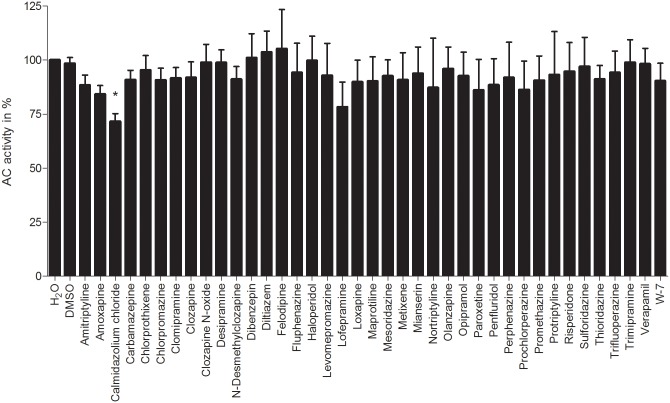
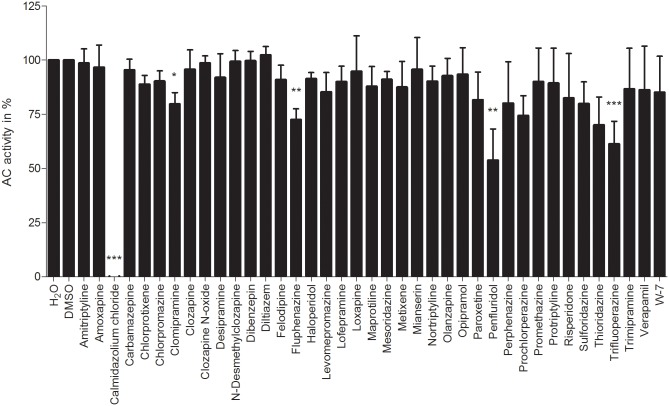
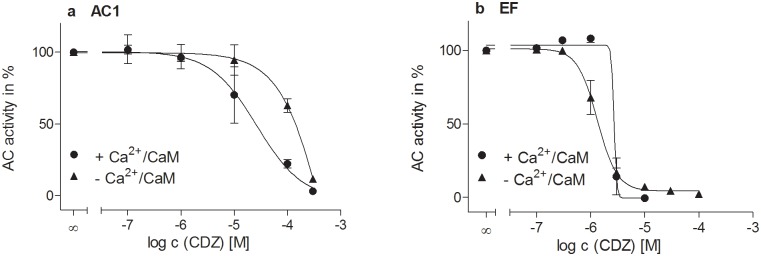
Adenylyl cyclases (ACs) catalyze the conversion of ATP into the second messenger cAMP. Membranous AC1 (AC1) is involved in processes of memory and learning and in muscle pain. The AC toxin edema factor (EF) of Bacillus anthracis is involved in the development of anthrax. Both ACs are stimulated by the eukaryotic Ca(2+)-sensor calmodulin (CaM). The CaM-AC interaction could constitute a potential target to enhance or impair the AC activity of AC1 and EF to intervene in above (patho)physiological mechanisms. Thus, we analyzed the impact of 39 compounds including typical CaM-inhibitors, an anticonvulsant, an anticholinergic, antidepressants, antipsychotics and Ca(2+)-antagonists on CaM-stimulated catalytic activity of AC1 and EF. Compounds were tested at 10 μM, i.e., a concentration that can be reached therapeutically for certain antidepressants and antipsychotics. Calmidazolium chloride decreased CaM-stimulated AC1 activity moderately by about 30%. In contrast, CaM-stimulated EF activity was abrogated by calmidazolium chloride and additionally decreased by chlorpromazine, felodipine, penfluridol and trifluoperazine by about 20-40%. The activity of both ACs was decreased by calmidazolium chloride in the presence and absence of CaM. Thus, CaM-stimulated AC1 activity is more insensitive to inhibition by small molecules than CaM-stimulated EF activity. Inhibition of AC1 and EF by calmidazolium chloride is largely mediated via a CaM-independent allosteric mechanism.
Overview
The claims and statistics of this paper haven’t been checked yet.
Free: it reads the open-access text and checks the first 5 claims that cite a source we can check. Create a free account to check every claim.
Integrity signals
Registry
Cites
Statistics
Figures
Verification
Claims the paper makes
The claims and statistics of this paper haven’t been checked yet.
Free: it reads the open-access text and checks the first 5 claims that cite a source we can check. Create a free account to check every claim.
Claims other papers make about this one
Each is checked against this paper’s own text: does it say what the citing paper says it does?
In the citing paper
“AC1 regulation by CaM appears to play roles in the physiological effects of both Bordetella pertussis (whooping cough) and Bacillus anthracis (anthrax) infections, raising the prospect that inhibitors of CaM stimulation of AC1 could be a viable therapeutic approach for treating these infections (252, 253).”
From Physiological roles of mammalian transmembrane adenylyl cyclase isoforms (2022) · cites this paper as [253]
Self-check
Percentages, sums and reported differences re-computed from the paper’s own numbers.
The self-check needs the paper’s full text.
Citations
Cites
PROTEIN MEASUREMENT WITH THE FOLIN PHENOL REAGENT
Lowry, O., Rosebrough, N., Farr, A. L., & Randall, R. (1951) · Journal of Biological Chemistry · doi:10.1016/s0021-9258(19)52451-6 · Cited by 317,331 · cited 1×
“The protein concentration of membrane preparations was determined by using the Lowry method [59] with the Bio-Rad DC protein assay kit using bovine serum albumin as the standard.”
MethodINTRACELLULAR CALCIUM HOMEOSTASIS
Carafoli, E. (1987) · Annual Review of Biochemistry · doi:10.1146/annurev.bi.56.070187.002143 · Cited by 2,190
Calmodulin: a prototypical calcium sensor
Chin, D., & Means, A. R. (2000) · Trends in Cell Biology · doi:10.1016/s0962-8924(00)01800-6 · Cited by 1,525 · cited 2×
“Ca-saturated CaM possesses a flexible linker region, connecting a C-terminal and an N-terminal globular region [16], which affords the interaction with numerous target proteins like myosin light-chain kinase (MLCK), cyclic nucleotide phosphodiesterase (PDE) and Bordetella pertussis AC toxin CyaA (CyaA) and the associa…”
BackgroundReview of the folin phenol protein quantitation method of lowry, rosebrough, farr and randall
Peterson, G. L. (1979) · Analytical Biochemistry · doi:10.1016/0003-2697(79)90222-7 · Cited by 1,147
Leppla, S. H. (1982) · Proceedings of the National Academy of Sciences · doi:10.1073/pnas.79.10.3162 · Cited by 935
Mock, M., & Fouet, A. (2001) · Annual Review of Microbiology · doi:10.1146/annurev.micro.55.1.647 · Cited by 894
How calmodulin binds its targets: sequence independent recognition of amphiphilic α-helices
O'Neil, K. T., & DeGrado, W. F. (1990) · Trends in Biochemical Sciences · doi:10.1016/0968-0004(90)90177-d · Cited by 842
Hoeflich, K. P., & Ikura, M. (2002) · Cell · doi:10.1016/s0092-8674(02)00682-7 · Cited by 700
Binding of Trifluoperazine to the Calcium-Dependent Activator of Cyclic Nucleotide Phosphodiesterase
LEVIN, R. M., & WEISS, B. (1977) · Molecular Pharmacology · doi:10.1016/s0026-895x(25)12432-2 · Cited by 563
Calcium-induced exposure of a hydrophobic surface on calmodulin
LaPorte, D. C., Wierman, B. M., & Storm, D. R. (1980) · Biochemistry · doi:10.1021/bi00557a025 · Cited by 515
Cited by
Dessauer, C. W., Watts, V. J., Ostrom, R. S., Conti, M., Dove, S., & Seifert, R. (2017) · Pharmacological Reviews · doi:10.1124/pr.116.013078 · Cited by 201
“Although all ACs are inhibited by high concentrations of Ca2+, AC5 and AC6 are inhibited by submicromolar concentrations of Ca2+; AC1 and AC8, and to a lesser extent AC3, are stimulated by low concentrations of Ca2+ via CaM (Tang et al., 1991; Choi et al., 1992; Katsushika et al., 1992; Yoshimura and Cooper, 1992; Cal…”
BackgroundInfluentialSelf-citationPhysiological roles of mammalian transmembrane adenylyl cyclase isoforms
Ostrom, K. F., LaVigne, J. E., Brust, T. F., Seifert, R., Dessauer, C. W., Watts, V. J., & Ostrom, R. S. (2022) · Physiological Reviews · doi:10.1152/physrev.00013.2021 · Cited by 131
Self-citationDynamics and structural changes of calmodulin upon interaction with the antagonist calmidazolium
Leger, C. C., Pitard, I., Sadi, M., Carvalho, N., Brier, S., Méchaly, A., Raoux‐Barbot, D., Davi, M., Hoos, S., Weber, P., et al. (2022) · BMC Biology · doi:10.1186/s12915-022-01381-5 · Cited by 33
“CDZ has been widely used to probe the role of holo-CaM in various biological processes [22, 33, 34, 52].”
BackgroundAlternative pre-approved and novel therapies for the treatment of anthrax
Head, B. M., Rubinstein, E., & Meyers, A. F. A. (2016) · BMC Infectious Diseases · doi:10.1186/s12879-016-1951-y · Cited by 34
Hayes, M. P., Soto‐Velasquez, M., Fowler, C. A., Watts, V. J., & Roman, D. L. (2017) · ACS Chemical Neuroscience · doi:10.1021/acschemneuro.7b00349 · Cited by 27
“AC toxin edema factor, which is also a CaM-stimulated cyclase, could be clinically useful for treatment of symptoms associated with anthrax.(16)”
BackgroundMethod
Metadata
- Authors
- Lübker, C., & Seifert, R.
- Affiliations
- Medizinische Hochschule Hannover (DE)
- Corresponding author
- Seifert, Roland
- ORCID
- Seifert, Roland
- Venue
- PLOS ONE
- Publisher
- Public Library of Science (PLoS)
- Published
- 2015-05-06
- Volume
- 10
- Issue
- 5
- Pages
- e0124017
- ISSN
- 1932-6203 (ISSN-L)
- PMC
- PMC4422518
- OpenAlex
- W2109167913
- Cited by
- 18
- References
- 86
- Citations by year
- 2022: 7 · 2021: 3 · 2020: 1 · 2019: 3 · 2017: 2 · 2016: 2
- FWCI
- 0.58
- Type
- journal article
- Language
- en
- Open access
- gold
- doi.org
- Licence
- Locations
- PLoS ONE (publishedVersion, cc-by)
- PubMed Central (publishedVersion, cc-by)
- PubMed (publishedVersion)
- DOAJ (DOAJ: Directory of Open Access Journals) (submittedVersion, cc-by-sa)
- Topics
- Life Sciences › Biochemistry, Genetics and Molecular Biology › Molecular Biology › Protein Kinase Regulation and GTPase Signaling
- Life Sciences › Biochemistry, Genetics and Molecular Biology › Molecular Biology › Phosphodiesterase function and regulation
- Life Sciences › Biochemistry, Genetics and Molecular Biology › Molecular Biology › Receptor Mechanisms and Signaling
- Keywords
- edema factor, Bacillus anthracis, calmodulin, allosteric inhibition, cAMP signaling, antidepressants, antipsychotic drugs, chlorpromazine, felodipine, penfluridol, trifluoperazine, calcium channel blockers, antiepileptic drugs, anticholinergic agents, anthrax toxin
- MeSH terms
- Adenylyl Cyclase Inhibitors, Adenylyl Cyclases, Animals, Antigens, Bacterial, Bacterial Toxins, Central Nervous System Depressants, Spodoptera, Small Molecule Libraries, Sf9 Cells
About these checks
Registry, retraction, Cites and statistics results are computed, not judged, with one exception: a printed reference that no index lists is read once by a model before it counts as a citation error. Claims are extracted by a model and kept only when their quote appears verbatim in the text; each cited source is then checked, with a model’s help, for whether it says what the claim relies on. Those verdicts can be wrong — read the claim’s quote and the cited source before relying on one.
Statistics and arithmetic are recomputed, not judged.
Confidence bands are shown only for fields calibrated on our annotated test set. None is calibrated yet, so no band is shown.
What counts as a claim ›How we measure confidence ›How we check this ›
Are you an author, or do you see a problem with this page? Request a review
Data sources
Bibliographic data: Semantic Scholar, OpenAlex, Crossref.
Contains information from the Semantic Scholar Academic Graph Datasets, made available under the ODC Attribution License (ODC-BY 1.0).
Semantic Scholar’s data is described in: Kinney, R., et al. (2023). The Semantic Scholar Open Data Platform. arXiv:2301.10140.
