

Effects of 39 Compounds on Calmodulin-Regulated Adenylyl Cyclases AC1 and Bacillus anthracis Edema Factor
Open accessThe DOI matches its Crossref record; 86 of the 86 references it cites were found in a registry or an index.
Abstract
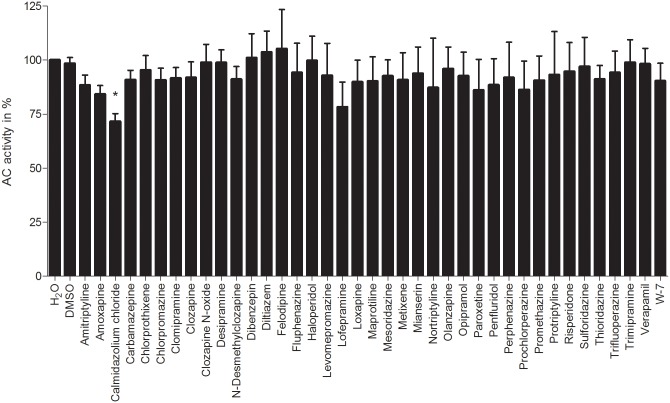
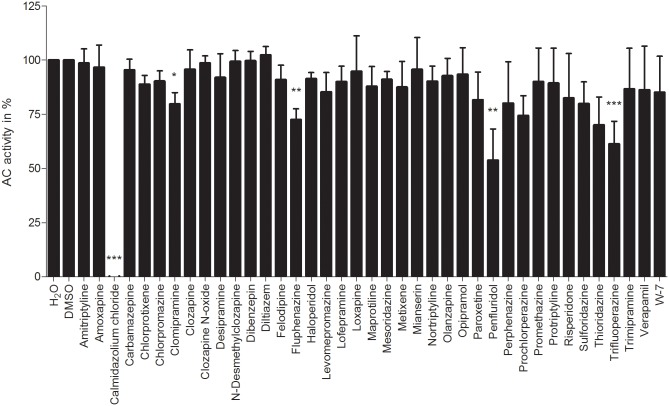
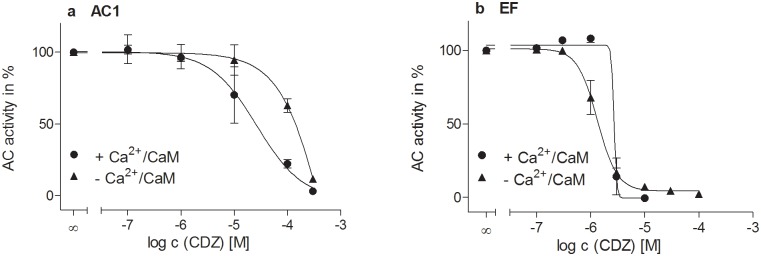
Adenylyl cyclases (ACs) catalyze the conversion of ATP into the second messenger cAMP. Membranous AC1 (AC1) is involved in processes of memory and learning and in muscle pain. The AC toxin edema factor (EF) of Bacillus anthracis is involved in the development of anthrax. Both ACs are stimulated by the eukaryotic Ca(2+)-sensor calmodulin (CaM). The CaM-AC interaction could constitute a potential target to enhance or impair the AC activity of AC1 and EF to intervene in above (patho)physiological mechanisms. Thus, we analyzed the impact of 39 compounds including typical CaM-inhibitors, an anticonvulsant, an anticholinergic, antidepressants, antipsychotics and Ca(2+)-antagonists on CaM-stimulated catalytic activity of AC1 and EF. Compounds were tested at 10 μM, i.e., a concentration that can be reached therapeutically for certain antidepressants and antipsychotics. Calmidazolium chloride decreased CaM-stimulated AC1 activity moderately by about 30%. In contrast, CaM-stimulated EF activity was abrogated by calmidazolium chloride and additionally decreased by chlorpromazine, felodipine, penfluridol and trifluoperazine by about 20-40%. The activity of both ACs was decreased by calmidazolium chloride in the presence and absence of CaM. Thus, CaM-stimulated AC1 activity is more insensitive to inhibition by small molecules than CaM-stimulated EF activity. Inhibition of AC1 and EF by calmidazolium chloride is largely mediated via a CaM-independent allosteric mechanism.
Overview
The claims and statistics of this paper haven’t been checked yet.
Free: it reads the open-access text and checks the first 5 claims that cite a source we can check. Create a free account to check every claim.
Integrity signals
Registry
Cites
Statistics
Figures
Verification
Claims the paper makes
The claims and statistics of this paper haven’t been checked yet.
Free: it reads the open-access text and checks the first 5 claims that cite a source we can check. Create a free account to check every claim.
Claims other papers make about this one
Each is checked against this paper’s own text: does it say what the citing paper says it does?
In the citing paper
“AC1 regulation by CaM appears to play roles in the physiological effects of both Bordetella pertussis (whooping cough) and Bacillus anthracis (anthrax) infections, raising the prospect that inhibitors of CaM stimulation of AC1 could be a viable therapeutic approach for treating these infections (252, 253).”
From Physiological roles of mammalian transmembrane adenylyl cyclase isoforms (2022) · cites this paper as [253]
Self-check
Percentages, sums and reported differences re-computed from the paper’s own numbers.
The self-check needs the paper’s full text.
Citations
Cites
PROTEIN MEASUREMENT WITH THE FOLIN PHENOL REAGENT
Lowry, O., Rosebrough, N., Farr, A. L., & Randall, R. (1951) · Journal of Biological Chemistry · doi:10.1016/s0021-9258(19)52451-6 · Cited by 317,331 · cited 1×
“The protein concentration of membrane preparations was determined by using the Lowry method [59] with the Bio-Rad DC protein assay kit using bovine serum albumin as the standard.”
MethodINTRACELLULAR CALCIUM HOMEOSTASIS
Carafoli, E. (1987) · Annual Review of Biochemistry · doi:10.1146/annurev.bi.56.070187.002143 · Cited by 2,190
Calmodulin: a prototypical calcium sensor
Chin, D., & Means, A. R. (2000) · Trends in Cell Biology · doi:10.1016/s0962-8924(00)01800-6 · Cited by 1,525 · cited 2×
“Ca-saturated CaM possesses a flexible linker region, connecting a C-terminal and an N-terminal globular region [16], which affords the interaction with numerous target proteins like myosin light-chain kinase (MLCK), cyclic nucleotide phosphodiesterase (PDE) and Bordetella pertussis AC toxin CyaA (CyaA) and the associa…”
BackgroundReview of the folin phenol protein quantitation method of lowry, rosebrough, farr and randall
Peterson, G. L. (1979) · Analytical Biochemistry · doi:10.1016/0003-2697(79)90222-7 · Cited by 1,147
Leppla, S. H. (1982) · Proceedings of the National Academy of Sciences · doi:10.1073/pnas.79.10.3162 · Cited by 935
Mock, M., & Fouet, A. (2001) · Annual Review of Microbiology · doi:10.1146/annurev.micro.55.1.647 · Cited by 894
How calmodulin binds its targets: sequence independent recognition of amphiphilic α-helices
O'Neil, K. T., & DeGrado, W. F. (1990) · Trends in Biochemical Sciences · doi:10.1016/0968-0004(90)90177-d · Cited by 842
Hoeflich, K. P., & Ikura, M. (2002) · Cell · doi:10.1016/s0092-8674(02)00682-7 · Cited by 700
Binding of Trifluoperazine to the Calcium-Dependent Activator of Cyclic Nucleotide Phosphodiesterase
LEVIN, R. M., & WEISS, B. (1977) · Molecular Pharmacology · doi:10.1016/s0026-895x(25)12432-2 · Cited by 563
Calcium-induced exposure of a hydrophobic surface on calmodulin
LaPorte, D. C., Wierman, B. M., & Storm, D. R. (1980) · Biochemistry · doi:10.1021/bi00557a025 · Cited by 515
Collier, R. J., & Young, J. A. T. (2003) · Annual Review of Cell and Developmental Biology · doi:10.1146/annurev.cellbio.19.111301.140655 · Cited by 511
KAKIUCHI, S., & RALL, T. W. (1968) · Molecular Pharmacology · doi:10.1016/s0026-895x(25)12615-1 · Cited by 452
Expression and characterization of calmodulin-activated (type I) adenylylcyclase
Tang, W. J., Krupinski, J., & Gilman, A. G. (1991) · Journal of Biological Chemistry · doi:10.1016/s0021-9258(18)93016-4 · Cited by 440 · cited 3×
“Baculovirus encoding bovine AC1 was kindly provided by Prof. Alfred G. Gilman (University of Texas, Dallas, TX, USA) [15].”
MethodStructural basis for the activation of anthrax adenylyl cyclase exotoxin by calmodulin
Drum, C. L., Yan, S.-Z., Bard, J., Shen, Y.-Q., Lu, D., Soelaiman, S., Grabarek, Z., Bohm, A., & Tang, W.-J. (2002) · Nature · doi:10.1038/415396a · Cited by 413
LEVIN, R. M., & WEISS, B. (1976) · Molecular Pharmacology · doi:10.1016/s0026-895x(25)10787-6 · Cited by 387 · cited 7×
“CaM is a fundamental biochemical regulator via interacting with a wide variety of proteins [16, 26] why inhibition of CaM could be a common mechanism for establishing some of the pharmacological effects of these drugs [25, 26, 33, 39, 40].”
BackgroundInfluentialLevin, R. M., & Weiss, B. (1979) · The Journal of Pharmacology and Experimental Therapeutics · doi:10.1016/s0022-3565(25)31595-8 · Cited by 386
Altered behavior and long-term potentiation in type I adenylyl cyclase mutant mice.
Wu, Z. L., Thomas, S. A., Villacres, E. C., Xia, Z., Simmons, M. L., Chavkin, C., Palmiter, R. D., & Storm, D. R. (1995) · Proceedings of the National Academy of Sciences · doi:10.1073/pnas.92.1.220 · Cited by 370 · cited 1×
“Otherwise, an improved activation of AC1 may be useful for enhancing processes of memory and learning [6, 9].”
BackgroundSadana, R., & Dessauer, C. W. (2009) · Neurosignals · doi:10.1159/000166277 · Cited by 361 · cited 11×
“Both ACs are stimulated by the eukaryotic Ca2+-sensor calmodulin (CaM).”
BackgroundInfluentialHodneland, C. D., Lee, Y.-S., Min, D.-H., & Mrksich, M. (2002) · Proceedings of the National Academy of Sciences · doi:10.1073/pnas.072685299 · Cited by 346 · cited 1×
“Subsequently, an evaluation of promising compounds using a surface plasmon resonance spectroscopy-based assay to detect compounds preventing the association of CaM and EF was performed [41, 61, 72, 73].”
BackgroundPHARMACOLOGICAL REGULATION OF CALMODULIN*
Weiss, B., Prozialeck, W., Cimino, M., Sellinger Barnette, M., & Wallace, T. L. (1980) · Annals of the New York Academy of Sciences · doi:10.1111/j.1749-6632.1980.tb29621.x · Cited by 340 · cited 1×
“CaM is a fundamental biochemical regulator via interacting with a wide variety of proteins [16, 26] why inhibition of CaM could be a common mechanism for establishing some of the pharmacological effects of these drugs [25, 26, 33, 39, 40].”
BackgroundHIDAKA, H., YAMAKI, T., NAKA, M., TANAKA, T., HAYASHI, H., & KOBAYASHI, R. (1980) · Molecular Pharmacology · doi:10.1016/s0026-895x(25)14070-4 · Cited by 333 · cited 1×
“At first glance, the potent CaM-inhibitor N-(6-aminohexyl)-5-chloro-1-naphthalenesulfonamide (W-7) appears to differ from the proposed structure but, in fact, the naphthalene ring constitutes the large hydrophobic region and a sidechain amino group in proposed distance removed from the ring is also present [29, 31].”
BackgroundInteraction of drugs with calmodulin
Weiss, B., Prozialeck, W. C., & Wallace, T. L. (1982) · Biochemical Pharmacology · doi:10.1016/0006-2952(82)90104-6 · Cited by 306 · cited 9×
“CaM is a fundamental biochemical regulator via interacting with a wide variety of proteins [16, 26] why inhibition of CaM could be a common mechanism for establishing some of the pharmacological effects of these drugs [25, 26, 33, 39, 40].”
BackgroundInfluentialBordetella pertussis adenylate cyclase: a toxin with multiple talents
Ladant, D., & Ullmann, A. (1999) · Trends in Microbiology · doi:10.1016/s0966-842x(99)01468-7 · Cited by 293
Calmodulin activates prokaryotic adenylate cyclase.
Wolff, J., Cook, G. H., Goldhammer, A. R., & Berkowitz, S. A. (1980) · Proceedings of the National Academy of Sciences · doi:10.1073/pnas.77.7.3841 · Cited by 276
Xia, Z., Refsdal, C. D., Merchant, K. M., Dorsa, D. M., & Storm, D. R. (1991) · Neuron · doi:10.1016/0896-6273(91)90251-t · Cited by 270
Gietzen, K., Wüthrich, A., & Bader, H. (1981) · Biochemical and Biophysical Research Communications · doi:10.1016/0006-291x(81)91276-6 · Cited by 260
Interaction of the antihypertensive drug felodipine with calmodulin
Boström, S.-L., Ljung, B., Mårdh, S., Forsen, S., & Thulin, E. (1981) · Nature · doi:10.1038/292777a0 · Cited by 252 · cited 10×
“Bordetella pertussis AC toxin CyaA [21] AC activity assay, fluorescence studies CDZ (0.001–100 μM) IC50: 0.66 μM; TFP (0.001– 100 μM); W-7 (0.001–100 μM) Inhibition of CyaA by CDZ is CaM-independent.”
BackgroundInfluentialOverexpression of type-1 adenylyl cyclase in mouse forebrain enhances recognition memory and LTP
Wang, H., Ferguson, G. D., Pineda, V. V., Cundiff, P. E., & Storm, D. R. (2004) · Nature Neuroscience · doi:10.1038/nn1248 · Cited by 244 · cited 1×
“Otherwise, an improved activation of AC1 may be useful for enhancing processes of memory and learning [6, 9].”
BackgroundChemical structure of phenothiazines and their biological activity
Jaszczyszyn, A., Gąsiorowski, K., Świątek, P., Malinka, W., Cieślik-Boczula, K., Petrus, J., & Czarnik-Matusewicz, B. (2012) · Pharmacological Reports · doi:10.1016/s1734-1140(12)70726-0 · Cited by 225 · cited 2×
“CaM is a fundamental biochemical regulator via interacting with a wide variety of proteins [16, 26] why inhibition of CaM could be a common mechanism for establishing some of the pharmacological effects of these drugs [25, 26, 33, 39, 40].”
BackgroundTrifluoperazine-induced conformational change in Ca2+-calmodulin
Vandonselaar, M., Hickie, R. A., Quail, W., & Delbaere, L. T. J. (1994) · Nature Structural Biology · doi:10.1038/nsb1194-795 · Cited by 217
Levin, R. M., & Weiss, B. (1978) · Biochimica et Biophysica Acta (BBA) - General Subjects · doi:10.1016/0304-4165(78)90132-0 · Cited by 205 · cited 2×
“Antipsychotic activity and CaM-inhibition are not necessarily related as expected based on findings for phenothiazine, diphenylbutylpiperidine and thioxanthene antipsychotics [25, 32, 40, 45].”
BackgroundWeiss, B., & Levin, R. M. (1978) · PubMed · Cited by 201
HIDAKA, H., YAMAKI, T., TOTSUKA, T., & ASANO, M. (1979) · Molecular Pharmacology · doi:10.1016/s0026-895x(25)11550-2 · Cited by 196
Type I Calmodulin‐Sensitive Adenylyl Cyclase Is Neural Specific
Xia, Z., Choi, E., Wang, F., Blazynski, C., & Storm, D. R. (1993) · Journal of Neurochemistry · doi:10.1111/j.1471-4159.1993.tb05852.x · Cited by 178
Brostrom, C. O., Brostrom, M. A., & Wolff, D. J. (1977) · Journal of Biological Chemistry · doi:10.1016/s0021-9258(17)40076-7 · Cited by 176 · cited 2×
“observed inhibition of AC activity using rat cerebellar cortex membranes by the phenothiazine antipsychotic chlorpromazine [27].”
BackgroundStructural basis for the interaction of Bordetella pertussis adenylyl cyclase toxin with calmodulin
Guo, Q., Shen, Y., Lee, Y., Gibbs, C. S., Mrksich, M., & Tang, W. (2005) · The EMBO Journal · doi:10.1038/sj.emboj.7600800 · Cited by 163
Local anesthetics, mepacrine, and propranolol are antagonists of calmodulin.
Volpi, M., Sha'afi, R. I., Epstein, P. M., Andrenyak, D. M., & Feinstein, M. B. (1981) · Proceedings of the National Academy of Sciences · doi:10.1073/pnas.78.2.795 · Cited by 160
Impaired Cerebellar Long-Term Potentiation in Type I Adenylyl Cyclase Mutant Mice
Storm, D. R., Hansel, C., Hacker, B., Parent, A., & Linden, D. J. (1998) · Neuron · doi:10.1016/s0896-6273(00)80500-0 · Cited by 159
β-ADRENERGIC RECEPTORS AND RECEPTOR SIGNALING IN HEART FAILURE
Post, S. R., Hammond, H. K., & Insel, P. A. (1999) · Annual Review of Pharmacology and Toxicology · doi:10.1146/annurev.pharmtox.39.1.343 · Cited by 153
The Relationship between the Free Concentrations of Ca2+ and Ca2+-calmodulin in Intact Cells
Persechini, A., & Cronk, B. (1999) · Journal of Biological Chemistry · doi:10.1074/jbc.274.11.6827 · Cited by 152
Hardman, J. G., Robison, G. A., & Sutherland, E. W. (1971) · Annual Review of Physiology · doi:10.1146/annurev.ph.33.030171.001523 · Cited by 142
Calcium‐independent calmodulin binding and two‐metal–ion catalytic mechanism of anthrax edema factor
Shen, Y., Zhukovskaya, N. L., Guo, Q., Florián, J., & Tang, W. (2005) · The EMBO Journal · doi:10.1038/sj.emboj.7600574 · Cited by 139
Norman, J. A., Drummond, A. H., & Moser, P. W. (1979) · Molecular Pharmacology · doi:10.1016/s0026-895x(25)13808-x · Cited by 133 · cited 1×
“Antipsychotic activity and CaM-inhibition are not necessarily related as expected based on findings for phenothiazine, diphenylbutylpiperidine and thioxanthene antipsychotics [25, 32, 40, 45].”
BackgroundA fluorescent calmodulin that reports the binding of hydrophobic inhibitory ligands
Johnson, J. D., & Wittenauer, L. A. (1983) · Biochemical Journal · doi:10.1042/bj2110473 · Cited by 132 · cited 10×
“Bordetella pertussis AC toxin CyaA [21] AC activity assay, fluorescence studies CDZ (0.001–100 μM) IC50: 0.66 μM; TFP (0.001– 100 μM); W-7 (0.001–100 μM) Inhibition of CyaA by CDZ is CaM-independent.”
BackgroundInfluentialHicks, C. W., Sweeney, D. A., Cui, X., Li, Y., & Eichacker, P. Q. (2012) · Intensive Care Medicine · doi:10.1007/s00134-012-2541-0 · Cited by 130
Shen, Y., Lee, Y., Soelaiman, S., Bergson, P., Lu, D., Chen, A., Beckingham, K., Grabarek, Z., Mrksich, M., & Tang, W. (2002) · The EMBO Journal · doi:10.1093/emboj/cdf681 · Cited by 117 · cited 2×
“Expression and purification of EF via DEAE, SP-Sepharose and Ni-NTA-columns were performed as previously described [61] with minor modifications [55].”
BackgroundMethodCalmodulin Activation of Red Blood Cell (Ca2+ + Mg2+)-ATPase and Its Antagonism by Phenothiazines
Raess, B. U., & Vincenzi, F. F. (1980) · Molecular Pharmacology · doi:10.1016/s0026-895x(25)14387-3 · Cited by 112
Schimmer, B. P. (1979) · Methods in enzymology on CD-ROM/Methods in enzymology · doi:10.1016/s0076-6879(79)58173-7 · Cited by 111 · cited 1×
“Subsequently, an evaluation of promising compounds using a surface plasmon resonance spectroscopy-based assay to detect compounds preventing the association of CaM and EF was performed [41, 61, 72, 73].”
BackgroundShen, Y., Zhukovskaya, N. L., Zimmer, M. I., Soelaiman, S., Bergson, P., Wang, C.-R., Gibbs, C. S., & Tang, W. (2004) · Proceedings of the National Academy of Sciences · doi:10.1073/pnas.0306552101 · Cited by 109 · cited 1×
“The findings with regard to AC1 and EF are essentially in accord with previous findings demonstrating that CaM-AC1 interaction is relatively insensitive to inhibition by small molecules whereas CaM-EF interaction is impaired by particular small molecules [41, 70, 71].”
ResultSeifert, R., Lee, T. W., Lam, V. T., & Kobilka, B. K. (1998) · European Journal of Biochemistry · doi:10.1046/j.1432-1327.1998.2550369.x · Cited by 102
Self-citationThe adenylyl cyclase activity of anthrax edema factor
Tang, W., & Guo, Q. (2009) · Molecular Aspects of Medicine · doi:10.1016/j.mam.2009.06.001 · Cited by 102
Uzunov, P., & Weiss, B. (1971) · Neuropharmacology · doi:10.1016/0028-3908(71)90084-0 · Cited by 98
Singaravelu, K., Lohr, C., & Deitmer, J. W. (2006) · Journal of Neuroscience · doi:10.1523/jneurosci.2604-06.2006 · Cited by 96
Soelaiman, S., Wei, B. Q., Bergson, P., Lee, Y., Shen, Y., Mrksich, M., Shoichet, B. K., & Tang, W. (2003) · Journal of Biological Chemistry · doi:10.1074/jbc.m301232200 · Cited by 93
Bartlett, R. K., Bieber Urbauer, R. J., Anbanandam, A., Smallwood, H. S., Urbauer, J. L., & Squier, T. C. (2003) · Biochemistry · doi:10.1021/bi026956z · Cited by 82
Vadakkan, K. I., Wang, H., Ko, S. W., Zastepa, E., Petrovic, M. J., Sluka, K. A., & Zhuo, M. (2006) · Molecular Pain · doi:10.1186/1744-8069-2-7 · Cited by 76 · cited 1×
“Inhibition of AC1 activity via disrupting CaM activation of AC1 could be useful for the treatment of muscle pain, where AC1 supposedly is involved [68].”
BackgroundVértessy, B. G., Harmat, V., Böcskei, Z., Náray‐Szabó, G., Orosz, F., & Ovádi, J. (1998) · Biochemistry · doi:10.1021/bi980795a · Cited by 73
Calcium-dependent adenylate cyclase from rat cerebral cortex: Activation by guanine nucleotides
Brostrom, M. A., Brostrom, C. O., & Wolff, D. J. (1978) · Archives of Biochemistry and Biophysics · doi:10.1016/0003-9861(78)90097-8 · Cited by 72
Inhibition of human erythrocyte Ca++-transport ATPase by phenothiazines and butyrophenones
Gietzen, K., Mansard, A., & Bader, H. (1980) · Biochemical and Biophysical Research Communications · doi:10.1016/0006-291x(80)91285-1 · Cited by 66
Itoh, H., & Hidaka, H. (1984) · The Journal of Biochemistry · doi:10.1093/oxfordjournals.jbchem.a135004 · Cited by 64
Guo, Q., Shen, Y., Zhukovskaya, N. L., Florián, J., & Tang, W. (2004) · Journal of Biological Chemistry · doi:10.1074/jbc.m402689200 · Cited by 61
Diurnal variation of the adenylyl cyclase type 1 in the rat pineal gland.
Tzavara, E. T., Pouille, Y., Defer, N., & Hanoune, J. (1996) · Proceedings of the National Academy of Sciences · doi:10.1073/pnas.93.20.11208 · Cited by 57
Appl, H., Holzammer, T., Dove, S., Haen, E., Straßer, A., & Seifert, R. (2011) · Naunyn-Schmiedeberg s Archives of Pharmacology · doi:10.1007/s00210-011-0704-0 · Cited by 55 · cited 2×
“This is because the therapeutic concentration of antipsychotics and antidepressants is generally 10 μM and results using higher concentrations are not relevant for invivo conditions [53].”
BackgroundMethodSelf-citationMasada, N., Ciruela, A., MacDougall, D. A., & Cooper, D. M. F. (2009) · Journal of Biological Chemistry · doi:10.1074/jbc.m807359200 · Cited by 55 · cited 1×
“4 [15] (20 mMHEPES, 1 mM EDTA, 1 mM EGTA, 2 mM DTT and 10 μg/ml benzamide, 10 μg/ml leupeptin and 200 μM phenylmethanesulfonyl fluoride as protease inhibitors) as previously described [15,57,58].”
MethodMolecular interaction and functional regulation of connexin50 gap junctions by calmodulin
Chen, Y., Zhou, Y.-B., Lin, X.-M., Wong, H., Xu, Q., Jiang, J., Wang, S.-M., Lurtz, M. M., Louis, C., Veenstra, R., et al. (2011) · Biochemical Journal · doi:10.1042/bj20101726 · Cited by 53 · cited 1×
“Connexin50 gap junctions (expressed in the lens of the eye) [78] Whole cell patch clamp experiments, NMR studies, fluorescence studies, CD, mass spectrometry Various concentrations of CDZ and Cx50-peptide (Cx50p(141-166) out of the CaM-binding domain of Cx50) Shown by using CDZ and Cx50p(141-166): Ca(2) -dependent inh…”
MethodHu, B., Nakata, H., Gu, C., de Beer, T., & Cooper, D. M. F. (2002) · Journal of Biological Chemistry · doi:10.1074/jbc.m112373200 · Cited by 49
Khan, S. Z., Longland, C. L., & Michelangeli, F. (2000) · Biochemical Pharmacology · doi:10.1016/s0006-2952(00)00505-0 · Cited by 46
Taha, H. M., Schmidt, J., Göttle, M., Suryanarayana, S., Shen, Y., Tang, W., Gille, A., Geduhn, J., König, B., Dove, S., et al. (2008) · Molecular Pharmacology · doi:10.1124/mol.108.052340 · Cited by 41
Self-citationMichel, M. C., & Seifert, R. (2015) · American Journal of Physiology-Cell Physiology · doi:10.1152/ajpcell.00389.2014 · Cited by 37 · cited 1×
“A review on the critical use of pharmacological inhibitors has been recently published [84].”
BackgroundSelf-citationLee, Y., Bergson, P., He, W. S., Mrksich, M., & Tang, W. (2004) · Chemistry & Biology · doi:10.1016/j.chembiol.2004.05.020 · Cited by 37 · cited 3×
“The findings with regard to AC1 and EF are essentially in accord with previous findings demonstrating that CaM-AC1 interaction is relatively insensitive to inhibition by small molecules whereas CaM-EF interaction is impaired by particular small molecules [41, 70, 71].”
BackgroundResultCalmodulin antagonists inhibit activity of myosin light‐chain kinase independent of calmodulin
Zimmer, M., & Hofmann, F. B. (1984) · European Journal of Biochemistry · doi:10.1111/j.1432-1033.1984.tb08300.x · Cited by 36 · cited 6×
“CaM-independent inhibition of CaM-target interactions are also known for other CaM-targets such as CyaA, NO-activated sGC, SERCA and MLCK [18,21,49,50,52].”
BackgroundMethodInfluentialAhlijanian, M. K., & Cooper, D. M. F. (1987) · Journal of Pharmacology and Experimental Therapeutics · doi:10.1016/s0022-5347(25)00282-4 · Cited by 35 · cited 8×
“A previous study using rat cerebellar membranes showed an AC activity inhibition of about 70% using 1 μMCaM and 10 μMCDZ [70], but these membranes did not exclusively express AC1, but also other AC isoforms.”
BackgroundMethodResultInfluentialMiller, R. J., & Iversen, L. L. (1974) · Journal of Pharmacy and Pharmacology · doi:10.1111/j.2042-7158.1974.tb09243.x · Cited by 34
Inhibition of skeletal muscle sarcoplasmic reticulum CaATPase activity by calmidazolium.
Anderson, K. W., Coll, R. J., & Murphy, A. J. (1984) · Journal of Biological Chemistry · doi:10.1016/s0021-9258(18)90887-2 · Cited by 33 · cited 6×
“CaM-independent inhibition of CaM-target interactions are also known for other CaM-targets such as CyaA, NO-activated sGC, SERCA and MLCK [18,21,49,50,52].”
BackgroundInfluentialCalmidazolium selectively inhibits exocytotic glutamate release evoked by P2X7 receptor activation
Cervetto, C., Mazzotta, M. C., Frattaroli, D., Alloisio, S., Nobile, M., Maura, G., & Marcoli, M. (2012) · Neurochemistry International · doi:10.1016/j.neuint.2012.02.034 · Cited by 31
Haunsø, A., Simpson, J., & Antoni, F. A. (2003) · Molecular Pharmacology · doi:10.1124/mol.63.3.624 · Cited by 30 · cited 2×
“AC2, AC9 and recombinant AC fusion proteins [51] AC activity assay CDZ (1–1000 μM) IC50 (AC5-AC2 fusion protein): 20 μM CDZ is a non-competitive inhibitor of AC activity.”
BackgroundDouglass, P. M., Salins, L. L. E., Dikici, E., & Daunert, S. (2002) · Bioconjugate Chemistry · doi:10.1021/bc010080b · Cited by 30
Anti-calmodulins and Tricyclic Adjuvants in Pain Therapy Block the TRPV1 Channel
Oláh, Z., Jósvay, K., Pecze, L., Letoha, T., Babai, N. Z., Budai, D., Ötvös, F., Szalma, S., & Vízler, C. (2007) · PLoS ONE · doi:10.1371/journal.pone.0000545 · Cited by 30
Two interaction sites on mammalian adenylyl cyclase type I and II: modulation by calmodulin and Gβγ
Diel, S., Beyermann, M., Lloréns, J. M. N., Wittig, B., & Kleuss, C. (2008) · Biochemical Journal · doi:10.1042/bj20071204 · Cited by 23 · cited 1×
“4 [15] (20 mMHEPES, 1 mM EDTA, 1 mM EGTA, 2 mM DTT and 10 μg/ml benzamide, 10 μg/ml leupeptin and 200 μM phenylmethanesulfonyl fluoride as protease inhibitors) as previously described [15,57,58].”
MethodInhibitors of Bacillus anthracis edema factor
Seifert, R., & Dove, S. (2013) · Pharmacology & Therapeutics · doi:10.1016/j.pharmthera.2013.07.002 · Cited by 20 · cited 1×
“Yet identified EF inhibitors such as “P”-site inhibitors (3'-nucleoside mono-, die and triphosphates), (N-methyl)anthraniloyl-nucleotides ((M)ANT-nucleotides) or adefovir and its active metabolite, targeting the catalytic site of EF, are mostly not selective for EF relative to mammalian ACs and, thus, not clinically u…”
BackgroundSelf-citationEffect of calmidazolium on [Ca2+]i and viability in human hepatoma cells
Liao, W., Huang, C.-C., Cheng, H., Wang, J., Lin, K., Cheng, J., Chai, K., Hsu, P., Tsai, J., Fang, Y., et al. (2008) · Archives of Toxicology · doi:10.1007/s00204-008-0328-4 · Cited by 18
Pharmacological characterization of adenylyl cyclase isoforms in rabbit kidney membranes
Erdorf, M., & Seifert, R. (2011) · Naunyn-Schmiedeberg s Archives of Pharmacology · doi:10.1007/s00210-011-0600-7 · Cited by 16 · cited 3×
“All other materials used for AC activity assay were from sources as previously described [54].”
MethodSelf-citationInhibition of nitric oxide‐activated guanylyl cyclase by calmodulin antagonists
James, L., Griffiths, C., Garthwaite, J., & Bellamy, T. C. (2009) · British Journal of Pharmacology · doi:10.1111/j.1476-5381.2009.00416.x · Cited by 14 · cited 6×
“NO-activated sGC (cerebellar cells and purified enzyme) [52] Ca-imaging, NO and sGC activity assay CDZ (1–100 μM) IC50: 11.”
BackgroundMethodInfluentialRegulation of store-operated Ca2+ entry in pulmonary artery smooth muscle cells
McElroy, S. P., Drummond, R. M., & Gurney, A. M. (2009) · Cell Calcium · doi:10.1016/j.ceca.2009.05.006 · Cited by 14
Schuler, D., Lübker, C., Lushington, G. H., Tang, W.-J., Shen, Y., Richter, M., & Seifert, R. (2012) · Biochemical Pharmacology · doi:10.1016/j.bcp.2012.01.005 · Cited by 8 · cited 14×
“Data suggest that CDZ binds to one or two hydrophobic binding sites in CyaA preventing conformational changes required for catalytic activity of CyaA.”
BackgroundMethodSelf-citationA whole-cell assay for the high throughput screening of calmodulin antagonists
Dikici, E., Deo, S. K., & Daunert, S. (2008) · Analytical and Bioanalytical Chemistry · doi:10.1007/s00216-008-1983-2 · Cited by 7
Cited by
Dessauer, C. W., Watts, V. J., Ostrom, R. S., Conti, M., Dove, S., & Seifert, R. (2017) · Pharmacological Reviews · doi:10.1124/pr.116.013078 · Cited by 201
“Although all ACs are inhibited by high concentrations of Ca2+, AC5 and AC6 are inhibited by submicromolar concentrations of Ca2+; AC1 and AC8, and to a lesser extent AC3, are stimulated by low concentrations of Ca2+ via CaM (Tang et al., 1991; Choi et al., 1992; Katsushika et al., 1992; Yoshimura and Cooper, 1992; Cal…”
BackgroundInfluentialSelf-citationPhysiological roles of mammalian transmembrane adenylyl cyclase isoforms
Ostrom, K. F., LaVigne, J. E., Brust, T. F., Seifert, R., Dessauer, C. W., Watts, V. J., & Ostrom, R. S. (2022) · Physiological Reviews · doi:10.1152/physrev.00013.2021 · Cited by 131
Self-citationDynamics and structural changes of calmodulin upon interaction with the antagonist calmidazolium
Leger, C. C., Pitard, I., Sadi, M., Carvalho, N., Brier, S., Méchaly, A., Raoux‐Barbot, D., Davi, M., Hoos, S., Weber, P., et al. (2022) · BMC Biology · doi:10.1186/s12915-022-01381-5 · Cited by 33
“CDZ has been widely used to probe the role of holo-CaM in various biological processes [22, 33, 34, 52].”
BackgroundAlternative pre-approved and novel therapies for the treatment of anthrax
Head, B. M., Rubinstein, E., & Meyers, A. F. A. (2016) · BMC Infectious Diseases · doi:10.1186/s12879-016-1951-y · Cited by 34
Hayes, M. P., Soto‐Velasquez, M., Fowler, C. A., Watts, V. J., & Roman, D. L. (2017) · ACS Chemical Neuroscience · doi:10.1021/acschemneuro.7b00349 · Cited by 27
“AC toxin edema factor, which is also a CaM-stimulated cyclase, could be clinically useful for treatment of symptoms associated with anthrax.(16)”
BackgroundMethod
Metadata
- Authors
- Lübker, C., & Seifert, R.
- Affiliations
- Medizinische Hochschule Hannover (DE)
- Corresponding author
- Seifert, Roland
- ORCID
- Seifert, Roland
- Venue
- PLOS ONE
- Publisher
- Public Library of Science (PLoS)
- Published
- 2015-05-06
- Volume
- 10
- Issue
- 5
- Pages
- e0124017
- ISSN
- 1932-6203 (ISSN-L)
- PMC
- PMC4422518
- OpenAlex
- W2109167913
- Cited by
- 18
- References
- 86
- Citations by year
- 2022: 7 · 2021: 3 · 2020: 1 · 2019: 3 · 2017: 2 · 2016: 2
- FWCI
- 0.58
- Type
- journal article
- Language
- en
- Open access
- gold
- doi.org
- Licence
- Locations
- PLoS ONE (publishedVersion, cc-by)
- PubMed Central (publishedVersion, cc-by)
- PubMed (publishedVersion)
- DOAJ (DOAJ: Directory of Open Access Journals) (submittedVersion, cc-by-sa)
- Topics
- Life Sciences › Biochemistry, Genetics and Molecular Biology › Molecular Biology › Protein Kinase Regulation and GTPase Signaling
- Life Sciences › Biochemistry, Genetics and Molecular Biology › Molecular Biology › Phosphodiesterase function and regulation
- Life Sciences › Biochemistry, Genetics and Molecular Biology › Molecular Biology › Receptor Mechanisms and Signaling
- Keywords
- edema factor, Bacillus anthracis, calmodulin, allosteric inhibition, cAMP signaling, antidepressants, antipsychotic drugs, chlorpromazine, felodipine, penfluridol, trifluoperazine, calcium channel blockers, antiepileptic drugs, anticholinergic agents, anthrax toxin
- MeSH terms
- Adenylyl Cyclase Inhibitors, Adenylyl Cyclases, Animals, Antigens, Bacterial, Bacterial Toxins, Central Nervous System Depressants, Spodoptera, Small Molecule Libraries, Sf9 Cells
About these checks
Registry, retraction, Cites and statistics results are computed, not judged, with one exception: a printed reference that no index lists is read once by a model before it counts as a citation error. Claims are extracted by a model and kept only when their quote appears verbatim in the text; each cited source is then checked, with a model’s help, for whether it says what the claim relies on. Those verdicts can be wrong — read the claim’s quote and the cited source before relying on one.
Statistics and arithmetic are recomputed, not judged.
Confidence bands are shown only for fields calibrated on our annotated test set. None is calibrated yet, so no band is shown.
What counts as a claim ›How we measure confidence ›How we check this ›
Are you an author, or do you see a problem with this page? Request a review
Data sources
Bibliographic data: Semantic Scholar, OpenAlex, Crossref.
Contains information from the Semantic Scholar Academic Graph Datasets, made available under the ODC Attribution License (ODC-BY 1.0).
Semantic Scholar’s data is described in: Kinney, R., et al. (2023). The Semantic Scholar Open Data Platform. arXiv:2301.10140.
