

The DOI matches its Crossref record; 44 of the 44 references it cites were found in a registry or an index.
Trends in the prevalence of autism spectrum disorder, cerebral palsy, hearing loss, intellectual disability, and vision impairment, metropolitan atlanta, 1991-2010
Open accessAbstract
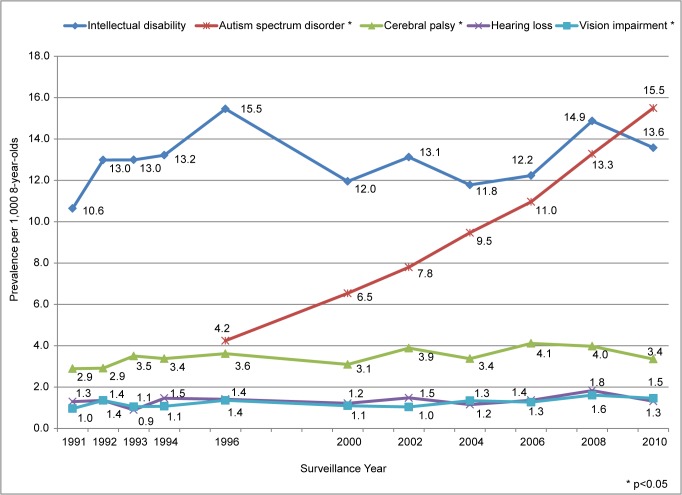
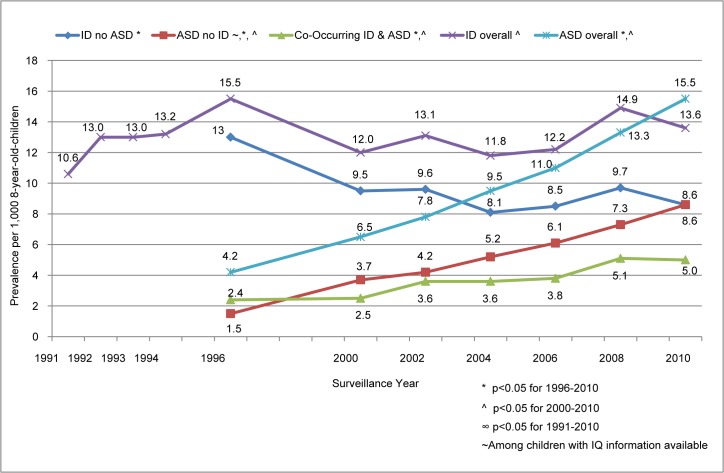
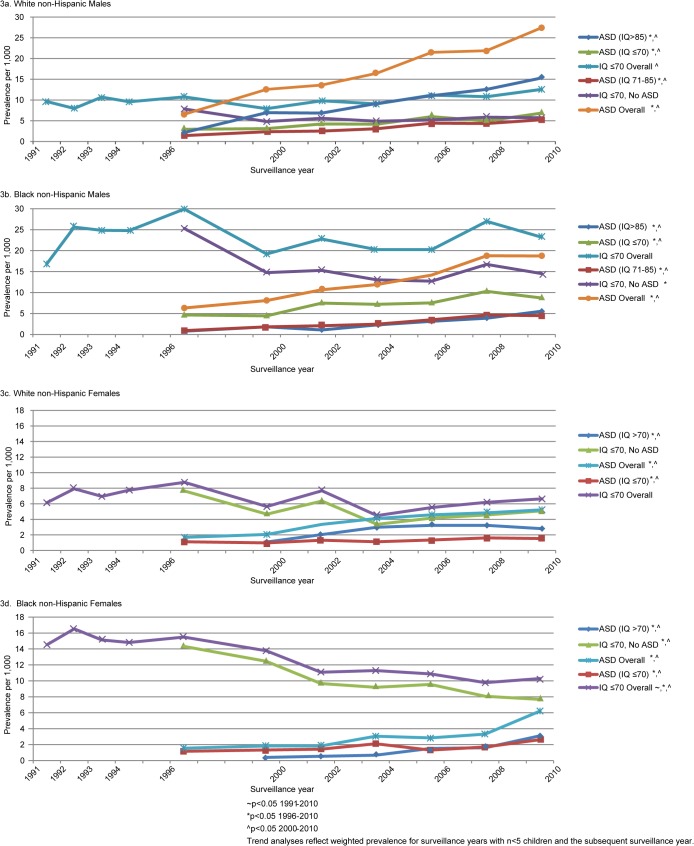
This study examined the prevalence and characteristics of autism spectrum disorder (ASD), cerebral palsy (CP), hearing loss (HL), intellectual disability (ID), and vision impairment (VI) over a 15-20 year time period, with specific focus on concurrent changes in ASD and ID prevalence. We used data from a population-based developmental disabilities surveillance program for 8-year-olds in metropolitan Atlanta. From 1991-2010, prevalence estimates of ID and HL were stable with slight increases in VI prevalence. CP prevalence was constant from 1993-2010. The average annual increase in ASD prevalence was 9.3% per year from 1996-2010, with a 269% increase from 4.2 per 1,000 in 1996 to 15.5 per 1,000 in 2010. From 2000-2010, the prevalence of ID without ASD was stable; during the same time, the prevalence of ASD with and without co-occurring ID increased by an average of 6.6% and 9.6% per year, respectively. ASD prevalence increases were found among both males and females, and among nearly all racial/ethnic subgroups and levels of intellectual ability. Average annual prevalence estimates from 1991-2010 underscore the significant community resources needed to provide early intervention and ongoing supports for children with ID (13.0 per 1,000), CP, (3.5 per 1,000), HL (1.4 per 1,000) and VI (1.3 in 1,000), with a growing urgency for children with ASD.
Overview
The claims and statistics of this paper haven’t been checked yet.
Run the check — free, no account needed. It reads the open-access text and checks the sources it cites.
Integrity signals
Registry
Cites
Statistics
Figures
Verification
Claims the paper makes
The claims and statistics of this paper haven’t been checked yet.
Run the check — free, no account needed. It reads the open-access text and checks the sources it cites.
Claims other papers make about this one
Each is checked against this paper’s own text: does it say what the citing paper says it does?
In the citing paper
“If loss of function of a particular gene conferred risk that was purely specific to ASD, the mean IQ associated with de novo pathogenic variants in that gene would not be significantly different from the population mean (100), or at least from the familial background mean, and the expected rate of ID would be no different from the ID rate in the general population (∼1.0%–1.3%).26,27”
From Insufficient Evidence for “Autism-Specific” Genes (2020) · cites this paper as [27]
Self-check
Percentages, sums and reported differences re-computed from the paper’s own numbers.
The self-check needs the paper’s full text.
Citations
Cites
Diagnostic and Statistical Manual of Mental Disorders
Williams, J. B. W., & First, M. B. (2013) · Oxford University Press eBooks · doi:10.1093/acrefore/9780199975839.013.104 · Cited by 109,845
Baio, J., Wiggins, L., Christensen, D. L., Maenner, M. J., Daniels, J., Warren, Z., Kurzius-Spencer, M., Zahorodny, W., Robinson, C., Rosenberg, et al. (2018) · MMWR. Surveillance Summaries · doi:10.15585/mmwr.ss6706a1 · Cited by 6,078
Self-citationEpidemiology of Pervasive Developmental Disorders
Fombonne, E. (2009) · Pediatric Research · doi:10.1203/pdr.0b013e31819e7203 · Cited by 1,971
Trends in the prevalence of developmental disabilities in US children, 1997-2008
Boyle, C. A., Boulet, S., Schieve, L. A., Cohen, R. A., Blumberg, S. J., Yeargin-Allsopp, M., Visser, S., & Kogan, M. D. (2011) · Pediatrics · doi:10.1542/peds.2010-2989 · Cited by 1,732
Self-citationPediatrics, S. O. D. B. (2006) · PEDIATRICS · doi:10.1542/peds.2006-1231 · Cited by 1,472
Naarden Braun, K. V., Lopez, M., White, T., et al. (2023) · Carolina Digital Repository (University of North Carolina at Chapel Hill) · doi:10.17615/y3kk-5x30 · Cited by 1,381
Prevalence of Autism in a US Metropolitan Area
Yeargin-Allsopp, M., Rice, C., Karapurkar, T., Doernberg, N., Boyle, C., & Murphy, C. (2003) · JAMA · doi:10.1001/jama.289.1.49 · Cited by 1,248
Self-citationParashar, U. (2006) · Medical Entomology and Zoology · Cited by 799
Rice, C. E. (2009) · PsycEXTRA Dataset · doi:10.1037/e562722010-001 · Cited by 762
Self-citationBlumberg, S. J., Bramlett, M. D., Kogan, M. D., Schieve, L. A., Jones, J. R., & Lu, M. C. (2013) · PubMed · Cited by 726
Self-citationThe Changing Prevalence of Autism in California
Croen, L., Grether, J. K., Hoogstrate, J., & Selvin, S. (2002) · Journal of Autism and Developmental Disorders · doi:10.1023/a:1015453830880 · Cited by 511
Mack, A. H. (2011) · Yearbook of Psychiatry and Applied Mental Health · doi:10.1016/j.ypsy.2010.11.009 · Cited by 500
Diagnostic change and the increased prevalence of autism
King, M., & Bearman, P. (2009) · International Journal of Epidemiology · doi:10.1093/ije/dyp261 · Cited by 481
Christensen, D., Van Naarden Braun, K., Doernberg, N. S., Maenner, M. J., Arneson, C. L., Durkin, M. S., Benedict, R. E., Kirby, R. S., Wingate, M. S., Fitzgerald, R., et al. (2014) · Developmental Medicine & Child Neurology · doi:10.1111/dmcn.12268 · Cited by 442
Self-citationIncreased Risk of Adverse Neurological Development for Late Preterm Infants
Petrini, J. R., Dias, T., McCormick, M. C., Massolo, M. L., Green, N., & Escobar, G. J. (2008) · The Journal of Pediatrics · doi:10.1016/j.jpeds.2008.08.020 · Cited by 424
(2009) · PubMed · Cited by 409
Neurodevelopmental outcomes of preterm infants
Allen, M. C. (2008) · Current Opinion in Neurology · doi:10.1097/wco.0b013e3282f88bb4 · Cited by 371
Neurodevelopmental outcomes of preterm infants
Song, I. G. (2022) · Korean Journal of Pediatrics · doi:10.3345/cep.2022.00822 · Cited by 367
Boulet, S. L., Boyle, C. A., & Schieve, L. A. (2009) · Archives of Pediatrics and Adolescent Medicine · doi:10.1001/archpediatrics.2008.506 · Cited by 337
Self-citationShattuck, P. T. (2006) · PEDIATRICS · doi:10.1542/peds.2005-1516 · Cited by 333
National Autism Prevalence Trends From United States Special Education Data
Newschaffer, C. J., Falb, M. D., & Gurney, J. G. (2005) · PEDIATRICS · doi:10.1542/peds.2004-1958 · Cited by 316
Environmental factors associated with a spectrum of neurodevelopmental deficits
Mendola, P., Selevan, S. G., Gutter, S., & Rice, D. (2002) · Mental Retardation and Developmental Disabilities Research Reviews · doi:10.1002/mrdd.10033 · Cited by 279
Kirby, R. S., Wingate, M. S., Braun, K. V. N., Doernberg, N. S., Arneson, C. L., Benedict, R. E., Mulvihill, B. A., Durkin, M. S., Fitzgerald, R. T., Maenner, M. J., et al. (2011) · Research in Developmental Disabilities · doi:10.1016/j.ridd.2010.12.042 · Cited by 232
Self-citationBlumberg, S. J., Bramlett, M. D., Kogan, M. D., Schieve, L. A., Jones, J. R., & Lu, M. C. (2013) · Cited by 224
Self-citationBhasin, T. K., Brocksen, S., Avchen, R. N., & Braun, K. V. N. (2006) · PsycEXTRA Dataset · doi:10.1037/e566462006-001 · Cited by 199
Addressing Health Disparities Through Promoting Equity for Individuals with Intellectual Disability
Ouellette-Kuntz, H. M. J., Minnes, P., Garcin, N., Martin, C., Lewis, M. E. S., & Holden, J. J. A. (2005) · Canadian Journal of Public Health · doi:10.1007/bf03403699 · Cited by 174
Surveillance for elevated blood lead levels among children--United States, 1997-2001.
Meyer, P. A., Pivetz, T., Dignam, T. A., Homa, D. M., Schoonover, J., & Brody, D. J. (2003) · PubMed · Cited by 166
Yeargin‐Allsopp, M., Oakley, G. P., Murphy, C. C., Sikes, R. K., & Staff, T. M. A. D. D. S. (1992) · PEDIATRICS · doi:10.1542/peds.89.4.624 · Cited by 158
Self-citationMild mental retardation in black and white children in metropolitan Atlanta: a case-control study.
Yeargin‐Allsopp, M., Drews‐Botsch, C., Decouflé, P., & Murphy, C. C. (1995) · American Journal of Public Health · doi:10.2105/ajph.85.3.324 · Cited by 89
Self-citationJarquin, V. G., Wiggins, L. D., Schieve, L. A., & Van Naarden-Braun, K. (2011) · Journal of Developmental & Behavioral Pediatrics · doi:10.1097/dbp.0b013e31820b4260 · Cited by 88
Self-citationWise, M. D., Little, A. A., Holliman, J. B., Wise, P. H., & Wang, C.-H. J. (2010) · Journal of Developmental & Behavioral Pediatrics · doi:10.1097/dbp.0b013e3181e56db2 · Cited by 80
Sellier, É., Surman, G., Himmelmann, K., Andersen, G. L., Colver, A., Krägeloh‐Mann, I., de la Cruz, J., & Cans, C. (2010) · European Journal of Epidemiology · doi:10.1007/s10654-010-9474-0 · Cited by 72
Sequelae after Bacterial Meningitis in Childhood
Oostenbrink, R., Maas, M., Moons, K. G. M., & Moll, H. A. (2002) · Scandinavian Journal of Infectious Diseases · doi:10.1080/00365540110080179 · Cited by 64
Developmental Disabilities: Delivery of Medical Care for Children and Adults
Holm, V. A. (1989) · JAMA · doi:10.1001/jama.1989.03430200183054 · Cited by 62
Schieve, L. A., Rice, C., Devine, O., Maenner, M. J., Lee, L.-C., Fitzgerald, R., Wingate, M. S., Schendel, D., Pettygrove, S., van Naarden Braun, K., et al. (2011) · Annals of Epidemiology · doi:10.1016/j.annepidem.2011.08.009 · Cited by 58
Self-citationNonkin Avchen, R., Wiggins, L. D., Devine, O., Van Naarden Braun, K., Rice, C., Hobson, N. C., Schendel, D., & Yeargin-Allsopp, M. (2011) · Journal of Autism and Developmental Disorders · doi:10.1007/s10803-010-1050-7 · Cited by 49
Self-citationDevelopmental Disabilities: Delivery of Medical Care for Children and Adults
Rubin, I. L., & Crocker, A. C. (1988) · Medical Entomology and Zoology · Cited by 32
Effect of Incorporating Adaptive Functioning Scores on the Prevalence of Intellectual Disability
Obi, O., Braun, K. V. N., Baio, J., Drews‐Botsch, C., Devine, O. J., & Yeargin‐Allsopp, M. (2011) · American Journal on Intellectual and Developmental Disabilities · doi:10.1352/1944-7558-116.5.360 · Cited by 28
Self-citationTrends in vaccine-preventable diseases
Orenstein, W. A., Hadler, S. C., & Wharton, M. E. (1997) · Seminars in Pediatric Infectious Diseases · doi:10.1016/s1045-1870(97)80006-4 · Cited by 11
Lazarus, C., Autry, A., Baio, J., Avchen, R. N., & Braun, K. V. N. (2007) · American Journal on Mental Retardation · doi:10.1352/0895-8017(2007)112[462:iopvip]2.0.co;2 · Cited by 8
Research works printed but not linked: 1
- Centers for Disease Control and Prevention. Workshop on U.S. Data to Evaluate Changes in the Prevalence of Autism Spectrum Disorders (ASDs). February 1, 2011. http://www.cdc.gov/NCBDDD/autism/documents/EvaluatingChanges_WorkshopSummary.pdf
Cited by
Sorted by citations
Maenner, M. J., Shaw, K. A., Baio, J., EdS1, Washington, A., Patrick, M., DiRienzo, M., Christensen, D. L., Wiggins, L. D., Pettygrove, S., et al. (2020) · MMWR. Surveillance Summaries · doi:10.15585/mmwr.ss6904a1 · Cited by 3,780
Self-citationMcKenzie, K., Milton, M., Smith, G. C., & Ouellette-Kuntz, H. M. J. (2016) · Current Developmental Disorders Reports · doi:10.1007/s40474-016-0085-7 · Cited by 504
The prevalence of parent-reported autism spectrum disorder among US children
Kogan, M. D., Vladutiu, C. J., Schieve, L. A., Ghandour, R. M., Blumberg, S. J., Zablotsky, B., Perrin, J. M., Shattuck, P., Kuhlthau, K. A., Harwood, R. L., et al. (2018) · Pediatrics · doi:10.1542/peds.2017-4161 · Cited by 354
Self-citationDurkin, M. S., Maenner, M. J., Baio, J., Christensen, D., Daniels, J., Fitzgerald, R., Imm, P., Lee, L.-C., Schieve, L. A., Van Naarden Braun, K., et al. (2017) · American Journal of Public Health · doi:10.2105/ajph.2017.304032 · Cited by 347
Self-citationBougeard, C., Picarel-Blanchot, F., Schmid, R., Campbell, R., & Buitelaar, J. (2021) · Frontiers in Psychiatry · doi:10.3389/fpsyt.2021.744709 · Cited by 330
Metadata
- Authors
- Van Naarden Braun, K., Christensen, D., Doernberg, N., Schieve, L., Rice, C., Wiggins, L., Schendel, D., & Yeargin-Allsopp, M.
- Affiliations
- Centers for Disease Control and Prevention (US)
- Venue
- PLOS ONE
- Publisher
- Public Library of Science (PLoS)
- Published
- 2015-04-29
- Volume
- 10
- Issue
- 4
- Pages
- e0124120
- ISSN
- 1932-6203 (ISSN-L)
- PMC
- PMC4414511
- OpenAlex
- W2070233808
- Cited by
- 292
- References
- 43
- Citations by year
- 2026: 6 · 2025: 14 · 2024: 25 · 2023: 32 · 2022: 29 · 2021: 35 · 2020: 33 · 2019: 27 · 2018: 37 · 2017: 29 · 2016: 20 · 2015: 5
- FWCI
- 18.22
- Type
- journal article
- Language
- en
- Open access
- gold
- doi.org
- Licence
- public-domain
- creativecommons.org/publicdomain/zero/1.0/ (vor)
- Locations
- PLoS ONE (publishedVersion, public-domain)
- Europe PMC (PubMed Central) (publishedVersion, public-domain)
- PubMed Central (publishedVersion, public-domain)
- PubMed (publishedVersion)
- DOAJ (DOAJ: Directory of Open Access Journals) (submittedVersion)
- Figshare (submittedVersion, cc-by)
- Funders
- Lundbeckfonden (R155-2014-1724)
- Centers for Disease Control and Prevention
- National Center on Birth Defects and Developmental Disabilities
- Topics
- Life Sciences › Neuroscience › Cognitive Neuroscience › Autism Spectrum Disorder Research
- Health Sciences › Medicine › Public Health, Environmental and Occupational Health › Down syndrome and intellectual disability research
- Social Sciences › Psychology › Clinical Psychology › Family and Disability Support Research
- Keywords
- autism spectrum disorder, cerebral palsy, hearing loss, intellectual disability, visual impairment, temporal trends, racial and ethnic disparities, sex differences, early intervention, Atlanta
- MeSH terms
- Autism Spectrum Disorder, Cerebral Palsy, Child, Child, Preschool, Cross-Sectional Studies, Demography, Ethnicity, Female, Georgia, Humans, Male, Intellectual Disability, Population Surveillance, Sex Factors, Vision Disorders, Prevalence, Hearing Loss
About these checks
Registry, retraction, Cites and statistics results are computed, not judged, with one exception: a printed reference that no index lists is read once by a model before it counts as a citation error. Claims are extracted by a model and kept only when their quote appears verbatim in the text; each cited source is then checked, with a model’s help, for whether it says what the claim relies on. Those verdicts can be wrong — read the claim’s quote and the cited source before relying on one.
Statistics and arithmetic are recomputed, not judged.
Confidence bands are shown only for fields calibrated on our annotated test set. None is calibrated yet, so no band is shown.
What counts as a claim ›How we measure confidence ›How we check this ›
Are you an author, or do you see a problem with this page? Request a review
