

The DOI matches its Crossref record; 36 of the 37 references it cites were found in a registry or an index.
CCTop: An Intuitive, Flexible and Reliable CRISPR/Cas9 Target Prediction Tool
Open accessAbstract
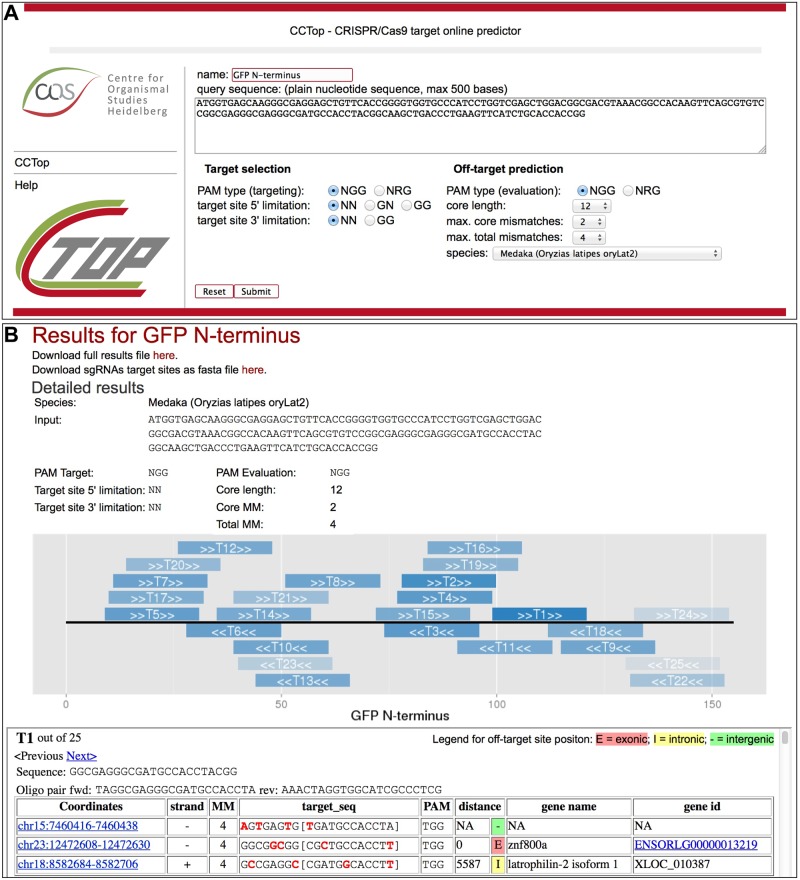
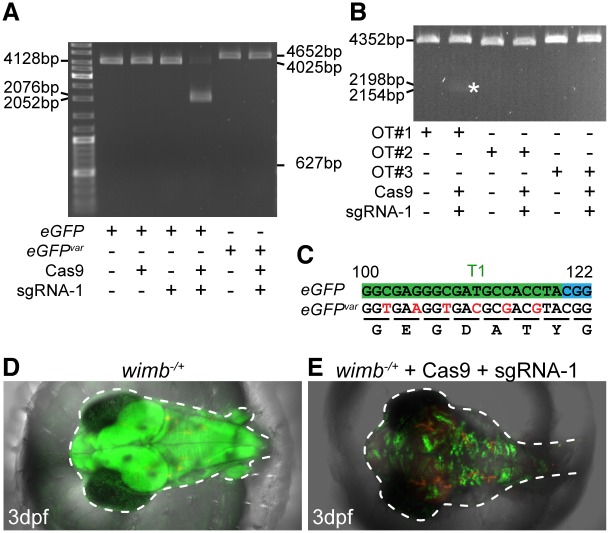
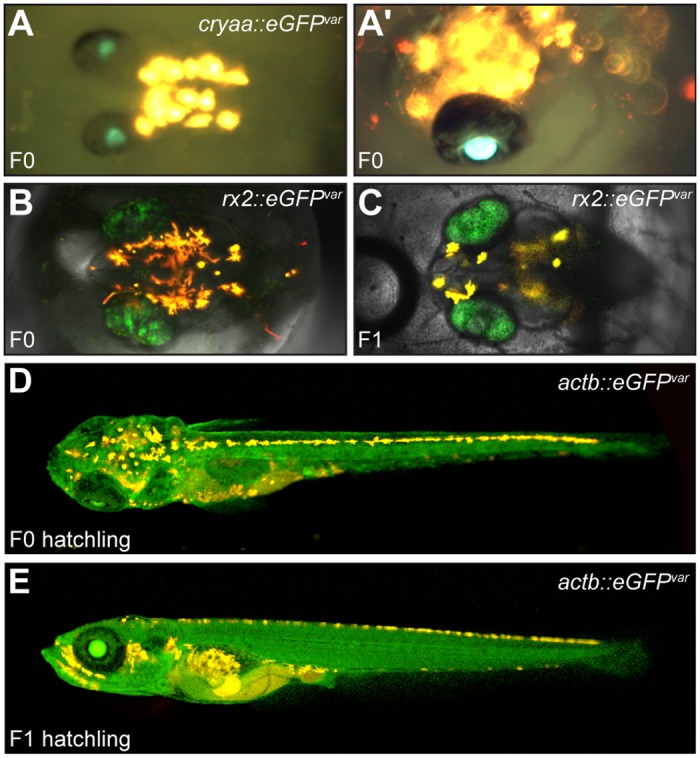
Engineering of the CRISPR/Cas9 system has opened a plethora of new opportunities for site-directed mutagenesis and targeted genome modification. Fundamental to this is a stretch of twenty nucleotides at the 5' end of a guide RNA that provides specificity to the bound Cas9 endonuclease. Since a sequence of twenty nucleotides can occur multiple times in a given genome and some mismatches seem to be accepted by the CRISPR/Cas9 complex, an efficient and reliable in silico selection and evaluation of the targeting site is key prerequisite for the experimental success. Here we present the CRISPR/Cas9 target online predictor (CCTop, http://crispr.cos.uni-heidelberg.de) to overcome limitations of already available tools. CCTop provides an intuitive user interface with reasonable default parameters that can easily be tuned by the user. From a given query sequence, CCTop identifies and ranks all candidate sgRNA target sites according to their off-target quality and displays full documentation. CCTop was experimentally validated for gene inactivation, non-homologous end-joining as well as homology directed repair. Thus, CCTop provides the bench biologist with a tool for the rapid and efficient identification of high quality target sites.
Overview
The claims and statistics of this paper haven’t been checked yet.
Run the check — free, no account needed. It reads the open-access text and checks the sources it cites.
Integrity signals
Registry
Cites
Statistics
Figures
Verification
Claims the paper makes
The claims and statistics of this paper haven’t been checked yet.
Run the check — free, no account needed. It reads the open-access text and checks the sources it cites.
Claims other papers make about this one
Each is checked against this paper’s own text: does it say what the citing paper says it does?
The cited source says what the claim attributes to it.
In the citing paper
“CCTop and CROP-IT generate scores based on the distances of the mismatches to the PAM (Singh et al., 2015; Stemmer et al., 2015).”
From Off-target effects in CRISPR/Cas9 gene editing (2023) · cites this paper as Stemmer et al., 2015
Self-check
Percentages, sums and reported differences re-computed from the paper’s own numbers.
The self-check needs the paper’s full text.
Citations
Cites
Fiji: an open-source platform for biological-image analysis
Schindelin, J., Arganda-Carreras, I., Frise, E., Kaynig, V., Longair, M., Pietzsch, T., Preibisch, S., Rueden, C., Saalfeld, S., Schmid, B., et al. (2012) · Nature Methods · doi:10.1038/nmeth.2019 · Cited by 66,890
Ultrafast and memory-efficient alignment of short DNA sequences to the human genome.
Langmead, B., Trapnell, C., Pop, M., & Salzberg, S. L. (2009) · Genome Biology · doi:10.1186/gb-2009-10-3-r25 · Cited by 21,849
A Programmable Dual-RNA–Guided DNA Endonuclease in Adaptive Bacterial Immunity
Jinek, M., Chylinski, K., Fonfara, I., Hauer, M., Doudna, J. A., & Charpentier, E. (2012) · Science · doi:10.1126/science.1225829 · Cited by 17,116
Multiplex Genome Engineering Using CRISPR/Cas Systems
Cong, L., Ran, F. A., Cox, D., Lin, S., Barretto, R., Habib, N., Hsu, P. D., Wu, X., Jiang, W., Marraffini, L. A., et al. (2013) · Science · doi:10.1126/science.1231143 · Cited by 15,339
The Human Genome Browser at UCSC
Kent, W. J., Sugnet, C. W., Furey, T. S., Roskin, K. M., Pringle, T. H., Zahler, A. M., & Haussler, A. D. (2002) · Genome Research · doi:10.1101/gr.229102 · Cited by 10,400
RNA-Guided Human Genome Engineering via Cas9
Mali, P., Yang, L., Esvelt, K. M., Aach, J., Guell, M., DiCarlo, J. E., Norville, J. E., & Church, G. M. (2013) · Science · doi:10.1126/science.1232033 · Cited by 9,210
DNA targeting specificity of RNA-guided Cas9 nucleases
Hsu, P. D., Scott, D. A., Weinstein, J. A., Ran, F. A., Konermann, S., Agarwala, V., Li, Y., Fine, E. J., Wu, X., Shalem, O., et al. (2013) · Nature Biotechnology · doi:10.1038/nbt.2647 · Cited by 4,741
Efficient genome editing in zebrafish using a CRISPR-Cas system
Hwang, W. Y., Fu, Y., Reyon, D., Maeder, M. L., Tsai, S. Q., Sander, J. D., Peterson, R. T., Yeh, J.-R. J., & Joung, J. K. (2013) · Nature Biotechnology · doi:10.1038/nbt.2501 · Cited by 2,937
Genome editing with engineered zinc finger nucleases
Urnov, F. D., Rebar, E. J., Holmes, M. C., Zhang, H. S., & Gregory, P. D. (2010) · Nature Reviews Genetics · doi:10.1038/nrg2842 · Cited by 2,285
A TALE nuclease architecture for efficient genome editing
Miller, J. C., Tan, S., Qiao, G., Barlow, K. A., Wang, J., Xia, D. F., Meng, X., Paschon, D. E., Leung, E., Hinkley, S. J., et al. (2011) · Nature Biotechnology · doi:10.1038/nbt.1755 · Cited by 2,098
Cited by
Sorted by citations
Optimized sgRNA design to maximize activity and minimize off-target effects of CRISPR-Cas9
Doench, J. G., Fusi, N., Sullender, M., Hegde, M., Vaimberg, E. W., Donovan, K. F., Smith, I., Tothova, Z., Wilen, C., Orchard, R., et al. (2016) · Nature Biotechnology · doi:10.1038/nbt.3437 · Cited by 4,637
CRISPOR: intuitive guide selection for CRISPR/Cas9 genome editing experiments and screens
Concordet, J., & Haeussler, M. (2018) · Nucleic Acids Research · doi:10.1093/nar/gky354 · Cited by 2,392
Haeussler, M., Schönig, K., Eckert, H., Eschstruth, A., Mianné, J., Renaud, J.-B., Schneider-Maunoury, S., Shkumatava, A., Teboul, L., Kent, J., et al. (2016) · Genome biology · doi:10.1186/s13059-016-1012-2 · Cited by 1,756
Targeted nucleotide editing using hybrid prokaryotic and vertebrate adaptive immune systems
Nishida, K., Arazoe, T., Yachie, N., Banno, S., Kakimoto, M., Tabata, M., Mochizuki, M., Miyabe, A., Araki, M., Hara, K. Y., et al. (2016) · Science · doi:10.1126/science.aaf8729 · Cited by 1,349
Targeted base editing in rice and tomato using a CRISPR-Cas9 cytidine deaminase fusion
Shimatani, Z., Kashojiya, S., Takayama, M., Terada, R., Arazoe, T., Ishii, H., Teramura, H., Yamamoto, T., Komatsu, H., Miura, K., et al. (2017) · Nature Biotechnology · doi:10.1038/nbt.3833 · Cited by 812
Metadata
- Authors
- Stemmer, M., Thumberger, T., del Sol Keyer, M., Wittbrodt, J., & Mateo, J. L.
- Affiliations
- Heidelberg University (DE)
- Corresponding author
- Thumberger, Thomas
- Wittbrodt, Joachim
- Mateo, Juan L.
- Venue
- PLoS ONE
- Publisher
- Public Library of Science (PLoS)
- Published
- 2015-04-24
- Volume
- 10
- Issue
- 4
- Pages
- e0124633
- ISSN
- 1932-6203 (ISSN-L)
- PMC
- PMC4409221
- OpenAlex
- W1990149668
- Cited by
- 1,088
- References
- 37
- Citations by year
- 2026: 87 · 2025: 99 · 2024: 106 · 2023: 140 · 2022: 129 · 2021: 114 · 2020: 139 · 2019: 96 · 2018: 72 · 2017: 53 · 2016: 39 · 2015: 13
- FWCI
- 25.61
- Type
- journal article
- Language
- en
- Update notices
- correction (2017-04-20)
- Open access
- gold
- doi.org
- Licence
- Locations
- PLoS ONE (publishedVersion, cc-by)
- Europe PMC (PubMed Central) (publishedVersion, cc-by)
- PubMed Central (publishedVersion, cc-by)
- PubMed (publishedVersion)
- DOAJ (DOAJ: Directory of Open Access Journals) (submittedVersion)
- Figshare (submittedVersion, cc-by)
- Funders
- Deutsche Forschungsgemeinschaft (SFB873)
- Universität Heidelberg
- Topics
- Life Sciences › Biochemistry, Genetics and Molecular Biology › Molecular Biology › CRISPR and Genetic Engineering
- Life Sciences › Biochemistry, Genetics and Molecular Biology › Molecular Biology › RNA regulation and disease
- Life Sciences › Biochemistry, Genetics and Molecular Biology › Molecular Biology › RNA Interference and Gene Delivery
- Keywords
- CRISPR/Cas9, sgRNA design, off-target prediction, genome editing, gene inactivation, non-homologous end joining, homology-directed repair, web-based prediction tool
- MeSH terms
- Animals, Binding Sites, Humans, RNA, Messenger, Software, User-Computer Interface, Reproducibility of Results, Gene Targeting, Computational Biology, Internet, Genomics, CRISPR-Cas Systems, Web Browser
About these checks
Registry, retraction, Cites and statistics results are computed, not judged, with one exception: a printed reference that no index lists is read once by a model before it counts as a citation error. Claims are extracted by a model and kept only when their quote appears verbatim in the text; each cited source is then checked, with a model’s help, for whether it says what the claim relies on. Those verdicts can be wrong — read the claim’s quote and the cited source before relying on one.
Statistics and arithmetic are recomputed, not judged.
Confidence bands are shown only for fields calibrated on our annotated test set. None is calibrated yet, so no band is shown.
What counts as a claim ›How we measure confidence ›How we check this ›
Are you an author, or do you see a problem with this page? Request a review
