

The DOI matches its Crossref record; 25 of the 26 references it cites were found in a registry or an index.
The REporting of Studies Conducted Using Observational Routinely-Collected Health Data (RECORD) Statement: Methods for Arriving at Consensus and Developing Reporting Guidelines
Open accessAbstract
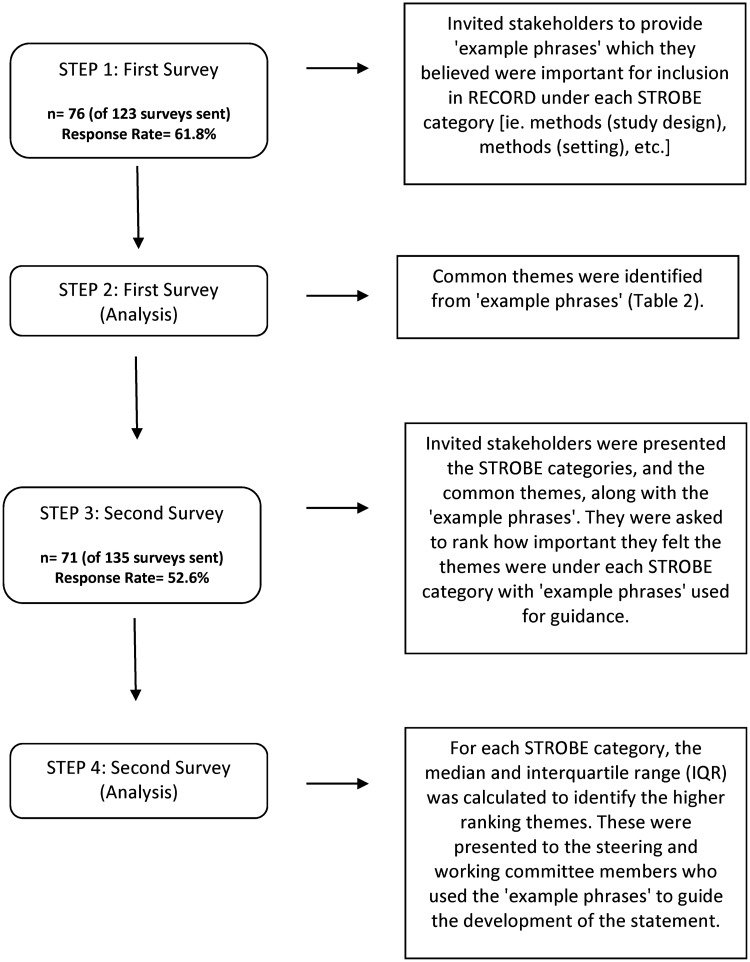
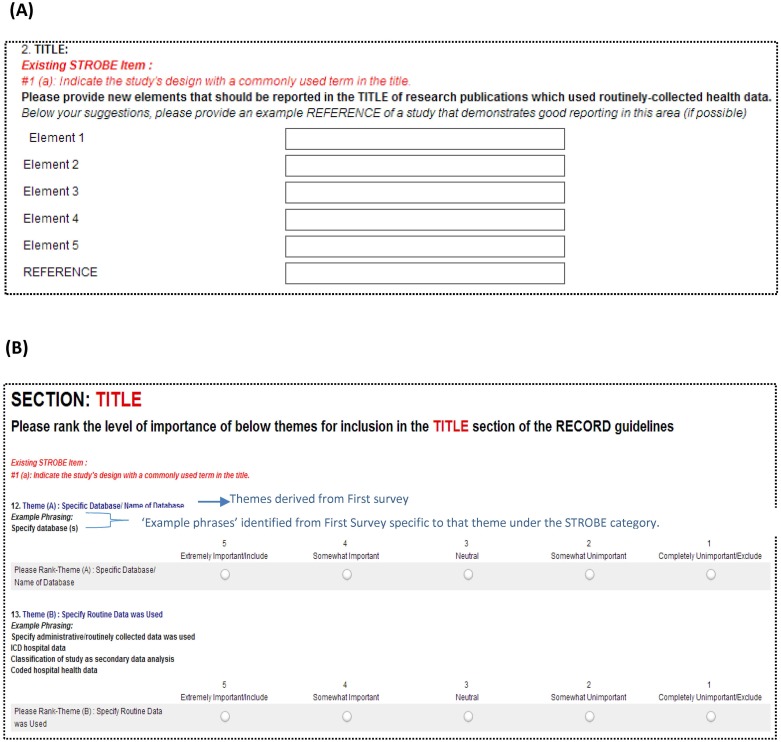
OBJECTIVE: Routinely collected health data, collected for administrative and clinical purposes, without specific a priori research questions, are increasingly used for observational, comparative effectiveness, health services research, and clinical trials. The rapid evolution and availability of routinely collected data for research has brought to light specific issues not addressed by existing reporting guidelines. The aim of the present project was to determine the priorities of stakeholders in order to guide the development of the REporting of studies Conducted using Observational Routinely-collected health Data (RECORD) statement. METHODS: Two modified electronic Delphi surveys were sent to stakeholders. The first determined themes deemed important to include in the RECORD statement, and was analyzed using qualitative methods. The second determined quantitative prioritization of the themes based on categorization of manuscript headings. The surveys were followed by a meeting of RECORD working committee, and re-engagement with stakeholders via an online commentary period. RESULTS: The qualitative survey (76 responses of 123 surveys sent) generated 10 overarching themes and 13 themes derived from existing STROBE categories. Highest-rated overall items for inclusion were: Disease/exposure identification algorithms; Characteristics of the population included in databases; and Characteristics of the data. In the quantitative survey (71 responses of 135 sent), the importance assigned to each of the compiled themes varied depending on the manuscript section to which they were assigned. Following the working committee meeting, online ranking by stakeholders provided feedback and resulted in revision of the final checklist. CONCLUSIONS: The RECORD statement incorporated the suggestions provided by a large, diverse group of stakeholders to create a reporting checklist specific to observational research using routinely collected health data. Our findings point to unique aspects of studies conducted with routinely collected health data and the perceived need for better reporting of methodological issues.
Overview
The claims and statistics of this paper haven’t been checked yet.
Run the check — free, no account needed. It reads the open-access text and checks the sources it cites.
Integrity signals
Registry
Cites
Statistics
Figures
Verification
Claims the paper makes
The claims and statistics of this paper haven’t been checked yet.
Run the check — free, no account needed. It reads the open-access text and checks the sources it cites.
Claims other papers make about this one
Each is checked against this paper’s own text: does it say what the citing paper says it does?
In the citing paper
“Extensive efforts were made to include a broad representation of stakeholders in the creation of these guidelines.”
From The Reporting of Studies Conducted Using Observational Routinely-Collected Health Data (RECORD) statement. (2015) · cites this paper as [16]
Self-check
Percentages, sums and reported differences re-computed from the paper’s own numbers.
The self-check needs the paper’s full text.
Citations
Cites
von Elm, E., Altman, D. G., Egger, M., Pocock, S. J., Gøtzsche, P. C., Vandenbroucke, J. P., & Initiative, F. T. S. (2007) · PLoS Medicine · doi:10.1371/journal.pmed.0040296 · Cited by 23,020
Moher, D., Cook, D. J., Eastwood, S., Olkin, I., Rennie, D., & Stroup, D. F. (1999) · The Lancet · doi:10.1016/s0140-6736(99)04149-5 · Cited by 4,826
Self-citationvon Elm, E., Altman, D. G., Egger, M., Pocock, S. J., Gøtzsche, P. C., & Vandenbroucke, J. P. (2007) · Preventive Medicine · doi:10.1016/j.ypmed.2007.08.012 · Cited by 2,698
Hillestad, R., Bigelow, J., Bower, A., Girosi, F., Meili, R., Scoville, R., & Taylor, R. (2005) · Health Affairs · doi:10.1377/hlthaff.24.5.1103 · Cited by 1,675
Bowling, A. (1998) · Journal of Psychophysiology · doi:10.1027//0269-8803.14.2.126 · Cited by 1,443 · cited 1×
“Additional participants were recruited through snowball sampling[10], in which the initially invited participants were asked to identify others.”
BackgroundGuidance for Developers of Health Research Reporting Guidelines
Moher, D., Schulz, K. F., Simera, I., & Altman, D. G. (2010) · PLoS Medicine · doi:10.1371/journal.pmed.1000217 · Cited by 1,437 · cited 2×
“[9] Such an exercise can be conducted using web and social media technologies to allow for the creation of a document that incorporates a large and diverse group of stakeholders.”
BackgroundSelf-citationPolicy: NIH plans to enhance reproducibility
Collins, F. S., & Tabak, L. A. (2014) · Nature · doi:10.1038/505612a · Cited by 1,247 · cited 1×
“Transparent reporting facilitates decision making by all readers and reproducibility of methods by interested researchers.[8] However, the rapid evolution and availability of routinely collected data for research has brought to light specific issues not addressed by STROBE.”
BackgroundTurner, L., Shamseer, L., Altman, D. G., Weeks, L., Peters, J., Kober, T., Dias, S., Schulz, K. F., Plint, A. C., & Moher, D. (2012) · Cochrane Database of Systematic Reviews · doi:10.1002/14651858.mr000030.pub2 · Cited by 740 · cited 1×
“They may also improve the completeness of reporting research.[16] Reporting guidelines have been demonstrated to improve reporting of studies when they are adopted by the research community and relevant journals, [17–20] although their effectiveness varies[20, 21] and may depend on implementation by journals rather th…”
BackgroundSelf-citationBenchimol, E. I., Manuel, D. G., To, T., Griffiths, A. M., Rabeneck, L., & Guttmann, A. (2011) · Journal of Clinical Epidemiology · doi:10.1016/j.jclinepi.2010.10.006 · Cited by 368
Self-citationThe 1% rule in four digital health social networks: An observational study
van Mierlo, T. (2014) · Journal of Medical Internet Research · doi:10.2196/jmir.2966 · Cited by 339 · cited 1×
“, that 1% of internet users create content, 9% of users modify or comment on that content, and 90% of users consume or observe internet activity.[26] Despite this, the contributions to the message board led to valuable pre-publication discussion and revision.”
Background
Research works printed but not linked: 1
- D Moher, 2010, Guidance for developers of health research reporting guidelines, PLoS Medicine, 7, e1000217, 10.1371/journal.pmed.1000217 · DOI · Paper page
Cited by
Sorted by citations
Benchimol, E. I., Smeeth, L., Guttmann, A., Harron, K., Moher, D., Petersen, I., Sørensen, H. T., von Elm, E., Langan, S. M., & RECORD Working Committee (2015) · PLOS Medicine · doi:10.1371/journal.pmed.1001885 · Cited by 5,749
“We recruited stakeholders through open calls and targeted invitations using a variety of channels [16].”
MethodSelf-citationLangan, S., Schmidt, S. A. J., Wing, K., Ehrenstein, V., Nicholls, S. G., Filion, K. B., Klungel, O. H., Petersen, I., Sørensen, H. T., Dixon, W. G., et al. (2018) · BMJ · doi:10.1136/bmj.k3532 · Cited by 673
Self-citationNwaru, B. I., Ekström, M. P., Hasvold, P., Wiklund, F., Telg, G., & Janson, C. (2020) · European Respiratory Journal · doi:10.1183/13993003.01872-2019 · Cited by 472
Long-term Cognitive, Psychological, and Health Outcomes Associated With Child Abuse and Neglect
Strathearn, L., Giannotti, M., Mills, R., Kisely, S., Najman, J., & Abajobir, A. (2020) · Pediatrics · doi:10.1542/peds.2020-0438 · Cited by 401
“Each of the reviewed articles followed Strengthening the Reporting of Observational Studies in Epidemiology (STROBE) guidelines for the conduct of cohort studies.(41) The quality of the studies was also evaluated by using a modified version of the Newcastle-Ottawa Scale, which is used to assess the following domains:…”
MethodStandards for Reporting Implementation Studies (StaRI): explanation and elaboration document
Pinnock, H., Barwick, M. A., Carpenter, C. R., Eldridge, S. M., Grandes, G., Griffiths, C., Rycroft‐Malone, J., Meißner, P., Murray, E., Patel, A. K., et al. (2017) · BMJ Open · doi:10.1136/bmjopen-2016-013318 · Cited by 355
“A description should be provided of the provenance of the data (data source/purpose and process of collection/data completeness) and validity of coding.(30)”
Background
Metadata
- Authors
- Nicholls, S. G., Quach, P., von Elm, E., Guttmann, A., Moher, D., Petersen, I., Sørensen, H. T., Smeeth, L., Langan, S. M., & Benchimol, E. I.
- Affiliations
- University of Ottawa (CA)
- Institute for Clinical Evaluative Sciences (CA)
- University of Toronto (CA)
- University College London (GB)
- Aarhus University (DK)
- London School of Hygiene & Tropical Medicine (GB)
- Corresponding author
- Benchimol, Eric I.
- ORCID
- Venue
- PLOS ONE
- Publisher
- Public Library of Science (PLoS)
- Published
- 2015-05-12
- Volume
- 10
- Issue
- 5
- Pages
- e0125620
- ISSN
- 1932-6203 (ISSN-L)
- PMC
- PMC4428635
- OpenAlex
- W1866803133
- Cited by
- 217
- References
- 26
- Citations by year
- 2026: 22 · 2025: 23 · 2024: 24 · 2023: 23 · 2022: 21 · 2021: 18 · 2020: 22 · 2019: 18 · 2018: 11 · 2017: 14 · 2016: 14 · 2015: 7
- FWCI
- 13.97
- Type
- journal article
- Language
- en
- Open access
- gold
- doi.org
- Licence
- Locations
- PLoS ONE (publishedVersion, cc-by)
- PubMed Central (publishedVersion, cc-by)
- PubMed (publishedVersion)
- LSHTM Research Online (London School of Hygiene and Tropical Medicine) (acceptedVersion)
- IRIS (submittedVersion)
- RePEc: Research Papers in Economics (submittedVersion)
- DOAJ (DOAJ: Directory of Open Access Journals) (submittedVersion, cc-by-sa)
- UCL Discovery (University College London) (submittedVersion)
- Figshare (submittedVersion, cc-by)
- SERVAL (Université de Lausanne) (submittedVersion, other-oa)
- Funders
- National Science Foundation
- Aarhus Universitet
- University of Ottawa
- Wellcome Trust (098504)
- Canadian Child Health Clinician Scientist Program
- National Institute for Health and Care Research (NIHR/CS/010/014, NF-SI-0510-10090)
- Schweizerischer Nationalfonds zur Förderung der Wissenschaftlichen Forschung (130512)
- Lundbeckfonden (R155-2014-2647)
- Novo Nordisk
- Novo Nordisk Fonden (NNF14SA0015794)
- H. Lundbeck A/S
- Canadian Institutes of Health Research (130512)
- Medical Research Council (MR/K006584/1)
- Topics
- Social Sciences › Decision Sciences › Statistics, Probability and Uncertainty › Meta-analysis and systematic reviews
- Social Sciences › Sociology and Political Science › Delphi Technique in Research
- Physical Sciences › Mathematics › Statistics and Probability › Statistical Methods in Epidemiology
- Keywords
- routinely collected health data, reporting guidelines, stakeholder consensus, Delphi method, observational studies, data characteristics, STROBE
- MeSH terms
- Adolescent, Adult, Aged, Database Management Systems, Female, Humans, Male, Medical Records, Middle Aged, Surveys and Questionnaires, Guidelines as Topic, Consensus, Observational Studies as Topic
About these checks
Registry, retraction, Cites and statistics results are computed, not judged, with one exception: a printed reference that no index lists is read once by a model before it counts as a citation error. Claims are extracted by a model and kept only when their quote appears verbatim in the text; each cited source is then checked, with a model’s help, for whether it says what the claim relies on. Those verdicts can be wrong — read the claim’s quote and the cited source before relying on one.
Statistics and arithmetic are recomputed, not judged.
Confidence bands are shown only for fields calibrated on our annotated test set. None is calibrated yet, so no band is shown.
What counts as a claim ›How we measure confidence ›How we check this ›
Are you an author, or do you see a problem with this page? Request a review
