

Use of Recommended Search Strategies in Systematic Reviews and the Impact of Librarian Involvement: A Cross-Sectional Survey of Recent Authors
Open accessThe DOI matches its Crossref record; 48 of the 48 references it cites were found in a registry or an index.
Abstract
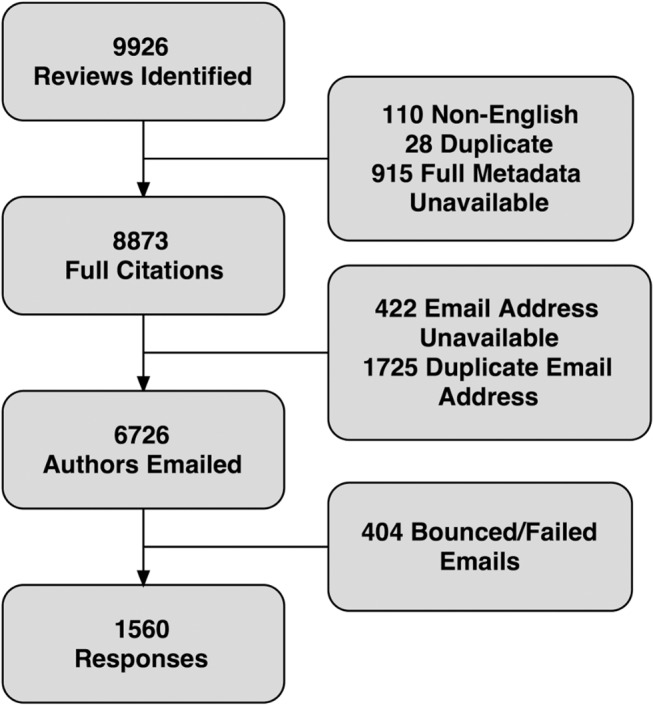
BACKGROUND: Previous research looking at published systematic reviews has shown that their search strategies are often suboptimal and that librarian involvement, though recommended, is low. Confidence in the results, however, is limited due to poor reporting of search strategies the published articles. OBJECTIVES: To more accurately measure the use of recommended search methods in systematic reviews, the levels of librarian involvement, and whether librarian involvement predicts the use of recommended methods. METHODS: A survey was sent to all authors of English-language systematic reviews indexed in the Database of Abstracts of Reviews of Effects (DARE) from January 2012 through January 2014. The survey asked about their use of search methods recommended by the Institute of Medicine, Cochrane Collaboration, and the Agency for Healthcare Research and Quality and if and how a librarian was involved in the systematic review. Rates of use of recommended methods and librarian involvement were summarized. The impact of librarian involvement on use of recommended methods was examined using a multivariate logistic regression. RESULTS: 1560 authors completed the survey. Use of recommended search methods ranged widely from 98% for use of keywords to 9% for registration in PROSPERO and were generally higher than in previous studies. 51% of studies involved a librarian, but only 64% acknowledge their assistance. Librarian involvement was significantly associated with the use of 65% of recommended search methods after controlling for other potential predictors. Odds ratios ranged from 1.36 (95% CI 1.06 to 1.75) for including multiple languages to 3.07 (95% CI 2.06 to 4.58) for using controlled vocabulary. CONCLUSIONS: Use of recommended search strategies is higher than previously reported, but many methods are still under-utilized. Librarian involvement predicts the use of most methods, but their involvement is under-reported within the published article.
Overview
The claims and statistics of this paper haven’t been checked yet.
Free: it reads the open-access text and checks the first 5 claims that cite a source we can check. Create a free account to check every claim.
Integrity signals
Registry
Cites
Statistics
Figures
Verification
Claims the paper makes
The claims and statistics of this paper haven’t been checked yet.
Free: it reads the open-access text and checks the first 5 claims that cite a source we can check. Create a free account to check every claim.
Claims other papers make about this one
Each is checked against this paper’s own text: does it say what the citing paper says it does?
The cited source says what the claim attributes to it.
In the citing paper
“Preliminary research suggests that librarian or information specialist involvement is correlated with reproducibility of searches [16 -18], likely due to their expertise surrounding search development and documentation.”
From PRISMA-S: an extension to the PRISMA Statement for Reporting Literature Searches in Systematic Reviews (2021) · cites this paper as [16]
The cited source says what the claim attributes to it.
In the citing paper
“Another part of the challenge may be that many systematic reviews do not include librarians or information specialists as members of the systematic review team or as authors on the final manuscript [11, 16 -18].”
From PRISMA-S: an extension to the PRISMA Statement for Reporting Literature Searches in Systematic Reviews (2021) · cites this paper as [16]
Self-check
Percentages, sums and reported differences re-computed from the paper’s own numbers.
The self-check needs the paper’s full text.
Citations
Cites
Preferred Reporting Items for Systematic Reviews and Meta-Analyses: the PRISMA statement
Moher, D., Liberati, A., Tetzlaff, J., Altman, D. G., & for the PRISMA Group (2009) · BMJ · doi:10.1136/bmj.b2535 · Cited by 83,823
Preferred reporting items for systematic reviews and meta-analyses: the PRISMA Statement.
(2009) · PubMed Central · Cited by 44,859
Liberati, A., Altman, D. G., Tetzlaff, J., Mulrow, C., Gøtzsche, P. C., Ioannidis, J. P. A., Clarke, M., Devereaux, P. J., Kleijnen, J., & Moher, D. (2009) · PLoS Medicine · doi:10.1371/journal.pmed.1000100 · Cited by 28,164 · cited 1×
“The foundation of any systematic review is a comprehensive and systematic search that identifies all eligible studies on the topic and utilizes specialized search tools and methods [3].”
BackgroundDermyshi, E., Wang, Y., Yan, C., Hong, W., Qiu, G., Gong, X., & Zhang, T. (2017) · Neonatology · doi:10.1159/000454668 · Cited by 24,451
Meta-analysis of Observational Studies in Epidemiology<SUBTITLE>A Proposal for Reporting</SUBTITLE>
Stroup, D. F. (2000) · JAMA · doi:10.1001/jama.283.15.2008 · Cited by 20,623
Preferred Reporting Items for Systematic Reviews and Meta-Analyses: The PRISMA Statement
Moher, D., Liberati, A., Tetzlaff, J., & Altman, D. G. (2009) · Journal of Clinical Epidemiology · doi:10.1016/j.jclinepi.2009.06.005 · Cited by 19,575
Why the impact factor of journals should not be used for evaluating research
Seglen, P. O. (1997) · BMJ · doi:10.1136/bmj.314.7079.497 · Cited by 2,447
Finding What Works in Health Care: Standards for Systematic Reviews
Eden, J., Levit, L. A., Berg, A. O., & Morton, S. C. (2013) · Cited by 948
Epidemiology and reporting characteristics of systematic reviews.
Moher, D., Tetzlaff, J., Tricco, A. C., Sampson, M., & Altman, D. G. (2007) · PLoS Medicine · doi:10.1371/journal.pmed.0040078 · Cited by 891
Panic, N., Leoncini, E., de Belvis, G., Ricciardi, W., & Boccia, S. (2013) · PLoS ONE · doi:10.1371/journal.pone.0083138 · Cited by 883 · cited 1×
“These include specialized knowledge in or training on systematic review methods [31, 32], publishing in a higher impact journal [32, 33], previous experience writing systematic reviews [34], use of a reporting guidelines [35, 36], years of professional practice, time taken to write the review, year of publication and…”
Background
Research works printed but not linked: 4
- OCEBM Levels of Evidence Working Group. The Oxford Levels of Evidence 2 website Oxford, UK: Oxford Centre for Evidence-Based Medicine Available: http://www.cebm.net/index.aspx?o=5653. Accessed 1 April 2015.
- Scopus [website]. Elsevier. 2014. Available: http://www.scopus.com/. Accessed 1 April 2015.
- Journal Citation Reports [website]. Thomson Reuters. 2014. Available: http://thomsonreuters.com/journal-citation-reports/. Accessed 1 April 2015.
- About Cochrane Reviews [website]. London, UK: The Cochrane Collaboration; 2015. Available: http://www.cochranelibrary.com/about/about-cochrane-systematic-reviews.html. Accessed 1 April 2015.
Cited by
Rethlefsen, M. L., Kirtley, S., Waffenschmidt, S., Ayala, A. P., Moher, D., Page, M. J., & Koffel, J. (2019) · doi:10.31219/osf.io/sfc38 · Cited by 3,696
Self-citationRethlefsen, M. L., Kirtley, S., Waffenschmidt, S., Ayala, A. P., Moher, D., Page, M. J., Koffel, J. B., PRISMA-S Group, Blunt, H., Brigham, T., et al. (2021) · Systematic Reviews · doi:10.1186/s13643-020-01542-z · Cited by 3,714
Self-citationGusenbauer, M., & Haddaway, N. R. (2020) · Research Synthesis Methods · doi:10.1002/jrsm.1378 · Cited by 2,379
“Accordingly, collaboration with librarians, as information experts in these complex literature search processes, has been shown to benefit study quality.(9,11,12) In evidence syntheses, online databases should “form the backbone of any comprehensive literature search.”
BackgroundPreferred Reporting Items for Systematic Reviews and Meta-Analyses
Vrabel, M. (2015) · Oncology Nursing Forum · doi:10.1188/15.onf.552-554 · Cited by 669
Meeting the review family: exploring review types and associated information retrieval requirements
Sutton, A., Clowes, M., Preston, L., & Booth, A. (2019) · Health Information & Libraries Journal · doi:10.1111/hir.12276 · Cited by 570
Metadata
- Authors
- Koffel, J. B.
- Affiliations
- University of Minnesota (US)
- Corresponding author
- Koffel, Jonathan B.
- ORCID
- Koffel, Jonathan B.
- Venue
- PLOS ONE
- Publisher
- Public Library of Science (PLoS)
- Published
- 2015-05-04
- Volume
- 10
- Issue
- 5
- Pages
- e0125931
- ISSN
- 1932-6203 (ISSN-L)
- PMC
- PMC4418838
- OpenAlex
- W2130019206
- Cited by
- 159
- References
- 48
- Citations by year
- 2026: 11 · 2025: 7 · 2024: 26 · 2023: 16 · 2022: 14 · 2021: 22 · 2020: 25 · 2019: 15 · 2018: 9 · 2017: 7 · 2016: 5 · 2015: 2
- FWCI
- 1.26
- Type
- journal article
- Language
- en
- Open access
- gold
- doi.org
- Licence
- Locations
- PLoS ONE (publishedVersion, cc-by)
- PubMed Central (publishedVersion, cc-by)
- PubMed (publishedVersion)
- University of Minnesota Digital Conservancy (University of Minnesota) (submittedVersion)
- RePEc: Research Papers in Economics (submittedVersion)
- DOAJ (DOAJ: Directory of Open Access Journals) (submittedVersion, cc-by-sa)
- Figshare (submittedVersion, cc-by)
- Topics
- Social Sciences › Decision Sciences › Statistics, Probability and Uncertainty › Meta-analysis and systematic reviews
- Social Sciences › Library and Information Sciences › scientometrics and bibliometrics research
- Health Sciences › Health Professions › General Health Professions › Health Sciences Research and Education
- Keywords
- systematic reviews, literature search strategies, librarian involvement, search strategy reporting, PROSPERO registration, controlled vocabulary, multilingual information retrieval, Institute of Medicine guidelines
- MeSH terms
- Cross-Sectional Studies, Humans, Surveys and Questionnaires, Databases, Factual, Librarians, Information Storage and Retrieval
About these checks
Registry, retraction, Cites and statistics results are computed, not judged, with one exception: a printed reference that no index lists is read once by a model before it counts as a citation error. Claims are extracted by a model and kept only when their quote appears verbatim in the text; each cited source is then checked, with a model’s help, for whether it says what the claim relies on. Those verdicts can be wrong — read the claim’s quote and the cited source before relying on one.
Statistics and arithmetic are recomputed, not judged.
Confidence bands are shown only for fields calibrated on our annotated test set. None is calibrated yet, so no band is shown.
What counts as a claim ›How we measure confidence ›How we check this ›
Are you an author, or do you see a problem with this page? Request a review
Data sources
Bibliographic data: Semantic Scholar, OpenAlex, Crossref.
Contains information from the Semantic Scholar Academic Graph Datasets, made available under the ODC Attribution License (ODC-BY 1.0).
Semantic Scholar’s data is described in: Kinney, R., et al. (2023). The Semantic Scholar Open Data Platform. arXiv:2301.10140.
