

Transcranial Electrical Stimulation over Dorsolateral Prefrontal Cortex Modulates Processing of Social Cognitive and Affective Information
Open accessThe DOI matches its Crossref record; 57 of the 57 references it cites were found in a registry or an index.
Abstract
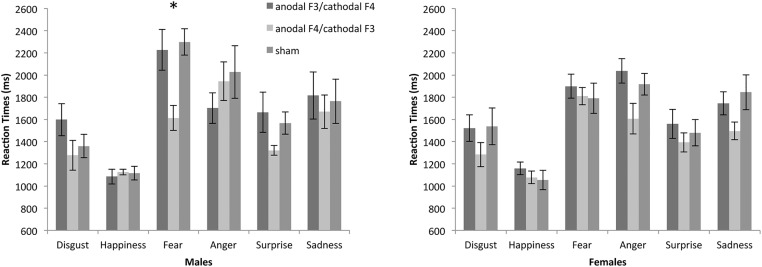
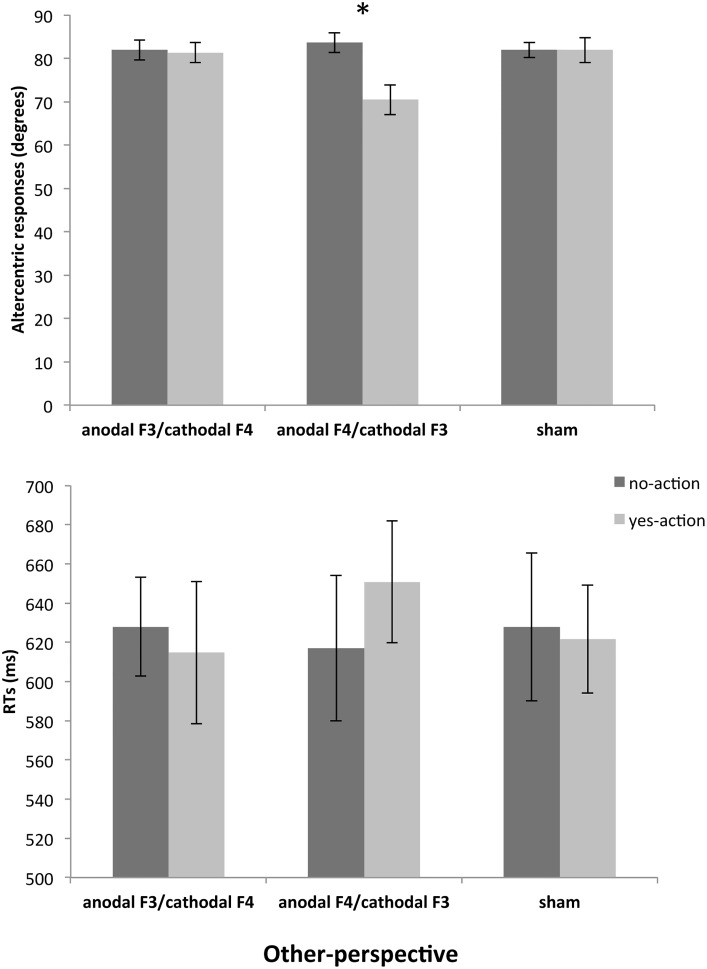
Recent neurofunctional studies suggested that lateral prefrontal cortex is a domain-general cognitive control area modulating computation of social information. Neuropsychological evidence reported dissociations between cognitive and affective components of social cognition. Here, we tested whether performance on social cognitive and affective tasks can be modulated by transcranial direct current stimulation (tDCS) over dorsolateral prefrontal cortex (DLPFC). To this aim, we compared the effects of tDCS on explicit recognition of emotional facial expressions (affective task), and on one cognitive task assessing the ability to adopt another person's visual perspective. In a randomized, cross-over design, male and female healthy participants performed the two experimental tasks after bi-hemispheric tDCS (sham, left anodal/right cathodal, and right anodal/left cathodal) applied over DLPFC. Results showed that only in male participants explicit recognition of fearful facial expressions was significantly faster after anodal right/cathodal left stimulation with respect to anodal left/cathodal right and sham stimulations. In the visual perspective taking task, instead, anodal right/cathodal left stimulation negatively affected both male and female participants' tendency to adopt another's point of view. These findings demonstrated that concurrent facilitation of right and inhibition of left lateral prefrontal cortex can speed-up males' responses to threatening faces whereas it interferes with the ability to adopt another's viewpoint independently from gender. Thus, stimulation of cognitive control areas can lead to different effects on social cognitive skills depending on the affective vs. cognitive nature of the task, and on the gender-related differences in neural organization of emotion processing.
Overview
The claims and statistics of this paper haven’t been checked yet.
Free: it reads the open-access text and checks the first 5 claims that cite a source we can check. Create a free account to check every claim.
Integrity signals
Registry
Cites
Statistics
Figures

Verification
Claims the paper makes
The claims and statistics of this paper haven’t been checked yet.
Free: it reads the open-access text and checks the first 5 claims that cite a source we can check. Create a free account to check every claim.
Claims other papers make about this one
Each is checked against this paper’s own text: does it say what the citing paper says it does?
In the citing paper
“Using transcranial electrical stimulation, a recent study suggested dysfunctional left DLPFC activity during perspective taking (Conson et al., 2015).”
From Social functioning in major depressive disorder (2016) · cites this paper as Conson et al., 2015
Self-check
Percentages, sums and reported differences re-computed from the paper’s own numbers.
The self-check needs the paper’s full text.
Citations
Cites
Baltosser, W. H., & Zar, J. H. (1996) · Ecology · doi:10.2307/2265725 · Cited by 35,166
Does the chimpanzee have a theory of mind?
Premack, D., & Woodruff, G. (1978) · Behavioral and Brain Sciences · doi:10.1017/s0140525x00076512 · Cited by 8,743
Zar, J. H. (1996) · Cited by 7,837
Rizzolatti, G., & Craighero, L. (2004) · Annual Review of Neuroscience · doi:10.1146/annurev.neuro.27.070203.144230 · Cited by 7,433 · cited 2×
“Thus, we might suggest that such “enhanced egocentrism” can be related to increased inhibitory control of the dorsolateral prefrontal cortex over domainspecific neural systems involved in mental simulation of others’ actions, such as the mirror neuron system [50].”
BackgroundBiostatistical Analysis (2nd ed.).
Breen, T. J., & Zar, J. H. (1986) · Journal of the American Statistical Association · doi:10.2307/2289268 · Cited by 5,781
Ekman, P. (1976) · Medical Entomology and Zoology · Cited by 4,345
Cattaneo, L., & Rizzolatti, G. (2009) · Archives of Neurology · doi:10.1001/archneurol.2009.41 · Cited by 3,137
Ochsner, K. N., Silvers, J. A., & Buhle, J. T. (2012) · Annals of the New York Academy of Sciences · doi:10.1111/j.1749-6632.2012.06751.x · Cited by 1,879
The Neural Basis of Mentalizing
Frith, C. D., & Frith, U. (2006) · Neuron · doi:10.1016/j.neuron.2006.05.001 · Cited by 1,855
Cognitive neuroscience of human social behaviour
Adolphs, R. (2003) · Nature Reviews Neuroscience · doi:10.1038/nrn1056 · Cited by 1,657 · cited 1×
“signals”, such as facial expressions, eye gaze and body posture [1–3].”
Background
Cited by
Social functioning in major depressive disorder
Kupferberg, A., Bicks, L., & Hasler, G. (2016) · Neuroscience & Biobehavioral Reviews · doi:10.1016/j.neubiorev.2016.07.002 · Cited by 663
“Using transcranial electrical stimulation, a recent study suggested dysfunctional left DLPFC activity during perspective taking (Conson et al., 2015).”
Social brain, social dysfunction and social withdrawal
Porcelli, S., Van Der Wee, N., van der Werff, S., Aghajani, M., Glennon, J. C., van Heukelum, S., Mogavero, F., Lobo, A., Olivera, F. J., Lobo, E., et al. (2019) · Neuroscience & Biobehavioral Reviews · doi:10.1016/j.neubiorev.2018.09.012 · Cited by 391
Adenzato, M., Brambilla, M., Manenti, R., Lucia, L. D., Trojano, L., Garofalo, S., Enrici, I., & Cotelli, M. (2017) · Scientific Reports · doi:10.1038/srep41219 · Cited by 140
Self-citationThe stimulated social brain: effects of transcranial direct current stimulation on social cognition
Sellaro, R., Nitsche, M. A., & Colzato, L. S. (2016) · Annals of the New York Academy of Sciences · doi:10.1111/nyas.13098 · Cited by 99
Neural mechanisms necessary for empathy-related phenomena across species
Paradiso, E., Gazzola, V., & Keysers, C. (2021) · Current Opinion in Neurobiology · doi:10.1016/j.conb.2021.02.005 · Cited by 78
Metadata
- Authors
- Conson, M., Errico, D., Mazzarella, E., Giordano, M., Grossi, D., & Trojano, L.
- Affiliations
- University of Campania "Luigi Vanvitelli" (IT)
- Fondazione Santa Lucia (IT)
- Corresponding author
- Conson, Massimiliano
- Trojano, Luigi
- Venue
- PLOS ONE
- Publisher
- Public Library of Science (PLoS)
- Published
- 2015-05-07
- Volume
- 10
- Issue
- 5
- Pages
- e0126448
- ISSN
- 1932-6203 (ISSN-L)
- PMC
- PMC4423854
- OpenAlex
- W314769892
- Cited by
- 57
- References
- 57
- Citations by year
- 2025: 4 · 2024: 6 · 2023: 5 · 2022: 3 · 2021: 9 · 2020: 7 · 2019: 6 · 2018: 6 · 2017: 6 · 2016: 4 · 2015: 1
- FWCI
- 3.03
- Type
- journal article
- Language
- en
- Open access
- gold
- doi.org
- Licence
- Locations
- PLoS ONE (publishedVersion, cc-by)
- PubMed Central (publishedVersion, cc-by)
- PubMed (publishedVersion)
- DOAJ (DOAJ: Directory of Open Access Journals) (submittedVersion)
- Archivio Istituzionale della Ricerca - Università degli Studi della Campania "Luigi Vanvitelli" (submittedVersion)
- Topics
- Life Sciences › Neuroscience › Neurology › Transcranial Magnetic Stimulation Studies
- Life Sciences › Neuroscience › Cognitive Neuroscience › Neural and Behavioral Psychology Studies
- Life Sciences › Neuroscience › Cognitive Neuroscience › Face Recognition and Perception
- Keywords
- transcranial direct current stimulation, dorsolateral prefrontal cortex, social cognition, emotional processing, facial expression recognition, fearful faces, perspective taking, cognitive control, hemispheric lateralization, gender differences
- MeSH terms
- Adult, Cognition, Decision Making, Emotions, Female, Humans, Inhibition, Psychological, Interpersonal Relations, Male, Reaction Time, Visual Perception, Prefrontal Cortex, Cross-Over Studies, Young Adult, Transcranial Direct Current Stimulation
About these checks
Registry, retraction, Cites and statistics results are computed, not judged, with one exception: a printed reference that no index lists is read once by a model before it counts as a citation error. Claims are extracted by a model and kept only when their quote appears verbatim in the text; each cited source is then checked, with a model’s help, for whether it says what the claim relies on. Those verdicts can be wrong — read the claim’s quote and the cited source before relying on one.
Statistics and arithmetic are recomputed, not judged.
Confidence bands are shown only for fields calibrated on our annotated test set. None is calibrated yet, so no band is shown.
What counts as a claim ›How we measure confidence ›How we check this ›
Are you an author, or do you see a problem with this page? Request a review
How to cite
Cite CoChat for the checks on this page, and the paper for its own findings.
- This page
- CoChat. (2026). Citation check: Transcranial Electrical Stimulation over Dorsolateral Prefrontal Cortex Modulates Processing of Social Cognitive and Affective Information. https://app.cochat.ai/papers/10.1371/journal.pone.0126448
- The paper
- Conson, M., Errico, D., Mazzarella, E., Giordano, M., Grossi, D., & Trojano, L. (2015). Transcranial Electrical Stimulation over Dorsolateral Prefrontal Cortex Modulates Processing of Social Cognitive and Affective Information. PLOS ONE. https://doi.org/10.1371/journal.pone.0126448
Data sources
Bibliographic data: Semantic Scholar, OpenAlex, Crossref.
Contains information from the Semantic Scholar Academic Graph Datasets, made available under the ODC Attribution License (ODC-BY 1.0).
Semantic Scholar’s data is described in: Kinney, R., et al. (2023). The Semantic Scholar Open Data Platform. arXiv:2301.10140.
