

The DOI matches its Crossref record; 51 of the 51 references it cites were found in a registry or an index.
Expectation Suppression in Early Visual Cortex Depends on Task Set
Open accessAbstract
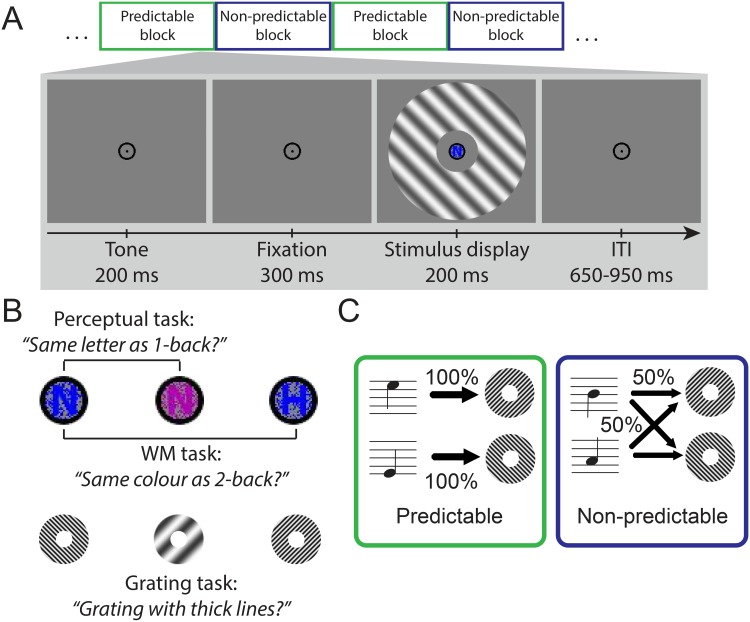
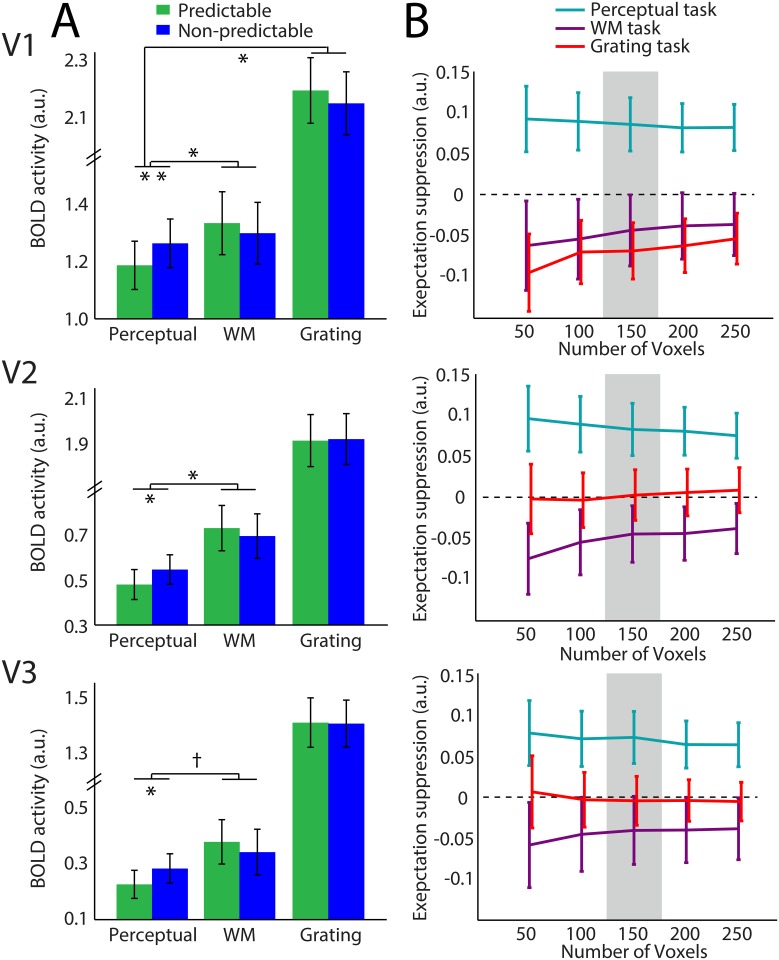
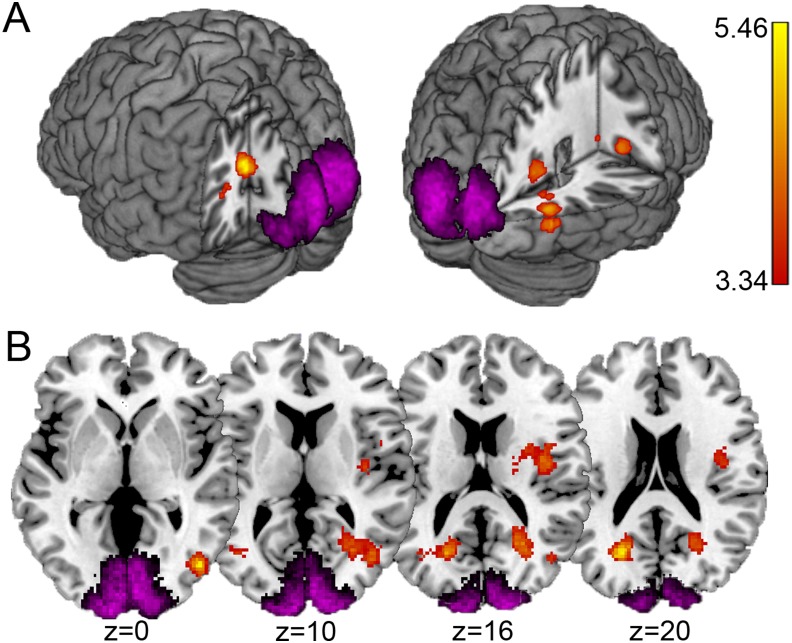
Stimulus expectation can modulate neural responses in early sensory cortical regions, with expected stimuli often leading to a reduced neural response. However, it is unclear whether this expectation suppression is an automatic phenomenon or is instead dependent on the type of task a subject is engaged in. To investigate this, human subjects were presented with visual grating stimuli in the periphery that were either predictable or non-predictable while they performed three tasks that differently engaged cognitive resources. In two of the tasks, the predictable stimulus was task-irrelevant and spatial attention was engaged at fixation, with a high load on either perceptual or working memory resources. In the third task, the predictable stimulus was task-relevant, and therefore spatially attended. We observed that expectation suppression is dependent on the cognitive resources engaged by a subjects' current task. When the grating was task-irrelevant, expectation suppression for predictable items was visible in retinotopically specific areas of early visual cortex (V1-V3) during the perceptual task, but it was abolished when working memory was loaded. When the grating was task-relevant and spatially attended, there was no significant effect of expectation in early visual cortex. These results suggest that expectation suppression is not an automatic phenomenon, but dependent on attentional state and type of available cognitive resources.
Overview
The claims and statistics of this paper haven’t been checked yet.
Free: it reads the open-access text and checks the first 5 claims that cite a source we can check. Create a free account to check every claim.
Integrity signals
Registry
Cites
Statistics
Figures
Verification
Claims the paper makes
The claims and statistics of this paper haven’t been checked yet.
Free: it reads the open-access text and checks the first 5 claims that cite a source we can check. Create a free account to check every claim.
Claims other papers make about this one
Each is checked against this paper’s own text: does it say what the citing paper says it does?
The source backs part of the claim, not all of it — or backs it for a different population, condition or comparison.
In the citing paper
“Indeed, most of the studies that report PP‐like dynamics in V1 use simple stimuli like gratings or flashes.”
From Evaluating the neurophysiological evidence for predictive processing as a model of perception (2020) · cites this paper as [107]
Experimental — accuracy not yet measured
Self-check
Percentages, sums and reported differences re-computed from the paper’s own numbers.
The self-check needs the paper’s full text.
Citations
Cites
Brainard, D. H. (1997) · Spatial Vision · doi:10.1163/156856897x00357 · Cited by 19,702 · cited 2×
“Stimuli were generated using MATLAB (MathWorks, Natick, MA, US) in conjunction with Psychophysics Toolbox [13].”
MethodThe attention system of the human brain
Posner, M. I., & Petersen, S. E. (1990) · Annual Review of Neuroscience · doi:10.1146/annurev.ne.13.030190.000325 · Cited by 8,070 · cited 1×
“Indeed, many studies on attention employ cues that concurrently signal what is likely and what is relevant [50], thereby conflating expectation and attention.”
BackgroundRao, R. P. N., & Ballard, D. H. (1999) · Nature Neuroscience · doi:10.1038/4580 · Cited by 5,483
A theory of cortical responses.
Friston, K. (2005) · Philosophical Transactions of the Royal Society B: Biological Sciences · doi:10.1098/rstb.2005.1622 · Cited by 4,578
Borders of Multiple Visual Areas in Humans Revealed by Functional Magnetic Resonance Imaging
Sereno, M. I., Dale, A. M., Reppas, J. B., Kwong, K. K., Belliveau, J. W., Brady, T. J., Rosen, B. R., & Tootell, R. B. H. (1995) · Science · doi:10.1126/science.7754376 · Cited by 2,658
Quest: A Bayesian adaptive psychometric method
Watson, A. B., & Pelli, D. G. (1983) · Perception & Psychophysics · doi:10.3758/bf03202828 · Cited by 2,410 · cited 1×
“The stimuli from the perceptual and grating tasks were adjusted using an adaptive staircase-procedure [19] set to the accuracy that the participant attained on the working memory task.”
MethodDistracted and confused? Selective attention under load
Lavie, N. (2005) · Trends in Cognitive Sciences · doi:10.1016/j.tics.2004.12.004 · Cited by 2,102 · cited 1×
“In line with this, previous research has shown that task set can have a profound effect on the extent to which items in the visual background are processed [11, 12]: irrelevant background stimuli tend to be suppressed during tasks that load perceptual resources, whereas there is no suppression for background stimuli w…”
ResultPersistent activity in the prefrontal cortex during working memory
Curtis, C. E., & D'Esposito, M. (2003) · Trends in Cognitive Sciences · doi:10.1016/s1364-6613(03)00197-9 · Cited by 2,001 · cited 1×
“Given that the task-relevant stimuli and the gratings were processed in non-overlapping regions of V1, the conflict may not be at the level of sensory cortex, but rather at the level of the frontal and parietal regions that are involved both in working memory [39, 40] and the generation of sensory predictions [41, 42].”
BackgroundConfidence Intervals from Normalized Data: A correction to Cousineau (2005)
Morey, R. D. (2008) · Tutorials in Quantitative Methods for Psychology · doi:10.20982/tqmp.04.2.p061 · Cited by 1,997
Confidence intervals in within-subject designs: A simpler solution to Loftus and Masson's method
Cousineau, D. (2005) · Tutorials in Quantitative Methods for Psychology · doi:10.20982/tqmp.01.1.p042 · Cited by 1,874
Cited by
How Do Expectations Shape Perception?
de Lange, F. P., Heilbron, M., & Kok, P. (2018) · Trends in Cognitive Sciences · doi:10.1016/j.tics.2018.06.002 · Cited by 975
Self-citationEvaluating the neurophysiological evidence for predictive processing as a model of perception
Walsh, K. S., McGovern, D. P., Clark, A., & O'Connell, R. G. (2020) · Annals of the New York Academy of Sciences · doi:10.1111/nyas.14321 · Cited by 333
Suppressed Sensory Response to Predictable Object Stimuli throughout the Ventral Visual Stream
Richter, D., Ekman, M., & de Lange, F. P. (2018) · The Journal of Neuroscience · doi:10.1523/jneurosci.3421-17.2018 · Cited by 150
“…of expected stimuli, evident throughout the ventral visual stream in the present study, extends and supports previous research showing expectation suppression in early visual areas (Kok et al., 2012a; St. John-Saaltink et al., 2015) and monkey IT (Meyer and Olson, 2011; Kaposvari et al., 2016).”
ResultSelective inhibition of distracting input
Noonan, M. P., Crittenden, B. M., Jensen, O. B., & Stokes, M. G. (2017) · Behavioural Brain Research · doi:10.1016/j.bbr.2017.10.010 · Cited by 146
“For example working memory load may be expected to affect expectation suppression if templates are compared to bottom-up input [77] but leave secondary”
BackgroundStimulus expectation alters decision criterion but not sensory signal in perceptual decision making
Bang, J. W., & Rahnev, D. (2017) · Scientific Reports · doi:10.1038/s41598-017-16885-2 · Cited by 121
Metadata
- Authors
- St. John-Saaltink, E., Utzerath, C., Kok, P., Lau, H. C., & de Lange, F. P.
- Affiliations
- Radboud University Nijmegen (NL)
- Venue
- PLOS ONE
- Publisher
- Public Library of Science (PLoS)
- Published
- 2015-06-22
- Volume
- 10
- Issue
- 6
- Pages
- e0131172
- ISSN
- 1932-6203 (ISSN-L)
- PMC
- PMC4476778
- OpenAlex
- W2280568909
- Cited by
- 43
- References
- 51
- Citations by year
- 2026: 1 · 2025: 5 · 2024: 5 · 2023: 1 · 2022: 4 · 2021: 3 · 2020: 2 · 2019: 7 · 2018: 4 · 2017: 7 · 2016: 3 · 2015: 1
- FWCI
- 3.01
- Type
- journal article
- Language
- en
- Open access
- gold
- doi.org
- Licence
- Locations
- PLoS ONE (publishedVersion, cc-by)
- Europe PMC (PubMed Central) (publishedVersion, cc-by)
- PubMed Central (publishedVersion, cc-by)
- PubMed (publishedVersion)
- DOAJ (DOAJ: Directory of Open Access Journals) (submittedVersion, cc-by-sa)
- The HKU Scholars Hub (University of Hong Kong) (submittedVersion, cc-by-nc-nd)
- Radboud Repository (Radboud University) (submittedVersion)
- Radboud Repository (Radboud University) (submittedVersion, other-oa)
- Data Archiving and Networked Services (DANS) (submittedVersion)
- Radboud Repository (Radboud University)
- Funders
- Nederlandse Organisatie voor Wetenschappelijk Onderzoek (404-10-037)
- Topics
- Life Sciences › Neuroscience › Cognitive Neuroscience › Visual perception and processing mechanisms
- Physical Sciences › Computer Science › Computer Vision and Pattern Recognition › Visual Attention and Saliency Detection
- Life Sciences › Neuroscience › Cognitive Neuroscience › Neural and Behavioral Psychology Studies
- Keywords
- early visual cortex, task sets, stimulus predictability, spatial attention, working memory load, perceptual load, peripheral vision, cognitive resources
- MeSH terms
- Attention, Female, Humans, Male, Memory, Short-Term, Photic Stimulation, Task Performance and Analysis, Visual Cortex, Visual Perception, Young Adult, Anticipation, Psychological
About these checks
Registry, retraction, Cites and statistics results are computed, not judged, with one exception: a printed reference that no index lists is read once by a model before it counts as a citation error. Claims are extracted by a model and kept only when their quote appears verbatim in the text; each cited source is then checked, with a model’s help, for whether it says what the claim relies on. Those verdicts can be wrong — read the claim’s quote and the cited source before relying on one.
Statistics and arithmetic are recomputed, not judged.
Confidence bands are shown only for fields calibrated on our annotated test set. None is calibrated yet, so no band is shown.
What counts as a claim ›How we measure confidence ›How we check this ›
Are you an author, or do you see a problem with this page? Request a review
How to cite
Cite CoChat for the checks on this page, and the paper for its own findings.
- This page
- CoChat. (2026). Citation check: Expectation Suppression in Early Visual Cortex Depends on Task Set. https://app.cochat.ai/papers/10.1371/journal.pone.0131172
- The paper
- St. John-Saaltink, E., Utzerath, C., Kok, P., Lau, H. C., & de Lange, F. P. (2015). Expectation Suppression in Early Visual Cortex Depends on Task Set. PLOS ONE. https://doi.org/10.1371/journal.pone.0131172
Data sources
Bibliographic data: Semantic Scholar, OpenAlex, Crossref.
Contains information from the Semantic Scholar Academic Graph Datasets, made available under the ODC Attribution License (ODC-BY 1.0).
Semantic Scholar’s data is described in: Kinney, R., et al. (2023). The Semantic Scholar Open Data Platform. arXiv:2301.10140.
