

Conservation Status of North American Birds in the Face of Future Climate Change
The DOI matches its Crossref record; 4 of the 4 references it cites were found in a registry or an index.
Abstract
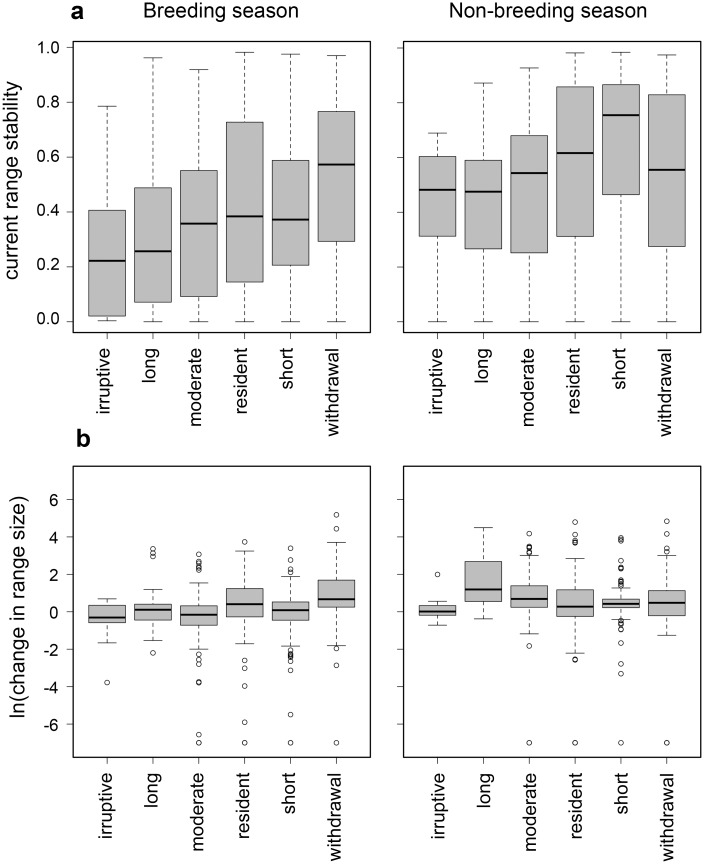
Human-induced climate change is increasingly recognized as a fundamental driver of biological processes and patterns. Historic climate change is known to have caused shifts in the geographic ranges of many taxa and future climate change is expected to result in even greater redistributions of species. As a result, predicting the impact of climate change on future patterns of biodiversity will greatly aid conservation planning. Using the North American Breeding Bird Survey and Audubon Christmas Bird Count, two of the most comprehensive continental datasets of vertebrates in the world, and correlative distribution modeling, we assessed geographic range shifts for 588 North American bird species during both the breeding and non-breeding seasons under a range of future emission scenarios (SRES A2, A1B, B2) through the end of the century. Here we show that 314 species (53%) are projected to lose more than half of their current geographic range across three scenarios of climate change through the end of the century. For 126 species, loss occurs without concomitant range expansion; whereas for 188 species, loss is coupled with potential to colonize new replacement range. We found no strong associations between projected climate sensitivities and existing conservation prioritizations. Moreover, species responses were not clearly associated with habitat affinities, migration strategies, or climate change scenarios. Our results demonstrate the need to include climate sensitivity into current conservation planning and to develop adaptive management strategies that accommodate shrinking and shifting geographic ranges. The persistence of many North American birds will depend on their ability to colonize climatically suitable areas outside of current ranges and management actions that target climate adaptation.
Overview
The claims and statistics of this paper haven’t been checked yet.
Free: it reads the open-access text and checks the first 5 claims that cite a source we can check. Create a free account to check every claim.
Integrity signals
Registry
Cites
Statistics
Figures
Verification
Claims the paper makes
The claims and statistics of this paper haven’t been checked yet.
Free: it reads the open-access text and checks the first 5 claims that cite a source we can check. Create a free account to check every claim.
Claims other papers make about this one
Each is checked against this paper’s own text: does it say what the citing paper says it does?
In the citing paper
“However, some predictions suggest that climatic conditions in the Rocky Mountains will become progressively less favorable for ravens in the coming decades, particularly during the breeding season (Langham, Schuetz, Distler, Soykan, & Wilsey, 2015)”
From Population responses of common ravens to reintroduced gray wolves (2018) · cites this paper as Langham, Schuetz, Distler, Soykan, & Wilsey, 2015
Self-check
Percentages, sums and reported differences re-computed from the paper’s own numbers.
The self-check needs the paper’s full text.
Citations
Cites
Ecological and Evolutionary Responses to Recent Climate Change
Parmesan, C. (2006) · Annual Review of Ecology, Evolution, and Systematics · doi:10.1146/annurev.ecolsys.37.091305.110100 · Cited by 8,652 · cited 1×
“Previous climate studies of North American birds have focused on responses dealing with few species or limited geographies [9–12], or global studies done at coarse scales [2,7,13,14].”
BackgroundA working guide to boosted regression trees
Elith, J., Leathwick, J. R., & Hastie, T. (2008) · Journal of Animal Ecology · doi:10.1111/j.1365-2656.2008.01390.x · Cited by 6,484
Ensemble forecasting of species distributions
ARAUJO, M., & NEW, M. (2007) · Trends in Ecology & Evolution · doi:10.1016/j.tree.2006.09.010 · Cited by 3,640 · cited 1×
“Because we were fundamentally interested in understanding responses of species to climate change across scenarios and time, we ensembled projections for multiple GCMs within each scenario and time period (consensus forecasting sensu [34]).”
MethodClimate Change, Elevational Range Shifts, and Bird Extinctions
SEKERCIOGLU, C. H., SCHNEIDER, S. H., FAY, J. P., & LOARIE, S. R. (2008) · Conservation Biology · doi:10.1111/j.1523-1739.2007.00852.x · Cited by 683
Research works printed but not linked: 39
- Schneider SH, Root TL, Eds. Climate Change: Overview and Implications for Wildlife Wildlife Responses to Climate Change: North American Case Studies. Washington, D.C.: Island Press; 2002.
- Thomas CD, Cameron A, Green RE, Bakkenes M, Beaumont LJ, Collingham YC, et al Extinction risk from climate change. Nature 2004; 427: 145– 148. 14712274 · DOI · Paper page
- Fischlin A, Midgley GF, Price JT, Leemans R, Gopal B, Turley C, et al in IPCC Climate Change 2007: Impacts, Adaptation and Vulnerability, Parry ML, Canziani OF, Palutikof JP, van der Linden PJ, Hanson CE, Eds. Cambridge Univ. Press; 2007 pp. 211– 272.
- Williams SE, Shoo L, Isaac JL, Hoffman AA, Langham G. Towards an integrated framework for assessing the vulnerability of species to climate change. PLOS Biology 2008; 6: e325. PMC2605927 19108608 · DOI · Paper page
- Lawler JJ, Shafer SL, White D, Kareiva P, Maurer EP, Blaustein AR, et al Projected climate-induced faunal change in the Western Hemisphere. Ecology 2009; 90: 588– 597. 19341131 · DOI · Paper page
- Warren R, VanDerWal J, Price J, Welbergen JA, Atkinson I, Ramirez-Villegas J, et al Quantifying the benefit of early climate change mitigation in avoiding biodiversity loss. Nature Climate Change 2013; 3: 678– 682. · DOI · Paper page
- Schuetz JG, Langham GM, Soykan CU, Wilsey CB, Auer T, Sanchez CC. Making spatial prioritizations robust to climate change uncertainties: A case study with North American birds. Ecol App. 2015; In press. 26591448
- Peterson AT. Projected climate change effects on Rocky Mountain and Great Plains birds: generalities of biodiversity consequences. Glob Change Biol. 2003; 9: 647– 655. · DOI · Paper page
- Stralberg D, Jongsomjit D, Howell CA, Snyder MA, Alexander JD, Weins JA, et al Re-shuffling of species with climate disruption: A no-analog future for California birds? PLOS One 2009; 4: e6825 10.1371/journal.pone.0006825 19724641 PMC2730567 · DOI · Paper page
- Tingley MW, Monahan WB, Beissinger SR, Moritz C. Birds track their Grinnellian niche through a century of climate change. Proc Nat Acad Sci. 2009; 106: 19637– 19643. 10.1073/pnas.0901562106 19805037 PMC2780944 · DOI · Paper page
- McDonald KW, McClure CJ, Rolek BW, Hill GE. Diversity of birds in eastern North America shifts north with global warming. Ecol Evol. 2012; 2: 3052– 3060. 10.1002/ece3.410 23301172 PMC3539000 · DOI
- Parmesan C, Yohe G. A globally coherent fingerprint of climate change impacts across natural systems. Nature 2003; 421: 37– 42. 12511946 · DOI · Paper page
- Root TL. Energy constraints on avian distributions and abundances. Ecology 1988; 69: 330– 339. · DOI · Paper page
- Wiens JA. Spatial scaling in ecology. Functional Ecology 1989; 3: 385– 397. · DOI · Paper page
- Gaston K. The Structure and Dynamics of Geographic Ranges. Oxford, UK: Oxford Univ. Press; 2003. · DOI · Paper page
- Rowland EL, Davison JE, Graumlich LJ. Approaches to evaluating climate change impacts on species: a guide to initiating the adaptation planning process. Environ Man. 2011; 47: 322– 337. 21259061
- Brown JH, Stevens GC, Kaufman DM. The geographic range: size, shape, boundaries, and internal structure. Ann Rev Ecol Syst. 1996; 27: 597– 623. · DOI · Paper page
- Guisan A, Thuiller W. Predicting species distribution: offering more than simple habitat models. Ecol Lett. 2005; 8: 993– 1009. 34517687 · DOI · Paper page
- Link WA, Sauer JR, Niven DK. A hierarchical model for regional analysis of population change using Christmas Bird Count data, with application to the American Black Duck. Condor 2006; 108: 13– 24. · doi:10.1650/0010-5422(2006)108[0013:ahmfra]2.0.co;2
- McKenney DW, Hutchinson MF, Papadopol P, Lawrence K, Pedlar J, Campbell K, et al Customized Spatial Climate Models for North America. Bulletin of the Am Meteor Soc. 2011; 92: 1611– 1622. · DOI · Paper page
- McKenney DW, Pedlar JH, Papadopol P, Hutchinson MF. The development of 1901–2000 historical monthly climate models for Canada and the United States. Agricultural and Forest Meteorology 2006; 138: 69– 81. 10.1016/j.agrformet.2006.03.012 · DOI
- Phillips SJ, Anderson RP, Schapire RE. Maximum entropy modeling of species geographic distributions. Ecol Modelling 2006; 190: 231– 259. · DOI · Paper page
- Dormann CF, Elith J, Bacher S, Buchmann C, Carl G, Carré G, et al Collinearity: a review of methods to deal with it and a simulation study evaluating their performance. Ecography 2013; 36: 27– 46. · DOI · Paper page
- Dunn EH, Francis CM, Blancher PJ, Roney Drennan S, Howe MA, Lepage D, et al Enhancing the scientific value of the Christmas Bird Count. Auk 2005; 122: 338– 346. · doi:10.1642/0004-8038(2005)122[0338:etsvot]2.0.co;2
- Distler T, Schuetz JG, Velasquez-Tibata J, Langham GM. Stacked species distribution models and macroecological models provide congruent projections of avian species richness under climate change. J Biog. 2015; 42: 967– 988. 10.1111/jbi.12479 · DOI · Paper page
- Hijmans RJ, Cameron SE, Parra JL, Jones PG, Jarvis A. Very high resolution interpolated climate surfaces for global land areas. Int J. Climat. 2005; 25: 1965– 1978. · DOI · Paper page
- Intergovernmental Panel on Climate Change (IPCC). IPCC Fourth Assessment Report: Climate Change. 2007. · DOI · Paper page
- Hijmans RJ, van Etten J. Raster: Geographic analysis and modeling with raster data. R package 2011; version 1, r948.
- Nenzén HK, Araújo MB. Choice of threshold alters projections of species range shifts under climate change. Ecol. Model. 2011; 222: 3346– 3354. · DOI · Paper page
- Freeman EA, Moisen GG. A comparison of the performance of threshold criteria for binary classification in terms of predicted prevalence and kappa. Ecol. Model. 2008; 217: 48– 58. · DOI · Paper page
- Hijmans RJ, Phillips S, Leathwick J, Elith J. dismo: Species distribution modeling. R package 2011; version 0.7–11.
- Peterson AT, Anderson MJ, Bodbyl-Roels SA, Hosner PA, Nyári ÁS, Oliveros CH, et al A prototype forecasting system for bird-borne disease spread in North America based on migratory bird movements. Epidemics 2009; 1: 240– 249. 10.1016/j.epidem.2009.11.003 21352770 · DOI
- McLachlan JS, Hellmann JJ, Schwartz MW. A Framework for Debate of Assisted Migration in an Era of Climate Change. Conserv Biol. 2007; 21: 297– 302. 17391179 · DOI · Paper page
- Tingley MW, Koo MS, Moritz C, Rush AC, Beissinger SR. The push and pull of climate change causes heterogeneous shifts in avian elevational ranges. Glob Change Biol. 2012; 18: 3279– 3290. · DOI · Paper page
- Small-Lorenz SL, Culp LA, Ryder TB, Will TC, Marra PP. A blind spot in climate change vulnerability assessments. Nature Climate Change 2013; 3: 91– 93. · DOI
- Case MJ, Lawler JJ, Tomasevic JA. Relative sensitivity to climate change of species in northwestern North America. Biol Cons. 2015; 187: 127– 133. · DOI
- Fink D, Hochachka WM, Zuckerberg B, Winkler DW, Shaby B, Munson MA, et al Spatiotemporal exploratory models for broad-scale survey data. Ecol App. 2010; 8: 2131– 2147. 21265447 · DOI · Paper page
- MacKenzie DI, Nichols JD, Royle JA, Pollock KH, Hines JE, Bailey LL. Occupancy estimation and modeling: inferring patterns and dynamics of species occurrence. San Diego, USA: Elsevier; 2006.
- Welsh AH, Lindenmayer DB, Donnelly CF. Fitting and Interpreting Occupancy Models. PLOS ONE 2013; 8: e52015 10.1371/journal.pone.0052015 23326323 PMC3542396 · DOI · Paper page
Cited by
Stillman, J. H. (2019) · Physiology · doi:10.1152/physiol.00040.2018 · Cited by 492
Urban, M. C. (2024) · Science · doi:10.1126/science.adp4461 · Cited by 190
Population responses of common ravens to reintroduced gray wolves
Walker, L. E., Marzluff, J. M., Metz, M. C., Wirsing, A. J., Moskal, L. M., Stahler, D. R., & Smith, D. W. (2018) · Ecology and Evolution · doi:10.1002/ece3.4583 · Cited by 15
Metadata
- Authors
- Langham, G. M., Schuetz, J. G., Distler, T., Soykan, C. U., & Wilsey, C.
- Venue
- PLOS ONE
- Publisher
- Public Library of Science (PLoS)
- Published
- 2015-09-02
- Volume
- 10
- Issue
- 9
- Pages
- e0135350
- ISSN
- 1932-6203
- PMC
- PMC4558014
- Cited by
- 116
- References
- 4
- Language
- en
About these checks
Registry, retraction, Cites and statistics results are computed, not judged, with one exception: a printed reference that no index lists is read once by a model before it counts as a citation error. Claims are extracted by a model and kept only when their quote appears verbatim in the text; each cited source is then checked, with a model’s help, for whether it says what the claim relies on. Those verdicts can be wrong — read the claim’s quote and the cited source before relying on one.
Statistics and arithmetic are recomputed, not judged.
Confidence bands are shown only for fields calibrated on our annotated test set. None is calibrated yet, so no band is shown.
What counts as a claim ›How we measure confidence ›How we check this ›
Are you an author, or do you see a problem with this page? Request a review
Data sources
Bibliographic data: Semantic Scholar, OpenAlex, Crossref.
Contains information from the Semantic Scholar Academic Graph Datasets, made available under the ODC Attribution License (ODC-BY 1.0).
Semantic Scholar’s data is described in: Kinney, R., et al. (2023). The Semantic Scholar Open Data Platform. arXiv:2301.10140.
