

The DOI matches its Crossref record; 34 of the 34 references it cites were found in a registry or an index.
Serum Trimethylamine-N-Oxide Is Strongly Related to Renal Function and Predicts Outcome in Chronic Kidney Disease
Open accessAbstract
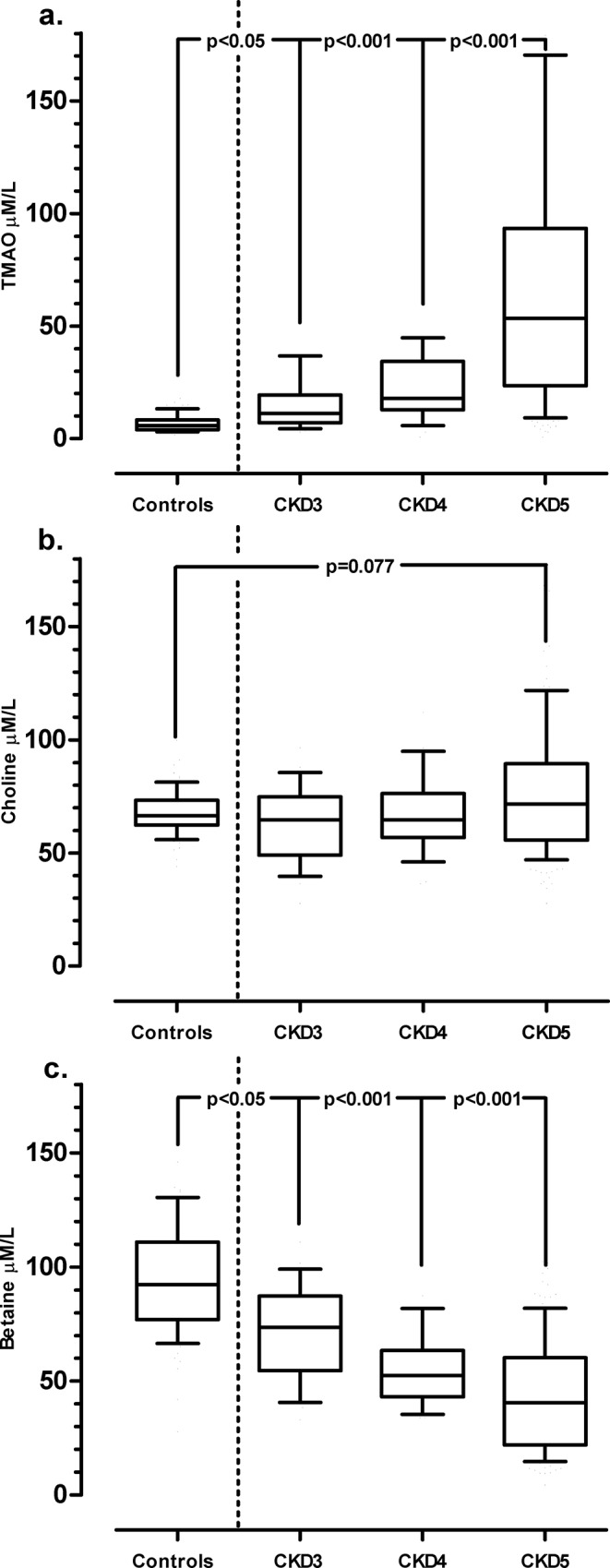
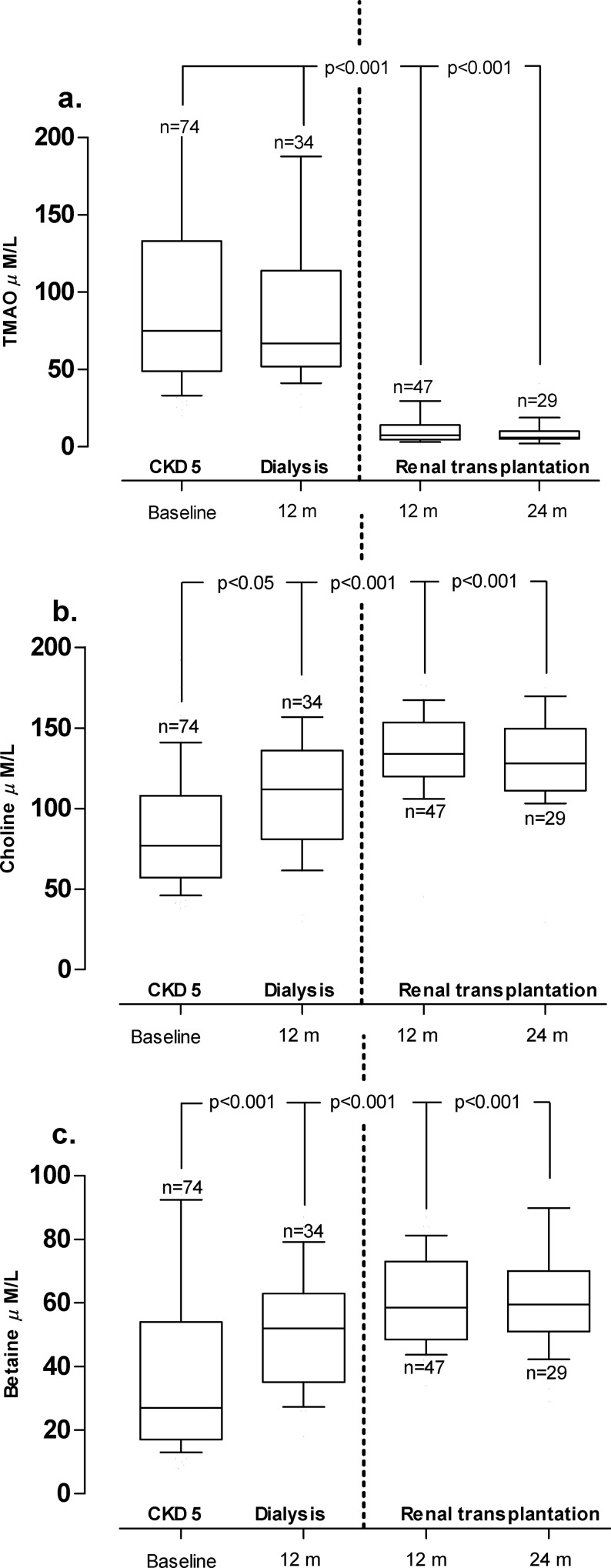
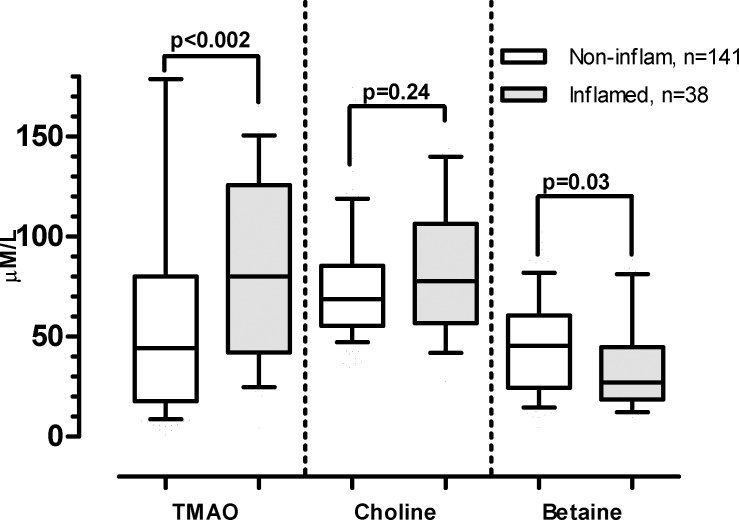
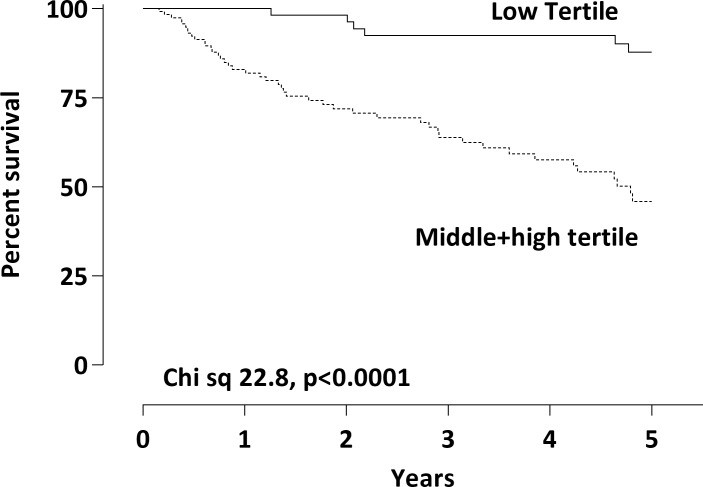
BACKGROUND: The microbial metabolite Trimethylamine-N-oxide (TMAO) has been linked to adverse cardiovascular outcome and mortality in the general population. OBJECTIVE: To assess the contribution of TMAO to inflammation and mortality in chronic kidney disease (CKD) patients ranging from mild-moderate to end-stage disease and 1) associations with glomerular filtration rate (GFR) 2) effect of dialysis and renal transplantation (Rtx) 3) association with inflammatory biomarkers and 4) its predictive value for all-cause mortality. METHODS: Levels of metabolites were quantified by a novel liquid chromatography/tandem mass spectrometry-based method in fasting plasma samples from 80 controls and 179 CKD 3-5 patients. Comorbidities, nutritional status, biomarkers of inflammation and GFR were assessed. RESULTS: GFR was the dominant variable affecting TMAO (β = -0.41; p<0.001), choline (β = -0.38; p<0.001), and betaine (β = 0.45; p<0.001) levels. A longitudinal study of 74 CKD 5 patients starting renal replacement therapy demonstrated that whereas dialysis treatment did not affect TMAO, Rtx reduced levels of TMAO to that of controls (p<0.001). Following Rtx choline and betaine levels continued to increase. In CKD 3-5, TMAO levels were associated with IL-6 (Rho = 0.42; p<0.0001), fibrinogen (Rho = 0.43; p<0.0001) and hsCRP (Rho = 0.17; p = 0.022). Higher TMAO levels were associated with an increased risk for all-cause mortality that remained significant after multivariate adjustment (HR 4.32, 95% CI 1.32-14.2; p = 0.016). CONCLUSION: Elevated TMAO levels are strongly associated with degree of renal function in CKD and normalize after renal transplantation. TMAO levels correlates with increased systemic inflammation and is an independent predictor of mortality in CKD 3-5 patients.
Overview
The claims and statistics of this paper haven’t been checked yet.
Run the check — free, no account needed. It reads the open-access text and checks the sources it cites.
Integrity signals
Registry
Cites
Statistics
Figures
Verification
Claims the paper makes
The claims and statistics of this paper haven’t been checked yet.
Run the check — free, no account needed. It reads the open-access text and checks the sources it cites.
Claims other papers make about this one
Each is checked against this paper’s own text: does it say what the citing paper says it does?
The cited source says what the claim attributes to it.
In the citing paper
“Missailidis et al. measured plasma concentration of TMAO in 80 controls and 179 CKD patients and reported that that elevated TMAO levels are strongly associated with degree of renal function [27].”
From Trimethylamine N-oxide: the good, the bad and the unknown. (2016) · cites this paper as [27]
In the citing paper
“levels are higher the more the glomerular filtration rate GFR is reduced [49]”
From Implication of Trimethylamine N-Oxide (TMAO) in Disease: Potential Biomarker or New Therapeutic Target (2018) · cites this paper as [49]
In the citing paper
“Nonetheless, median values of TMAO concentrations in healthy individuals were reported as ranges of 3 to 6 μmol/L,8, 17, 18, 19 and the study by Shafi et al22 consisted of hemodialysis patients with the substantially high mean vale of TMAO (101.9 μmol/L among total participants).”
From Gut Microbiota Metabolites and Risk of Major Adverse Cardiovascular Disease Events and Death: A Systematic Review and Meta‐Analysis of Prospective Studies (2017) · cites this paper as [18]
In the citing paper
“In 179 CKD stage 3-5 patients, the GFR and impaired renal function were the main variables affecting plasma TMAO concentrations (81).”
From Trimethylamine N -Oxide, the Microbiome, and Heart and Kidney Disease (2017) · cites this paper as [81]
In the citing paper
“Serum concentration of TMAO was inversely associated with eGFR and was markedly higher in patients receiving dialysis (59,81); hemodialysis efficiently removed TMAO from blood (8).”
From Trimethylamine N -Oxide, the Microbiome, and Heart and Kidney Disease (2017) · cites this paper as [81]
In the citing paper
“Increased TMAO concentrations were associated with systemic inflammatory markers and predicted a reduced fiveyear survival (81).”
From Trimethylamine N -Oxide, the Microbiome, and Heart and Kidney Disease (2017) · cites this paper as [81]
In the citing paper
“Renal transplantation corrects the high plasma TMAO concentrations seen in renal failure (81,106).”
From Trimethylamine N -Oxide, the Microbiome, and Heart and Kidney Disease (2017) · cites this paper as [81]
In the citing paper
“TMAO levels increase with decreasing levels of kidney function and is associated with mortality in patients with chronic kidney disease.”
From Trimethylamine N-oxide: the good, the bad and the unknown. (2016) · cites this paper as [27]
Self-check
Percentages, sums and reported differences re-computed from the paper’s own numbers.
The self-check needs the paper’s full text.
Citations
Cites
Ahmed, A., Jorna, T., & Bhandari, S. (2016) · The Nephron journals/Nephron journals · doi:10.1159/000447068 · Cited by 11,782
Gut flora metabolism of phosphatidylcholine promotes cardiovascular disease
Wang, Z., Klipfell, E., Bennett, B. J., Koeth, R., Levison, B. S., DuGar, B., Feldstein, A. E., Britt, E. B., Fu, X., Chung, Y.-M., et al. (2011) · Nature · doi:10.1038/nature09922 · Cited by 5,597
Intestinal microbiota metabolism of l-carnitine, a nutrient in red meat, promotes atherosclerosis
Koeth, R. A., Wang, Z., Levison, B. S., Buffa, J. A., Org, E., Sheehy, B. T., Britt, E. B., Fu, X., Wu, Y., Li, L., et al. (2013) · Nature Medicine · doi:10.1038/nm.3145 · Cited by 4,386
Intestinal microbial metabolism of phosphatidylcholine and cardiovascular risk
Tang, W. H. W., Wang, Z., Levison, B. S., Koeth, R. A., Britt, E. B., Fu, X., Wu, Y., & Hazen, S. L. (2013) · New England Journal of Medicine · doi:10.1056/nejmoa1109400 · Cited by 3,400
Strong association between malnutrition, inflammation, and atherosclerosis in chronic renal failure
Stenvinkel, P., Heimbürger, O., Paultre, F., Diczfalusy, U., Wang, T., Berglund, L., & Jogestrand, T. (1999) · Kidney International · doi:10.1046/j.1523-1755.1999.00422.x · Cited by 1,767
Self-citationFox, C. S., Matsushita, K., Woodward, M., Bilo, H. J., Chalmers, J., Heerspink, H. J. L., Lee, B. J., Perkins, R. M., Rossing, P., Sairenchi, T., et al. (2012) · The Lancet · doi:10.1016/s0140-6736(12)61350-6 · Cited by 1,401
Tang, W. H. W., Wang, Z., Kennedy, D. J., Wu, Y., Buffa, J. A., Agatisa-Boyle, B., Li, X. S., Levison, B. S., & Hazen, S. L. (2015) · Circulation Research · doi:10.1161/circresaha.116.305360 · Cited by 1,223
Chronic kidney disease alters intestinal microbial flora
Vaziri, N. D., Wong, J., Pahl, M., Piceno, Y. M., Yuan, J., DeSantis, T. Z., Ni, Z., Nguyen, T.-H., & Andersen, G. L. (2013) · Kidney International · doi:10.1038/ki.2012.345 · Cited by 1,164
Bennett, B. J., Vallim, T. Q. D. A., Wang, Z., Shih, D. M., Meng, Y., Gregory, J., Allayee, H., Lee, R., Graham, M., Crooke, R., et al. (2013) · Cell Metabolism · doi:10.1016/j.cmet.2012.12.011 · Cited by 1,070
The Gut Microbiome, Kidney Disease, and Targeted Interventions
Ramezani, A., & Raj, D. S. (2013) · Journal of the American Society of Nephrology · doi:10.1681/asn.2013080905 · Cited by 773
Wong, J., Piceno, Y. M., DeSantis, T. Z., Pahl, M. V., Andersen, G. L., & Vaziri, N. D. (2014) · American Journal of Nephrology · doi:10.1159/000360010 · Cited by 658
Factors predicting malnutrition in hemodialysis patients: A cross-sectional study
Qureshi, A. R., Alvestrand, A., Danielsson, A., Divino‐Filho, J. C., Gutiérrez, A., Lindholm, B., & Bergström, J. P. (1998) · Kidney International · doi:10.1046/j.1523-1755.1998.00812.x · Cited by 589
Self-citationComparative Associations of Muscle Mass and Muscle Strength with Mortality in Dialysis Patients
Isoyama, N., Qureshi, A. R., Avesani, C. M., Lindholm, B., Barany, P. F., Heimbürger, O., Cederholm, T., Stenvinkel, P., & Carrero, J. J. (2014) · Clinical Journal of the American Society of Nephrology · doi:10.2215/cjn.10261013 · Cited by 561
Self-citationTrøseid, M., Ueland, T., Hov, J. R., Svardal, A., Gregersen, I., Dahl, C. P., Aakhus, S., Gude, E., Bjørndal, B., Halvorsen, B., et al. (2015) · Journal of Internal Medicine · doi:10.1111/joim.12328 · Cited by 464
Serum Trimethylamine-N-Oxide is Elevated in CKD and Correlates with Coronary Atherosclerosis Burden
Stubbs, J. R., House, J. A., Ocque, A. J., Zhang, S., Johnson, C., Kimber, C., Schmidt, K., Gupta, A., Wetmore, J. B., Nolin, T. D., et al. (2016) · Journal of the American Society of Nephrology · doi:10.1681/asn.2014111063 · Cited by 450
Colonic Contribution to Uremic Solutes
Aronov, P. A., Luo, F. J.-G., Plummer, N. S., Quan, Z., Holmes, S., Hostetter, T. H., & Meyer, T. W. (2011) · Journal of the American Society of Nephrology · doi:10.1681/asn.2010121220 · Cited by 435
Chronic kidney disease and premature ageing
Kooman, J. P., Kotanko, P., Schols, A. M. W. J., Shiels, P. G., & Stenvinkel, P. (2014) · Nature Reviews Nephrology · doi:10.1038/nrneph.2014.185 · Cited by 390
Self-citationTang, W. H. W., Wang, Z., Shrestha, K., Borowski, A. G., Wu, Y., Troughton, R. W., Klein, A. L., & Hazen, S. L. (2015) · Journal of Cardiac Failure · doi:10.1016/j.cardfail.2014.11.006 · Cited by 325
Grubb, A., Horio, M., Hansson, L.-O., Björk, J., Nyman, U., Flodin, M., Larsson, A., Bökenkamp, A., Yasuda, Y., Blufpand, H., et al. (2014) · Clinical Chemistry · doi:10.1373/clinchem.2013.220707 · Cited by 324
A Combined Epidemiologic and Metabolomic Approach Improves CKD Prediction
Rhee, E. P., Clish, C. B., Ghorbani, A., Larson, M. G., Elmariah, S., McCabe, E., Yang, Q., Cheng, S., Pierce, K., Deik, A., et al. (2013) · Journal of the American Society of Nephrology · doi:10.1681/asn.2012101006 · Cited by 307
Bain, M. A., Faull, R., Fornasini, G., Milne, R. W., & Evans, A. M. (2006) · Nephrology Dialysis Transplantation · doi:10.1093/ndt/gfk056 · Cited by 282
Miller, C. A., Corbin, K. D., da Costa, K.-A., Zhang, S., Zhao, X., Galanko, J. A., Blevins, T., Bennett, B. J., O’Connor, A., & Zeisel, S. H. (2014) · The American Journal of Clinical Nutrition · doi:10.3945/ajcn.114.087692 · Cited by 240
Dietary Precursors of Trimethylamine in Man: A Pilot Study
Zhang, A. Q., Mitchell, S. C., & Smith, R. L. (1999) · Food and Chemical Toxicology · doi:10.1016/s0278-6915(99)00028-9 · Cited by 232
Chronic Kidney Disease Causes Disruption of Gastric and Small Intestinal Epithelial Tight Junction
Vaziri, N. D., Yuan, J. J., Nazertehrani, S., Ni, Z., & Liu, S. (2013) · American Journal of Nephrology · doi:10.1159/000353764 · Cited by 195
Kaysen, G. A., Johansen, K. L., Chertow, G. M., Dalrymple, L. S., Kornak, J., Grimes, B., Dwyer, T., Chassy, A. W., & Fiehn, O. (2015) · Journal of Renal Nutrition · doi:10.1053/j.jrn.2015.02.006 · Cited by 164
Bell, J. D., Lee, J. A., Lee, H. A., Sadler, P. J., Wilkie, D. R., & Woodham, R. H. (1991) · Biochimica et Biophysica Acta (BBA) - Molecular Basis of Disease · doi:10.1016/0925-4439(91)90046-c · Cited by 147
Pathology of gastrointestinal tract in chronic hemodialysis patients: an autopsy study of 78 cases.
Vaziri, N. D., Dure-Smith, B., Miller, R., & Mirahmadi, M. K. (1985) · PubMed · Cited by 140
Mortality in chronic kidney disease and renal replacement therapy: a population-based cohort study
Neovius, M., Jacobson, S. H., Eriksson, J. K., Elinder, C., & Hylander, B. (2014) · BMJ Open · doi:10.1136/bmjopen-2013-004251 · Cited by 131
Bossola, M., Sanguinetti, M., Scribano, D., Zuppi, C., Giungi, S., Luciani, G., Torelli, R., Posteraro, B., Fadda, G., & Tazza, L. (2008) · Clinical Journal of the American Society of Nephrology · doi:10.2215/cjn.03490708 · Cited by 111
Soluble CD14 Levels, Interleukin 6, and Mortality Among Prevalent Hemodialysis Patients
Raj, D. S., Carrero, J. J., Shah, V. O., Qureshi, A. R., Barany, P. F., Heimbürger, O., Lindholm, B., Ferguson, J., Moseley, P. L., & Stenvinkel, P. (2009) · American Journal of Kidney Diseases · doi:10.1053/j.ajkd.2009.06.022 · Cited by 89
Self-citationSrinivasa, S., Fitch, K. V., Lo, J., Kadar, H., Knight, R., Wong, K., Abbara, S., Gauguier, D., Capeau, J., Boccara, F., et al. (2015) · AIDS · doi:10.1097/qad.0000000000000565 · Cited by 68
A Review of Dietary Intake Studies in Maintenance Dialysis Patients
Therrien, M., Byham-Gray, L. D., & Beto, J. A. (2015) · Journal of Renal Nutrition · doi:10.1053/j.jrn.2014.11.001 · Cited by 58
Wetmore, J. B., Lovett, D. H., Hung, A. M., Cook‐Wiens, G., Mahnken, J. D., Sen, Ś., & Johansen, K. L. (2008) · Nephrology · doi:10.1111/j.1440-1797.2008.01021.x · Cited by 36
Ghanavatian, S., Diep, L. M., Barany, P. F., Heimbürger, O., Seeberger, A., Stenvinkel, P., Rohani, M., & Agewall, S. (2013) · Angiology · doi:10.1177/0003319713483000 · Cited by 21
Self-citation
Cited by
Sorted by citations
Dietary metabolism, the gut microbiome, and heart failure
Tang, W. H. W., Li, D. Y., & Hazen, S. L. (2019) · Nature Reviews Cardiology · doi:10.1038/s41569-018-0108-7 · Cited by 789
Janeiro, M., Ramírez, M., Milagro, F., Martínez, J., & Solas, M. (2018) · Nutrients · doi:10.3390/nu10101398 · Cited by 631
“Other studies revealed that TMAO is augmented in renal insufficiency but concentrations normalize after renal transplantation [48] and levels are higher the more the glomerular filtration rate GFR is reduced [49].”
BackgroundSchiattarella, G. G., Sannino, A., Toscano, E., Giugliano, G., Gargiulo, G., Franzone, A., Trimarco, B., Esposito, G., & Perrino, C. (2017) · European Heart Journal · doi:10.1093/eurheartj/ehx342 · Cited by 563
Heianza, Y., Ma, W., Manson, J. E., Rexrode, K. M., & Qi, L. (2017) · Journal of the American Heart Association · doi:10.1161/jaha.116.004947 · Cited by 544
Trimethylamine N-oxide: the good, the bad and the unknown.
Velasquez, M., Ramezani, A., Manal, A., & Raj, D. (2016) · Toxins · doi:10.3390/toxins8110326 · Cited by 504
Metadata
- Authors
- Missailidis, C., Hällqvist, J., Qureshi, A. R., Barany, P., Heimbürger, O., Lindholm, B., Stenvinkel, P., & Bergman, P.
- Affiliations
- Karolinska University Hospital (SE)
- Swedish University of Agricultural Sciences (SE)
- Corresponding author
- Missailidis, Catharina
- ORCID
- Venue
- PLOS ONE
- Publisher
- Public Library of Science (PLoS)
- Published
- 2016-01-11
- Volume
- 11
- Issue
- 1
- Pages
- e0141738
- ISSN
- 1932-6203 (ISSN-L)
- PMC
- PMC4709190
- OpenAlex
- W2232990799
- Cited by
- 338
- References
- 34
- Citations by year
- 2026: 22 · 2025: 32 · 2024: 27 · 2023: 36 · 2022: 44 · 2021: 34 · 2020: 42 · 2019: 33 · 2018: 28 · 2017: 27 · 2016: 13
- FWCI
- 34.20
- Type
- journal article
- Language
- en
- Open access
- gold
- doi.org
- Licence
- Locations
- PLoS ONE (publishedVersion, cc-by)
- Europe PMC (PubMed Central) (publishedVersion, cc-by)
- PubMed Central (publishedVersion, cc-by)
- PubMed (publishedVersion)
- DOAJ (DOAJ: Directory of Open Access Journals) (submittedVersion, cc-by-sa)
- Figshare (submittedVersion, cc-by)
- Funders
- Stockholms Läns Landsting (2013-0317)
- Vetenskapsrådet
- Topics
- Health Sciences › Medicine › Nephrology › Dialysis and Renal Disease Management
- Health Sciences › Medicine › Nephrology › Chronic Kidney Disease and Diabetes
- Life Sciences › Biochemistry, Genetics and Molecular Biology › Molecular Biology › Metabolomics and Mass Spectrometry Studies
- Keywords
- trimethylamine N-oxide, chronic kidney disease, glomerular filtration rate, renal function, kidney transplantation, dialysis, all-cause mortality, systemic inflammation, interleukin-6, fibrinogen, C-reactive protein, choline, betaine, microbial metabolites, prognostic factors
- MeSH terms
- Adult, Aged, Betaine, C-Reactive Protein, Cardiovascular Diseases, Choline, Female, Fibrinogen, Glomerular Filtration Rate, Renal Dialysis, Humans, Inflammation, Longitudinal Studies, Male, Methylamines, Middle Aged, Prognosis, Severity of Illness Index, Biomarkers, Interleukin-6, Multivariate Analysis, Survival Analysis, Kidney Transplantation, Renal Insufficiency, Chronic
About these checks
Registry, retraction, Cites and statistics results are computed, not judged, with one exception: a printed reference that no index lists is read once by a model before it counts as a citation error. Claims are extracted by a model and kept only when their quote appears verbatim in the text; each cited source is then checked, with a model’s help, for whether it says what the claim relies on. Those verdicts can be wrong — read the claim’s quote and the cited source before relying on one.
Statistics and arithmetic are recomputed, not judged.
Confidence bands are shown only for fields calibrated on our annotated test set. None is calibrated yet, so no band is shown.
What counts as a claim ›How we measure confidence ›How we check this ›
Are you an author, or do you see a problem with this page? Request a review
