

Bridging organizations drive effective governance outcomes for conservation of Indonesia's marine systems
The DOI matches its Crossref record; 3 of the 3 references it cites were found in a registry or an index.
Overview
The claims and statistics of this paper haven’t been checked yet.
Free: it reads the open-access text and checks the first 5 claims that cite a source we can check. Create a free account to check every claim.
Integrity signals
Registry
Cites
Statistics
Figures
Verification
Claims the paper makes
The claims and statistics of this paper haven’t been checked yet.
Free: it reads the open-access text and checks the first 5 claims that cite a source we can check. Create a free account to check every claim.
Claims other papers make about this one
Each is checked against this paper’s own text: does it say what the citing paper says it does?
In the citing paper
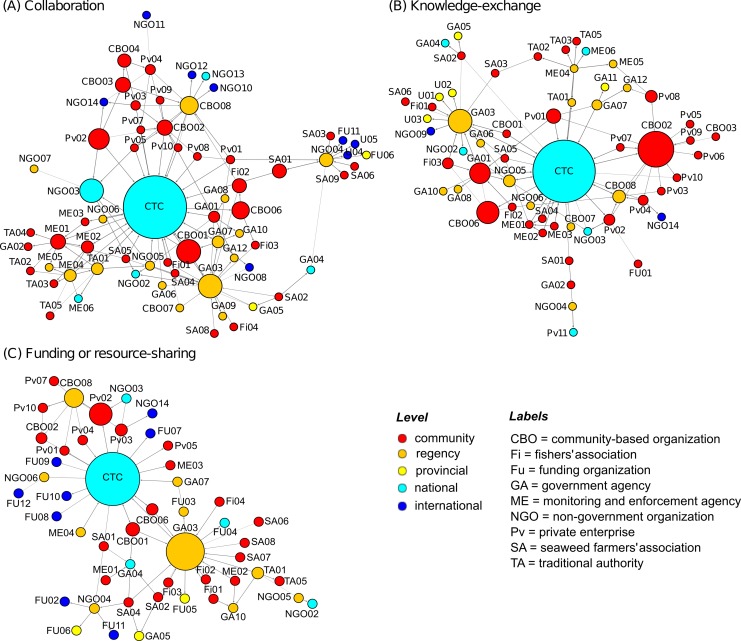
“Consequently, Berdej and Armitage (2016) find that the CTC is at the center of the island's collaboration, knowledge-sharing, and funding networks related to marine protection.”
From Collaborative Platforms as a Governance Strategy (2018) · cites this paper as Berdej and Armitage 2016
In the citing paper
“For example, on the Indonesian island of Nusa Penida, the CTC has sought “to catalyze new institutions and forums for interaction” and had sponsored over 60 forums with local stakeholders by 2014 (Berdej and Armitage 2016, 13).”
From Collaborative Platforms as a Governance Strategy (2018) · cites this paper as Berdej and Armitage 2016
Self-check
Percentages, sums and reported differences re-computed from the paper’s own numbers.
The self-check needs the paper’s full text.
Citations
Cites
ADAPTIVE GOVERNANCE OF SOCIAL-ECOLOGICAL SYSTEMS
Folke, C., Hahn, T., Olsson, P., & Norberg, J. (2005) · Annual Review of Environment and Resources · doi:10.1146/annurev.energy.30.050504.144511 · Cited by 5,814 · cited 1×
“By management we refer to the operational decisions and practices in natural resource use that influence governance [8].”
BackgroundThe Struggle to Govern the Commons
Dietz, T., Ostrom, E., & Stern, P. C. (2003) · Science · doi:10.1126/science.1091015 · Cited by 4,209
Hahn, T., Olsson, P., Folke, C., & Johansson, K. (2006) · Human Ecology · doi:10.1007/s10745-006-9035-z · Cited by 503
Research works printed but not linked: 49
- Mills M, Pressey RL, Weeks R, Foale S, Ban N. A mismatch of scales: Challenges in planning for implementation of marine protected areas in the Coral Triangle. Conservation Letters. 2010; 3: 291– 303. · DOI
- Clifton J, Majors C. Culture, conservation, and conflict: perspectives on marine protection among the Bajau of Southeast Asia. Society & Natural Resources: An International Journal. 2012; 25(7): 716– 725. · doi:10.1080/08941920.2011.618487
- Fidelman P, Evans L, Fabinyi M, Foale S, Cinner J, Rosen F. Governing large-scale marine commons: contextual challenges in the Coral Triangle. Marine Policy. 2012; 36(1): 42– 53. · DOI
- Fidelman P, Evans LS, Foale S, Weible C, von Heland F, Elgin D. Coalition cohesion for regional marine governance: a stakeholder analysis of the Coral Triangle Initiative. Ocean & Coastal Management. 2014; 95: 117– 128. · DOI
- von Helan F, Crona B, Fidelman P. Mediating science and action across multiple boundaries in the Coral Triangle. Global Environmental Change. 2014; 29: 53– 64. · DOI
- Weeks R, Pressey RL, Wilson JR, Knight M, Horigue V, Abesamis A et al Ten things to get right for marine conservation planning in the Coral Triangle. F1000Research. 2014a; 3: 91. 25110579 PMC4111118 · DOI
- Armitage D, Plummer R, Berkes F, Arthur R, Charles AT, Davidson-Hunt IJ et al Adaptive co-management for social-ecological complexity. Front Ecol Envion. 2009; 7(2): 95– 102. · DOI · Paper page
- Crona BI, Parker JN. Learning in support of governance: theories, methods, and a framework to assess how bridging organizations contribute to adaptive resource governance. Ecology and Society. 2012; 17(1): 32. · DOI · Paper page
- Olsson P, Folke C, Galaz V, Hahn T, Schulz L. Enhancing the Fit through Adaptive Co- management: Creating and Maintaining Bridging Functions for Matching Scales in the Kristianstads Vattenrike Biosphere Reserve, Sweden. Ecology and Society. 2007; 12(1): 28. · DOI · Paper page
- Berkes F. Evolution of co-management: role of knowledge generation, bridging organizations and social learning. Journal of Environmental Management. 2009; 90: 1692– 1702. 10.1016/j.jenvman.2008.12.001 19110363 · DOI · Paper page
- Marin A, Berkes F. Network approach for understanding small-scale fisheries governance: The case of the Chilean coastal co-management system. Marine Policy. 2010; 34: 851– 58. · DOI
- Schultz L, Lundholm C. Learning for resilience? Exploring learning opportunities in biosphere reserves. Environmental Education Research. 2011; 16(5–6): 645– 663.
- Jacobson C, Robertson AL. Landscape conservation cooperatives: bridging entities to facilitate adaptive co-governance of social-ecological systems. Human Dimensions of Wildlife. 2012; 17: 333– 343. · DOI
- Cohen PJ, Evans LS, Mills M. Social networks supporting governance of coastal ecosystems in the Solomon Island. Conservation Letters. 2012; 5: 376– 386. · DOI
- Horigue V, Alino PM, White AT, Pressey RL. Marine protected area networks in the Philippines: Trends and challenges for establishment and governance. Ocean Coast Manage. 2012; 64: 15– 26. · DOI
- Lowry GT, White AT, Christie P. Scaling up to networks of marine protected areas in the Philippines: biophysical, legal, institutional and social considerations. Coastal Management. 2009; 37: 335– 349. · DOI
- Green SJ, White AT, Christie P, Kilarski S, Meneses ABT, Samonte-Tan G et al Emerging marine protected are networks in the Coral Triangle: Lessons and way forward. Conservation and Society. 2011; 9(3): 173– 188. · DOI
- Weeks R, Alino PM, Atkinson S, Beldia P II, Binson A, Campos WL et al Developing marine protected area networks in the Coral Triangle: good practices for expanding the Coral Triangle Marine Protected Area System. Coastal Management. 2014b; 42: 183– 205. · DOI
- Armitage D. Governance and the commons in a multi-level world. International Journal of the Commons. 2008; 2(1): 2– 32.
- Armitage D, Marschke M, Plummer R. Adaptive co-management and the paradox of learning. Glob. Environ. Change-Human Policy Dimens. 2008; 18: 86– 98. · DOI · Paper page
- Newig J, Guenther D, Pahl-Wostl C. Synapses in the network: learning in governance networks in the context of environmental management. Ecology and Society. 2010; 15: 2. · DOI · Paper page
- Cinner J, Marnane MJ, McClanahan TR, Almany GR. Periodic closures as adaptive coral reef management in the Indo-Pacific. Ecology and Society. 2006; 11: 31. · DOI · Paper page
- McClanahan TR, Cinner JE. A framework for adaptive gear and ecosystem-based management in the artisanal coral reef fishery of Papua New Guinea. Aquatic Conservation: Marine and Freshwater Ecosystems. 2008; 18: 493– 507. · DOI
- Evans LS, Brown K, Allison EH. Factors influencing adaptive marine governance in developing country context: a case study of southern Kenya. Ecology and Society. 2011; 16(2): 21. · DOI
- 28. Allen GR. Conservation hotspots of biodiversity and endemism for Indo-Pacific coral reef fishes. Aquat Conserv. 2008; 18(5): 541– 556. · DOI · Paper page
- Bruno JF, Selig ER. Regional Decline of Coral Cover in the Indo-Pacific: Timing, Extent, and Subregional Comparisons. PLoS ONE. 2007; 2(8): e711 10.1371/journal.pone.0000711 17684557 PMC1933595 · DOI · Paper page
- Mustika PL, Ratha IMJ, Purwanto S. The 2011 Bali marine rapid assessment. 2nd English edition. RAP Bulletin of Biological Assessment 64. Bali Marine and Fisheries Affairs, South East Asia Center for Ocean Research and Monitoring, Warmadewa University, Conservation International Indonesia, Denpasar; 2013.
- Majors C. Seas of discontent: conflicting knowledge paradigms within Indonesia’s marine environmental arena In: Sodhi NS, Acciaioli G, Erb M, Tan AKJ, editors. Biodiversity and Human Livelihoods in Protected Areas: Case Studies from the Malay Archipelago. Cambridge, UK: Cambridge University Press; 2008 pp. 241– 265.
- Foale S, Adhuri D, Alino P, Allison EH, Andrew N, Cohen P et al Food security and the Coral Triangle Initiative. Mar. Policy. 2013; 38: 174– 183. · DOI · Paper page
- Patlis JM. The role of law and legal institutions in determining the sustainability of integrated coastal management projects in Indonesia. Ocean & Coast Manage. 2005; 48(3–6): 450– 467. · doi:10.1016/j.ocecoaman.2005.04.005
- Satria A, Matsuda Y, Sano M. Questioning community based coral reef management systems: case-study of awig-awig in Gili Indah, Indonesia. Environment, Development and Sustainability. 2006; 8: 99– 118. · DOI
- Frey JB, Berkes F. Can partnerships and community-based conservation reverse the decline of coral reef social-ecological systems? International Journal of the Commons. 2014; 8(1): 26– 46. · doi:10.18352/ijc.408
- Miles MB, Huberman AM. Qualitative Data Analysis—An Expanded Sourcebook. 2nd ed. Thousands Oak, CA: Sage Publications; 1994.
- Hay I. Qualitative Research Methods in Human Geography. Toronto, CA: Oxford University Press; 2010.
- Wasserman S, Faust K. Social Network Analysis: Methods And Applications. Cambridge University Press, Cambridge; 1994. · DOI · Paper page
- Alexander SM, Armitage D. A social relational network perspective for MPA science. Conservation Letters. 2014.
- Bodin O, Crona BI, Ernstson H. Social networks in natural resource management: what is there to learn from a structural perspective? Ecology and Society. 2006; 11(2). · DOI · Paper page
- Bodin O, Crona BI. The role of social networks in natural resource governance: What relational patterns make a difference? Global Environmental Change. 2009; 19: 366– 374. · DOI · Paper page
- Prell C. Social network analysis: history, theory, and methodology Londong, UK: Sage Publications; 2011.
- Armitage D, de Loe R, Plummer R. Environmental governance and its implications for conservation practice. Conservation Letters. 2012; 5: 245– 255. · DOI · Paper page
- Kark S, Tulloch A, Gordon A, Mazor T, Bunnefeld N, Levin N. Cross-boundary collaboration: key to the conservation puzzle. Current Opinion in Environmental Sustainability. 2015; 12: 12– 24. · DOI · Paper page
- Cros A, Ahamad Fatan N, White A, Teoh SJ, Tan S, Handayani C, et al The Coral Triangle Atlas: An Integrated Online Spatial Database System for Improving Coral Reef Management. PLoS ONE. 2014; 9(6): e96332 10.1371/journal.pone.0096332 24941442 PMC4062393 · DOI
- Campbell SJ, Hoey AS, Maynard J, Kartawijaya T, Cinner J, Graham NAJ, et al Weak Compliance Undermines the Success of No-Take Zones in a Large Government-Controlled Marine Protected Area. PLoS ONE. 2012; 7(11): e50074 10.1371/journal.pone.0050074 23226237 PMC3511441 · DOI
- Hirsch PD, Adams WM, Brosius JP, Zia A, Bariola N, Dammert JL. Acknowledging Conservation Trade-offs and Embracing Complexity. Conservation Biology. 2011; 25: 259– 264. 10.1111/j.1523-1739.2010.01608.x 21091769 · DOI · Paper page
- McShane TO, Hirsch PD, Trung TC, Songorwa AN, Kingzig A, Monteferri B et al Hard choices: Making trade-offs between biodiversity conservation and human well-being. Biological Conservation. 2011; 144: 966– 972. · DOI · Paper page
- Berdej S, Andrachuk M, Armitage D. Conservation narratives and their implications in the Coral Triangle Initiative. Conservation and Society. In press 2015.
- Rosen F, Olsson P. Institutional entrepreneurs, global networks, and the emergence of international institutions for ecosystem-based management: The Coral Triangle Initiative. Marine Policy. 2013; 38: 195– 204. · DOI
- Reed MS, Evely AC, Cundill G, Fazet I, Glass J, Lain A et al What is social learning? Ecology & Society. 2010; 15(4).
- De Meo P, Ferrara E, Fiumara G, Ricciardello A. A novel measure of edge centrality in social networks. Knowledge-Based Systems. 2012; 30: 136– 150. · DOI
Cited by
Collaborative Platforms as a Governance Strategy
Ansell, C., & Gash, A. (2018) · Journal of Public Administration Research and Theory · doi:10.1093/jopart/mux030 · Cited by 604
Stakeholder engagement in the governance of marine migratory species: barriers and building blocks
Miller, R., Marsh, H., Benham, C., & Hamann, M. (2020) · Endangered Species Research · doi:10.3354/esr01049 · Cited by 12
Metadata
- Authors
- Berdej, S. M., & Armitage, D. R.
- Venue
- PLOS ONE
- Publisher
- Public Library of Science (PLoS)
- Published
- 2016-01-21
- Volume
- 11
- Issue
- 1
- Pages
- e0147142
- ISSN
- 1932-6203
- PMC
- PMC4721869
- Cited by
- 67
- References
- 3
- Language
- en
About these checks
Registry, retraction, Cites and statistics results are computed, not judged, with one exception: a printed reference that no index lists is read once by a model before it counts as a citation error. Claims are extracted by a model and kept only when their quote appears verbatim in the text; each cited source is then checked, with a model’s help, for whether it says what the claim relies on. Those verdicts can be wrong — read the claim’s quote and the cited source before relying on one.
Statistics and arithmetic are recomputed, not judged.
Confidence bands are shown only for fields calibrated on our annotated test set. None is calibrated yet, so no band is shown.
What counts as a claim ›How we measure confidence ›How we check this ›
Are you an author, or do you see a problem with this page? Request a review
Data sources
Bibliographic data: Semantic Scholar, OpenAlex, Crossref.
Contains information from the Semantic Scholar Academic Graph Datasets, made available under the ODC Attribution License (ODC-BY 1.0).
Semantic Scholar’s data is described in: Kinney, R., et al. (2023). The Semantic Scholar Open Data Platform. arXiv:2301.10140.
