

Presentation of Various Tactile Sensations Using Micro-Needle Electrotactile Display
Open accessThe DOI matches its Crossref record; 27 of the 28 references it cites were found in a registry or an index.
Abstract
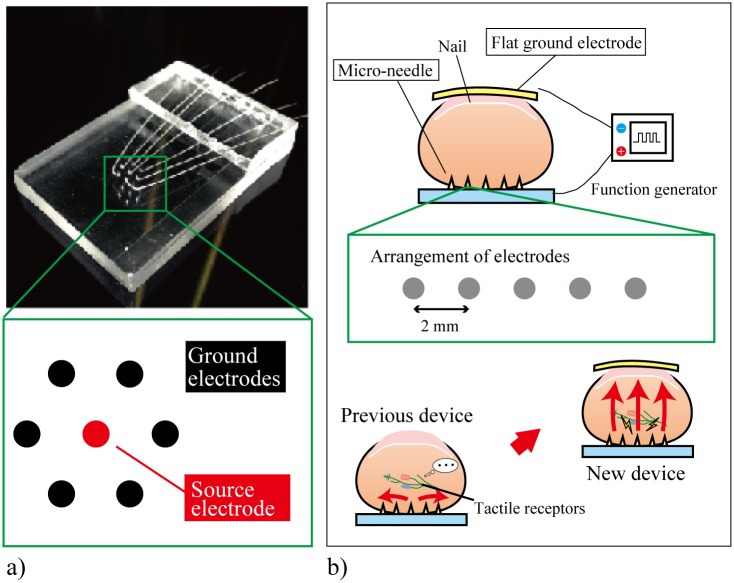
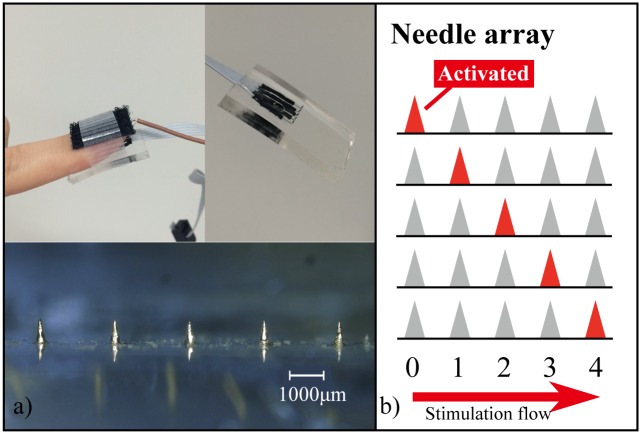
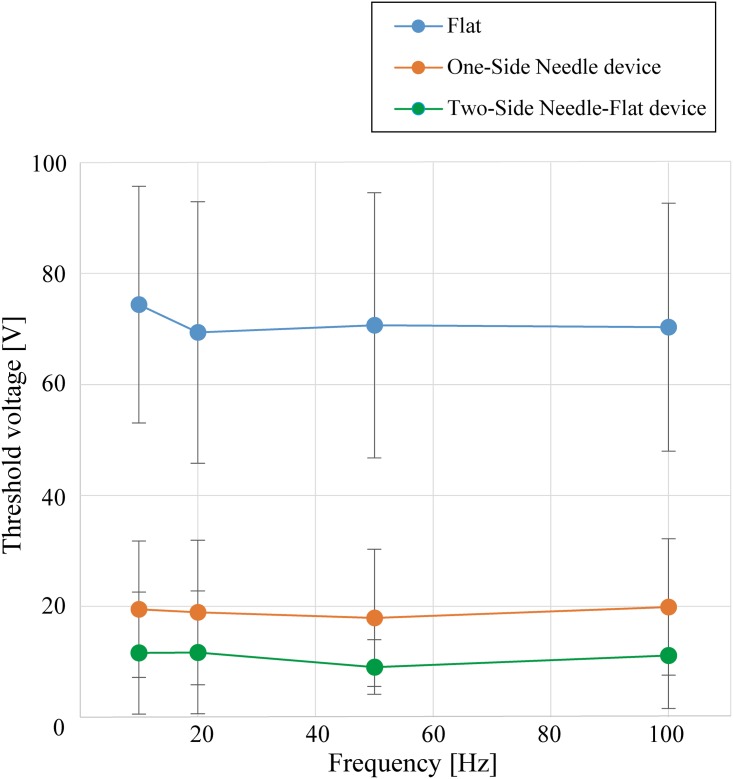
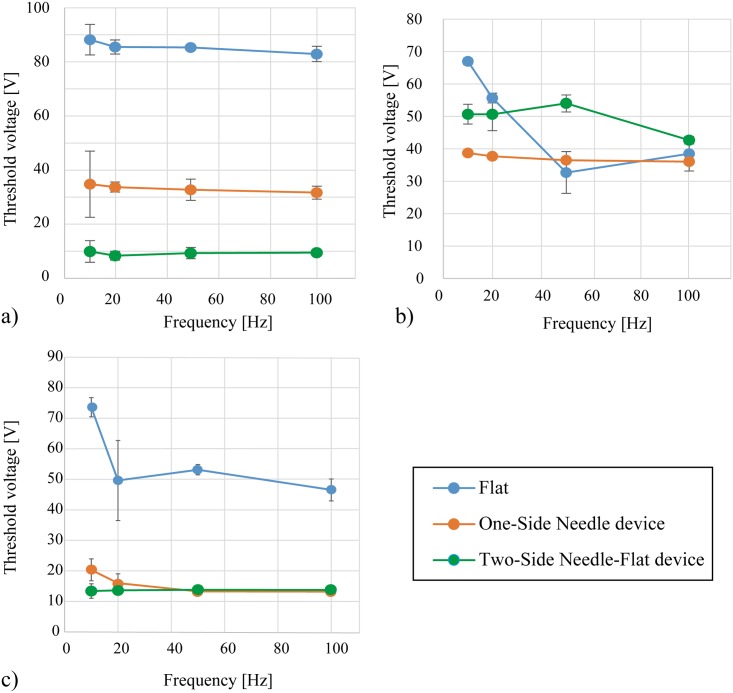
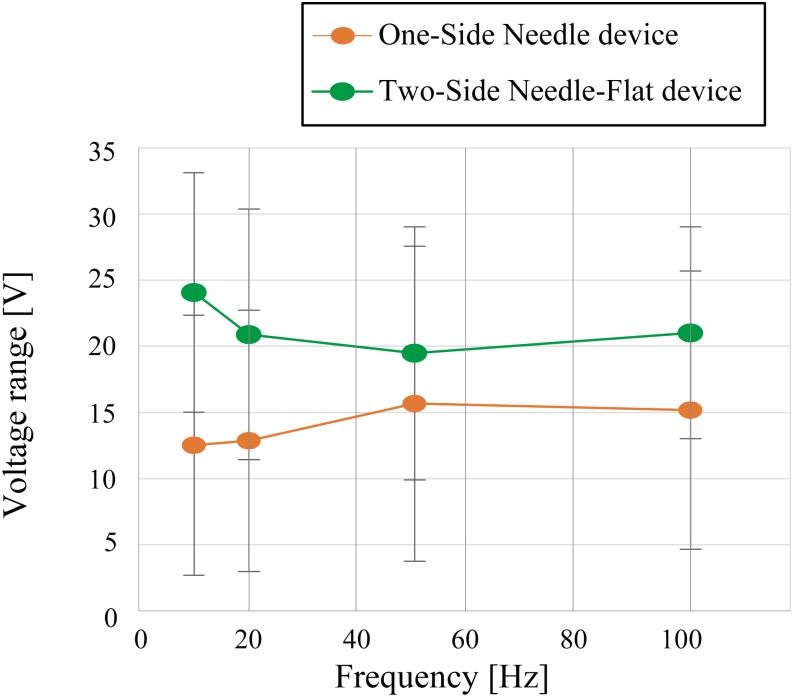
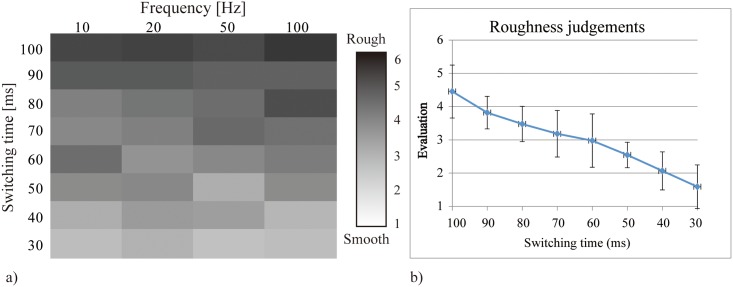
Tactile displays provoke tactile sensations by artificially stimulating tactile receptors. While many types of tactile displays have been developed, electrotactile displays that exploit electric stimulation can be designed to be thin, light, flexible and thus, wearable. However, the high voltages required to stimulate tactile receptors and limited varieties of possible sensations pose problems. In our previous work, we developed an electrotactile display using a micro-needle electrode array that can drastically reduce the required voltage by penetrating through the high-impedance stratum corneum painlessly, but displaying various tactile sensations was still a challenge. In this work, we demonstrate presentation of tactile sensation of different roughness to the subjects, which is enabled by the arrangement of the electrodes; the needle electrodes are on the fingertip and the ground electrode is on the fingernail. With this arrangement, the display can stimulate the tactile receptors that are located not only in the shallow regions of the finger but also those in the deep regions. It was experimentally revealed that the required voltage was further reduced compared to previous devices and that the roughness presented by the display was controlled by the pulse frequency and the switching time, or the stimulation flow rate. The proposed electrotactile display is readily applicable as a new wearable haptic device for advanced information communication technology.
Overview
The claims and statistics of this paper haven’t been checked yet.
Free: it reads the open-access text and checks the first 5 claims that cite a source we can check. Create a free account to check every claim.
Integrity signals
Registry
Cites
Statistics
Figures
Verification
Claims the paper makes
The claims and statistics of this paper haven’t been checked yet.
Free: it reads the open-access text and checks the first 5 claims that cite a source we can check. Create a free account to check every claim.
Claims other papers make about this one
Each is checked against this paper’s own text: does it say what the citing paper says it does?
The source backs part of the claim, not all of it — or backs it for a different population, condition or comparison.
In the citing paper
“It is possible to lower down voltage and current value for electrostimulation by using needle electrodes to release signal under the epidermis”
From Self-powered electro-tactile system for virtual tactile experiences (2021) · cites this paper as [15]
Experimental — accuracy not yet measuredThe check wasn’t confident either way, so it gives no verdict — never disputed.
In the citing paper
“Moreover, the direct contact of skin with electrodes, whether it is shaped in pin or microneedle, can increase the risk of skin tearing and cause infections (15).”
From Self-powered electro-tactile system for virtual tactile experiences (2021) · cites this paper as [15]
Experimental — accuracy not yet measuredThe check wasn’t confident either way, so it gives no verdict — never disputed.
In the citing paper
“but this kind of penetration mode still has the risk of skin lesions and infections (15–18).”
From Self-powered electro-tactile system for virtual tactile experiences (2021) · cites this paper as [15]
Experimental — accuracy not yet measured
Self-check
Percentages, sums and reported differences re-computed from the paper’s own numbers.
The self-check needs the paper’s full text.
Citations
Cites
(1984) · PubMed · Cited by 908
Noncontact Tactile Display Based on Radiation Pressure of Airborne Ultrasound
Hoshi, T., Takahashi, M., Iwamoto, T., & Shinoda, H. (2010) · IEEE Transactions on Haptics · doi:10.1109/toh.2010.4 · Cited by 470
Johansson, R. S. (1978) · The Journal of Physiology · doi:10.1113/jphysiol.1978.sp012411 · Cited by 430
Mechanism of fluid infusion during microneedle insertion and retraction
Martanto, W., Moore, J. S., Couse, T., & Prausnitz, M. R. (2006) · Journal of Controlled Release · doi:10.1016/j.jconrel.2006.02.017 · Cited by 250 · cited 1×
“Considering that the nerves innervate the area 700 μm below the surface of the finger [21], and that needles do not penetrate completely in its length [23], we decided that the appropriate length of the micro-needles to penetrate the stratum corneum and reduce the impedance is 600 μm.”
BackgroundA method for controlling tactile sensation of surface roughness using ultrasonic vibration
Watanabe, T., & Fukui, S. (2002) · Proceedings of 1995 IEEE International Conference on Robotics and Automation · doi:10.1109/robot.1995.525433 · Cited by 240
Squeeze film effect for the design of an ultrasonic tactile plate
Biet, M., Giraud, F., & Lemaire-Semail, B. (2007) · IEEE Transactions on Ultrasonics, Ferroelectrics and Frequency Control · doi:10.1109/tuffc.2007.596 · Cited by 207
Srinivasan, M. A., & Dandekar, K. (1996) · Journal of Biomechanical Engineering · doi:10.1115/1.2795945 · Cited by 202
SmartTouch: electric skin to touch the untouchable
Kajimoto, H., Kawakami, N., Tachi, S., & Inami, M. (2004) · IEEE Computer Graphics and Applications · doi:10.1109/mcg.2004.1255807 · Cited by 173
Tactile Feeling Display using Functional Electrical Stimulation
Kajimoto, H., Kawakami, N., & Maeda, T. (1999) · Cited by 126
Ju, B.-F., Chen, Y.-L., & Ge, Y. (2011) · Review of Scientific Instruments · doi:10.1063/1.3529880 · Cited by 122
Research works printed but not linked: 2
- Kajimoto H, Kawakami N, Tachi S. Psychophysical evaluation of receptor selectivity in electro-tactile display In Proc. of 13th International Symposium on Measurement and Control in Robotics (ISMCR). 2003; 83– 86.
- Montagna W, Lobitz WC. The Epidermis. 1st ed New York: Academic Press; 1964.
Cited by
Self-powered electro-tactile system for virtual tactile experiences
Shi, Y., Wang, F., Tian, J., Li, S., Fu, E., Nie, J., Lei, R., Ding, Y., Chen, X., & Wang, Z. L. (2021) · Science Advances · doi:10.1126/sciadv.abe2943 · Cited by 251
Navigation Systems for the Blind and Visually Impaired: Past Work, Challenges, and Open Problems
Real, S., & Araujo, A. (2019) · Sensors · doi:10.3390/s19153404 · Cited by 196
“…years, subsequent prototypes have strived for various improvements, such as combining electrotactile technology with mechanical stimuli [102,103], stabilizing the transcutaneous electrode-neuron electrical contact, albeit with closed-loop designs [104], or micro-needle interfaces [105,106], etc.”
BackgroundEmerging Material Technologies for Haptics
Biswas, S., & Visell, Y. (2019) · Advanced Materials Technologies · doi:10.1002/admt.201900042 · Cited by 150
Haptic Sensing and Feedback Techniques toward Virtual Reality
Shi, Y., & Shen, G. (2024) · Research · doi:10.34133/research.0333 · Cited by 150
“Tezuka et al. [145] improved the ET electrodes using a micro-needle electrode array (Fig.”
MethodWearable triboelectric devices for haptic perception and VR/AR applications
Fang, H., Guo, J., & Wu, H. (2022) · Nano Energy · doi:10.1016/j.nanoen.2022.107112 · Cited by 105
Stereo-Smell via Electrical Trigeminal Stimulation
Brooks, J., Teng, S.-Y., Wen, J., Nith, R., Nishida, J., & Lopes, P. (2021) · CHI Conference on Human Factors in Computing Systems · doi:10.1145/3411764.3445300 · Cited by 68
“, [23, 24, 58]), our approach is in fact specific to the trigeminal nerve inside the nose.”
BackgroundElectrically-Evoked Proximity Sensation Can Enhance Fine Finger Control in Telerobotic Pinch
Zhao, Z., Yeo, M., Manoharan, S., Ryu, S. C., & Park, H. (2020) · Scientific Reports · doi:10.1038/s41598-019-56985-9 · Cited by 31
Zhou, W., Liu, W., Liu, S., Zhang, C., Shen, Z., & Zhang, G. (2017) · Sensors and Actuators A Physical · doi:10.1016/j.sna.2017.05.032 · Cited by 29
HapBead: On-Skin Microfluidic Haptic Interface using Tunable Bead
Han, T., Bansal, S., Shi, X., Chen, Y.-J., Quan, B., Tian, F., Wang, H., & Subramanian, S. (2020) · CHI Conference on Human Factors in Computing Systems · doi:10.1145/3313831.3376190 · Cited by 29
“By selecting appropriate voltages and currents it creates desired responses to generate sensations of vibrations, textures and even forces [38].”
BackgroundLocalized Fretting-Vibrotactile Sensations for Large-Area Displays
Duong, Q. V., Nguyen, V. P., Santos, F. D. D., & Choi, S. T. (2019) · ACS Applied Materials & Interfaces · doi:10.1021/acsami.9b09691 · Cited by 26
Development of a Fully Flexible Sheet-Type Tactile Display Based on Electrovibration Stimulus
Ishizuka, H., Hatada, R., Cortes, C., & Miki, N. (2018) · Micromachines · doi:10.3390/mi9050230 · Cited by 24
“The needle-type electrical tactile display was able to present tactile stimulus with low voltage, since the tactile display penetrated the epidermis and applied the voltage directly to the dermis [14].”
BackgroundSelf-citationLin, H., Liu, X., Jiang, S., Wang, Q., Tao, Y., Wang, G., Sun, W. G., Han, T., & Tian, F. (2024) · CHI Conference on Human Factors in Computing Systems · doi:10.1145/3613904.3642873 · Cited by 18
“Different techniques have been proposed to lower the driving voltage, including the use of wet electrodes, finger caps and gloves that maintain pressure and moisture of contact between electrodes and the skin [9], and micro-needle electrodes [48].”
MethodElectrotactile display composed of two-dimensionally and densely distributed microneedle electrodes
Tezuka, M., Ishimaru, K., & Miki, N. (2017) · Sensors and Actuators A Physical · doi:10.1016/j.sna.2017.02.021 · Cited by 17
Self-citationInformation transfer using wearable thin electrotactile displays with microneedle electrodes
Tezuka, M., Kitamura, N., & Miki, N. (2016) · Japanese Journal of Applied Physics · doi:10.7567/jjap.55.06gp15 · Cited by 16
Self-citationKorn, O., Holt, R. J., Kontopoulos, E., Kappers, A. M. L., Persson, N., & Olson, N. (2018) · International Conference on PErvasive Technologies Related to Assistive Environments (PETRA) · doi:10.1145/3197768.3201541 · Cited by 14
“• Electrotactile displays use an electric current to stimulate nerve endings in the fingers, thus recreating tactile sensations [23].”
BackgroundResonance frequency selective electromagnetic actuation for high-resolution vibrotactile displays
Mohammadi, A., Abdelkhalek, M., & Sadrafshari, S. (2019) · Sensors and Actuators A Physical · doi:10.1016/j.sna.2019.111818 · Cited by 14
Electrotactile displays: taxonomy, cross-modality, psychophysics and challenges
Ray, R. K., Vasudevan, M. K., & Manivannan, M. (2024) · Frontiers in Virtual Reality · doi:10.3389/frvir.2024.1406923 · Cited by 11
The quantitative evaluation of electrotactile stimulation mode
He, K., Yu, P., Li, M., Yang, Y., & Liu, L. (2016) · IEEE International Conference on Real-time Computing and Robotics (RCAR) · doi:10.1109/rcar.2016.7784052 · Cited by 11
Encoding and presentation of surface textures using a mechanotactile display
Kawazoe, M., Kosemura, Y., & Miki, N. (2017) · Sensors and Actuators A Physical · doi:10.1016/j.sna.2017.03.035 · Cited by 10
Self-citationNg, K. K. W., So, A., Fang, J. Y., Birznieks, I., & Vickery, R. M. (2024) · Frontiers in Neuroscience · doi:10.3389/fnins.2024.1125597 · Cited by 9
Experiment Study for Wrist-Wearable Electro-Tactile Display
Lu, X., Lin, M., Wang, S., Hu, X., Yin, H., & Yan, Y. (2021) · Sensors · doi:10.3390/s21041332 · Cited by 9
“[7] developed a new tactile display device called the “Two-Side Needle-Flat Device” based on previous research of Kitamura.”
MethodNovel dry metal electrode with tilted microstructure fabricated with laser micromilling process
Zhou, W., Liu, S., Liu, W., Zhang, C., Li, Y., Xu, W., & Hui, K. S. (2017) · Sensors and Actuators A Physical · doi:10.1016/j.sna.2017.07.028 · Cited by 8
Tactile samples with variable surface textures to investigate tactile perception characteristic
Kawazoe, M., & Miki, N. (2020) · Journal of Micromechanics and Microengineering · doi:10.1088/1361-6439/ab9f59 · Cited by 8
Self-citationXiong, Q., Yao, H., Wang, J., Huang, Z., Luo, J., Zhong, C., Lin, Y., & Shu, L. (2025) · Frontiers in Neuroscience · doi:10.3389/fnins.2025.1519758 · Cited by 7
Shi, Y., Peng, T., Liang, Y., Li, Y., Ren, R., Zhang, Y., Yan, X., Chen, X., Chen, D., & Shen, G. (2024) · ACS Applied Materials & Interfaces · doi:10.1021/acsami.4c13002 · Cited by 6
The Wearable Tactile Information Expression System Based on Electrotactile Rendering
Hu, X., Lu, X., & Sun, H. (2017) · Lecture notes in computer science · doi:10.1007/978-3-662-54395-5_5 · Cited by 3
VET: A Visual-Electronic Tactile System for Immersive Human-Machine Interaction
Zhang, C., Yang, Y., Mu, S., Lyu, C., Li, S., Chai, X., & Ding, W. (2025) · IEEE/RSJ International Conference on Intelligent Robots and Systems (IROS) · doi:10.1109/iros60139.2025.11247401 · Cited by 1
“Various grounding configurations exist, including back [16], ring [17], palm [7], dorsum [18], coaxial [19] , and coplanar [20] placement.”
Tactile Perception Modulation by Transcutaneous Electrical Stimulation
An, H., Seul, J., & Shin, H. (2021) · International Conference on Information Networking · doi:10.1109/icoin50884.2021.9333947 · Cited by 1
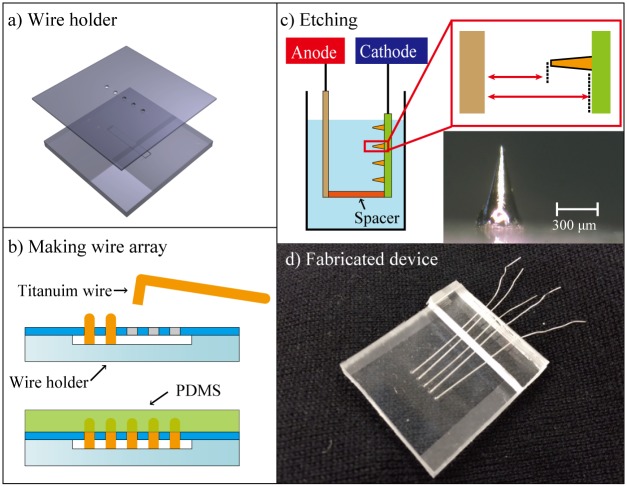
“developed tactile displays with micro-needle arrays using electrochemical etching technology [18], [19].”
MethodTime Domain Multiplexing for Equalized Vibration in Miniaturized Electromagnetic Tactile Pixels
Sadrafshari, S., Musa, H. S., Mohammadi, P., & Mohammadi, A. (2025) · IEEE International Symposium on Circuits and Systems proceedings · doi:10.1109/iscas56072.2025.11043280
“For example, electro-tactile devices generate unpleasant feelings of electrocution [1, 2], piezoelectric actuators fail to generate large displacement [3, 4], and pneumatic actuators are limited to very low frequencies.”
New Physics at the LHC: Direct and Indirect Probes
Frediani, G. (2018) · Queen Mary Research Online (Queen Mary University of London)
TactileWalk: Dynamic Electrotactile Patterns for Fingertip-Based Interaction During Walking
Nimbalkar, V., & Peiris, R. L. (2026) · CHI Conference Extended Abstracts on Human Factors in Computing Systems (CHI EA) · doi:10.1145/3772363.3798818
“Much of this research has utilized sparse or linear electrode arrays to explore perceptual phenomena such as apparent motion, slip illusions, and funneling effects on the forearm and fingertips [17, 26, 27, 31].”
Li, P., Du, D., Hu, X., Gao, Z., He, J., Ding, F., & Liang, C. (2026) · Sensors and Actuators A Physical · doi:10.1016/j.sna.2026.118548
Shi, Y., Feng, C., Xu, Z., Liang, Y., Liu, X., Yuan, X., Luo, J., Zhang, J., Qin, Y., & Shen, G. (2026) · Advanced Functional Materials · doi:10.1002/adfm.79266
Metadata
- Authors
- Tezuka, M., Kitamura, N., Tanaka, K., & Miki, N.
- Affiliations
- Keio University (JP)
- Corresponding author
- Tezuka, Mayuko
- Miki, Norihisa
- Venue
- PLOS ONE
- Publisher
- Public Library of Science (PLoS)
- Published
- 2016-02-04
- Volume
- 11
- Issue
- 2
- Pages
- e0148410
- ISSN
- 1932-6203 (ISSN-L)
- PMC
- PMC4742061
- OpenAlex
- W2255111570
- Cited by
- 31
- References
- 28
- Citations by year
- 2026: 2 · 2025: 3 · 2024: 5 · 2022: 1 · 2021: 4 · 2020: 3 · 2019: 4 · 2018: 2 · 2017: 5 · 2016: 2
- FWCI
- 2.76
- Type
- journal article
- Language
- en
- Open access
- gold
- doi.org
- Licence
- Locations
- PLoS ONE (publishedVersion, cc-by)
- PubMed Central (publishedVersion, cc-by)
- PubMed (publishedVersion)
- DOAJ (DOAJ: Directory of Open Access Journals) (submittedVersion, cc-by-sa)
- Funders
- Japan Science and Technology Agency
- Precursory Research for Embryonic Science and Technology
- Topics
- Life Sciences › Neuroscience › Cognitive Neuroscience › Tactile and Sensory Interactions
- Physical Sciences › Engineering › Biomedical Engineering › Advanced Sensor and Energy Harvesting Materials
- Physical Sciences › Engineering › Mechanical Engineering › Teleoperation and Haptic Systems
- Keywords
- tactile perception, roughness perception, wearable haptic device, stratum corneum, pulse frequency, switching time, fingertip stimulation, tactile receptors
- MeSH terms
- Electric Stimulation, Equipment Design, Humans, Needles, Touch, Threshold Limit Values, Touch Perception
About these checks
Registry, retraction, Cites and statistics results are computed, not judged, with one exception: a printed reference that no index lists is read once by a model before it counts as a citation error. Claims are extracted by a model and kept only when their quote appears verbatim in the text; each cited source is then checked, with a model’s help, for whether it says what the claim relies on. Those verdicts can be wrong — read the claim’s quote and the cited source before relying on one.
Statistics and arithmetic are recomputed, not judged.
Confidence bands are shown only for fields calibrated on our annotated test set. None is calibrated yet, so no band is shown.
What counts as a claim ›How we measure confidence ›How we check this ›
Are you an author, or do you see a problem with this page? Request a review
Data sources
Bibliographic data: Semantic Scholar, OpenAlex, Crossref.
Contains information from the Semantic Scholar Academic Graph Datasets, made available under the ODC Attribution License (ODC-BY 1.0).
Semantic Scholar’s data is described in: Kinney, R., et al. (2023). The Semantic Scholar Open Data Platform. arXiv:2301.10140.
