

The DOI matches its Crossref record; 49 of the 49 references it cites were found in a registry or an index.
Prevalence of Depression among Chinese University Students: A Meta-Analysis
Open accessAbstract
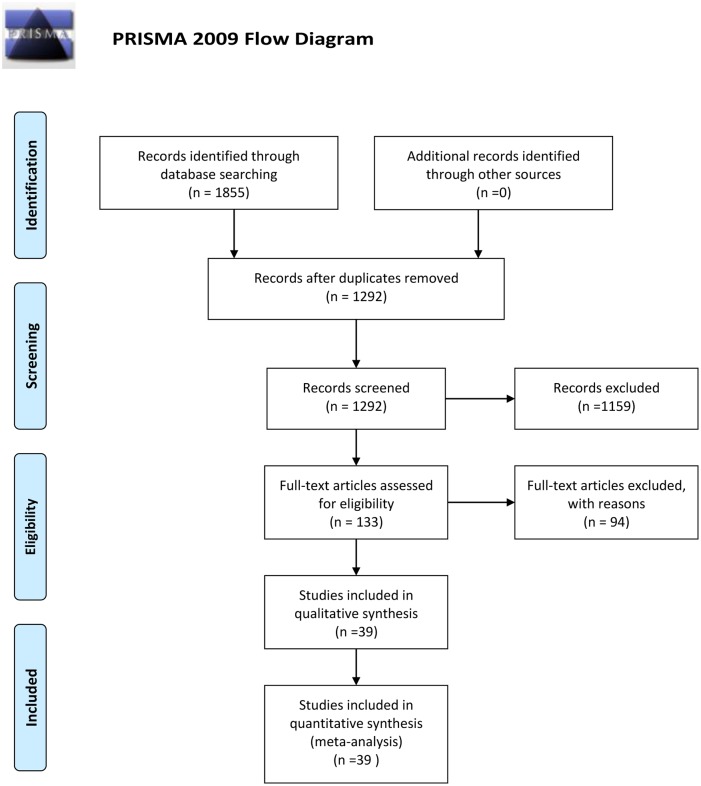
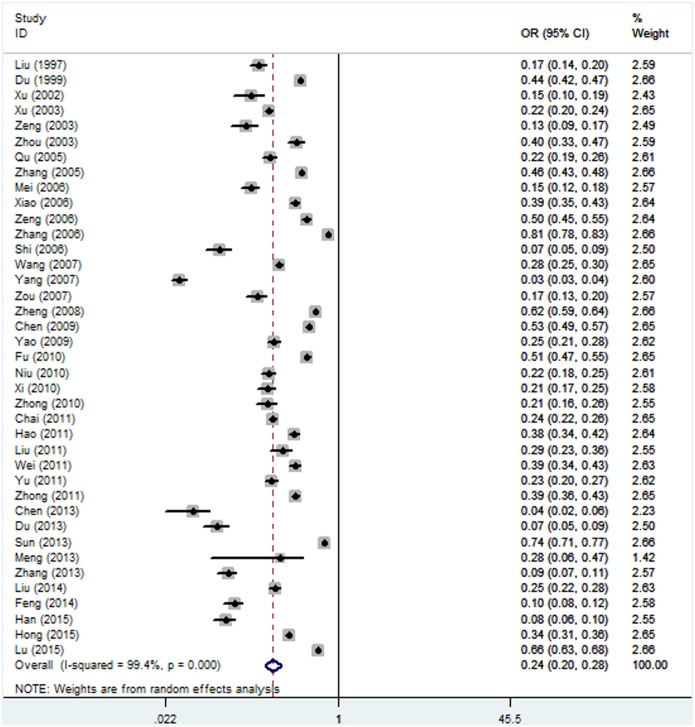
BACKGROUND: Depression is a major mental health issue worldwide, and university students with heavy burdens of study are at a high risk for depression. While a number of studies have been conducted regarding depression among university students in China, there is a lack of information regarding the national prevalence of depression among Chinese university students. Therefore, we performed a meta-analysis to statistically pool the prevalence of depression among Chinese university students. METHODS: A systematic search of scientific databases was conducted, including Chinese Web of Knowledge, Embase, PubMed, Wanfang (a Chinese database) and Weipu (a Chinese database) to find relevant publications published between 1995 and December 2015. This was supplemented by a secondary review of the reference lists of all retrieved papers to find additional relevant citations. Studies published in either English or Chinese that provided prevalence estimates of depression in Chinese university students were considered. Prevalence estimates of each eligible study were extracted and pooled in our meta-analysis using a random-effects model. RESULTS: A total of 39 studies conducted between 1997 and 2015 including 32,694 university students were analyzed. Our results indicate that the overall prevalence of depression among Chinese university students is 23.8% (95% CI: 19.9%-28.5%). Substantial heterogeneity in prevalence estimates was noted. Subgroup analysis revealed that the prevalence of depression among medical students is higher than among other students. CONCLUSIONS: Overall, the prevalence of depression among Chinese university students is exceedingly high. This suggests that it is imperative that more attention be given to the development of appropriate mental healthcare strategies for university students in China.
Overview
The claims and statistics of this paper haven’t been checked yet.
Run the check — free, no account needed. It reads the open-access text and checks the sources it cites.
Integrity signals
Registry
Cites
Statistics
Figures
Verification
Claims the paper makes
The claims and statistics of this paper haven’t been checked yet.
Run the check — free, no account needed. It reads the open-access text and checks the sources it cites.
Claims other papers make about this one
Each is checked against this paper’s own text: does it say what the citing paper says it does?
The source backs part of the claim, not all of it — or backs it for a different population, condition or comparison.
In the citing paper
“Academic pressure, achievement expectations, study stress, living away from home amidst many life changes, and ineffective coping strategies were found to be associated with mental distress and psychological disorders such as internet addiction, anxiety, and depression [2-4].”
From Promoting the mental health of university students in China: Protocol for contextual assessment to inform intervention design and adaptation (2021) · cites this paper as [4]
Experimental — accuracy not yet measuredThe cited source says what the claim attributes to it.
In the citing paper
“The prevalence of depression among Chinese university students is even higher, at approximately 20%-30% [3,4].”
From Promoting the mental health of university students in China: Protocol for contextual assessment to inform intervention design and adaptation (2021) · cites this paper as [4]
In the citing paper
“The prevalence of clinically elevated depressive symptoms in our sample (46.6%) is roughly twice as high as meta-analytic estimates of clinical elevations among Chinese college students prior to the pandemic (23.8%) [36].”
From Psychiatric symptoms, risk, and protective factors among university students in quarantine during the COVID-19 pandemic in China (2021) · cites this paper as [36]
Self-check
Percentages, sums and reported differences re-computed from the paper’s own numbers.
The self-check needs the paper’s full text.
Citations
Cites
Measuring inconsistency in meta-analyses
Higgins, J. P. T., Thompson, S. G., Deeks, J. J., & Altman, D. G. (2003) · BMJ · doi:10.1136/bmj.327.7414.557 · Cited by 63,139
Bias in meta-analysis detected by a simple, graphical test
Egger, M., Smith, G. D., Schneider, M., & Minder, C. (1997) · BMJ · doi:10.1136/bmj.315.7109.629 · Cited by 56,722
The CES-D Scale: A Self-Report Depression Scale for Research in the General Population
Radloff, L. S. (1977) · Applied Psychological Measurement · doi:10.1177/014662167700100306 · Cited by 53,267
Meta-analysis in clinical trials
DerSimonian, R., & Laird, N. (1986) · Controlled Clinical Trials · doi:10.1016/0197-2456(86)90046-2 · Cited by 39,552
An inventory for measuring depression
BECK, A. T. (1961) · Archives of General Psychiatry · doi:10.1001/archpsyc.1961.01710120031004 · Cited by 38,032
A self-rating depression scale
ZUNG, W. W. K. (1965) · Archives of General Psychiatry · doi:10.1001/archpsyc.1965.01720310065008 · Cited by 9,813
Kessler, R. C., Berglund, P., Demler, O., Jin, R., Koretz, D., Merikangas, K. R., Rush, A. J., Walters, E. E., & Wang, P. S. (2003) · JAMA · doi:10.1001/jama.289.23.3095 · Cited by 7,988
Selective Cortical Undercutting As a Means of Modifying and Studying Frontal Lobe Function in Man
Scoville, W. B. (1949) · Journal of neurosurgery · doi:10.3171/jns.1949.6.1.0065 · Cited by 7,374
Social Origins of Depression: A Study of Psychiatric Disorder in Women.
Schnitzer, P. K., Brown, G. W., & Harris, T. (1980) · Contemporary Sociology A Journal of Reviews · doi:10.2307/2065631 · Cited by 3,053
Deeks, J. J., Altman, D. G., & Bradburn, M. J. (2001) · Systematic Reviews in Health Care · doi:10.1002/9780470693926.ch15 · Cited by 2,163
Research works printed but not linked: 2
- MY Luo, 2010, Social Assessment and Subdividing of After-1980s, China Youth Study, 11, 32
- M Nguyen, 2011, Why medical school is depressing and what we should be doing about it, Australian Medical Student Journal, 2, 65
Cited by
Sorted by citations
Salari, N., Khazaie, H., Far, A. H., Khaledi‐Paveh, B., Kazeminia, M., Mohammadi, M., Shohaimi, S., Daneshkhah, A., & Eskandari, S. (2020) · Human Resources for Health · doi:10.1186/s12960-020-00544-1 · Cited by 623
Mental health problems among medical students in Brazil: a systematic review and meta-analysis
Pacheco, J. P. G., Giacomin, H. T. A., Tam, W., Ribeiro, T. B., Arab, C., Bezerra, Í. M. P., & Pinasco, G. C. (2017) · Brazilian Journal of Psychiatry · doi:10.1590/1516-4446-2017-2223 · Cited by 581
Deng, J., Zhou, F., Hou, W., Silver, Z. A., Wong, C. Y., Chang, O., Drakos, A., Zuo, Q., & Huang, E. (2021) · Psychiatry Research · doi:10.1016/j.psychres.2021.113863 · Cited by 532
Li, Y., Wang, A., Wu, Y., Han, N., & Huang, H. (2021) · Frontiers in Psychology · doi:10.3389/fpsyg.2021.669119 · Cited by 441
Self-citationCollege life is stressful today – Emerging stressors and depressive symptoms in college students
Acharya, L., Jin, L., & Collins, W. (2018) · Journal of American College Health · doi:10.1080/07448481.2018.1451869 · Cited by 410
Metadata
- Authors
- Lei, X.-Y., Xiao, L.-M., Liu, Y.-N., & Li, Y.-M.
- Affiliations
- Central South University (CN)
- Venue
- PLOS ONE
- Publisher
- Public Library of Science (PLoS)
- Published
- 2016-04-12
- Volume
- 11
- Issue
- 4
- Pages
- e0153454
- ISSN
- 1932-6203 (ISSN-L)
- PMC
- PMC4829172
- OpenAlex
- W2336738582
- Cited by
- 300
- References
- 48
- Citations by year
- 2026: 20 · 2025: 31 · 2024: 41 · 2023: 36 · 2022: 35 · 2021: 58 · 2020: 39 · 2019: 15 · 2018: 19 · 2017: 4 · 2016: 2
- FWCI
- 2.46
- Type
- journal article
- Language
- en
- Open access
- gold
- doi.org
- Licence
- Locations
- PLoS ONE (publishedVersion, cc-by)
- Europe PMC (PubMed Central) (publishedVersion, cc-by)
- PubMed Central (publishedVersion, cc-by)
- PubMed (publishedVersion)
- RePEc: Research Papers in Economics (submittedVersion)
- DOAJ (DOAJ: Directory of Open Access Journals) (submittedVersion, cc-by-sa)
- Figshare (submittedVersion, cc-by)
- Topics
- Social Sciences › Psychology › Developmental and Educational Psychology › Student Stress and Coping
- Health Sciences › Medicine › Psychiatry and Mental health › Mental Health Treatment and Access
- Health Sciences › Health Professions › General Health Professions › Healthcare professionals’ stress and burnout
- Keywords
- depression, prevalence, university students, Chinese students, medical students, student mental health, mental health services
- MeSH terms
- China, Depression, Humans, Students, Universities, Prevalence
About these checks
Registry, retraction, Cites and statistics results are computed, not judged, with one exception: a printed reference that no index lists is read once by a model before it counts as a citation error. Claims are extracted by a model and kept only when their quote appears verbatim in the text; each cited source is then checked, with a model’s help, for whether it says what the claim relies on. Those verdicts can be wrong — read the claim’s quote and the cited source before relying on one.
Statistics and arithmetic are recomputed, not judged.
Confidence bands are shown only for fields calibrated on our annotated test set. None is calibrated yet, so no band is shown.
What counts as a claim ›How we measure confidence ›How we check this ›
Are you an author, or do you see a problem with this page? Request a review
