

Evaluation of the relative efficacy of a couple cognitive-behaviour therapy (CBT) for Premenstrual Disorders (PMDs), in comparison to one-to-one CBT and a wait list control: A randomized controlled trial
Open accessThe DOI matches its Crossref record; 77 of the 80 references it cites were found in a registry or an index, and 1 are not checked yet; 2 of the 97 sources its claims cite were checked for support.
Abstract
Design: A randomised control trial (RCT) was conducted to examine the efficacy of couple-based cognitive behaviour therapy (CBT) for Premenstrual Disorders (PMDs), in comparison to one-to-one CBT and a wait-list control. Methods: Triangulation of quantitative and qualitative outcome measures evaluated changes pre-post intervention. Eighty three women were randomly allocated across three conditions, with 63 completing post-intervention measures, a retention rate of 76%. Results: Repeated measures analysis of variance found a significant time by group interaction identifying that women in the two CBT conditions reported lower total premenstrual symptoms, emotional reactivity/mood, and premenstrual distress, in comparison to the wait list control. Significantly higher active behavioural coping post-intervention was found in the couple condition than in the one-to-one and wait list control groups. Qualitative analysis provided insight into the subjective experience of PMDs and participation in the intervention study. Across groups, women reported increased awareness and understanding of premenstrual change post-intervention. A larger proportion of women in the CBT conditions reported reduction in intensity and frequency of negative premenstrual emotional reactivity, increased communication and help-seeking, increased understanding and acceptance of embodied change, and the development of coping skills, post-intervention. Increased partner understanding and improved relationship post-intervention was reported by a greater proportion of participants in the CBT conditions, most markedly in the couple condition. Conclusion: These findings suggest that one-to-one and couple CBT interventions can significantly reduce women's premenstrual symptomatology and distress, and improve premenstrual coping. Couple based CBT interventions may have a greater positive impact upon behavioural coping and perceptions of relationship context and support. This suggests that CBT should be available for women reporting moderate-severe PMDs, with couple-based CBT offering additional benefits to a one-to-one modality. © 2017 Ussher, Perz.This is an open access article distributed under the terms of the Creative Commons Attribution License, which permits unrestricted use, distribution, and reproduction in any medium, provided the original author and source are credited.
Verified 2026-11-22 · 1 reference not checked yet
Overview
CoChat Summary
## TL;DR
This randomized controlled trial found that both one-to-one CBT and couple-based CBT reduced premenstrual symptoms and distress compared with a wait-list control, with benefits maintained at follow-up. Couple-based CBT appeared to add benefits for behavioural coping and relationship understanding/support.
## Key findings
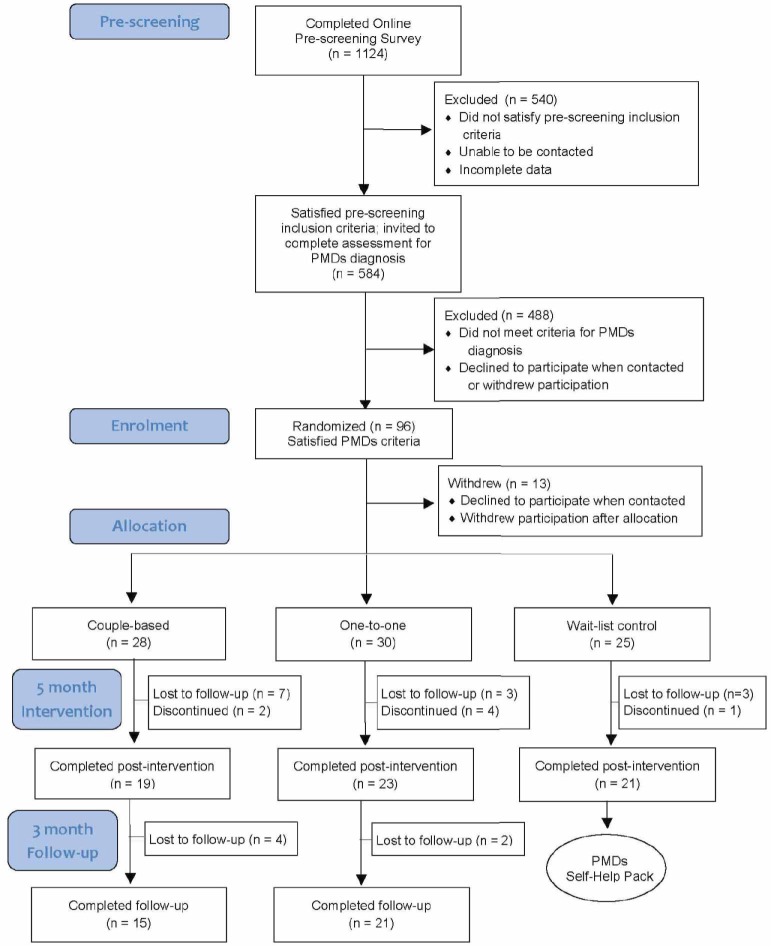
- Eighty-three women were randomized across three conditions; 63 completed post-intervention measures, a retention rate of 76%.
- Repeated-measures analyses found significant time-by-group interactions for total premenstrual symptoms, emotional reactivity/mood, premenstrual distress, premenstrual coping, and active cognitive coping; post-intervention, the two CBT conditions had lower symptoms/distress than the wait-list control.
- Post-test, total premenstrual symptoms were significantly higher in the wait-list group than in the couple group (MD = 6.25, SE = 2.55, p = .045), and premenstrual distress was significantly higher in the wait-list group than in the active treatment groups (MD = 3.14, SE = 0.57, p < .001).
- Qualitative results showed larger reductions in negative emotional reactivity in the couple and one-to-one groups (61% and 64%) than in the wait-list control (35%), and partner understanding/support was reported by 84% of the couple group, 39% of the one-to-one group, and 19% of the wait-list control.
## Methods
- Randomized controlled trial comparing couple-based CBT, one-to-one CBT, and a wait-list control, using triangulation of quantitative and qualitative outcome measures pre- and post-intervention; follow-up was collected for the two active treatment groups.
- Recruited women with moderate-severe PMDs; 1124 completed the baseline prescreen, 584 were invited to daily diaries, and 96 met criteria and were randomized. Eligibility included ages 18–45, regular cycles, and several medication/health exclusions; PMDs diagnosis was confirmed with PSST and daily diaries.
- Main analysis used mixed 2×3 ANOVA for pre/post outcomes, mixed 2×2 ANOVA for post/follow-up in active groups, chi-square tests for PMDs caseness, and thematic analysis for open-ended responses and interviews.
## Limitations
- The paper states that attrition post-intervention was a limitation, resulting in a small sample size; it also notes that daily diary ratings were not collected throughout the study, due to participant survey fatigue.
- The paper states that no evaluation of partners’ perspectives was included, even though partners were involved in the couple condition.
- Evident from the text: the wait-list group did not complete three-month follow-up questionnaires or interviews for ethical reasons, so long-term comparisons are only available for the two active conditions.
Model-written summary. Check it against the paper before relying on it.
Integrity signals
Registry
Cites
Statistics
Figures
Verification
Claims the paper makes
1 Valid · 1 Not valid · 39 Not checked · 145 Own results and interpretations
At least one cited source doesn’t support this claim or points to a different paper, and none confirmed it — see the verdicts below.
In the paper
“Pre-intervention, the majority of women reported feeling angry, irritable and oversensitive, which is central to clinical definitions of PMDs [3], and has been reported in previous qualitative PMDs research [7, 76, 77].”
§ Evaluation of the relative efficacy of a couple cognitive-behaviour therapy (CBT) for Premenstrual Disorders (PMDs), in comparison to one-to-one CBT and a wait list control: A randomized controlled trial > Discussion
What the sources say
- Disputedcites [3] Nevatte T, O'Brien P, Bäckström T, Brown C, Dennerstein L, Endicott J, et al ISPMD consensus on the management of premenstrual disorders. Archives of Women's Mental Health 2013; 16(4): 279– 291. doi: 10.1007/s00737-013-0346-y 23624686 PMC3955202 sourceExperimental — accuracy not yet measured
Citation [3] is attached to the assertion that feeling angry, irritable and oversensitive is central to clinical definitions of PMDs, not to the citing study’s pre-intervention finding. The paper’s Introduction > Classification says that timing, rather than the nature of symptoms, is important for classifying core PMDs. Its Epidemiology section identifies irritability as a prevalent mood symptom, but that does not make the listed feelings central to the definition. (LLM, conf=0.82)
Checked by a reasoning model — may be wrong.
- Not checked — no full text of the sourcecites [7] Ussher JM, Perz J. PMS as a Gendered Illness Linked to the Construction and Relational Experience of Hetero-Femininity. Sex Roles 2013; 68(1–2): 132– 150. source
- Not checked — no full text of the sourcecites [76] Ussher JM. The ongoing silencing of women in families: An analysis and rethinking of premenstrual syndrome and therapy. Journal of Family Therapy 2003; 25: 388– 405. source
- Not checked — no full text of the sourcecites [77] Cosgrove L, Riddle B. Constructions of femininity and experiences of menstrual distress. Women & Health 2003; 38(3): 37– 58. 14664304 source
plain- Asserted: passes — The authors put it forward as true.
- Checkable: passes — It can be checked against evidence.
- Load-bearing: unclear — It is unclear whether the paper’s conclusions depend on it.
- Based: passes — The paper gives a reason why it holds.
- Disputed
A result the paper reports from its own data — it cites no other source for it, so there is none to check. The quote shows it is in the paper.
In the paper
“A larger proportion of women in the CBT conditions reported reduction in intensity and frequency of negative premenstrual emotional reactivity, increased communication and help-seeking, increased understanding and acceptance of embodied change, and the development of coping skills, post-intervention.”
§ Evaluation of the relative efficacy of a couple cognitive-behaviour therapy (CBT) for Premenstrual Disorders (PMDs), in comparison to one-to-one CBT and a wait list control: A randomized controlled trial > Abstract > Results
plainstates an association- Asserted: passes — The authors put it forward as true.
- Checkable: passes — It can be checked against evidence.
- Load-bearing: unclear — It is unclear whether the paper’s conclusions depend on it.
- Based: passes — The paper gives a reason why it holds.
A result the paper reports from its own data — it cites no other source for it, so there is none to check. The quote shows it is in the paper.
In the paper
“Significantly higher active behavioural coping post-intervention was found in the couple condition than in the one-to-one and wait list control groups.”
§ Evaluation of the relative efficacy of a couple cognitive-behaviour therapy (CBT) for Premenstrual Disorders (PMDs), in comparison to one-to-one CBT and a wait list control: A randomized controlled trial > Abstract > Results
plainstates a cause- Asserted: passes — The authors put it forward as true.
- Checkable: passes — It can be checked against evidence.
- Load-bearing: passes — The paper’s conclusions depend on it.
- Based: passes — The paper gives a reason why it holds.
A result the paper reports from its own data — it cites no other source for it, so there is none to check. The quote shows it is in the paper.
In the paper
“Increased partner understanding and improved relationship post-intervention was reported by a greater proportion of participants in the CBT conditions, most markedly in the couple condition.”
§ Evaluation of the relative efficacy of a couple cognitive-behaviour therapy (CBT) for Premenstrual Disorders (PMDs), in comparison to one-to-one CBT and a wait list control: A randomized controlled trial > Abstract > Results
plainstates an association- Asserted: passes — The authors put it forward as true.
- Checkable: passes — It can be checked against evidence.
- Load-bearing: unclear — It is unclear whether the paper’s conclusions depend on it.
- Based: passes — The paper gives a reason why it holds.
A result the paper reports from its own data — it cites no other source for it, so there is none to check. The quote shows it is in the paper.
In the paper
“Repeated measures analysis of variance found a significant time by group interaction identifying that women in the two CBT conditions reported lower total premenstrual symptoms, emotional reactivity/mood, and premenstrual distress, in comparison to the wait list control.”
§ Evaluation of the relative efficacy of a couple cognitive-behaviour therapy (CBT) for Premenstrual Disorders (PMDs), in comparison to one-to-one CBT and a wait list control: A randomized controlled trial > Abstract > Results
plainstates a cause- Asserted: passes — The authors put it forward as true.
- Checkable: passes — It can be checked against evidence.
- Load-bearing: passes — The paper’s conclusions depend on it.
- Based: passes — The paper gives a reason why it holds.
106 more claims
Create a free account to see all 186 claims and to verify the 8 references still open.
- Probably not a substantial claim. 35
- It may state two separate claims as one. 55
Citations
Cites
Using thematic analysis in psychology
Braun, V., & Clarke, V. (2006) · Qualitative Research in Psychology · doi:10.1191/1478088706qp063oa · Cited by 194,414
Qualitative Data Analysis: An Expanded Sourcebook
(1994) · Journal of Environmental Psychology · doi:10.1016/s0272-4944(05)80231-2 · Cited by 48,420
The Hospital Anxiety and Depression Scale
Zigmond, A. S., & Snaith, R. P. (1983) · Acta Psychiatrica Scandinavica · doi:10.1111/j.1600-0447.1983.tb09716.x · Cited by 47,139 · cited 4×
“Specially, outcome measures include the Hospital Anxiety and Depression Scale (Zigmond and Snaith 1983); Daily rating of severity of problems form (Endicott and Harrison 1990); the Dyadic Adjustment Scale (DAS) (Spanier 1976); Subjective evaluation of PMS questionnaire (Ussher and Perz…”
MethodInfluentialResearch Design: Qualitative, Quantitative, and Mixed Methods Approaches
Creswell, J. W. (1994) · Cited by 35,500
Research Design: Qualitative, Quantitative, and Mixed Methods Approaches
Sloane-Seale, A. (2009) · Canadian Journal of University Continuing Education · doi:10.21225/d54s3d · Cited by 14,328
Depression and quality of life in older persons: A review
Sivertsen, H., Bjørkløf, G. H., Engedal, K., Selbæk, G., & Helvik, A.-S. (2015) · Dementia and Geriatric Cognitive Disorders · doi:10.1159/000437299 · Cited by 14,152
The validity of the Hospital Anxiety and Depression Scale
Bjelland, I., Dahl, A. A., Haug, T. T., & Neckelmann, D. (2002) · Journal of Psychosomatic Research · doi:10.1016/s0022-3999(01)00296-3 · Cited by 9,779
Measuring Dyadic Adjustment: New Scales for Assessing the Quality of Marriage and Similar Dyads
Spanier, G. B. (1976) · Journal of Marriage and the Family · doi:10.2307/350547 · Cited by 7,050 · cited 5×
“Outcome measures include the Hospital Anxiety and Depression Scale (Zigmond and Snaith 1983); a daily rating of severity of problems form (Endicott and Harrison 1990); the Dyadic Adjustment Scale (DAS) (Spanier 1976); subjective evaluation of PMS questionnaire (Ussher and Perz 2006); affectional expression subscale of…”
MethodInfluentialUnbearable Weight: Feminism, Western Culture and the Body.
Nichter, M., & Bordo, S. (1995) · Contemporary Sociology · doi:10.2307/2075082 · Cited by 5,018
The prevalence, impairment, impact, and burden of premenstrual dysphoric disorder (PMS/PMDD)
Halbreich, U., Borenstein, J., Pearlstein, T., & Kahn, L. S. (2003) · Psychoneuroendocrinology · doi:10.1016/s0306-4530(03)00098-2 · Cited by 740
Research works printed but not linked: 6
- Parry B. Biological correlates of premenstrual complaints In: Gold JH, Severino SK, editors. Premenstrual dysphoria: Myths and realities. London: American Psychiatric Press; 1994 p. 47– 66.
- Ussher JM, Perz J. Disruption of the Silenced-Self: The Case of Pre-Menstrual Syndrome In: Jack DC, Ali A, editors. The depression epidemic: International Perspectives on Women's Self-silencing and psychological distress. Oxford: Oxford University Press 2010 p. 435– 458.
- Rundle R. A qualitative exploration of couples' relational experiences when one partner suffers from symptoms of PMS: A systems approach. Dissertation Abstracts International: Section B: The Sciences and Engineering 2005;66(2-B):1185.
- Hammond DC. The psychosocial consequences In: Keye WR, editor. The premenstrual syndrome. Philadelphia: WB Saunders Company; 1988 p. 128– 144.
- Miyaoka Y, Akimoto Y, Kamo T, Ueda K. The reliability and validity of the newly developed PMDD scale. Journal of Japanese Society of Psychosomatic Obstetrics and Gynecology 2009; 14(2): 194– 201.
- Lewis CM. Therapeutic value of daily selfmonitoring for women seeking treatment for premenstrual syndrome Dissertation-Abstracts-International: Section B: the Sciences & Engineering [Doctor of Philosophy Thesis] 1995;56(3452).
Cited by
The Madness of Women: Myth and Experience
Ussher, J. M. (2022) · Springer eBooks · doi:10.1007/978-981-16-7255-2_34 · Cited by 123
Self-citationPremenstrual syndrome, a common but underrated entity: review of the clinical literature
Dilbaz, B., & Aksan, A. (2021) · Journal of the Turkish-German Gynecological Association · doi:10.4274/jtgga.galenos.2021.2020.0133 · Cited by 152
Premenstrual syndrome and premenstrual dysphoric disorder in adolescents
Itriyeva, K. (2022) · Current problems in pediatric and adolescent health care · doi:10.1016/j.cppeds.2022.101187 · Cited by 119
Premenstrual syndrome: new insights into etiology and review of treatment methods
Modzelewski, S., Oracz, A. J., Żukow, X., Iłendo, K., Śledzikowska, Z., & Waszkiewicz, N. (2024) · Frontiers in Psychiatry · doi:10.3389/fpsyt.2024.1363875 · Cited by 140
ACOG Clinical Practice Guideline No. 7: Management of Premenstrual Disorders
(2023) · Obstetrics and Gynecology · doi:10.1097/aog.0000000000005426 · Cited by 116
Weise, C., Kaiser, G., Janda, C., Kues, J. N., Andersson, G., Strahler, J., & Kleinstäuber, M. (2019) · Psychotherapy and Psychosomatics · doi:10.1159/000496237 · Cited by 86
Premenstrual exacerbation of mental health disorders: a systematic review of prospective studies
Nolan, L. N., & Hughes, E. A. (2022) · Archives of Women s Mental Health · doi:10.1007/s00737-022-01246-4 · Cited by 62
“Certain disorders and symptoms appear to be more vulnerable to PME, and it may be that distinct neurological and psychological mechanisms underly menstrual exacerbation of symptoms within each disorder.”
BackgroundInfluentialLandolt, N. K., & Ivanov, K. M. (2020) · Psychology Health & Medicine · doi:10.1080/13548506.2020.1810718 · Cited by 48
“Treatment effect might be somewhat faster with pharmacological methods; however, it stops soon after discontinuation of the treatment (Ussher & Perz, 2017; Lopez et al., 2012; Pearlstein et al., 2003).”
BackgroundThe Madness of Women: Myth and Experience
Ussher, J. M. (2021) · Springer eBooks · doi:10.1007/978-981-15-4106-3_34-1 · Cited by 40
Self-citationUssher, J. M., & Perz, J. (2020) · Springer eBooks · doi:10.1007/978-981-15-0614-7_19 · Cited by 78
Self-citationCurrent Approaches in Premenstrual Syndrome Management
Abay, H., & Kaplan, S. (2019) · Bezmialem Science · doi:10.14235/bas.galenos.2018.2358 · Cited by 33
“In the management of PMS, with CBT which is a routine treatment option, the woman’s cultural perception of PMS and negative menstrual attitudes are changed (3,4,15,22,26,27).”
‘Silencing the self’ and women’s mental health problems: A narrative review
Emran, A., Iqbal, N., & Dar, I. A. (2020) · Asian Journal of Psychiatry · doi:10.1016/j.ajp.2020.102197 · Cited by 37
Ussher, J. M., & Perz, J. (2020) · Feminism & Psychology · doi:10.1177/0959353519900196 · Cited by 53
“Details of the methodology and results of the therapy evaluation are presented elsewhere (Ussher & Perz, 2017).”
BackgroundMethodInfluentialSelf-citationRyan, S., Ussher, J. M., & Hawkey, A. (2022) · Feminism & Psychology · doi:10.1177/09593535211069290 · Cited by 35
“Participants reported moderate-severe premenstrual distress with a mean score of 22.06 on the Premenstrual Symptom Screening Tool (Steiner et al., 2003), lower than scores in a sample that met diagnostic criteria for PMS (M= 26.60) (Ussher & Perz, 2017).”
BackgroundInfluentialSelf-citationRyan, S., Ussher, J. M., & Hawkey, A. (2021) · Journal of Eating Disorders · doi:10.1186/s40337-021-00478-6 · Cited by 31
Self-citationBrown, D. E., Smith, D. M., Osborn, E., & Wittkowski, A. (2024) · Frontiers in Psychiatry · doi:10.3389/fpsyt.2024.1440690 · Cited by 36
Ryan, S., Ussher, J. M., & Perz, J. (2020) · Women s Reproductive Health · doi:10.1080/23293691.2020.1740482 · Cited by 20
Self-citationFarahmand, M., Khalili, D., Tehrani, F. R., Amin, G., & Negarandeh, R. (2020) · Journal of Complementary and Integrative Medicine · doi:10.1515/jcim-2019-0077 · Cited by 15
Chai, N., Wu, Y., Zhang, M., Wu, W., Zhang, H., Kong, F.-W., & Zhang, Y. (2018) · Medicine · doi:10.1097/md.0000000000011629 · Cited by 11
Gregory, V. L. (2020) · Journal of Evidence-Based Social Work · doi:10.1080/26408066.2020.1806164 · Cited by 12
Delineating a Design Space for Premenstrual Disorders as a Relational Phenomenon
Martinussen, S. A. N., & Vallgårda, A. (2024) · Nordic Conference on Human-Computer Interaction · doi:10.1145/3679318.3685395 · Cited by 7
Síndrome pré-menstrual: possibilidades de cuidados para atenuação dos sintomas
da Silva, M. F. O., de Azevedo, L. O., Campelo, M. G. D. O. C., et al. (2023) · Revista de Medicina · doi:10.11606/issn.1679-9836.v102i3e-196886 · Cited by 7
Winslow, A., Hooberman, L., & Rubin, L. (2022) · Women s Reproductive Health · doi:10.1080/23293691.2022.2124652 · Cited by 7
Ebadi, Z., Pasha, R., Hafezi, F., & Eftekhar, Z. (2018) · Avicenna Journal of Neuro Psycho Physiology · doi:10.32598/ajnpp.4.3.290
Premenstrual dysphoric disorder
Khan, A. H., Hardway, M., & Younas, K. (2021) · InnovAiT Education and inspiration for general practice · doi:10.1177/1755738021990414 · Cited by 3
Lamont, J. M. (2022) · Women s Reproductive Health · doi:10.1080/23293691.2022.2034275 · Cited by 5
Lavu, D., Indusekhar, R., & O’Brien, S. (2022) · doi:10.1093/med/9780198870197.003.0157 · Cited by 3
Sarıkaya, N. A., & Meral, D. K. (2024) · Psychology Health & Medicine · doi:10.1080/13548506.2024.2424999 · Cited by 4
“Although there is a large body of descriptive research on PMS, few researchers have focused on interventions to reduce PMS symptoms (Karakucuk et al., 2022; Kleinstäuber et al., 2016; Shehadeh & Hamdan-Mansour, 2018; Ussher et al., 2017).”
Lambert, E. R., Nolan, L. N., & Schmalenberger, K. M. (2026) · British Journal of Clinical Psychology · doi:10.1111/bjc.70066 · Cited by 3
“Extreme emotions” - the impact of reproductive life events for women living with bipolar disorder
Perich, T., Fraser, I., & Ussher, J. M. (2021) · Health Care For Women International · doi:10.1080/07399332.2021.1884683 · Cited by 3
Self-citationSarabadani, A., Hassanzadeh, R., & Emadian, S. O. (2023) · مجله علمی دانشگاه علوم پزشکی رفسنجان · doi:10.52547/jrums.21.12.1249 · Cited by 9
Marwah, G., McGuire, A., Cooke, M. L., Anderson, D. J., & Seib, C. A. (2021) · European Journal of Integrative Medicine · doi:10.1016/j.eujim.2021.101399 · Cited by 2
Dinarvand, F., Bakhtiarpour, S., & Heydarei, A. (2022) · Journal of Research in Behavioural Sciences · doi:10.52547/rbs.19.4.590 · Cited by 4
Patel, T. A., Abber, S. R., & Cougle, J. R. (2023) · Psychotherapy Research · doi:10.1080/10503307.2023.2249215 · Cited by 1
“…et al., 2010; O ’ Far-rell et al., 2017; O ’ Hara et al., 2000; Reay et al., 2012; Schumm et al., 2014; Tremblay et al., 2022; Trombello et al., 2019; Ussher & Perz, 2017; Van Lieshout et al., 2017; Vedel et al., 2008; Vittengl et al., 2020; Vittengl et al., 2016; Vit-tengl et al., 2004;…”
Asadi, H., Kivi, H. G., & Samarein, Z. A. (2025) · BMC Women s Health · doi:10.1186/s12905-025-03690-7 · Cited by 9
“These findings align with previous research that emphasizes the short-term and rapid effectiveness of structured interventions [56–63].”
Psychotherapy Modalities for Premenstrual Change: A Systematic Review
Buys, M. E. (2025) · Women & Therapy · doi:10.1080/02703149.2025.2534636 · Cited by 2
“Studies utilizing narrative-therapy informed CBT acknowledged this phenomenon (Başoğul et al., 2020; Hunter et al., 2002a, 2002b; Izadi-Mazidi et al., 2016; Ussher & Perz, 2006, 2017).”
InfluentialSynopsis of ACOG Guideline on Management of Premenstrual Disorders
Worthington, R. O., Eastman, L. M., & Alexander, J. T. (2026) · JAMA · doi:10.1001/jama.2025.26054 · Cited by 4
Prämenstruelle dysphorische Störung
Kühner, C., & Nayman, S. (2025) · Die Psychotherapie · doi:10.1007/s00278-025-00766-5 · Cited by 1
Estudo reflexivo: as influências da síndrome pré-menstrual na vida laboral das mulheres
Ozanam, M. A. Q., Bardaquim, V. A., da Silva, P. G., et al. (2019) · Brazilian Journal of Development · doi:10.34117/bjdv5n6-161
Sidani, S., & Braden, C. J. (2021) · Wiley eBooks · doi:10.1002/9781119610113.ch14
Sathiyaseelan, A., Patangia, B., Chaudhury, S., & Jariwala, D. (2023) · Advances in medical diagnosis, treatment, and care (AMDTC) book series · doi:10.4018/978-1-6684-5088-8.ch005 · Cited by 1
Torfiamidpoor, S., Heydarei, A., Makvandi, B., & Bakhtiarpour, S. (2022) · مجله علمی پزشکی جندی شاپور · doi:10.32598/jsmj.21.5.2890
Roudsari, H. D. (2024) · doi:10.61838/kman.aftj.5.1.15 · Cited by 1
Premenstrual syndrome: A modern view on the problem
Enkova, E. V., Khoperskaya, O. V., Enkova, V. V., Хороших, Н. В., & Karpova, D. V. (2025) · Meditsinskiy sovet = Medical Council · doi:10.21518/ms2024-556
Chen, Q., Jiang, L., Hui, Y., Xin, G., Li, P., Wang, Y., Gao, T., Li, Q., Wang, X., Wang, X., et al. (2025) · Applied Developmental Science · doi:10.1080/10888691.2025.2476619
The medicalisation of menstruation: a double-edged sword
Ford, A., Campbell, J., & Marwick, K. F. M. (2025) · Wellcome Open Research · doi:10.12688/wellcomeopenres.24017.1 · Cited by 1
“Further, a randomised controlled trial that found that treating PMS with CBT delivered to couples was more effective in some domains than CBT delivered to the affected individual only 10 .”
Jacobs, M., & Ehman, A. C. (2025) · Women s Reproductive Health · doi:10.1080/23293691.2025.2542315
König, A. (2025) · Osteopathische Medizin · doi:10.1016/s1615-9071(25)00099-1
Prämenstruelles Syndrom (PMS) & Prämenstruelle dysphorische Störung (PMDS)
Yamanaka, M., & Eisenegger, L. (2025) · Springer eBooks · doi:10.1007/978-3-662-72284-8_3
Exploring the role of menstrual perceptions on health, well-being, and daily functioning
Dhonnabháin, B. N., & Wallace, H. (2025) · Women s Health · doi:10.1177/17455057251399893 · Cited by 3
“47 These findings underscore the importance of a supportive social environment in managing the psychological and relational impacts of menstrual symptoms.”
Ryan, S., & Hawkey, A. (2026) · Women s Reproductive Health · doi:10.1080/23293691.2026.2636626
Hartley, S., Fernández-Bolaños, M., & Dagneaux, S. (2026) · Médecine du Sommeil · doi:10.1016/j.msom.2026.02.003
Buys, M. E., Peel, R., & Buiten, D. (2026) · Feminism & Psychology · doi:10.1177/09593535261464231 · Cited by 1
Liu, Y., Wu, R., Liu, X., Sun, Y., Wang, F., & Dai, L. (2026) · Journal of Affective Disorders · doi:10.1016/j.jad.2026.122264 · Cited by 1
Applying the Biopsychosocial Model to Menstrual Health Experiences
Abdullayev, K., Windgassen, S., Wallace, H., & Brown, A. (2026) · Women's Reproductive Health · doi:10.1080/23293691.2026.2703586
Reproductive Life Cycle and Depression in Women
Kim, K.-M., & Jung, Y. (2026) · Springer eBooks · doi:10.1007/978-981-92-1331-3_4
Larmanou, M., Marais-Thomas, H., Dauvier, B., Bouvet, C., & Pavani, J. (2026) · Journal of Psychosomatic Research · doi:10.1016/j.jpsychores.2026.112961
Kayacık, A. D., & Özdemir, K. (2026) · Archives of Women s Mental Health · doi:10.1007/s00737-026-01757-4
“Individual and couple-based cognitive-behavioral therapy interventions have been associated with reductions in premenstrual symptoms and distress and with improvements in coping (Ussher and Perz 2017).”
Metadata
- Authors
- Ussher, J. M., & Perz, J.
- Affiliations
- Western Sydney University (AU)
- Corresponding author
- Ussher, Jane M.
- Venue
- PLoS ONE
- Publisher
- Public Library of Science (PLoS)
- Published
- 2017-04-18
- Volume
- 12
- Issue
- 4
- Pages
- e0175068
- ISSN
- 1932-6203 (ISSN-L)
- PMC
- PMC5395168
- OpenAlex
- W2605498024
- Cited by
- 60
- References
- 80
- Citations by year
- 2026: 11 · 2025: 10 · 2024: 6 · 2023: 5 · 2022: 9 · 2021: 7 · 2020: 7 · 2019: 3 · 2018: 2
- FWCI
- 3.08
- Type
- journal article
- Language
- en
- Open access
- gold
- doi.org
- Licence
- Locations
- PLoS ONE (publishedVersion, cc-by)
- PubMed Central (publishedVersion, cc-by)
- PubMed (publishedVersion)
- RePEc: Research Papers in Economics (submittedVersion)
- DOAJ (DOAJ: Directory of Open Access Journals) (submittedVersion, cc-by-sa)
- Figshare (submittedVersion, cc-by)
- Funders
- Australian Research Council (DP0984913)
- Topics
- Health Sciences › Medicine › Public Health, Environmental and Occupational Health › Menstrual Health and Disorders
- Health Sciences › Medicine › Public Health, Environmental and Occupational Health › Maternal Mental Health During Pregnancy and Postpartum
- Social Sciences › Psychology › Experimental and Cognitive Psychology › Anxiety, Depression, Psychometrics, Treatment, Cognitive Processes
- Keywords
- premenstrual disorders, premenstrual symptoms, premenstrual distress, emotional reactivity, partner communication, relationship support, help-seeking, women's mental health
- MeSH terms
- Adult, Anxiety Disorders, Depressive Disorder, Female, Humans, Premenstrual Syndrome, Quality of Life, Surveys and Questionnaires, Waiting Lists, Cognitive Behavioral Therapy, Treatment Outcome
About these checks
Registry, retraction, Cites and statistics results are computed, not judged, with one exception: a printed reference that no index lists is read once by a model before it counts as a citation error. Claims are extracted by a model and kept only when their quote appears verbatim in the text; each cited source is then checked, with a model’s help, for whether it says what the claim relies on. Those verdicts can be wrong — read the claim’s quote and the cited source before relying on one.
The claim verdicts this report counts are experimental: their accuracy is not yet measured.
A language model drew the claims from the paper on 2026-10-11, under version 3 of the claim definition (model deepseek-v4.1-flash, prompt extract-v3).
A second model labelled each claim on 2026-10-11 (model jev-1.13-20260917, definition revision gold-guideline-v0.2).
Cited sources are checked with a language model’s help (gpt-6-sol).
Statistics and arithmetic are recomputed, not judged.
Confidence bands are shown only for fields calibrated on our annotated test set. None is calibrated yet, so no band is shown.
What counts as a claim ›How we measure confidence ›How we check this ›
Are you an author, or do you see a problem with this page? Request a review
Data sources
Bibliographic data: Semantic Scholar, OpenAlex, Crossref.
Contains information from the Semantic Scholar Academic Graph Datasets, made available under the ODC Attribution License (ODC-BY 1.0).
Semantic Scholar’s data is described in: Kinney, R., et al. (2023). The Semantic Scholar Open Data Platform. arXiv:2301.10140.
