

The DOI matches its Crossref record; 75 of the 75 references it cites were found in a registry or an index.
Grief interventions for people bereaved by suicide: A systematic review
Open accessAbstract
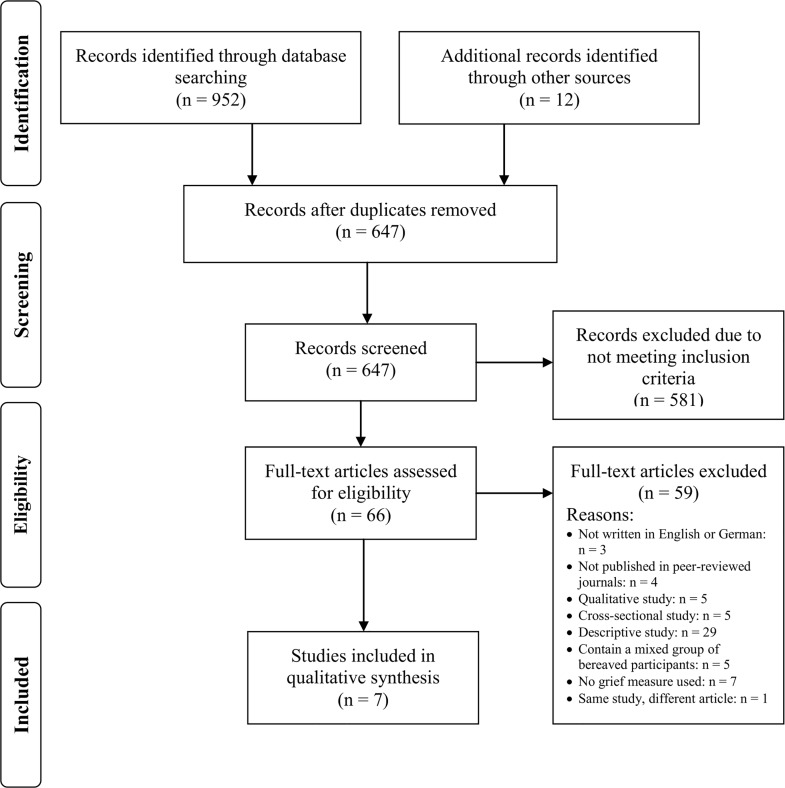
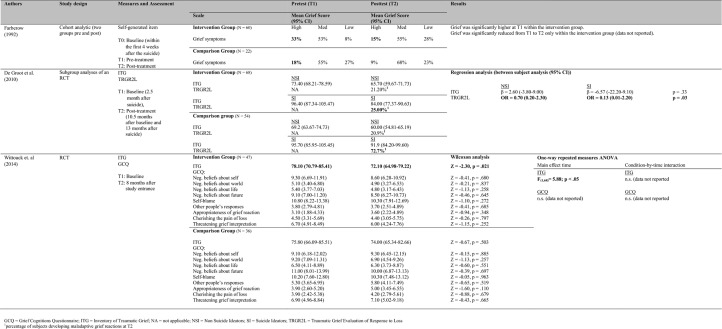
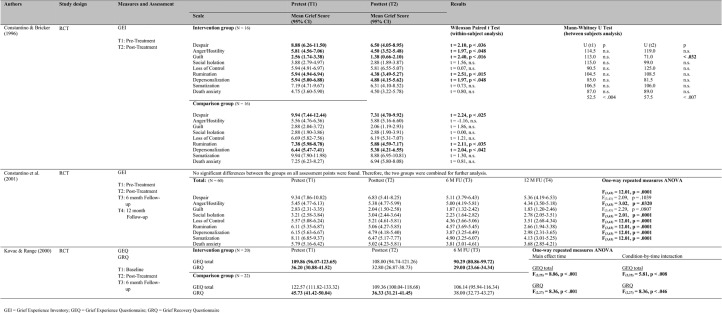
BACKGROUND: Adaption to the loss of a loved one due to suicide can be complicated by feelings of guilt, shame, responsibility, rejection, and stigmatization. Therefore people bereaved by suicide have an increased risk for developing complicated grief which is related to negative physical and mental disorders and an increased risk for suicidal behavior. Grief interventions are needed for this vulnerable population. The aim of this systematic review was to provide an overview of the current state of evidence concerning the effectiveness of interventions that focus on grief for people bereaved by suicide. METHODS: We conducted a systematic literature search using PubMed, Web of Science, and PsycINFO for articles published up until November 2016. Relevant papers were identified and methodological quality was assessed by independent raters. A narrative synthesis was conducted. RESULTS: Seven intervention studies met the inclusion criteria. Two interventions were based on cognitive-behavioral approaches, four consisted of bereavement groups, and one utilized writing therapy. As five of the seven interventions were effective in reducing grief intensity on at least one outcome measure, there is some evidence that they are beneficial. Bereavement groups tend to be effective in lowering the intensity of uncomplicated grief, as are writing interventions in lowering suicide-specific aspects of grief. Cognitive-behavioral programs were helpful for a subpopulation of people who had high levels of suicidal ideation. LIMITATION: On average, methodological quality was low so the evidence for benefits is not robust. The stability of treatment effects could not be determined as follow-up assessments are rare. Generalizability is limited due to homogeneous enrollments of mainly female, white, middle-aged individuals. CONCLUSIONS: People bereaved by suicide are especially vulnerable to developing complicated grief. Therefore, grief therapies should be adapted to and evaluated in this population. Prevention of complicated grief may be successful in populations of high risk individuals.
Overview
The claims and statistics of this paper haven’t been checked yet.
Run the check — free, no account needed. It reads the open-access text and checks the sources it cites.
Integrity signals
Registry
Cites
Statistics
Figures

Verification
Claims the paper makes
The claims and statistics of this paper haven’t been checked yet.
Run the check — free, no account needed. It reads the open-access text and checks the sources it cites.
Claims other papers make about this one
Each is checked against this paper’s own text: does it say what the citing paper says it does?
The source backs part of the claim, not all of it — or backs it for a different population, condition or comparison.
In the citing paper
“Group therapy is effective in reducing the intensity of uncomplicated grief”
From Prolonged grief disorder treatment: An approach to COVID-19 grief (2023) · cites this paper as Linde et al., 2017
Experimental — accuracy not yet measuredThe source backs part of the claim, not all of it — or backs it for a different population, condition or comparison.
In the citing paper
“Cognitive behavioral programs proved useful for a subgroup of people with complicated grief with high levels of suicidal ideation (Linde, Treml, Steinig, Nagl, & Kersting, 2017).”
From Prolonged grief disorder treatment: An approach to COVID-19 grief (2023) · cites this paper as Linde et al., 2017
Experimental — accuracy not yet measuredThe source backs part of the claim, not all of it — or backs it for a different population, condition or comparison.
In the citing paper
“-Effective for subgroup of people with high levels of suicidal ideation (Linde et al., 2017).”
From Prolonged grief disorder treatment: An approach to COVID-19 grief (2023) · cites this paper as Linde et al., 2017
Experimental — accuracy not yet measuredThe source backs part of the claim, not all of it — or backs it for a different population, condition or comparison.
In the citing paper
“-They are effective for de-escalating uncomplicated grief (Linde et al., 2017).”
From Prolonged grief disorder treatment: An approach to COVID-19 grief (2023) · cites this paper as Linde et al., 2017
Experimental — accuracy not yet measuredThe cited source says what the claim attributes to it.
In the citing paper
“This dovetails with intervention evidence suggesting potential benefits of group-based and psychosocial approaches for some suicide-bereaved individuals, while also highlighting that the overall evidence base remains heterogeneous and methodologically uneven (Linde et al., 2017;McDaid et al., 2008).”
From Relational and Institutional Disenfranchisement in Suicide Bereavement: A Qualitative Meta-Synthesis of Family Members' Experiences (2026) · cites this paper as Linde et al., 2017
The cited source says what the claim attributes to it.
In the citing paper
“While little is known of the effectiveness of postvention, this review aimed to investigate what is known of the effects of postvention service delivery models and the components that may contribute to the effectiveness.”
From Suicide Postvention Service Models and Guidelines 2014–2019: A Systematic Review (2019) · cites this paper as Linde et al., 2017
The cited source says what the claim attributes to it.
In the citing paper
“They also pointed out the limitations of the field, namely the paucity of intervention research in postvention, the diversity of methodologies used, and the general poor quality of the relevant studies.”
The cited source says what the claim attributes to it.
In the citing paper
“The three systematic reviews conducted to-date found some evidence of effectiveness of postvention interventions [24–26].”
The cited source says what the claim attributes to it.
In the citing paper
“However, little is known about its effectiveness.”
The cited source says what the claim attributes to it.
In the citing paper
“Five of the seven interventions proved efficacious in decreasing grief intensity on at least one outcome measure.”
From Prolonged grief disorder treatment: An approach to COVID-19 grief (2023) · cites this paper as Linde et al., 2017
The cited source says what the claim attributes to it.
In the citing paper
“writing therapy (by inviting subjects to write openly and in a safe environment about suicidal thoughts and emotions) has been shown to reduce specific aspects of suicide-related grief compared to those randomly assigned to a control condition.”
From Prolonged grief disorder treatment: An approach to COVID-19 grief (2023) · cites this paper as Linde et al., 2017
Self-check
Percentages, sums and reported differences re-computed from the paper’s own numbers.
The self-check needs the paper’s full text.
Citations
Cites
Diagnostic and Statistical Manual of Mental Disorders
American Psychiatric Association (2013) · doi:10.1176/appi.books.9780890425596 · Cited by 116,369
Liberati, A., Altman, D. G., Tetzlaff, J., Mulrow, C., Gøtzsche, P. C., Ioannidis, J. P. A., Clarke, M., Devereaux, P. J., Kleijnen, J., & Moher, D. (2009) · PLoS Medicine · doi:10.1371/journal.pmed.1000100 · Cited by 28,164
Liberati, A., Altman, D. G., Tetzlaff, J., Mulrow, C., Gøtzsche, P. C., Ioannidis, J. P. A., Clarke, M., Devereaux, P. J., Kleijnen, J., & Moher, D. (2009) · Annals of Internal Medicine · doi:10.7326/0003-4819-151-4-200908180-00136 · Cited by 10,349
Psychological autopsy studies of suicide: a systematic review.
CAVANAGH, J. T. O., CARSON, A. J., SHARPE, M., & LAWRIE, S. M. (2003) · Psychological Medicine · doi:10.1017/s0033291702006943 · Cited by 2,207
Confronting a traumatic event: Toward an understanding of inhibition and disease.
Pennebaker, J. W., & Beall, S. K. (1986) · Journal of Abnormal Psychology · doi:10.1037/0021-843x.95.3.274 · Cited by 2,074
Prolonged grief disorder: psychometric validation of criteria proposed for DSM-V and ICD-11
Prigerson, H. G., Horowitz, M. J., Jacobs, S. C., Parkes, C. M., Aslan, M., Goodkin, K., Raphael, B., Marwit, S. J., Wortman, C., Neimeyer, R. A., et al. (2009) · PLoS Medicine · doi:10.1371/journal.pmed.1000121 · Cited by 1,863
Inventory of complicated grief: a scale to measure maladaptive symptoms of loss.
Prigerson, H. G., Maciejewski, P. K., Reynolds, C. F., Bierhals, A. J., Newsom, J. T., Fasiczka, A., Frank, E., Doman, J., & Miller, M. (1995) · Psychiatry Research · doi:10.1016/0165-1781(95)02757-2 · Cited by 1,582
Complicated grief and related bereavement issues for DSM-5
Shear, M. K., Simon, N. M., Wall, M. M., Zisook, S., Neimeyer, R. A., Duan, N., Reynolds, C. F., Lebowitz, B. D., Sung, S. C., Ghesquiere, A., et al. (2011) · Depression and Anxiety · doi:10.1002/da.20780 · Cited by 1,121
Treatment of Complicated Grief: A Randomized Controlled Trial
Shear, K., Frank, E., Houck, P. R., & Reynolds, C. F. (2005) · JAMA · doi:10.1001/jama.293.21.2601 · Cited by 1,097
The Dual Process Model of Coping with Bereavement: A Decade on
Stroebe, M., & Schut, H. (2010) · OMEGA - Journal of Death and Dying · doi:10.2190/om.61.4.b · Cited by 981
Cited by
Sorted by citations
Prolonged Grief Disorder: Course, Diagnosis, Assessment, and Treatment
Szuhany, K. L., Malgaroli, M., Miron, C. D., & Simon, N. M. (2021) · FOCUS The Journal of Lifelong Learning in Psychiatry · doi:10.1176/appi.focus.20200052 · Cited by 203
Andriessen, K., Krysinska, K., Hill, N. T. M., Reifels, L., Robinson, J., Reavley, N., & Pirkis, J. (2019) · BMC Psychiatry · doi:10.1186/s12888-019-2020-z · Cited by 172
Scott, H. R., Pitman, A., Kozhuharova, P., & Lloyd‐Evans, B. (2020) · BMC Psychiatry · doi:10.1186/s12888-020-02639-4 · Cited by 121
Suicide Postvention Service Models and Guidelines 2014–2019: A Systematic Review
Andriessen, K., Krysinska, K., Kõlves, K., & Reavley, N. (2019) · Frontiers in Psychology · doi:10.3389/fpsyg.2019.02677 · Cited by 129
Lived experience peer support programs for suicide prevention: a systematic scoping review
Schlichthorst, M., Ozols, I., Reifels, L., & Morgan, A. J. (2020) · International Journal of Mental Health Systems · doi:10.1186/s13033-020-00396-1 · Cited by 114
The Influence of Stigma on Suicide Bereavement: A Systematic Review
Evans, A., & Abrahamson, K. A. (2020) · Journal of Psychosocial Nursing and Mental Health Services · doi:10.3928/02793695-20200127-02 · Cited by 60
Treml, J., Nagl, M., Linde, K., Kündiger, C., Peterhänsel, C., & Kersting, A. (2021) · European Journal of Psychotraumatology · doi:10.1080/20008198.2021.1926650 · Cited by 66
Kõlves, K., Zhao, Q., Ross, V., Hawgood, J., Spence, S. H., & de Leo, D. (2020) · Australian & New Zealand Journal of Psychiatry · doi:10.1177/0004867419882490 · Cited by 50
Gitterman, A., & Knight, C. (2018) · Clinical Social Work Journal · doi:10.1007/s10615-018-0682-5 · Cited by 46
Wainwright, V., Cordingley, L., Chew-Graham, C. A., Kapur, N., Shaw, J. J., Smith, S., McGale, B., & Mcdonnell, S. (2020) · British Journal of General Practice · doi:10.3399/bjgp20x707849 · Cited by 58
Kustanti, C. Y., Fang, H., Kang, X. L., Chiou, J., Wu, S., Yunitri, N., Chu, H., & Chou, K. (2021) · Journal of Nursing Scholarship · doi:10.1111/jnu.12630 · Cited by 42
Scoping Review of Peer-Led Support for People Bereaved by Suicide
Higgins, A., Hybholt, L., Meuser, O. A., Eustace Cook, J., Downes, C., & Morrissey, J. (2022) · International Journal of Environmental Research and Public Health · doi:10.3390/ijerph19063485 · Cited by 36
“Given the distinctive nature of bereavement by suicide, in terms of stigma, self-blame, guilt, societal reactions [6], the potential for prolonged and complicated grief [23], and the absence of a review in this area, the authors were of the view there was merit in conducting a separate review to examine the extent, ra…”
BackgroundInfluentialKaspersen, S. L., Kalseth, J., Stene‐Larsen, K., & Reneflot, A. (2022) · International Journal of Environmental Research and Public Health · doi:10.3390/ijerph191610016 · Cited by 32
Pizzoli, S. F. M., Monzani, D., Vergani, L., Sanchini, V., & Mazzocco, K. (2021) · Current Psychology · doi:10.1007/s12144-021-02158-9 · Cited by 31
Ligier, F., Rassy, J., Fortin, G., van Haaster, I., Doyon, C., Brouillard, C., Séguin, M., & Lesage, A. (2020) · BMC Public Health · doi:10.1186/s12889-020-09636-y · Cited by 25
Spirituality and Religiosity during Suicide Bereavement: A Qualitative Systematic Review
Čepulienė, A. A., Pučinskaitė, B., Spangelytė, K., Skruibis, P., & Gailienė, D. (2021) · Religions · doi:10.3390/rel12090766 · Cited by 26
The “men in grief” phenomenon among suicide bereaved Chinese men in Hong Kong
Chan, T. M. S., & Cheung, M. (2020) · Death Studies · doi:10.1080/07481187.2020.1855609 · Cited by 19
Causer, H., Bradley, E., Muse, K., & Smith, J. (2021) · PLoS ONE · doi:10.1371/journal.pone.0251369 · Cited by 19
A Narrative Evaluation of a Grief Support Camp for Families Affected by a Parent's Suicide
Hagström, A. S. (2021) · Frontiers in Psychiatry · doi:10.3389/fpsyt.2021.783066 · Cited by 20
Efficacy of an online-group intervention after suicide bereavement: A randomized controlled trial
Wagner, B., Grafiadeli, R., Schäfer, T., & Hofmann, L. (2022) · Internet Interventions · doi:10.1016/j.invent.2022.100542 · Cited by 21
Sudden Infant Death Syndrome (SIDS): State of the Art and Future Directions
Fraile‐Μartinez, O., Montero, C. G., Díez, S. C., Bravo, C., Quintana-Coronado, M. D. G., López-González, L., Barrena-Blázquez, S., García‐Honduvilla, N., León-Luis, J. A. D., Rodriguez-Martín, S., et al. (2024) · International Journal of Medical Sciences · doi:10.7150/ijms.89490 · Cited by 20
Creation and validation of a high-fidelity simulation scenario for suicide postvention
Pedrollo, L. F. S., Silva, A. C., Zanetti, A. C. G., & Vedana, K. G. G. (2022) · Revista Latino-Americana de Enfermagem · doi:10.1590/1518-8345.6034.3699 · Cited by 18
Refining Suicide Prevention: a Narrative Review on Advances in Psychotherapeutic Tools
Calati, R., Courtet, P., & López‐Castromán, J. (2018) · Current Psychiatry Reports · doi:10.1007/s11920-018-0876-0 · Cited by 22
Hom, M. A., Stanley, I. H., Spencer‐Thomas, S., & Joiner, T. E. (2018) · Journal of Clinical Psychology · doi:10.1002/jclp.22674 · Cited by 18
Griffin, E., O’Connell, S., Ruane‐McAteer, E., Corcoran, P. E., & Arensman, E. (2022) · International Journal of Environmental Research and Public Health · doi:10.3390/ijerph19074076 · Cited by 25
Lenferink, L. I. M., de Keijser, J., Eisma, M. C., Smid, G. E., & Boelen, P. A. (2020) · BMJ Open · doi:10.1136/bmjopen-2019-035050 · Cited by 19
Listening to a Silent Crisis: Men’s Suicide in Rural and Farming Communities in Slovenia
Roy, P., & Hočevar, D. K. (2019) · Revija za socijalnu politiku · doi:10.3935/rsp.v26i2.1593 · Cited by 22
Live-Chat Support for People Bereaved by Suicide
Cipolletta, S., Entilli, L., Bettio, F., & Leo, D. D. (2021) · Crisis · doi:10.1027/0227-5910/a000759 · Cited by 16
Pitman, A., Logeswaran, Y., McDonald, K. C., Cerel, J., Lewis, G., & Erlangsen, A. (2023) · Epidemiology and Psychiatric Sciences · doi:10.1017/s2045796023000653 · Cited by 15
Suicide postvention for staff and students on university campuses: a scoping review
Allie, S.-L. N., Bantjes, J. R., & Andriessen, K. (2023) · BMJ Open · doi:10.1136/bmjopen-2022-068730 · Cited by 14
Peer-support groups for suicide loss survivors: a systematic review
Inostroza, C., Rubio-Ramírez, F., Bustos, C., Quijada, Y., Fernández, D., Vasily Buhring, S., Vargas, B., Riquelme-Bórquez, A., & Araya, M. P. (2023) · Social Work With Groups · doi:10.1080/01609513.2023.2249053 · Cited by 15
Hao, F., Qiu, F., Liang, Z., & Li, P. (2024) · Asian Journal of Psychiatry · doi:10.1016/j.ajp.2024.104133 · Cited by 16
Yasın Aile Üzerine Etkilerini Azaltmak İçin Uygulanan Yas Destek Programları
Arslan, B. Ş., & Buldukoğlu, K. (2019) · Psikiyatride Guncel Yaklasimlar - Current Approaches in Psychiatry · doi:10.18863/pgy.444297 · Cited by 13
O’Connell, S., Troya, M. I., Arensman, E., & Griffin, E. (2023) · Death Studies · doi:10.1080/07481187.2023.2201922 · Cited by 13
Perceived Effectiveness of Components of Interventions to Support People Bereaved By Suicide
Hofmann, L., Putri, A. K., Pitman, A., Bantjes, J. R., Dransart, D. A. C., Causer, H., Cerel, J., Chow, A. Y. M., Leo, D. D., Feigelman, W. T., et al. (2024) · Crisis · doi:10.1027/0227-5910/a000978 · Cited by 14
What we know about grief intervention: a bibliometric analysis
Li, J., Li, Y., Wang, Y., Jishi, W.-G., & Fang, J. (2023) · Frontiers in Psychiatry · doi:10.3389/fpsyt.2023.1152660 · Cited by 15
State of the Science: Psychotherapeutic Interventions for Prolonged Grief Disorder
LaPlante, C. D., Hardt, M. M., Maciejewski, P. K., & Prigerson, H. G. (2024) · Behavior Therapy · doi:10.1016/j.beth.2024.07.002 · Cited by 14
DeCamp, M. W., & Levine, M. A. (2021) · Journal of General Internal Medicine · doi:10.1007/s11606-021-06852-z · Cited by 10
Quayle, K., Jones, P., Simplicio, M. C. D., Kamboj, S. K., & Pitman, A. (2023) · PLoS ONE · doi:10.1371/journal.pone.0284897 · Cited by 14
Leaune, É., Lestienne, L., Grandgenèvre, P., Morgiève, M., Vaïva, G., Vieux, M., Chalancon, B., Laplace, N., Haesebaert, J., & Poulet, E. (2021) · Frontiers in Psychiatry · doi:10.3389/fpsyt.2021.770154 · Cited by 9
Itua, I., Shah, K., Galway, P., Chaudhry, F., Georgiadi, T., Rastogi, J., Naleer, S., & Knipe, D. W. (2024) · Archives of Suicide Research · doi:10.1080/13811118.2024.2322144 · Cited by 7
Grief, bereavement and prolonged grief disorder: scoping and mapping the evidence
Raine, G., Khouja, C., Khatwa, M., Fulbright, H., Sutcliffe, K., & Sowden, A. J. (2025) · BJPsych Open · doi:10.1192/bjo.2025.10050 · Cited by 7
Xiu, D., Chow, A. Y. M., & Tang, S. (2020) · Clinical Psychology & Psychotherapy · doi:10.1002/cpp.2425 · Cited by 7
Survivors bereaved by suicide and the possibilities of postvention within Brazilian public health
Dantas, E. S. O., Bredemeier, J., & Amorim, K. P. C. (2022) · Saúde e Sociedade · doi:10.1590/s0104-12902022210496en · Cited by 7
Pitman, A., McDonald, K. C., Logeswaran, Y., Lewis, G., Cerel, J., Lewis, G., & Erlangsen, A. (2024) · Psychological Medicine · doi:10.1017/s0033291724000448 · Cited by 11
Regehr, L. J., Heath, M. A., Jackson, A. P., Nelson, D. A., & Cutrer‐Párraga, E. A. (2019) · Death Studies · doi:10.1080/07481187.2019.1692972 · Cited by 7
The Efficacy of Bereavement Interventions: A Systematic Umbrella Review
Avis, K. A., Missler, M. A., van Deursen, D. S., Lenferink, L. I. M., Stroebe, M., & Schut, H. A. W. (2025) · Harvard Review of Psychiatry · doi:10.1097/hrp.0000000000000426 · Cited by 6
Coping with suicide loss: a qualitative study in primary health care
Suija, K., Rooväli, L., Aksen, M., Pisarev, H., Uusküla, A., & Kiivet, R. (2022) · Primary Health Care Research & Development · doi:10.1017/s1463423622000263 · Cited by 11
Narrative review of the potential for psychedelics to treat Prolonged Grief Disorder
Ehrenkranz, R. C., Agrawal, M., Penberthy, J. K., & Yaden, D. B. (2024) · International Review of Psychiatry · doi:10.1080/09540261.2024.2357668 · Cited by 6
Hofmann, L., & Wagner, B. (2024) · Death Studies · doi:10.1080/07481187.2024.2369858 · Cited by 8
Romero-Moreno, J. C., Cantero-García, M., Arco, A. H.-D., Izquierdo-Sotorrío, E., Rueda-Extremera, M., & González-Moreno, J. (2024) · Behavioral Sciences · doi:10.3390/bs14090791 · Cited by 10
Froese, J., McDermott, L. M., & Iwasaki, Y. (2019) · Annals of Leisure Research · doi:10.1080/11745398.2019.1616572 · Cited by 8
Suicide bereavement support: a literature review.
Griffin, E., & McMahon, E. M. (2019) · HRB National Drugs Library (Health Research Board) · Cited by 5
Prolonged grief disorder treatment: An approach to COVID-19 grief
Martínez-Medina, C. B., & Rodríguez-Orozco, A. R. (2023) · Salud Mental · doi:10.17711/sm.0185-3325.2023.021 · Cited by 5
“Effective for subgroup of people with high levels of suicidal ideation (Linde et al., 2017).”
InfluentialUsing Photovoice to Promote Meaning-Making in a Suicide Loss Support Group
Delgado, H., & Wester, K. L. (2020) · Journal of Mental Health Counseling · doi:10.17744/mehc.42.3.01 · Cited by 5
Wirksamkeit von Interventionen für Hinterbliebene nach einem Suizid: ein Systematischer Review
Wagner, B., Hofmann, L., & Grafiadeli, R. (2020) · Psychiatrische Praxis · doi:10.1055/a-1182-2821 · Cited by 6
Čepulienė, A. A. (2022) · Religions · doi:10.3390/rel13060500 · Cited by 4
A Narrative Review of Suicide: Aiming at a More Encompassing Understanding
Madeira, L., & Miranda, A. T. (2021) · Philosophies · doi:10.3390/philosophies6030074 · Cited by 4
Carrandi, A., Hu, Y., Wayland, S., & Maple, M. J. (2023) · Health & Social Care in the Community · doi:10.1155/2023/5961793 · Cited by 5
Construção e validação de cenário de simulação de alta fidelidade para a posvenção do suicídio
Pedrollo, L. F. S., Silva, A. C., Zanetti, A. C. G., & Vedana, K. G. G. (2022) · Revista Latino-Americana de Enfermagem · doi:10.1590/1518-8345.6034.3700 · Cited by 3
Lesinskienė, S., Karalienė, V., Pociūtė, K., & Šambaras, R. (2024) · Journal of Clinical Medicine · doi:10.3390/jcm13072032 · Cited by 3
Case report on the multiple pathways to posttraumatic stress disorder following suicide
Padoan, C. S., Cardoso, T. D. A., Martini, M., Farias, C. D. A., Contessa, J. C., & Magalhães, P. V. D. S. (2019) · Death Studies · doi:10.1080/07481187.2019.1572675 · Cited by 3
Hafford‐Letchfield, T., Hanna, J. R., Grant, E., Ryder-Davies, L., Cogan, N. A., Goodman, J., & Rassmussen, S. (2023) · International Journal of Population Studies · doi:10.36922/ijps.0777 · Cited by 2
Engagement in meaningful activities post suicide loss: A scoping review protocol
Gill, M., Premnazeer, M., Scali, O. L., Rizvi, S. J., Schendelman, A., Polatajko, H. J., & Cameron, J. I. (2024) · PLoS ONE · doi:10.1371/journal.pone.0296522 · Cited by 3
Stories That Heal: Characterizing and Supporting Narrative for Suicide Bereavement
Doyle, D. T., Ghosh, J. K., Suchocki, R., Keegan, B., Voida, S., & Brubaker, J. R. (2024) · Proceedings of the International AAAI Conference on Web and Social Media · doi:10.1609/icwsm.v18i1.31319 · Cited by 3
Huang, J. S., Ballard, C. W., Zisook, S., Davidson, J. E., & Lee, K. C. (2024) · American Journal of Pharmaceutical Education · doi:10.1016/j.ajpe.2024.101296 · Cited by 3
Suicide Bereavement and Postvention: What Do We Know and What Should We Know?
Jiménez-Molina, Á., Güemes, F. O., Miranda, T. B., Venegas, J. P. P., & Morgiève, M. (2025) · Depression and personality · doi:10.1007/978-3-031-96037-6_10 · Cited by 2
Anet, Á. A., Jones, P., Quayle, K., Simplicio, M. D., Kamboj, S. K., & Pitman, A. (2026) · Current Research in Behavioral Sciences · doi:10.1016/j.crbeha.2026.100211 · Cited by 2
A Longitudinal Study of the Impact of a Suicide Bereavement Service on People Bereaved by Suicide
Visser, V., & Tretheway, R. (2023) · OMEGA - Journal of Death and Dying · doi:10.1177/00302228231188751 · Cited by 2
Exploring experiences of supports for suicide bereavement in Ireland: protocol for a national survey
O’Connell, S., Ruane‐McAteer, E., Daly, C., O’Connor, C., Tuomey, F., McDonnell, L., Arensman, E., Andriessen, K., & Griffin, E. (2021) · HRB Open Research · doi:10.12688/hrbopenres.13437.1 · Cited by 2
Gori, A., Topino, E., Imperatore, P., Musetti, A., Sim, J., & Machin, L. (2023) · European Journal of Investigation in Health Psychology and Education · doi:10.3390/ejihpe13060074 · Cited by 1
Fukuchi, N., Shigemura, J., & Obara, A. (2023) · Disaster Medicine and Public Health Preparedness · doi:10.1017/dmp.2023.169 · Cited by 1
Neto, D. D., Coelho, A., da Silva, A. N., Garcia‐Marques, T., & Albuquerque, S. (2025) · Behavioral Sciences · doi:10.3390/bs15070972 · Cited by 1
McGill, K., Bhullar, N., Carrandi, A., Batterham, P. J., Wayland, S., & Maple, M. J. (2025) · Suicide and Life-Threatening Behavior · doi:10.1111/sltb.70043 · Cited by 1
“Under Lock and Key”: Paternal Bereavement Following Child’s Suicide, a Case Study
Batista, C. I., Nery, M., & Ferrajão, P. C. (2025) · Journal of Loss and Trauma · doi:10.1080/15325024.2025.2574709 · Cited by 1
Utilization of Postvention Supports: A National Cross-Sectional Survey of Adults Bereaved by Suicide
Griffin, E., O’Connell, S., Andriessen, K., Khan, A., O’Brien, C., Daly, C., Tuomey, F., & Arensman, E. (2025) · Archives of Suicide Research · doi:10.1080/13811118.2025.2552953 · Cited by 1
Engagement in meaningful activities post suicide loss: A scoping review
Gill, M., Wu, M., Pierre, S., Joachim, L., Premnazeer, M., Scali, O. L., Rizvi, S. J., Renwick, R. M., Polatajko, H. J., & Cameron, J. I. (2025) · PLoS ONE · doi:10.1371/journal.pone.0336640 · Cited by 1
Bereavement service deserts: A 2024 statewide assessment of bereavement services
Giang, C. W., Kcomt, L., Truchan, J., Dickinson, K., Evans‐Polce, R. J., & McCabe, S. E. (2025) · Death Studies · doi:10.1080/07481187.2025.2595997 · Cited by 2
Suicide-Prevention Technology Toward Co-production with Caregivers
Nguyen, N. P. (2026) · Journal of Technology in Behavioral Science · doi:10.1007/s41347-026-00612-8 · Cited by 1
Andriessen, K., & Krysinska, K. E. (2021) · doi:10.1093/med/9780198834441.003.0064 · Cited by 1
Girault, N., & Dutemple, M. (2020) · EMC - Tratado de Medicina · doi:10.1016/s1636-5410(20)43789-4 · Cited by 1
Exploring experiences of supports for suicide bereavement in Ireland: protocol for a national survey
O’Connell, S., Ruane‐McAteer, E., Daly, C., O’Connor, C., Tuomey, F., McDonnell, L., Arensman, E., Andriessen, K., & Griffin, E. (2022) · HRB Open Research · doi:10.12688/hrbopenres.13437.2 · Cited by 1
Pedrollo, L. F. S., Silva, A. C., Zanetti, A. C. G., & Vedana, K. G. G. (2022) · Revista Latino-Americana de Enfermagem · doi:10.1590/1518-8345.6034.3698 · Cited by 1
Dantas, E. S. O., Bredemeier, J., & Amorim, K. P. C. (2022) · Saúde e Sociedade · doi:10.1590/s0104-12902022210496pt · Cited by 2
Albuquerque, S., Pennetta, G., Coelho, A., Pinto, R. J., & Delalibera, M. (2024) · Psychology Health & Medicine · doi:10.1080/13548506.2024.2417312 · Cited by 1
Petersen, S. H., Kalseth, J., & Kaspersen, S. L. (2020) · BMJ Open · doi:10.1136/bmjopen-2020-041978 · Cited by 1
Schlichthorst, M., Ozols, I., Reifels, L., & Morgan, A. J. (2019) · doi:10.21203/rs.2.16656/v1 · Cited by 1
Romão, M. E., Gündoğan, S., Baptista, M. N., & Barello, S. (2026) · Archives of Suicide Research · doi:10.1080/13811118.2026.2690232
Futuristic prevention science and therapeutic conversations
Bhui, K. S. (2018) · The British Journal of Psychiatry · doi:10.1192/bjp.2018.57
Nunes, L. (2020) · Springer eBooks · doi:10.1007/978-3-030-42556-2_15
Kearns, M. L. (2017) · University of Limerick Institutional Repository (University of Limerick) · doi:10.13140/rg.2.2.23989.12002
Imagined Intergroup Contact Reduces Prejudice Against Suicide Loss Survivors;
Yamanaka, A., & Tagami, K. (2021) · Asian Journal of Human Services · doi:10.14391/ajhs.21.18
LUTO PARENTAL: A EXPERIÊNCIA DE PAIS/MÃES EM CASOS DE MORTES POR SUICÍDIO
Guerreiro, P. G. (2022) · doi:10.17771/pucrio.acad.58667
Fogarty, S., Huberty, J., & Hay, P. (2022) · Integrative Medicine Reports · doi:10.1089/imr.2021.0010
Andriessen, K., Krysinska, K. E., Kõlves, K., & Reavley, N. J. (2019) · doi:10.57022/txtp7812
Ose, S. O., & Kaspersen, S. L. (2023) · Suicidologi/Nytt i suicidologi · doi:10.5617/suicidologi.10312
Prolonged Grief Disorder di Masa Pandemi COVID-19: Suatu Tinjauan Pustaka
Wiyoga, R. L., Indriarti, M. R., & Septiawan, D. (2023) · Jurnal Kedokteran Meditek · doi:10.36452/jkdoktmeditek.v29i3.2656
The Phenomenological Approach to Psychological Autopsy of Suicide among the YouthPreprint
Manjares, S. M., & Patag, M. D. (2023) · SSRN Electronic Journal · doi:10.2139/ssrn.4591224
Suicide contagion and psychosocial risks among Nepali youth through a near-hanging case study
Atreya, A., Mahato, T., Nepal, S., Paudel, S., Sharma, B., Acharya, B., & Bashyal, D. (2024) · Medico-Legal Journal · doi:10.1177/00258172241243169
Metadata
- Authors
- Linde, K., Treml, J., Steinig, J., Nagl, M., & Kersting, A.
- Affiliations
- Leipzig University (DE)
- Corresponding author
- Kersting, Anette
- Venue
- PLoS ONE
- Publisher
- Public Library of Science (PLoS)
- Published
- 2017-06-23
- Volume
- 12
- Issue
- 6
- Pages
- e0179496
- ISSN
- 1932-6203 (ISSN-L)
- PMC
- PMC5482439
- OpenAlex
- W2702460881
- Cited by
- 107
- References
- 74
- Citations by year
- 2026: 6 · 2025: 10 · 2024: 16 · 2023: 15 · 2022: 15 · 2021: 14 · 2020: 15 · 2019: 11 · 2018: 4 · 2017: 1
- FWCI
- 1.30
- Type
- journal article
- Language
- en
- Open access
- gold
- doi.org
- Licence
- Locations
- PLoS ONE (publishedVersion, cc-by)
- PubMed Central (publishedVersion, cc-by)
- PubMed (publishedVersion)
- RePEc: Research Papers in Economics (submittedVersion)
- DOAJ (DOAJ: Directory of Open Access Journals) (submittedVersion)
- Figshare (submittedVersion, cc-by)
- Funders
- Deutsche Forschungsgemeinschaft
- Topics
- Social Sciences › Psychology › Clinical Psychology › Grief, Bereavement, and Mental Health
- Social Sciences › Anthropology › Death, Funerary Practices, and Mourning
- Social Sciences › Psychology › Clinical Psychology › Suicide and Self-Harm Studies
- Keywords
- complicated grief, suicide bereavement, grief intervention, bereavement groups, therapeutic writing, cognitive behavioral therapy, suicidal ideation, guilt and shame
- MeSH terms
- Grief, Humans, Social Support, Suicide, Writing, Cognitive Behavioral Therapy
About these checks
Registry, retraction, Cites and statistics results are computed, not judged, with one exception: a printed reference that no index lists is read once by a model before it counts as a citation error. Claims are extracted by a model and kept only when their quote appears verbatim in the text; each cited source is then checked, with a model’s help, for whether it says what the claim relies on. Those verdicts can be wrong — read the claim’s quote and the cited source before relying on one.
Statistics and arithmetic are recomputed, not judged.
Confidence bands are shown only for fields calibrated on our annotated test set. None is calibrated yet, so no band is shown.
What counts as a claim ›How we measure confidence ›How we check this ›
Are you an author, or do you see a problem with this page? Request a review
