

The DOI matches its Crossref record; 75 of the 75 references it cites were found in a registry or an index.
Grief interventions for people bereaved by suicide: A systematic review
Open accessAbstract
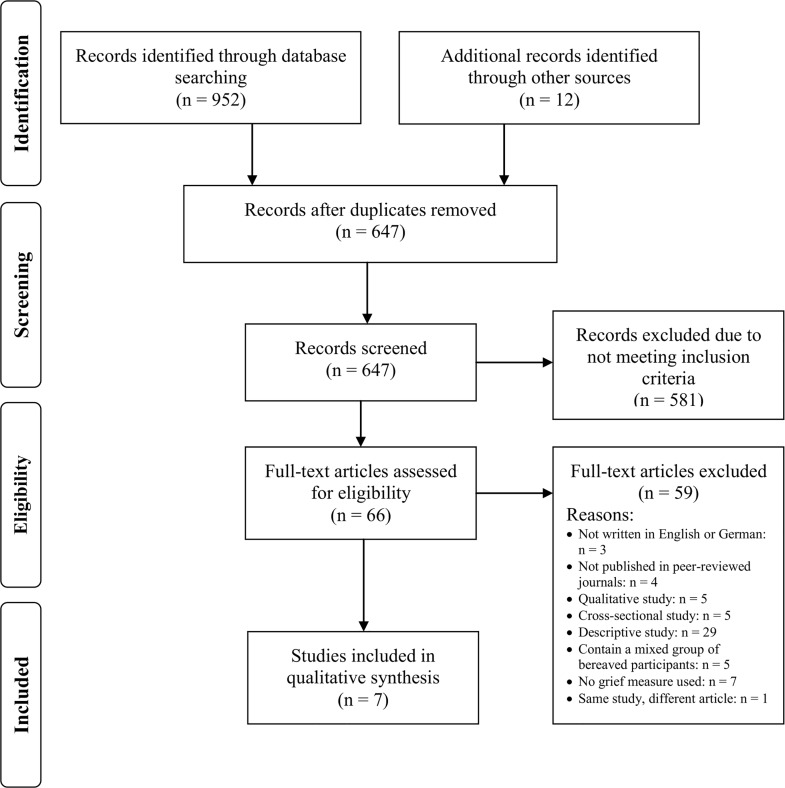
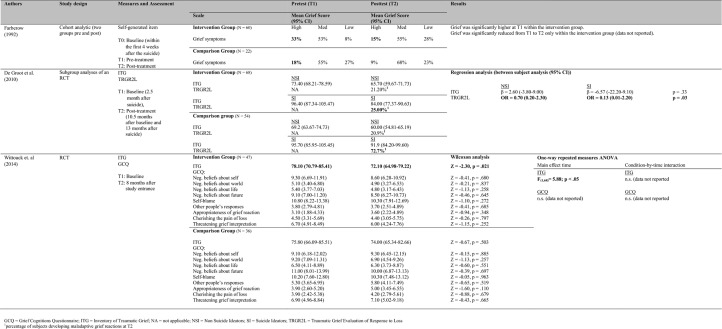
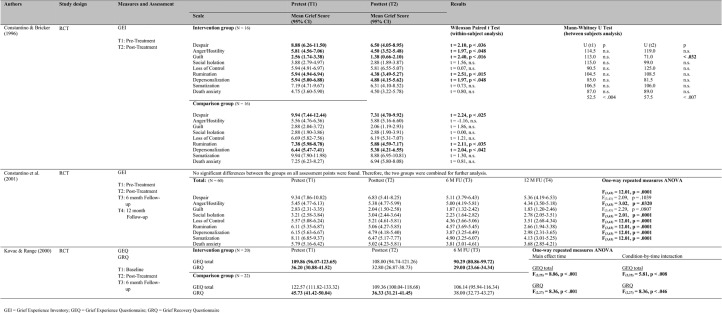
BACKGROUND: Adaption to the loss of a loved one due to suicide can be complicated by feelings of guilt, shame, responsibility, rejection, and stigmatization. Therefore people bereaved by suicide have an increased risk for developing complicated grief which is related to negative physical and mental disorders and an increased risk for suicidal behavior. Grief interventions are needed for this vulnerable population. The aim of this systematic review was to provide an overview of the current state of evidence concerning the effectiveness of interventions that focus on grief for people bereaved by suicide. METHODS: We conducted a systematic literature search using PubMed, Web of Science, and PsycINFO for articles published up until November 2016. Relevant papers were identified and methodological quality was assessed by independent raters. A narrative synthesis was conducted. RESULTS: Seven intervention studies met the inclusion criteria. Two interventions were based on cognitive-behavioral approaches, four consisted of bereavement groups, and one utilized writing therapy. As five of the seven interventions were effective in reducing grief intensity on at least one outcome measure, there is some evidence that they are beneficial. Bereavement groups tend to be effective in lowering the intensity of uncomplicated grief, as are writing interventions in lowering suicide-specific aspects of grief. Cognitive-behavioral programs were helpful for a subpopulation of people who had high levels of suicidal ideation. LIMITATION: On average, methodological quality was low so the evidence for benefits is not robust. The stability of treatment effects could not be determined as follow-up assessments are rare. Generalizability is limited due to homogeneous enrollments of mainly female, white, middle-aged individuals. CONCLUSIONS: People bereaved by suicide are especially vulnerable to developing complicated grief. Therefore, grief therapies should be adapted to and evaluated in this population. Prevention of complicated grief may be successful in populations of high risk individuals.
Overview
The claims and statistics of this paper haven’t been checked yet.
Run the check — free, no account needed. It reads the open-access text and checks the sources it cites.
Integrity signals
Registry
Cites
Statistics
Figures

Verification
Claims the paper makes
The claims and statistics of this paper haven’t been checked yet.
Run the check — free, no account needed. It reads the open-access text and checks the sources it cites.
Claims other papers make about this one
Each is checked against this paper’s own text: does it say what the citing paper says it does?
The source backs part of the claim, not all of it — or backs it for a different population, condition or comparison.
In the citing paper
“Group therapy is effective in reducing the intensity of uncomplicated grief”
From Prolonged grief disorder treatment: An approach to COVID-19 grief (2023) · cites this paper as Linde et al., 2017
Experimental — accuracy not yet measuredThe source backs part of the claim, not all of it — or backs it for a different population, condition or comparison.
In the citing paper
“Cognitive behavioral programs proved useful for a subgroup of people with complicated grief with high levels of suicidal ideation (Linde, Treml, Steinig, Nagl, & Kersting, 2017).”
From Prolonged grief disorder treatment: An approach to COVID-19 grief (2023) · cites this paper as Linde et al., 2017
Experimental — accuracy not yet measuredThe source backs part of the claim, not all of it — or backs it for a different population, condition or comparison.
In the citing paper
“-Effective for subgroup of people with high levels of suicidal ideation (Linde et al., 2017).”
From Prolonged grief disorder treatment: An approach to COVID-19 grief (2023) · cites this paper as Linde et al., 2017
Experimental — accuracy not yet measuredThe source backs part of the claim, not all of it — or backs it for a different population, condition or comparison.
In the citing paper
“-They are effective for de-escalating uncomplicated grief (Linde et al., 2017).”
From Prolonged grief disorder treatment: An approach to COVID-19 grief (2023) · cites this paper as Linde et al., 2017
Experimental — accuracy not yet measuredThe cited source says what the claim attributes to it.
In the citing paper
“This dovetails with intervention evidence suggesting potential benefits of group-based and psychosocial approaches for some suicide-bereaved individuals, while also highlighting that the overall evidence base remains heterogeneous and methodologically uneven (Linde et al., 2017;McDaid et al., 2008).”
From Relational and Institutional Disenfranchisement in Suicide Bereavement: A Qualitative Meta-Synthesis of Family Members' Experiences (2026) · cites this paper as Linde et al., 2017
The cited source says what the claim attributes to it.
In the citing paper
“While little is known of the effectiveness of postvention, this review aimed to investigate what is known of the effects of postvention service delivery models and the components that may contribute to the effectiveness.”
From Suicide Postvention Service Models and Guidelines 2014–2019: A Systematic Review (2019) · cites this paper as Linde et al., 2017
The cited source says what the claim attributes to it.
In the citing paper
“They also pointed out the limitations of the field, namely the paucity of intervention research in postvention, the diversity of methodologies used, and the general poor quality of the relevant studies.”
The cited source says what the claim attributes to it.
In the citing paper
“The three systematic reviews conducted to-date found some evidence of effectiveness of postvention interventions [24–26].”
The cited source says what the claim attributes to it.
In the citing paper
“However, little is known about its effectiveness.”
The cited source says what the claim attributes to it.
In the citing paper
“Five of the seven interventions proved efficacious in decreasing grief intensity on at least one outcome measure.”
From Prolonged grief disorder treatment: An approach to COVID-19 grief (2023) · cites this paper as Linde et al., 2017
The cited source says what the claim attributes to it.
In the citing paper
“writing therapy (by inviting subjects to write openly and in a safe environment about suicidal thoughts and emotions) has been shown to reduce specific aspects of suicide-related grief compared to those randomly assigned to a control condition.”
From Prolonged grief disorder treatment: An approach to COVID-19 grief (2023) · cites this paper as Linde et al., 2017
Self-check
Percentages, sums and reported differences re-computed from the paper’s own numbers.
The self-check needs the paper’s full text.
Citations
Cites
Diagnostic and Statistical Manual of Mental Disorders
American Psychiatric Association (2013) · doi:10.1176/appi.books.9780890425596 · Cited by 116,369
Liberati, A., Altman, D. G., Tetzlaff, J., Mulrow, C., Gøtzsche, P. C., Ioannidis, J. P. A., Clarke, M., Devereaux, P. J., Kleijnen, J., & Moher, D. (2009) · PLoS Medicine · doi:10.1371/journal.pmed.1000100 · Cited by 28,164
Liberati, A., Altman, D. G., Tetzlaff, J., Mulrow, C., Gøtzsche, P. C., Ioannidis, J. P. A., Clarke, M., Devereaux, P. J., Kleijnen, J., & Moher, D. (2009) · Annals of Internal Medicine · doi:10.7326/0003-4819-151-4-200908180-00136 · Cited by 10,349
Psychological autopsy studies of suicide: a systematic review.
CAVANAGH, J. T. O., CARSON, A. J., SHARPE, M., & LAWRIE, S. M. (2003) · Psychological Medicine · doi:10.1017/s0033291702006943 · Cited by 2,207
Confronting a traumatic event: Toward an understanding of inhibition and disease.
Pennebaker, J. W., & Beall, S. K. (1986) · Journal of Abnormal Psychology · doi:10.1037/0021-843x.95.3.274 · Cited by 2,074
Prolonged grief disorder: psychometric validation of criteria proposed for DSM-V and ICD-11
Prigerson, H. G., Horowitz, M. J., Jacobs, S. C., Parkes, C. M., Aslan, M., Goodkin, K., Raphael, B., Marwit, S. J., Wortman, C., Neimeyer, R. A., et al. (2009) · PLoS Medicine · doi:10.1371/journal.pmed.1000121 · Cited by 1,863
Inventory of complicated grief: a scale to measure maladaptive symptoms of loss.
Prigerson, H. G., Maciejewski, P. K., Reynolds, C. F., Bierhals, A. J., Newsom, J. T., Fasiczka, A., Frank, E., Doman, J., & Miller, M. (1995) · Psychiatry Research · doi:10.1016/0165-1781(95)02757-2 · Cited by 1,582
Complicated grief and related bereavement issues for DSM-5
Shear, M. K., Simon, N. M., Wall, M. M., Zisook, S., Neimeyer, R. A., Duan, N., Reynolds, C. F., Lebowitz, B. D., Sung, S. C., Ghesquiere, A., et al. (2011) · Depression and Anxiety · doi:10.1002/da.20780 · Cited by 1,121
Treatment of Complicated Grief: A Randomized Controlled Trial
Shear, K., Frank, E., Houck, P. R., & Reynolds, C. F. (2005) · JAMA · doi:10.1001/jama.293.21.2601 · Cited by 1,097
The Dual Process Model of Coping with Bereavement: A Decade on
Stroebe, M., & Schut, H. (2010) · OMEGA - Journal of Death and Dying · doi:10.2190/om.61.4.b · Cited by 981
Resilience to loss and chronic grief: A prospective study from preloss to 18-months postloss
Bonanno, G. A., Wortman, C. B., Lehman, D. R., Tweed, R. G., Haring, M., Sonnega, J., Carr, D., & Nesse, R. M. (2002) · Journal of Personality and Social Psychology · doi:10.1037/0022-3514.83.5.1150 · Cited by 836
Diagnosis and classification of disorders specifically associated with stress: proposals for ICD-11
Maercker, A., Brewin, C. R., Bryant, R. A., Cloitre, M., van Ommeren, M., Jones, L. M., Humayan, A., Kagee, A., Llosa, A. E., Rousseau, C., et al. (2013) · World Psychiatry · doi:10.1002/wps.20057 · Cited by 762
Traumatic grief as a risk factor for mental and physical morbidity
(1997) · American Journal of Psychiatry · doi:10.1176/ajp.154.5.616 · Cited by 693
The varieties of grief experience
Bonanno, G. A., & Kaltman, S. I. (2001) · Clinical Psychology Review · doi:10.1016/s0272-7358(00)00062-3 · Cited by 657
Diagnostic criteria for complicated grief disorder
(1997) · American Journal of Psychiatry · doi:10.1176/ajp.154.7.904 · Cited by 648
Prevalence of complicated grief in a representative population-based sample.
Kersting, A., Brähler, E., Glaesmer, H., & Wagner, B. (2011) · Journal of Affective Disorders · doi:10.1016/j.jad.2010.11.032 · Cited by 628
Prospective Patterns of Resilience and Maladjustment During Widowhood.
Bonanno, G. A., Wortman, C. B., & Nesse, R. M. (2004) · Psychology and Aging · doi:10.1037/0882-7974.19.2.260 · Cited by 595
A Cognitive-Behavioral Conceptualization of Complicated Grief.
Boelen, P. A., van den Hout, M. A., & van den Bout, J. (2006) · Clinical Psychology: Science and Practice · doi:10.1111/j.1468-2850.2006.00013.x · Cited by 523
Effects of suicide bereavement on mental health and suicide risk
Pitman, A., Osborn, D., King, M., & Erlangsen, A. (2014) · The Lancet Psychiatry · doi:10.1016/s2215-0366(14)70224-x · Cited by 492
Grief and bereavement: what psychiatrists need to know
ZISOOK, S., & SHEAR, K. (2009) · World Psychiatry · doi:10.1002/j.2051-5545.2009.tb00217.x · Cited by 451
Latham, A. E., & Prigerson, H. G. (2004) · Suicide and Life-Threatening Behavior · doi:10.1521/suli.34.4.350.53737 · Cited by 448
Is Suicide Bereavement Different? A Reassessment of the Literature
Jordan, J. R. (2001) · Suicide and Life-Threatening Behavior · doi:10.1521/suli.31.1.91.21310 · Cited by 433
Currier, J. M., Neimeyer, R. A., & Berman, J. S. (2008) · Psychological Bulletin · doi:10.1037/0033-2909.134.5.648 · Cited by 431
Book Review: The International Handbook of Suicide and Attempted Suicide
Rosenman, S. J. (2001) · Australian & New Zealand Journal of Psychiatry · doi:10.1046/j.1440-1614.2001.0949k.x · Cited by 429
Internet-Based Cognitive-Behavioral Therapy for Complicated Grief: A Randomized Controlled Trial
Wagner, B., Knaevelsrud, C., & Maercker, A. (2006) · Death Studies · doi:10.1080/07481180600614385 · Cited by 376
The prevention and treatment of complicated grief: a meta-analysis
Wittouck, C., Van Autreve, S., De Jaegere, E., Portzky, G., & van Heeringen, K. (2011) · Clinical Psychology Review · doi:10.1016/j.cpr.2010.09.005 · Cited by 361
Suicide survivors’ mental health and grief reactions: A systematic review of controlled studies
Sveen, C., & Walby, F. A. (2008) · Suicide and Life-Threatening Behavior · doi:10.1521/suli.2008.38.1.13 · Cited by 343
The prevalence and correlates of psychiatric comorbidity in individuals with complicated grief
Simon, N. M., Shear, K. M., Thompson, E. H., Zalta, A. K., Perlman, C., Reynolds, C. F., Frank, E., Melhem, N. M., & Silowash, R. (2007) · Comprehensive Psychiatry · doi:10.1016/j.comppsych.2007.05.002 · Cited by 333
Predictors of psychosocial distress after suicide, SIDS and accidents
DYREGROV, K., NORDANGER, D., & DYREGROV, A. (2003) · Death Studies · doi:10.1080/07481180302892 · Cited by 327
Suicide bereavement and complicated grief
Tal Young, I., Iglewicz, A., Glorioso, D., Lanouette, N., Seay, K., Ilapakurti, M., & Zisook, S. (2012) · Dialogues in Clinical Neuroscience · doi:10.31887/dcns.2012.14.2/iyoung · Cited by 291
Boelen, P. A., & Prigerson, H. G. (2007) · European Archives of Psychiatry and Clinical Neuroscience · doi:10.1007/s00406-007-0744-0 · Cited by 288
The prevalence and characteristics of complicated grief in older adults
Newson, R. S., Boelen, P. A., Hek, K., Hofman, A., & Tiemeier, H. (2011) · Journal of Affective Disorders · doi:10.1016/j.jad.2011.02.021 · Cited by 281
Treatment of Complicated Grief in Elderly Persons: A Randomized Clinical Trial
Shear, M. K., Wang, Y., Skritskaya, N., Duan, N., Mauro, C., & Ghesquiere, A. (2014) · JAMA Psychiatry · doi:10.1001/jamapsychiatry.2014.1242 · Cited by 276
DEVELOPMENT AND VALIDATION OF THE HOGAN GRIEF REACTION CHECKLIST
Hogan, D. B. G. N. S., Greenfield, D. B., & Schmidt, L. A. (2001) · Death Studies · doi:10.1080/07481180125831 · Cited by 274
Inclusion of patients in clinical trial analysis: the intention‐to‐treat principle
Heritier, S. R., Gebski, V., & KEECH, A. C. (2003) · The Medical Journal of Australia · doi:10.5694/j.1326-5377.2003.tb05627.x · Cited by 271
The impact of parental status on the risk of completed suicide
Qin, P., & Mortensen, P. B. (2003) · Archives of General Psychiatry · doi:10.1001/archpsyc.60.8.797 · Cited by 242
Kersting, A., Dölemeyer, R., Steinig, J., Walter, F., Kroker, K., Baust, K., & Wagner, B. (2013) · Psychotherapy and Psychosomatics · doi:10.1159/000348713 · Cited by 210
DEVELOPMENT AND VALIDATION OF THE HOGAN GRIEF REACTION CHECKLIST
Hogan, N. S., Greenfield, D. B., & Schmidt, L. A. (2001) · Death Studies · doi:10.1080/074811801750058609 · Cited by 203
Simon, N. M. (2013) · JAMA · doi:10.1001/jama.2013.8614 · Cited by 198
RELIABILITY AND VALIDITY OF THE DUTCH VERSION OF THE INVENTORY OF TRAUMATIC GRIEF (ITG)
BOELEN, P. A., DEN BOUT, J. V., DE KEIJSER, J., & HOIJTINK, H. (2003) · Death Studies · doi:10.1080/07481180302889 · Cited by 186 · cited 3×
“Instrument (author, year of publication) Included in Type/ number of items/ scale/ reference period Scales /Subscales Reliability/Validity Focus Grief Cognitions Questionnaire (GCQ) (Boelen et al., 2003) Wittouck et al. (2014) questionnaire/38/ 6-point rating scale/NR 9 subscales: global negative beliefs about the sel…”
BackgroundEffectiveness of grief therapy: A meta-analysis.
Allumbaugh, D. L., & Hoyt, W. T. (1999) · Journal of Counseling Psychology · doi:10.1037/0022-0167.46.3.370 · Cited by 185
Agerbo, E. (2005) · Journal of Epidemiology and Community Health · doi:10.1136/jech.2004.024950 · Cited by 180
Complicated grief and suicidal ideation in adult survivors of suicide.
Mitchell, A. M., Kim, Y., Prigerson, H. G., & Mortimer, M. K. (2005) · Suicide and Life-Threatening Behavior · doi:10.1521/suli.2005.35.5.498 · Cited by 171
Interventions to Enhance Adaptation to Bereavement
Schut, H., & Stroebe, M. S. (2005) · Journal of Palliative Medicine · doi:10.1089/jpm.2005.8.s-140 · Cited by 162
Quality of life impairments associated with diagnostic criteria for traumatic grief
SILVERMAN, G. K., JACOBS, S. C., KASL, S. V., SHEAR, M. K., MACIEJEWSKI, P. K., NOAGHIUL, F. S., & PRIGERSON, H. G. (2000) · Psychological Medicine · doi:10.1017/s0033291799002524 · Cited by 156
Suicidal Ideation in Elderly Bereaved: The Role of Complicated Grief
Szántó, K., Prigerson, H. G., Houck, P. R., Ehrenpreis, L., & Reynolds, C. F. (1997) · Suicide and Life-Threatening Behavior · doi:10.1111/j.1943-278x.1997.tb00291.x · Cited by 153
Development of the Grief Experience Questionnaire
Barrett, T. W., & Scott, T. B. (1989) · Suicide and Life-Threatening Behavior · doi:10.1111/j.1943-278x.1989.tb01033.x · Cited by 146 · cited 1×
“…of Control, Rumination, Depersonalization, Somatization, Death Anxiety .52 rtt .85/ NR [59] Uncomplicated grief Grief Experience Questionnaire (GEQ) (Barrett & Scott, 1989) Kovac & Range (2000) questionnaire/55/ 5-point Likert scale/the first two years after the death 1 total scale and 11…”
Backgroundde Groot, M. H., de Keijser, J., & Neeleman, J. (2006) · Suicide and Life-Threatening Behavior · doi:10.1521/suli.2006.36.4.418 · Cited by 139
Rosner, R., Pfoh, G., Kotoučová, M., & Hagl, M. (2014) · Journal of Affective Disorders · doi:10.1016/j.jad.2014.05.035 · Cited by 133
Indirect Self-Destructive Behavior and Overt Suicidality in Patients With Complicated Grief
Szántó, K., Shear, M. K., Houck, P. R., Reynolds, C. F., Frank, E., Caroff, K., & Silowash, R. (2006) · The Journal of Clinical Psychiatry · doi:10.4088/jcp.v67n0209 · Cited by 128
Jordan, J. R. (2008) · Psychiatric Annals · doi:10.3928/00485713-20081001-05 · Cited by 127
Bereavement after the suicide of a significant other
Pompili, M., Shrivastava, A., Serafini, G., Innamorati, M., Milelli, M., Erbuto, D., Ricci, F., Lamis, D., Scocco, P., Amore, M., et al. (2013) · Indian Journal of Psychiatry · doi:10.4103/0019-5545.117145 · Cited by 125
Psychometric Properties of the Grief Cognitions Questionnaire (GCQ)
Boelen, P. A., & Lensvelt‐Mulders, G. (2005) · Journal of Psychopathology and Behavioral Assessment · doi:10.1007/s10862-005-2409-5 · Cited by 124
Neimeyer, R. A., & Currier, J. M. (2009) · Current Directions in Psychological Science · doi:10.1111/j.1467-8721.2009.01666.x · Cited by 122
Sleep quality in complicated grief
Germain, A., Caroff, K., Buysse, D. J., & Shear, M. K. (2005) · Journal of Traumatic Stress · doi:10.1002/jts.20035 · Cited by 118
Interventions for people bereaved through suicide: systematic review
McDaid, C., Trowman, R., Golder, S., Hawton, K., & Sowden, A. (2008) · British Journal of Psychiatry · doi:10.1192/bjp.bp.107.040824 · Cited by 107
The Impact of Suicide on Relatives and Friends
Clark, S., & Goldney, R. D. (2000) · Wiley eBooks · doi:10.1002/9780470698976.ch26 · Cited by 104
Diagnostic Criteria for Complicated Grief Disorder
Horowitz, M. J., Siegel, B., Holen, A., Bonanno, G. A., Milbrath, C., & Stinson, C. H. (2003) · FOCUS The Journal of Lifelong Learning in Psychiatry · doi:10.1176/foc.1.3.290 · Cited by 92
de Groot, M., de Keijser, J., Neeleman, J., Kerkhof, A., Nolen, W., & Burger, H. (2007) · BMJ · doi:10.1136/bmj.39161.457431.55 · Cited by 91
Suicide-Bereaved Children and Adolescents: II. Parental and Family Functioning
CEREL, J., FRISTAD, M. A., WELLER, E. B., & WELLER, R. A. (2000) · Journal of the American Academy of Child & Adolescent Psychiatry · doi:10.1097/00004583-200004000-00012 · Cited by 86
Writing Projects: Lessening Undergraduates' Unique Suicidal Bereavement
Kovac, S. H., & Range, L. M. (2000) · Suicide and Life-Threatening Behavior · doi:10.1111/j.1943-278x.2000.tb01064.x · Cited by 83
Efficacy of an integrative CBT for prolonged grief disorder: A long-term follow-up
Rosner, R., Bartl, H., Pfoh, G., Kotoučová, M., & Hagl, M. (2015) · Journal of Affective Disorders · doi:10.1016/j.jad.2015.04.051 · Cited by 76
Do They Suffer More? Reflections on Research Comparing Suicide Survivors to Other Survivors
Ellenbogen, S., & Gratton, F. (2001) · Suicide and Life-Threatening Behavior · doi:10.1521/suli.31.1.83.21315 · Cited by 76
Post-suicide Intervention Programs: A Systematic Review
Szumilas, M., & Kutcher, S. (2011) · Canadian Journal of Public Health · doi:10.1007/bf03404872 · Cited by 74
The support needs and experiences of suicidally bereaved family and friends
Wilson, A., & Marshall, A. (2010) · Death Studies · doi:10.1080/07481181003761567 · Cited by 72
Group intervention for widowed survivors of suicide
Constantino, R. E., Sekula, L. K., & Rubinstein, E. N. (2001) · Suicide and Life-Threatening Behavior · doi:10.1521/suli.31.4.428.22044 · Cited by 64 · cited 1×
“…discriminative validity shown [58] Uncomplicated grief Grief Experiences Inventory (GEI) (Sanders et al., 1985) Constantino & Bricker (1996); Constantino et al. (2001) questionnaire /135/ 2-point rating scale/ NR 1 total scale and 9 subscales: Despair, Anger/Hostility, Guilt, Social…”
BackgroundAn evaluation of a suicide bereavement peer support program
Barlow, C. A., Waegemakers Schiff, J., Chugh, U., Rawlinson, D., Hides, E., & Leith, J. (2010) · Death Studies · doi:10.1080/07481181003761435 · Cited by 59
Helping people bereaved by suicide
Hawton, K. E., & Simkin, S. (2003) · BMJ · doi:10.1136/bmj.327.7408.177 · Cited by 51
Wittouck, C., Van Autreve, S., Portzky, G., & van Heeringen, K. (2014) · Crisis · doi:10.1027/0227-5910/a000252 · Cited by 49
(1992) · PubMed · Cited by 43
The International Handbook of Suicide and Attempted Suicide
Bronisch, T. (2003) · Zeitschrift für Klinische Psychologie und Psychotherapie · doi:10.1026//1616-3443.32.2.151 · Cited by 43
Suicide Bereavement and Complicated Grief: Experiential Avoidance as a Mediating Mechanism
Nam, I. (2015) · Journal of Loss and Trauma · doi:10.1080/15325024.2015.1067099 · Cited by 42
de Groot, M., Neeleman, J., van der Meer, K., & Burger, H. (2010) · Suicide and Life-Threatening Behavior · doi:10.1521/suli.2010.40.5.425 · Cited by 34
Nursing Postvention for Spousal Survivors of Suicide
Constantino, R. E., & Bricker, P. L. (1996) · Issues in Mental Health Nursing · doi:10.3109/01612849609035002 · Cited by 26
Suicide of a close family member through the eyes of a child
Jackson, D. W., Peters, K., & Murphy, G. (2014) · Journal of Child Health Care · doi:10.1177/1367493513519297 · Cited by 6
Cited by
Sorted by citations
Prolonged Grief Disorder: Course, Diagnosis, Assessment, and Treatment
Szuhany, K. L., Malgaroli, M., Miron, C. D., & Simon, N. M. (2021) · FOCUS The Journal of Lifelong Learning in Psychiatry · doi:10.1176/appi.focus.20200052 · Cited by 203
Andriessen, K., Krysinska, K., Hill, N. T. M., Reifels, L., Robinson, J., Reavley, N., & Pirkis, J. (2019) · BMC Psychiatry · doi:10.1186/s12888-019-2020-z · Cited by 172
Scott, H. R., Pitman, A., Kozhuharova, P., & Lloyd‐Evans, B. (2020) · BMC Psychiatry · doi:10.1186/s12888-020-02639-4 · Cited by 121
Suicide Postvention Service Models and Guidelines 2014–2019: A Systematic Review
Andriessen, K., Krysinska, K., Kõlves, K., & Reavley, N. (2019) · Frontiers in Psychology · doi:10.3389/fpsyg.2019.02677 · Cited by 129
Lived experience peer support programs for suicide prevention: a systematic scoping review
Schlichthorst, M., Ozols, I., Reifels, L., & Morgan, A. J. (2020) · International Journal of Mental Health Systems · doi:10.1186/s13033-020-00396-1 · Cited by 114
Metadata
- Authors
- Linde, K., Treml, J., Steinig, J., Nagl, M., & Kersting, A.
- Affiliations
- Leipzig University (DE)
- Corresponding author
- Kersting, Anette
- Venue
- PLoS ONE
- Publisher
- Public Library of Science (PLoS)
- Published
- 2017-06-23
- Volume
- 12
- Issue
- 6
- Pages
- e0179496
- ISSN
- 1932-6203 (ISSN-L)
- PMC
- PMC5482439
- OpenAlex
- W2702460881
- Cited by
- 107
- References
- 74
- Citations by year
- 2026: 6 · 2025: 10 · 2024: 16 · 2023: 15 · 2022: 15 · 2021: 14 · 2020: 15 · 2019: 11 · 2018: 4 · 2017: 1
- FWCI
- 1.30
- Type
- journal article
- Language
- en
- Open access
- gold
- doi.org
- Licence
- Locations
- PLoS ONE (publishedVersion, cc-by)
- PubMed Central (publishedVersion, cc-by)
- PubMed (publishedVersion)
- RePEc: Research Papers in Economics (submittedVersion)
- DOAJ (DOAJ: Directory of Open Access Journals) (submittedVersion)
- Figshare (submittedVersion, cc-by)
- Funders
- Deutsche Forschungsgemeinschaft
- Topics
- Social Sciences › Psychology › Clinical Psychology › Grief, Bereavement, and Mental Health
- Social Sciences › Anthropology › Death, Funerary Practices, and Mourning
- Social Sciences › Psychology › Clinical Psychology › Suicide and Self-Harm Studies
- Keywords
- complicated grief, suicide bereavement, grief intervention, bereavement groups, therapeutic writing, cognitive behavioral therapy, suicidal ideation, guilt and shame
- MeSH terms
- Grief, Humans, Social Support, Suicide, Writing, Cognitive Behavioral Therapy
About these checks
Registry, retraction, Cites and statistics results are computed, not judged, with one exception: a printed reference that no index lists is read once by a model before it counts as a citation error. Claims are extracted by a model and kept only when their quote appears verbatim in the text; each cited source is then checked, with a model’s help, for whether it says what the claim relies on. Those verdicts can be wrong — read the claim’s quote and the cited source before relying on one.
Statistics and arithmetic are recomputed, not judged.
Confidence bands are shown only for fields calibrated on our annotated test set. None is calibrated yet, so no band is shown.
What counts as a claim ›How we measure confidence ›How we check this ›
Are you an author, or do you see a problem with this page? Request a review
