

A parallel metaheuristic for large mixed-integer dynamic optimization problems, with applications in computational biology
Open accessThe DOI matches its Crossref record; 112 of the 112 references it cites were found in a registry or an index.
Abstract
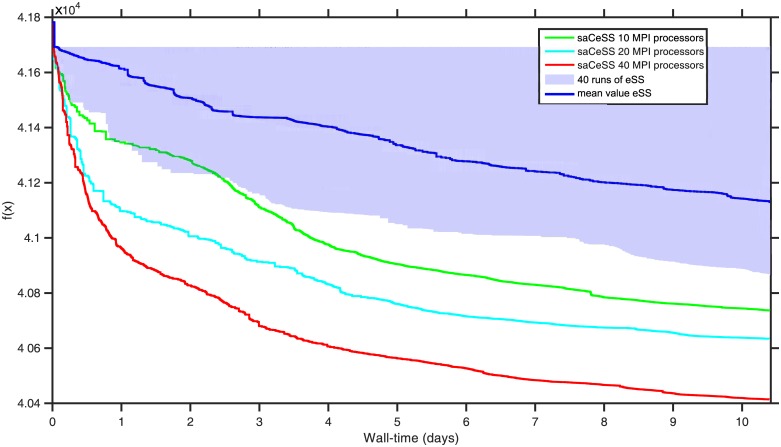
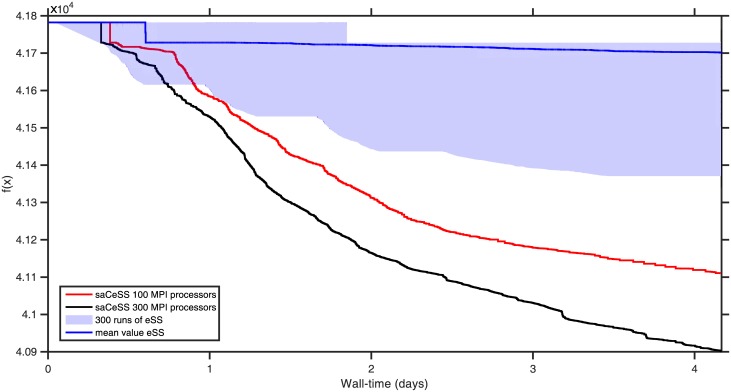
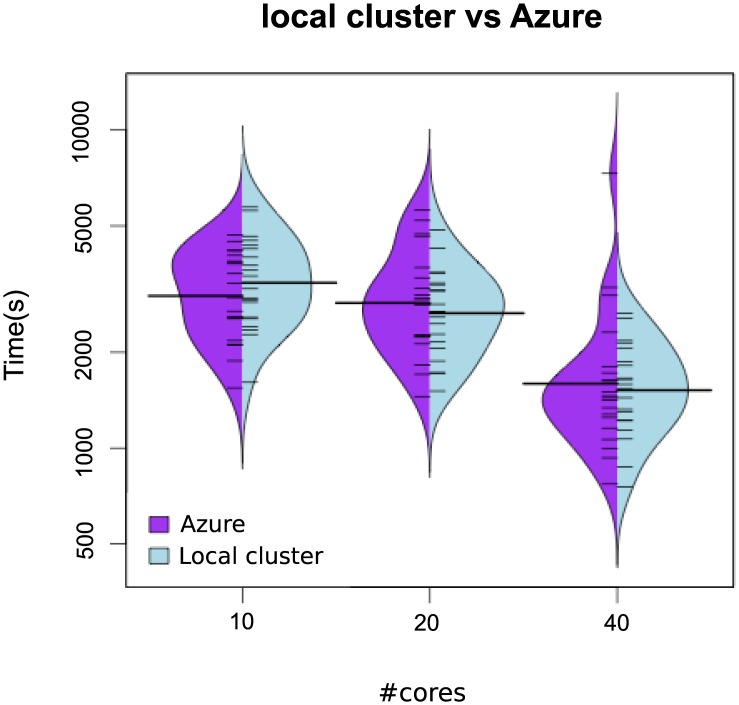
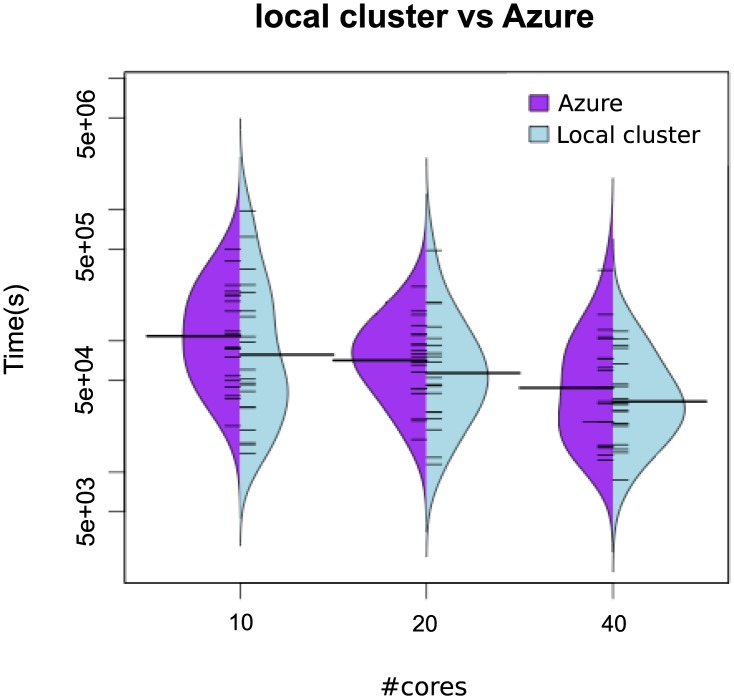
BACKGROUND: We consider a general class of global optimization problems dealing with nonlinear dynamic models. Although this class is relevant to many areas of science and engineering, here we are interested in applying this framework to the reverse engineering problem in computational systems biology, which yields very large mixed-integer dynamic optimization (MIDO) problems. In particular, we consider the framework of logic-based ordinary differential equations (ODEs). METHODS: We present saCeSS2, a parallel method for the solution of this class of problems. This method is based on an parallel cooperative scatter search metaheuristic, with new mechanisms of self-adaptation and specific extensions to handle large mixed-integer problems. We have paid special attention to the avoidance of convergence stagnation using adaptive cooperation strategies tailored to this class of problems. RESULTS: We illustrate its performance with a set of three very challenging case studies from the domain of dynamic modelling of cell signaling. The simpler case study considers a synthetic signaling pathway and has 84 continuous and 34 binary decision variables. A second case study considers the dynamic modeling of signaling in liver cancer using high-throughput data, and has 135 continuous and 109 binaries decision variables. The third case study is an extremely difficult problem related with breast cancer, involving 690 continuous and 138 binary decision variables. We report computational results obtained in different infrastructures, including a local cluster, a large supercomputer and a public cloud platform. Interestingly, the results show how the cooperation of individual parallel searches modifies the systemic properties of the sequential algorithm, achieving superlinear speedups compared to an individual search (e.g. speedups of 15 with 10 cores), and significantly improving (above a 60%) the performance with respect to a non-cooperative parallel scheme. The scalability of the method is also good (tests were performed using up to 300 cores). CONCLUSIONS: These results demonstrate that saCeSS2 can be used to successfully reverse engineer large dynamic models of complex biological pathways. Further, these results open up new possibilities for other MIDO-based large-scale applications in the life sciences such as metabolic engineering, synthetic biology, drug scheduling.
Overview
The claims and statistics of this paper haven’t been checked yet.
Free: it reads the open-access text and checks the first 5 claims that cite a source we can check. Create a free account to check every claim.
Integrity signals
Registry
Cites
Statistics
Figures
Verification
Claims the paper makes
The claims and statistics of this paper haven’t been checked yet.
Free: it reads the open-access text and checks the first 5 claims that cite a source we can check. Create a free account to check every claim.
Claims other papers make about this one
Each is checked against this paper’s own text: does it say what the citing paper says it does?
The source backs part of the claim, not all of it — or backs it for a different population, condition or comparison.
In the citing paper
“Some methods have been demonstrated to detect such problems (Kondofersky et al., 2016; Penas et al., 2017); however, it is unlikely that these methods scale sufficiently well.”
From Efficient Parameter Estimation Enables the Prediction of Drug Response Using a Mechanistic Pan-Cancer Pathway Model (2018) · cites this paper as Penas et al., 2017
Experimental — accuracy not yet measured
Self-check
Percentages, sums and reported differences re-computed from the paper’s own numbers.
The self-check needs the paper’s full text.
Citations
Cites
Model selection and multimodel inference: a practical information-theoretic approach.
Guthery, F. S., Burnham, K. P., & Anderson, D. R. (2003) · The Journal of Wildlife Management · doi:10.2307/3802723 · Cited by 41,495
(1995) · Cited by 10,558
Metabolic stability and epigenesis in randomly constructed genetic nets
Kauffman, S. A. (1969) · Journal of Theoretical Biology · doi:10.1016/0022-5193(69)90015-0 · Cited by 4,819
MPI: A Message-Passing Interface Standard
Forum, M. P. (1994) · Cited by 3,443
Model selection and multimodel inference : a practical information-theoretic approach
Burnham, K. P., Anderson, D. R., & Burnham, K. P. (2002) · Thammasat University Digital Collections · Cited by 2,907
Modeling and Simulation of Genetic Regulatory Systems: A Literature Review
de Jong, H. (2002) · Journal of Computational Biology · doi:10.1089/10665270252833208 · Cited by 2,663
Applied Optimal Control: Optimization, Estimation, and Control
Bryson, A. E., Ho, Y.-C., & Siouris, G. M. (1979) · IEEE Transactions on Systems, Man, and Cybernetics · doi:10.1109/tsmc.1979.4310229 · Cited by 2,582
SUNDIALS: Suite of nonlinear and differential/algebraic equation solvers
Hindmarsh, A. C., Brown, P. N., Grant, K. E., Lee, S. L., Serban, R., Shumaker, D. E., & Woodward, C. S. (2005) · ACM Transactions on Mathematical Software · doi:10.1145/1089014.1089020 · Cited by 2,556
(2010) · International Series in Operations Research & Management Science · doi:10.1007/978-1-4419-1665-5 · Cited by 1,642
Handbook of Global Optimization
(1995) · Nonconvex Optimization and Its Applications · doi:10.1007/978-1-4615-2025-2 · Cited by 1,628
Research works printed but not linked: 1
- C. Evangelinos, C. Hill, Cloud computing for parallel scientific HPC applications: Feasibility of running coupled atmosphere-ocean climate models on amazon’s EC2, in: 1st Workshop on Cloud Computing and its Applications (CCA’08), 2008, pp. 1–6.
Cited by
Fröhlich, F., Kessler, T., Weindl, D., Shadrin, A., Schmiester, L., Hache, H., Muradyan, A., Schütte, M., Lim, J.-H., Heinig, M., et al. (2018) · Cell Systems · doi:10.1016/j.cels.2018.10.013 · Cited by 143
“Some methods have been demonstrated to detect such problems (Kondofersky et al., 2016; Penas et al., 2017); however, it is unlikely that these methods scale sufficiently well.”
MethodLee, D., Jayaraman, A., & Kwon, J. S. (2019) · IET Systems Biology · doi:10.1049/iet-syb.2018.5079 · Cited by 19
Automated Design of Synthetic Gene Circuits in the Presence of Molecular Noise
Sequeiros, C., Vázquez, C., Banga, J. R., & Otero‐Muras, I. (2023) · ACS Synthetic Biology · doi:10.1021/acssynbio.3c00033 · Cited by 20
Self-citationPenas, D. R., Hashemi, M., Jirsa, V., & Banga, J. R. (2024) · PLoS Computational Biology · doi:10.1371/journal.pcbi.1011642 · Cited by 17
“In previous research, SaCeSS demonstrated good performance and robustness in addressing complex, large-scale model calibration problems within the domain of computational systems biology [69].”
Self-citationBridging intracellular scales by mechanistic computational models
Widmer, L. A., & Stelling, J. (2018) · Current Opinion in Biotechnology · doi:10.1016/j.copbio.2018.02.005 · Cited by 14
Metadata
- Authors
- Penas, D. R., Henriques, D., González, P., Doallo, R., Saez-Rodriguez, J., & Banga, J. R.
- Affiliations
- Consejo Superior de Investigaciones Científicas (ES)
- Universidade da Coruña (ES)
- Corresponding author
- González, Patricia
- Banga, Julio R.
- Venue
- PLOS ONE
- Publisher
- Public Library of Science (PLoS)
- Published
- 2017-08-15
- Volume
- 12
- Issue
- 8
- Pages
- e0182186
- ISSN
- 1932-6203 (ISSN-L)
- PMC
- PMC5557587
- OpenAlex
- W2745970186
- Cited by
- 16
- References
- 112
- Citations by year
- 2025: 2 · 2024: 3 · 2023: 2 · 2022: 1 · 2021: 1 · 2019: 3 · 2018: 4
- FWCI
- 1.14
- Type
- journal article
- Language
- en
- Open access
- gold
- doi.org
- Licence
- Locations
- PLoS ONE (publishedVersion, cc-by)
- PubMed Central (publishedVersion, cc-by)
- PubMed (publishedVersion)
- RePEc: Research Papers in Economics (submittedVersion)
- DIGITAL.CSIC (Spanish National Research Council (CSIC)) (submittedVersion, cc-by)
- LA Referencia (Red Federada de Repositorios Institucionales de Publicaciones Científicas) (submittedVersion, cc-by)
- DOAJ (DOAJ: Directory of Open Access Journals) (submittedVersion, cc-by-sa)
- RWTH Publications (RWTH Aachen) (submittedVersion, cc-by)
- RWTH Publications (RWTH Aachen)
- Funders
- Ministerio de Economía y Competitividad (ES) (TIN2016-75845-P, DPI2014-55276-C5-2-R)
- Galician Government under the Consolidation Program of Competitive Research Units (R2016/045, GRC2013/055)
- Topics
- Physical Sciences › Computer Science › Artificial Intelligence › Metaheuristic Optimization Algorithms Research
- Life Sciences › Biochemistry, Genetics and Molecular Biology › Molecular Biology › Gene Regulatory Network Analysis
- Physical Sciences › Mathematics › Numerical Analysis › Advanced Optimization Algorithms Research
- Keywords
- mixed-integer dynamic optimization, parallel metaheuristics, scatter search, reverse engineering, computational systems biology, cell signaling dynamics, superlinear speedup
- MeSH terms
- Algorithms, Software, Signal Transduction, Computational Biology, Systems Biology
About these checks
Registry, retraction, Cites and statistics results are computed, not judged, with one exception: a printed reference that no index lists is read once by a model before it counts as a citation error. Claims are extracted by a model and kept only when their quote appears verbatim in the text; each cited source is then checked, with a model’s help, for whether it says what the claim relies on. Those verdicts can be wrong — read the claim’s quote and the cited source before relying on one.
Statistics and arithmetic are recomputed, not judged.
Confidence bands are shown only for fields calibrated on our annotated test set. None is calibrated yet, so no band is shown.
What counts as a claim ›How we measure confidence ›How we check this ›
Are you an author, or do you see a problem with this page? Request a review
How to cite
Cite CoChat for the checks on this page, and the paper for its own findings.
- This page
- CoChat. (2026). Citation check: A parallel metaheuristic for large mixed-integer dynamic optimization problems, with applications in computational biology. https://app.cochat.ai/papers/10.1371/journal.pone.0182186
- The paper
- Penas, D. R., Henriques, D., González, P., Doallo, R., Saez-Rodriguez, J., & Banga, J. R. (2017). A parallel metaheuristic for large mixed-integer dynamic optimization problems, with applications in computational biology. PLOS ONE. https://doi.org/10.1371/journal.pone.0182186
Data sources
Bibliographic data: Semantic Scholar, OpenAlex, Crossref.
Contains information from the Semantic Scholar Academic Graph Datasets, made available under the ODC Attribution License (ODC-BY 1.0).
Semantic Scholar’s data is described in: Kinney, R., et al. (2023). The Semantic Scholar Open Data Platform. arXiv:2301.10140.
