

The DOI matches its Crossref record; 102 of the 103 references it cites were found in a registry or an index.
Effect of cervical cancer education and provider recommendation for screening on screening rates: A systematic review and meta-analysis
Open accessAbstract
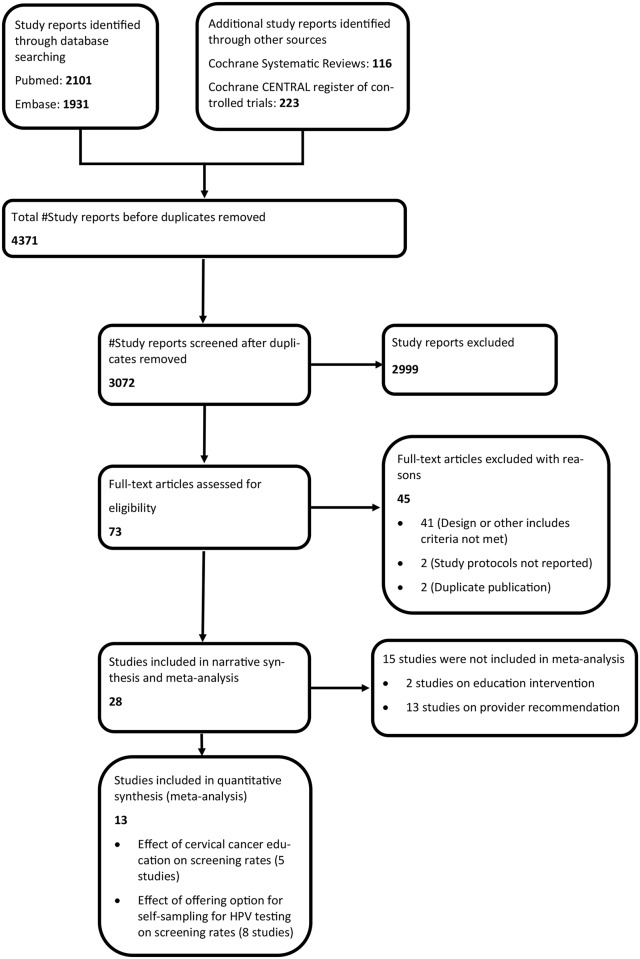
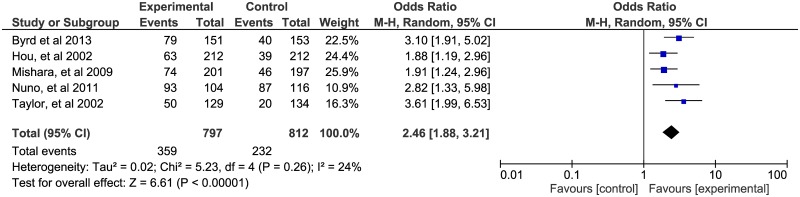
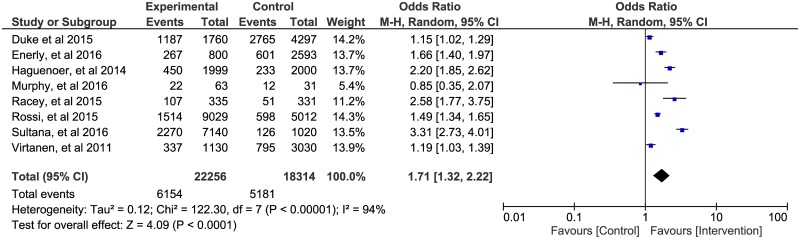
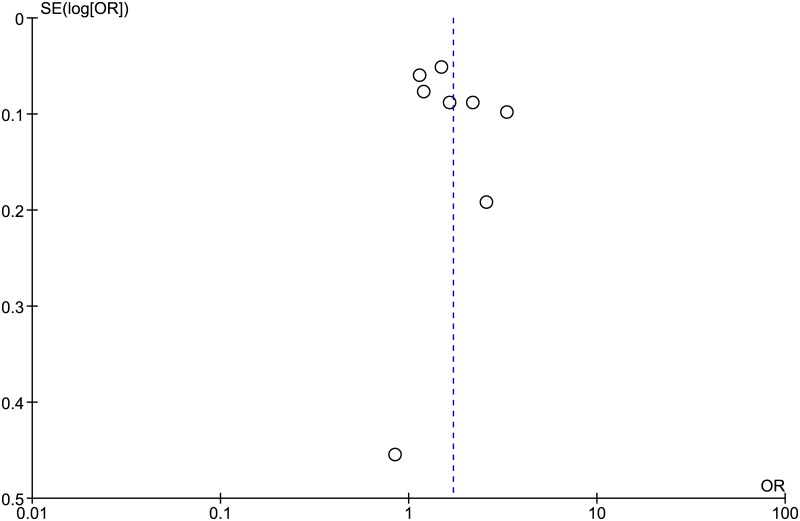
BACKGROUND: Although cervical cancer is largely preventable through screening, detection and treatment of precancerous abnormalities, it remains one of the top causes of cancer-related morbidity and mortality globally. OBJECTIVES: The objective of this systematic review is to understand the evidence of the effect of cervical cancer education compared to control conditions on cervical cancer screening rates in eligible women population at risk of cervical cancer. We also sought to understand the effect of provider recommendations for screening to eligible women on cervical cancer screening (CCS) rates compared to control conditions in eligible women population at risk of cervical cancer. METHODS: We used the PICO (Problem or Population, Interventions, Comparison and Outcome) framework as described in the Cochrane Collaboration Handbook to develop our search strategy. The details of our search strategy has been described in our systematic review protocol published in the International Prospective Register of systematic reviews (PROSPERO). The protocol registration number is CRD42016045605 available at: http://www.crd.york.ac.uk/prospero/display_record.asp?src=trip&ID=CRD42016045605. The search string was used in Pubmed, Embase, Cochrane Systematic Reviews and Cochrane CENTRAL register of controlled trials to retrieve study reports that were screened for inclusion in this review. Our data synthesis and reporting was guided by the Preferred Reporting Items for Systematic Reviews and Meta-analysis (PRISMA). We did a qualitative synthesis of evidence and, where appropriate, individual study effects were pooled in meta-analyses using RevMan 5.3 Review Manager. The Higgins I2 was used to assess for heterogeneity in studies pooled together for overall summary effects. We did assessment of risk of bias of individual studies included and assessed risk of publication bias across studies pooled together in meta-analysis by Funnel plot. RESULTS: Out of 3072 study reports screened, 28 articles were found to be eligible for inclusion in qualitative synthesis (5 of which were included in meta-analysis of educational interventions and 8 combined in meta-analysis of HPV self-sampling interventions), while 45 were excluded for various reasons. The use of theory-based educational interventions significantly increased CCS rates by more than double (OR, 2.46, 95% CI: 1.88, 3.21). Additionally, offering women the option of self-sampling for Human Papillomavirus (HPV) testing increased CCS rates by nearly 2-fold (OR = 1.71, 95% CI: 1.32, 2.22). We also found that invitation letters alone (or with a follow up phone contact), making an appointment, and sending reminders to patients who are due or overdue for screening had a significant effect on improving participation and CCS rates in populations at risk. CONCLUSION: Our findings supports the implementation of theory-based cervical cancer educational interventions to increase women's participation in cervical cancer screening programs, particularly when targeting communities with low literacy levels. Additionally, cervical cancer screening programs should consider the option of offering women the opportunity for self-sample collection particularly when such women have not responded to previous screening invitation or reminder letters for Pap smear collection as a method of screening.
Overview
The claims and statistics of this paper haven’t been checked yet.
Run the check — free, no account needed. It reads the open-access text and checks the sources it cites.
Integrity signals
Registry
Cites
Statistics
Figures
Verification
Claims the paper makes
The claims and statistics of this paper haven’t been checked yet.
Run the check — free, no account needed. It reads the open-access text and checks the sources it cites.
Claims other papers make about this one
Each is checked against this paper’s own text: does it say what the citing paper says it does?
The cited source doesn’t support the claim as written.
In the citing paper
“Compared to reminder letters, phone calls to non-responders after the initial letter increased screening [51].”
From Improving cancer screening uptake: A behavioural and cultural insights perspective and rapid review (2026) · cites this paper as [51]
Checked by a reasoning model — may be wrong.
Experimental — accuracy not yet measuredThe source backs part of the claim, not all of it — or backs it for a different population, condition or comparison.
In the citing paper
“Promotora-led education programmes also increased the knowledge and intention to be screened for CC [51] and BC [45].”
From Improving cancer screening uptake: A behavioural and cultural insights perspective and rapid review (2026) · cites this paper as [51]
Experimental — accuracy not yet measuredThe cited source says what the claim attributes to it.
In the citing paper
“Addressing structural and motivational barriers may be essential to raising participation rates as knowledge does not always translate into action [9, 44, 51, 65].”
From Improving cancer screening uptake: A behavioural and cultural insights perspective and rapid review (2026) · cites this paper as [51]
The cited source says what the claim attributes to it.
In the citing paper
“In a meta-analysis, theory-based, culturally and linguistically sensitive, community participatory educational interventions demonstrated a consistent positive effect on CC screening [51].”
From Improving cancer screening uptake: A behavioural and cultural insights perspective and rapid review (2026) · cites this paper as [51]
The cited source says what the claim attributes to it.
In the citing paper
“Invitations in different forms have increased cancer screening (e.g., letters, text messages, phone calls) [42,51,52].”
From Improving cancer screening uptake: A behavioural and cultural insights perspective and rapid review (2026) · cites this paper as [51]
Self-check
Percentages, sums and reported differences re-computed from the paper’s own numbers.
The self-check needs the paper’s full text.
Citations
Cites
Liberati, A., Altman, D. G., Tetzlaff, J., Mulrow, C., Gøtzsche, P. C., Ioannidis, J. P. A., Clarke, M., Devereaux, P. J., Kleijnen, J., & Moher, D. (2009) · PLoS Medicine · doi:10.1371/journal.pmed.1000100 · Cited by 28,164
Cochrane Handbook for Systematic Reviews of Interventions: Cochrane Book Series
(2008) · doi:10.1002/9780470712184 · Cited by 25,048
Health Promotion by Social Cognitive Means
Bandura, A. (2004) · Health Education & Behavior · doi:10.1177/1090198104263660 · Cited by 7,238
The Global Burden of Cancer 2013
Fitzmaurice, C., Dicker, D., Pain, A. W., Hamavid, H., Moradi‐Lakeh, M., MacIntyre, M. F., Allen, C., Hansen, G. M., Woodbrook, R., Wolfe, C. D. A., et al. (2015) · JAMA Oncology · doi:10.1001/jamaoncol.2015.0735 · Cited by 2,763
Allemani, C., Weir, H. K., Carreira, H., Harewood, R., Spika, D., Wang, X.-S., Bannon, F., Ahn, J. V., Johnson, C. J., Bonaventure, A., et al. (2015) · The Lancet · doi:10.1016/s0140-6736(14)62038-9 · Cited by 2,614
Ronco, G., Dillner, J., Elfström, K. M., Tunesi, S., Snijders, P. J. F., Arbyn, M., Kitchener, H., Segnan, N., Gilham, C., Giorgi-Rossi, P., et al. (2014) · The Lancet · doi:10.1016/s0140-6736(13)62218-7 · Cited by 1,810
HPV Screening for Cervical Cancer in Rural India
Sankaranarayanan, R., Nene, B. M., Shastri, S. S., Jayant, K., Muwonge, R., Budukh, A. M., Hingmire, S., Malvi, S. G., Thorat, R., Kothari, A., et al. (2009) · New England Journal of Medicine · doi:10.1056/nejmoa0808516 · Cited by 1,278
Screening for cervical cancer: U.S. preventive services Task force recommendation statement
Moyer, V. A., & on behalf of the U.S. Preventive Services Task Force* (2012) · Annals of Internal Medicine · doi:10.7326/0003-4819-156-12-201206190-00424 · Cited by 1,049
Breast and cervical cancer in 187 countries between 1980 and 2010: a systematic analysis
Forouzanfar, M. H., Foreman, K. J., Delossantos, A. M., Lozano, R., Lopez, A. D., Murray, C. J. L., & Naghavi, M. (2011) · The Lancet · doi:10.1016/s0140-6736(11)61351-2 · Cited by 1,009
Ronco, G., Rossi, P. G., Carozzi, F., Confortini, M., Palma, P. D., Mistro, A. D., Ghiringhello, B., Girlando, S., Gillio‐Tos, A., Marco, L. D., et al. (2010) · The Lancet Oncology · doi:10.1016/s1470-2045(09)70360-2 · Cited by 955
Research works printed but not linked: 2
- European guidelines for quality assurance in cervical cancer screening, International Agency for Research on Cancer, 2007
- CS Racey, 2015, Randomized Intervention of Self-Collected Sampling for Human Papillomavirus Testing in Under-Screened Rural Women: Uptake of Screening and Acceptability, Journal of women's health (2002)
Cited by
Sorted by citations
Suk, R., Hong, Y., Rajan, S. S., Xie, Z., Zhu, Y., & Spencer, J. C. (2022) · JAMA Network Open · doi:10.1001/jamanetworkopen.2021.43582 · Cited by 204
Fuzzell, L. N., Perkins, R. B., Christy, S. M., Lake, P. W., & Vadaparampil, S. T. (2020) · Preventive Medicine · doi:10.1016/j.ypmed.2020.106400 · Cited by 215
Worldwide initiatives to eliminate cervical cancer
Wilailak, S., Kengsakul, M., & Kehoe, S. T. (2021) · International Journal of Gynecology & Obstetrics · doi:10.1002/ijgo.13879 · Cited by 140
Guo, M., Xu, J., & Du, J. (2021) · BMC Public Health · doi:10.1186/s12889-021-11401-8 · Cited by 123
Barriers to cervical cancer screening in Africa: a systematic review
Mantula, F., Toefy, Y., & Sewram, V. (2024) · BMC Public Health · doi:10.1186/s12889-024-17842-1 · Cited by 119
Metadata
- Authors
- Musa, J., Achenbach, C. J., O’Dwyer, L. C., Evans, C. T., McHugh, M., Hou, L., Simon, M. A., Murphy, R. L., & Jordan, N.
- Affiliations
- Northwestern University (US)
- Corresponding author
- Musa, Jonah
- ORCID
- Venue
- PLOS ONE
- Publisher
- Public Library of Science (PLoS)
- Published
- 2017-09-05
- Volume
- 12
- Issue
- 9
- Pages
- e0183924
- ISSN
- 1932-6203 (ISSN-L)
- PMC
- PMC5584806
- OpenAlex
- W2753548446
- Cited by
- 223
- References
- 103
- Citations by year
- 2026: 23 · 2025: 23 · 2024: 29 · 2023: 22 · 2022: 41 · 2021: 40 · 2020: 25 · 2019: 13 · 2018: 6 · 2017: 1
- FWCI
- 1.63
- Type
- journal article
- Language
- en
- Update notices
- correction (2017-12-29)
- Open access
- gold
- doi.org
- Licence
- Locations
- PLoS ONE (publishedVersion, cc-by)
- PubMed Central (publishedVersion, cc-by)
- PubMed (publishedVersion)
- RePEc: Research Papers in Economics (submittedVersion)
- DOAJ (DOAJ: Directory of Open Access Journals) (submittedVersion)
- Figshare (submittedVersion, cc-by)
- Funders
- Fogarty International Center (US) (D43TW009575)
- National Cancer Institute (1 U54 CA221205-01)
- Topics
- Health Sciences › Medicine › Epidemiology › Cervical Cancer and HPV Research
- Health Sciences › Medicine › Public Health, Environmental and Occupational Health › Women's cancer prevention and management
- Health Sciences › Medicine › Oncology › Global Cancer Incidence and Screening
- Keywords
- cervical cancer screening, provider recommendation, screening rates, educational intervention, HPV self-sampling, HPV testing, theory-based intervention, women's health promotion, screening uptake, cervical cancer prevention, risk communication, health behavior change
- MeSH terms
- Uterine Cervical Neoplasms, Female, Health Education, Humans, Mass Screening, Patient Education as Topic, Prospective Studies, Quality of Life, Bias, Treatment Outcome, Papillomaviridae, Early Detection of Cancer
About these checks
Registry, retraction, Cites and statistics results are computed, not judged, with one exception: a printed reference that no index lists is read once by a model before it counts as a citation error. Claims are extracted by a model and kept only when their quote appears verbatim in the text; each cited source is then checked, with a model’s help, for whether it says what the claim relies on. Those verdicts can be wrong — read the claim’s quote and the cited source before relying on one.
Statistics and arithmetic are recomputed, not judged.
Confidence bands are shown only for fields calibrated on our annotated test set. None is calibrated yet, so no band is shown.
What counts as a claim ›How we measure confidence ›How we check this ›
Are you an author, or do you see a problem with this page? Request a review
