

Neural mechanisms underlying sensitivity to reverse-phi motion in the fly
Open accessThe DOI matches its Crossref record; 77 of the 77 references it cites were found in a registry or an index.
Abstract
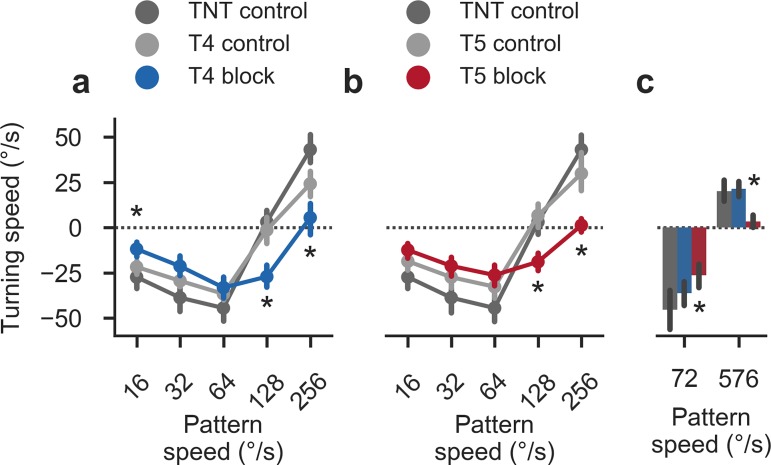
Optical illusions provide powerful tools for mapping the algorithms and circuits that underlie visual processing, revealing structure through atypical function. Of particular note in the study of motion detection has been the reverse-phi illusion. When contrast reversals accompany discrete movement, detected direction tends to invert. This occurs across a wide range of organisms, spanning humans and invertebrates. Here, we map an algorithmic account of the phenomenon onto neural circuitry in the fruit fly Drosophila melanogaster. Through targeted silencing experiments in tethered walking flies as well as electrophysiology and calcium imaging, we demonstrate that ON- or OFF-selective local motion detector cells T4 and T5 are sensitive to certain interactions between ON and OFF. A biologically plausible detector model accounts for subtle features of this particular form of illusory motion reversal, like the re-inversion of turning responses occurring at extreme stimulus velocities. In light of comparable circuit architecture in the mammalian retina, we suggest that similar mechanisms may apply even to human psychophysics.
Overview
The claims and statistics of this paper haven’t been checked yet.
Free: it reads the open-access text and checks the first 5 claims that cite a source we can check. Create a free account to check every claim.
Integrity signals
Registry
Cites
Statistics
Figures


Verification
Claims the paper makes
The claims and statistics of this paper haven’t been checked yet.
Free: it reads the open-access text and checks the first 5 claims that cite a source we can check. Create a free account to check every claim.
Claims other papers make about this one
Each is checked against this paper’s own text: does it say what the citing paper says it does?
In the citing paper
“In contrast, most previous studies using task-optimized deep neural networks have predominantly focused on modeling computations without such detailed connectomic measurements: in fly motion vision pathways 115, 116 and olfactory system 36 , in fish oculomotor system 117 in mammalian visual pathways 44,76,106,118 and prefrontal cortex 45 .”
From Connectome-constrained deep mechanistic networks predict neural responses across the fly visual system at single-neuron resolution (2023) · cites this paper as [116]
Self-check
Percentages, sums and reported differences re-computed from the paper’s own numbers.
The self-check needs the paper’s full text.
Citations
Cites
Targeted gene expression as a means of altering cell fates and generating dominant phenotypes
Brand, A. H., & Perrimon, N. (1993) · Development · doi:10.1242/dev.118.2.401 · Cited by 9,612
Ultrasensitive fluorescent proteins for imaging neuronal activity
Chen, T.-W., Wardill, T. J., Sun, Y., Pulver, S. R., Renninger, S. L., Baohan, A., Schreiter, E. R., Kerr, R. A., Orger, M. B., Jayaraman, V., et al. (2013) · Nature · doi:10.1038/nature12354 · Cited by 6,474
Spatiotemporal energy models for the perception of motion
Adelson, E. H., & Bergen, J. R. (1985) · Journal of the Optical Society of America A · doi:10.1364/josaa.2.000284 · Cited by 3,442
Sweeney, S. T., Broadie, K., Keane, J., Niemann, H., & O'Kane, C. J. (1995) · Neuron · doi:10.1016/0896-6273(95)90290-2 · Cited by 938
Elaborated Reichardt detectors
van Santen, J. P. H., & Sperling, G. (1985) · Journal of the Optical Society of America A · doi:10.1364/josaa.2.000300 · Cited by 890
Hassenstein, B., & Reichardt, W. (1956) · Zeitschrift für Naturforschung B · doi:10.1515/znb-1956-9-1004 · Cited by 869
Kitamoto, T. (2001) · Journal of Neurobiology · doi:10.1002/neu.1018 · Cited by 867
A visual motion detection circuit suggested by Drosophila connectomics
Takemura, S.-Y., Bharioke, A., Lu, Z., Nern, A., Vitaladevuni, S., Rivlin, P. K., Katz, W. T., Olbris, D. J., Plaza, S. M., Winston, P., et al. (2013) · Nature · doi:10.1038/nature12450 · Cited by 686
Directional selectivity and its use in early visual processing
Marr, D., & Ullman, S. (1981) · Proceedings of the Royal Society of London. Series B. Biological Sciences · doi:10.1098/rspb.1981.0001 · Cited by 638
Model for the extraction of image flow
Heeger, D. J. (1987) · Journal of the Optical Society of America A · doi:10.1364/josaa.4.001455 · Cited by 574
Cited by
How fly neurons compute the direction of visual motion
Borst, A., Haag, J., & Mauss, A. S. (2020) · Journal of Comparative Physiology A · doi:10.1007/s00359-019-01375-9 · Cited by 109
Self-citationElementary Motion Detection in Drosophila: Algorithms and Mechanisms
Yang, H. H., & Clandinin, T. R. (2018) · Annual Review of Vision Science · doi:10.1146/annurev-vision-091517-034153 · Cited by 70
Visual processing in the fly, from photoreceptors to behavior
Currier, T. A., Pang, M. M., & Clandinin, T. R. (2023) · GENETICS · doi:10.1093/genetics/iyad064 · Cited by 63
Borst, A., & Groschner, L. N. (2023) · Annual Review of Neuroscience · doi:10.1146/annurev-neuro-080422-111929 · Cited by 61
Self-citationKetkar, M. D., Šporar, K., Gür, B., Ramos-Traslosheros, G., Seifert, M., & Silies, M. (2020) · Current Biology · doi:10.1016/j.cub.2019.12.038 · Cited by 54
Salazar-Gatzimas, E., Agrochao, M., Fitzgerald, J. E., & Clark, D. A. (2018) · Current Biology · doi:10.1016/j.cub.2018.10.007 · Cited by 42
Lappalainen, J. K., Tschopp, F. D., Prakhya, S., McGill, M., Nern, A., Shinomiya, K., Takemura, S.-Y., Gruntman, E., Macke, J. H., & Turaga, S. C. (2023) · doi:10.1101/2023.03.11.532232 · Cited by 31
Gruntman, E., Reimers, P., Romani, S., & Reiser, M. B. (2021) · Current Biology · doi:10.1016/j.cub.2021.09.072 · Cited by 12
Opto-locomotor reflexes of mice to reverse-phi stimuli
Kirkels, L. A. M. H., Zhang, W., Duijnhouwer, J., & Wezel, R. J. A. V. (2020) · Journal of Vision · doi:10.1167/jov.20.2.7 · Cited by 10
FlyHack: Stress-Testing Mechanistic Claims in a Connectome-Constrained Visual ModelPreprint
Dhawan, A. (2026) · arXiv (Cornell University) · doi:10.48550/arxiv.2610.13018 · Cited by 2
López, L. (2020) · eDiss (Georg-August-Universität Göttingen) · doi:10.53846/goediss-8344 · Cited by 1
Gruntman, E., Reimers, P., Romani, S., & Reiser, M. B. (2021) · bioRxiv (Cold Spring Harbor Laboratory) · doi:10.1101/2021.04.29.442028 · Cited by 1
Afterimages drive a shared visual motion-reversal illusion in DrosophilaPreprint
Wu, H., Gou, T., & Clark, D. A. (2026) · bioRxiv (Cold Spring Harbor Laboratory) · doi:10.64898/2026.01.19.700413
Species difference in visual motion integration in pigeons, primates and other vertebrates
Hataji, Y. (2023) · Hikaku seiri seikagaku(Comparative Physiology and Biochemistry) · doi:10.3330/hikakuseiriseika.40.46
Šporar, K. (2020) · eDiss (Georg-August-Universität Göttingen) · doi:10.53846/goediss-7817
Strategies for dynamic vision in the Drosophila peripheral visual system
Ketkar, M. D. (2022) · eDiss (Georg-August-Universität Göttingen) · doi:10.53846/goediss-9193
The rebound response plays a role in the motion mechanisms and perceptionPreprint
Cohen-Duwek, H., & Spitzer, H. (2020) · bioRxiv (Cold Spring Harbor Laboratory) · doi:10.1101/2019.12.31.891580
Investigation of the Drosophila motion vision circuit using remote-focusing two-photon microscopy
Schützenberger, A. (2019) · Elektronische Hochschulschriften der LMU München (Ludwig-Maximilians-Universität München) · doi:10.5282/edoc.25808
Garcia-Duran, A., Rodríguez-García, A., Molano‐Mazón, M., Hyafil, A., Ramaswamy, S., & Lappalainen, J. K. (2026) · arXiv (Cornell University) · doi:10.48550/arxiv.2611.14498
Metadata
- Authors
- Leonhardt, A., Meier, M., Serbe, E., Eichner, H., & Borst, A.
- Affiliations
- Max Planck Institute of Neurobiology (DE)
- Corresponding author
- Leonhardt, Aljoscha
- Venue
- PLOS ONE
- Publisher
- Public Library of Science (PLoS)
- Published
- 2017-12-20
- Volume
- 12
- Issue
- 12
- Pages
- e0189019
- ISSN
- 1932-6203 (ISSN-L)
- PMC
- PMC5737883
- OpenAlex
- W2781056526
- Cited by
- 16
- References
- 77
- Citations by year
- 2026: 1 · 2023: 4 · 2022: 1 · 2021: 2 · 2020: 5 · 2019: 1 · 2018: 2
- FWCI
- 1.26
- Type
- journal article
- Language
- en
- Open access
- gold
- doi.org
- Licence
- Locations
- PLoS ONE (publishedVersion, cc-by)
- Europe PMC (PubMed Central) (publishedVersion, cc-by)
- PubMed Central (publishedVersion, cc-by)
- PubMed (publishedVersion)
- DOAJ (DOAJ: Directory of Open Access Journals) (submittedVersion, cc-by-sa)
- Max Planck Digital Library (submittedVersion, other-oa)
- MPG.PuRe (Max Planck Society) (submittedVersion, other-oa)
- Funders
- Topics
- Life Sciences › Neuroscience › Cognitive Neuroscience › Visual perception and processing mechanisms
- Life Sciences › Neuroscience › Cellular and Molecular Neuroscience › Neurobiology and Insect Physiology Research
- Social Sciences › Psychology › Experimental and Cognitive Psychology › Multisensory perception and integration
- Keywords
- motion detection, Drosophila melanogaster, contrast reversal, neural circuits
- MeSH terms
- Algorithms, Animals, Behavior, Animal, Drosophila melanogaster, Models, Neurological, Motion Perception, Neurons, Optical Illusions
About these checks
Registry, retraction, Cites and statistics results are computed, not judged, with one exception: a printed reference that no index lists is read once by a model before it counts as a citation error. Claims are extracted by a model and kept only when their quote appears verbatim in the text; each cited source is then checked, with a model’s help, for whether it says what the claim relies on. Those verdicts can be wrong — read the claim’s quote and the cited source before relying on one.
Statistics and arithmetic are recomputed, not judged.
Confidence bands are shown only for fields calibrated on our annotated test set. None is calibrated yet, so no band is shown.
What counts as a claim ›How we measure confidence ›How we check this ›
Are you an author, or do you see a problem with this page? Request a review
Data sources
Bibliographic data: Semantic Scholar, OpenAlex, Crossref.
Contains information from the Semantic Scholar Academic Graph Datasets, made available under the ODC Attribution License (ODC-BY 1.0).
Semantic Scholar’s data is described in: Kinney, R., et al. (2023). The Semantic Scholar Open Data Platform. arXiv:2301.10140.
