

Neural mechanisms underlying sensitivity to reverse-phi motion in the fly
Open accessThe DOI matches its Crossref record; 77 of the 77 references it cites were found in a registry or an index.
Abstract
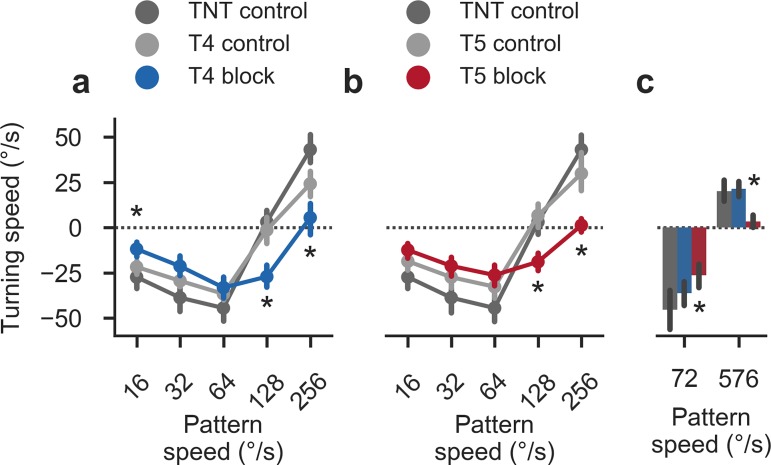
Optical illusions provide powerful tools for mapping the algorithms and circuits that underlie visual processing, revealing structure through atypical function. Of particular note in the study of motion detection has been the reverse-phi illusion. When contrast reversals accompany discrete movement, detected direction tends to invert. This occurs across a wide range of organisms, spanning humans and invertebrates. Here, we map an algorithmic account of the phenomenon onto neural circuitry in the fruit fly Drosophila melanogaster. Through targeted silencing experiments in tethered walking flies as well as electrophysiology and calcium imaging, we demonstrate that ON- or OFF-selective local motion detector cells T4 and T5 are sensitive to certain interactions between ON and OFF. A biologically plausible detector model accounts for subtle features of this particular form of illusory motion reversal, like the re-inversion of turning responses occurring at extreme stimulus velocities. In light of comparable circuit architecture in the mammalian retina, we suggest that similar mechanisms may apply even to human psychophysics.
Overview
The claims and statistics of this paper haven’t been checked yet.
Free: it reads the open-access text and checks the first 5 claims that cite a source we can check. Create a free account to check every claim.
Integrity signals
Registry
Cites
Statistics
Figures


Verification
Claims the paper makes
The claims and statistics of this paper haven’t been checked yet.
Free: it reads the open-access text and checks the first 5 claims that cite a source we can check. Create a free account to check every claim.
Claims other papers make about this one
Each is checked against this paper’s own text: does it say what the citing paper says it does?
In the citing paper
“In contrast, most previous studies using task-optimized deep neural networks have predominantly focused on modeling computations without such detailed connectomic measurements: in fly motion vision pathways 115, 116 and olfactory system 36 , in fish oculomotor system 117 in mammalian visual pathways 44,76,106,118 and prefrontal cortex 45 .”
From Connectome-constrained deep mechanistic networks predict neural responses across the fly visual system at single-neuron resolution (2023) · cites this paper as [116]
Self-check
Percentages, sums and reported differences re-computed from the paper’s own numbers.
The self-check needs the paper’s full text.
Citations
Cites
Targeted gene expression as a means of altering cell fates and generating dominant phenotypes
Brand, A. H., & Perrimon, N. (1993) · Development · doi:10.1242/dev.118.2.401 · Cited by 9,612
Ultrasensitive fluorescent proteins for imaging neuronal activity
Chen, T.-W., Wardill, T. J., Sun, Y., Pulver, S. R., Renninger, S. L., Baohan, A., Schreiter, E. R., Kerr, R. A., Orger, M. B., Jayaraman, V., et al. (2013) · Nature · doi:10.1038/nature12354 · Cited by 6,474
Spatiotemporal energy models for the perception of motion
Adelson, E. H., & Bergen, J. R. (1985) · Journal of the Optical Society of America A · doi:10.1364/josaa.2.000284 · Cited by 3,442
Sweeney, S. T., Broadie, K., Keane, J., Niemann, H., & O'Kane, C. J. (1995) · Neuron · doi:10.1016/0896-6273(95)90290-2 · Cited by 938
Elaborated Reichardt detectors
van Santen, J. P. H., & Sperling, G. (1985) · Journal of the Optical Society of America A · doi:10.1364/josaa.2.000300 · Cited by 890
Hassenstein, B., & Reichardt, W. (1956) · Zeitschrift für Naturforschung B · doi:10.1515/znb-1956-9-1004 · Cited by 869
Kitamoto, T. (2001) · Journal of Neurobiology · doi:10.1002/neu.1018 · Cited by 867
A visual motion detection circuit suggested by Drosophila connectomics
Takemura, S.-Y., Bharioke, A., Lu, Z., Nern, A., Vitaladevuni, S., Rivlin, P. K., Katz, W. T., Olbris, D. J., Plaza, S. M., Winston, P., et al. (2013) · Nature · doi:10.1038/nature12450 · Cited by 686
Directional selectivity and its use in early visual processing
Marr, D., & Ullman, S. (1981) · Proceedings of the Royal Society of London. Series B. Biological Sciences · doi:10.1098/rspb.1981.0001 · Cited by 638
Model for the extraction of image flow
Heeger, D. J. (1987) · Journal of the Optical Society of America A · doi:10.1364/josaa.4.001455 · Cited by 574
Temporal covariance model of human motion perception
van Santen, J. P. H., & Sperling, G. (1984) · Journal of the Optical Society of America A · doi:10.1364/josaa.1.000451 · Cited by 465
Low-level and high-level processes in apparent motion
Braddick, O. J. (1980) · Philosophical Transactions of the Royal Society of London. B, Biological Sciences · doi:10.1098/rstb.1980.0087 · Cited by 456
Genetic Manipulation of Genes and Cells in the Nervous System of the Fruit Fly
Venken, K. J. T., Simpson, J. H., & Bellen, H. J. (2011) · Neuron · doi:10.1016/j.neuron.2011.09.021 · Cited by 450
Active flight increases the gain of visual motion processing in Drosophila
Maimon, G., Straw, A. D., & Dickinson, M. H. (2010) · Nature Neuroscience · doi:10.1038/nn.2492 · Cited by 420
Using translational enhancers to increase transgene expression in Drosophila
Pfeiffer, B. D., Truman, J. W., & Rubin, G. M. (2012) · Proceedings of the National Academy of Sciences · doi:10.1073/pnas.1204520109 · Cited by 395
A directional tuning map of Drosophila elementary motion detectors
Maisak, M. S., Haag, J., Ammer, G., Serbe, E., Meier, M., Leonhardt, A., Schilling, T., Bahl, A., Rubin, G. M., Nern, A., et al. (2013) · Nature · doi:10.1038/nature12320 · Cited by 390
Self-citationPhi movement as a subtraction process
Anstis, S. M. (1970) · Vision Research · doi:10.1016/0042-6989(70)90092-1 · Cited by 377
ON and OFF pathways in Drosophila motion vision
Joesch, M., Schnell, B., Raghu, S. V., Reiff, D. F., & Borst, A. (2010) · Nature · doi:10.1038/nature09545 · Cited by 352
Self-citationSeeing Things in Motion: Models, Circuits, and Mechanisms
Borst, A., & Euler, T. (2011) · Neuron · doi:10.1016/j.neuron.2011.08.031 · Cited by 281
Self-citationWalking Modulates Speed Sensitivity in Drosophila Motion Vision
Chiappe, M. E., Seelig, J. D., Reiser, M. B., & Jayaraman, V. (2010) · Current Biology · doi:10.1016/j.cub.2010.06.072 · Cited by 273
Synaptic circuits and their variations within different columns in the visual system of Drosophila
Takemura, S.-Y., Xu, C. S., Lu, Z., Rivlin, P. K., Parag, T., Olbris, D. J., Plaza, S., Zhao, T., Katz, W. T., Umayam, L., et al. (2015) · Proceedings of the National Academy of Sciences · doi:10.1073/pnas.1509820112 · Cited by 264
Processing properties of ON and OFF pathways for Drosophila motion detection
Behnia, R., Clark, D. A., Carter, A. G., Clandinin, T. R., & Desplan, C. (2014) · Nature · doi:10.1038/nature13427 · Cited by 262
Defining the Computational Structure of the Motion Detector in Drosophila
Clark, D. A., Bursztyn, L., Horowitz, M. A., Schnitzer, M. J., & Clandinin, T. R. (2011) · Neuron · doi:10.1016/j.neuron.2011.05.023 · Cited by 259
Contributions of the 12 Neuron Classes in the Fly Lamina to Motion Vision
Tuthill, J. C., Nern, A., Holtz, S. L., Rubin, G. M., & Reiser, M. B. (2013) · Neuron · doi:10.1016/j.neuron.2013.05.024 · Cited by 248
Common circuit design in fly and mammalian motion vision
Borst, A., & Helmstaedter, M. (2015) · Nature Neuroscience · doi:10.1038/nn.4050 · Cited by 220
Self-citationPerception of Fourier and non-Fourier motion by larval zebrafish
Orger, M. B., Smear, M. C., Anstis, S. M., & Baier, H. (2000) · Nature Neuroscience · doi:10.1038/80649 · Cited by 210
Two motion perception mechanisms revealed through distance-driven reversal of apparent motion
Chubb, C., & Sperling, G. (1989) · Proceedings of the National Academy of Sciences · doi:10.1073/pnas.86.8.2985 · Cited by 202
Joesch, M., Plett, J., Borst, A., & Reiff, D. F. (2008) · Current Biology · doi:10.1016/j.cub.2008.02.022 · Cited by 196
Self-citationThe Emergence of Directional Selectivity in the Visual Motion Pathway of Drosophila
Strother, J. A., Wu, S.-T., Wong, A. M., Nern, A., Rogers, E. M., Le, J. Q., Rubin, G. M., & Reiser, M. B. (2017) · Neuron · doi:10.1016/j.neuron.2017.03.010 · Cited by 188
Illusory reversal of visual depth and movement during changes of contrast
Anstis, S. M., & Rogers, B. J. (1975) · Vision Research · doi:10.1016/0042-6989(75)90236-9 · Cited by 184
Internal Structure of the Fly Elementary Motion Detector
Eichner, H., Joesch, M., Schnell, B., Reiff, D. F., & Borst, A. (2011) · Neuron · doi:10.1016/j.neuron.2011.03.028 · Cited by 176
Self-citationFly visual course control: behaviour, algorithms and circuits
Borst, A. (2014) · Nature reviews. Neuroscience · doi:10.1038/nrn3799 · Cited by 158
Self-citationObject tracking in motion-blind flies
Bahl, A., Ammer, G., Schilling, T., & Borst, A. (2013) · Nature Neuroscience · doi:10.1038/nn.3386 · Cited by 153
Self-citationProcessing of Horizontal Optic Flow in Three Visual Interneurons of the Drosophila Brain
Schnell, B., Joesch, M., Forstner, F., Raghu, S. V., Otsuna, H., Ito, K., Borst, A., & Reiff, D. F. (2010) · Journal of Neurophysiology · doi:10.1152/jn.00950.2009 · Cited by 153
Self-citationModular Use of Peripheral Input Channels Tunes Motion-Detecting Circuitry
Silies, M., Gohl, D. M., Fisher, Y. E., Freifeld, L., Clark, D. A., & Clandinin, T. R. (2013) · Neuron · doi:10.1016/j.neuron.2013.04.029 · Cited by 146
Neural Circuit to Integrate Opposing Motions in the Visual Field
Mauss, A. S., Pankova, K., Arenz, A., Nern, A., Rubin, G. M., & Borst, A. (2015) · Cell · doi:10.1016/j.cell.2015.06.035 · Cited by 143
Self-citationFly motion vision is based on Reichardt detectors regardless of the signal-to-noise ratio
Haag, J., Denk, W., & Borst, A. (2004) · Proceedings of the National Academy of Sciences · doi:10.1073/pnas.0407368101 · Cited by 140
Self-citationArenz, A., Drews, M. S., Richter, F. G., Ammer, G., & Borst, A. (2017) · Current Biology · doi:10.1016/j.cub.2017.01.051 · Cited by 137
Self-citationFlight Activity Alters Velocity Tuning of Fly Motion-Sensitive Neurons
Jung, S. N., Borst, A., & Haag, J. (2011) · Journal of Neuroscience · doi:10.1523/jneurosci.1138-11.2011 · Cited by 126
Self-citationCandidate Neural Substrates for Off-Edge Motion Detection in Drosophila
Shinomiya, K., Karuppudurai, T., Lin, T.-Y., Lu, Z., Lee, C.-H., & Meinertzhagen, I. A. (2014) · Current Biology · doi:10.1016/j.cub.2014.03.051 · Cited by 119
Orientation Selectivity Sharpens Motion Detection in Drosophila
Fisher, Y. E., Silies, M., & Clandinin, T. R. (2015) · Neuron · doi:10.1016/j.neuron.2015.09.033 · Cited by 117
Global motion perception: Interaction of the ON and OFF pathways
Edwards, M., & Badcock, D. R. (1994) · Vision Research · doi:10.1016/0042-6989(94)90054-x · Cited by 115
Serbe-Kamp, E., Meier, M., Leonhardt, A., & Borst, A. (2016) · Neuron · doi:10.1016/j.neuron.2016.01.006 · Cited by 111
Self-citationColumnar cells necessary for motion responses of wide-field visual interneurons in Drosophila
Schnell, B., Raghu, S. V., Nern, A., & Borst, A. (2012) · Journal of Comparative Physiology A · doi:10.1007/s00359-012-0716-3 · Cited by 109
Self-citationComplementary mechanisms create direction selectivity in the fly
Haag, J., Arenz, A., Serbe, E., Gabbiani, F., & Borst, A. (2016) · eLife · doi:10.7554/elife.17421 · Cited by 104
Self-citationWhat kind of movement detector is triggering the landing response of the housefly?
Borst, A., & Bahde, S. (1986) · Biological Cybernetics · doi:10.1007/bf00363978 · Cited by 100
Self-citationFlies and humans share a motion estimation strategy that exploits natural scene statistics
Clark, D. A., Fitzgerald, J. E., Ales, J. M., Gohl, D. M., Silies, M. A., Norcia, A. M., & Clandinin, T. R. (2014) · Nature Neuroscience · doi:10.1038/nn.3600 · Cited by 96
Optogenetic Control of Fly Optomotor Responses
Haikala, V., Joesch, M., Borst, A., & Mauss, A. S. (2013) · The Journal of Neuroscience · doi:10.1523/jneurosci.0340-13.2013 · Cited by 93
Self-citationOptogenetic and Pharmacologic Dissection of Feedforward Inhibition in Drosophila Motion Vision
Mauss, A. S., Meier, M., Serbe, E., & Borst, A. (2014) · The Journal of Neuroscience · doi:10.1523/jneurosci.3938-13.2014 · Cited by 92
Self-citationLeong, J. C. S., Esch, J. J., Poole, B., Ganguli, S., & Clandinin, T. R. (2016) · Journal of Neuroscience · doi:10.1523/jneurosci.1272-16.2016 · Cited by 90
A unified account of three apparent motion illusions
Johnston, A., & Clifford, C. W. G. (1995) · Vision Research · doi:10.1016/0042-6989(94)00175-l · Cited by 85
Asymmetry of Drosophila ON and OFF motion detectors enhances real-world velocity estimation
Leonhardt, A., Ammer, G., Meier, M., Serbe-Kamp, E., Bahl, A., & Borst, A. (2016) · Nature Neuroscience · doi:10.1038/nn.4262 · Cited by 84
Self-citationMotion Mechanisms in Macaque MT
Krekelberg, B., & Albright, T. D. (2004) · Journal of Neurophysiology · doi:10.1152/jn.00473.2004 · Cited by 80
ISI produces reverse apparent motion
Shioiri, S., & Cavanagh, P. (1990) · Vision Research · doi:10.1016/0042-6989(90)90101-p · Cited by 74
Adaptation of response transients in fly motion vision. II: Model studies
Borst, A., Reisenman, C. E., & Haag, J. (2003) · Vision Research · doi:10.1016/s0042-6989(03)00092-0 · Cited by 72
Self-citationCellular mechanisms for integral feedback in visually guided behavior
Schnell, B., Weir, P. T., Roth, E., Fairhall, A. L., & Dickinson, M. H. (2014) · Proceedings of the National Academy of Sciences · doi:10.1073/pnas.1400698111 · Cited by 71
Functional Specialization of Parallel Motion Detection Circuits in the Fly
Joesch, M., Weber, F., Eichner, H., & Borst, A. (2013) · The Journal of Neuroscience · doi:10.1523/jneurosci.3374-12.2013 · Cited by 70
Self-citationSalazar-Gatzimas, E., Chen, J., Creamer, M. S., Mano, O., Mandel, H. B., Matulis, C. A., Pottackal, J., & Clark, D. A. (2016) · Neuron · doi:10.1016/j.neuron.2016.09.017 · Cited by 63
Functional Specialization of Neural Input Elements to the Drosophila ON Motion Detector
Ammer, G., Leonhardt, A., Bahl, A., Dickson, B. J., & Borst, A. (2015) · Current Biology · doi:10.1016/j.cub.2015.07.014 · Cited by 61
Self-citationNeural correlates of illusory motion perception in Drosophila
Tuthill, J. C., Chiappe, M. E., & Reiser, M. B. (2011) · Proceedings of the National Academy of Sciences · doi:10.1073/pnas.1100062108 · Cited by 60
Are there separate ON and OFF channels in fly motion vision?
Egelhaaf, M., & Borst, A. (1992) · Visual Neuroscience · doi:10.1017/s0952523800009317 · Cited by 58
Self-citationNeural model of first-order and second-order motion perception and magnocellular dynamics
Baloch, A. A., Grossberg, S., Mingolla, E., & Nogueira, C. A. M. (1999) · Journal of the Optical Society of America A · doi:10.1364/josaa.16.000953 · Cited by 46
Reversed apparent motion with random dot patterns
Satô, T. (1989) · Vision Research · doi:10.1016/0042-6989(89)90157-0 · Cited by 46
Neural Mechanisms for Drosophila Contrast Vision
Bahl, A., Serbe-Kamp, E., Meier, M., Ammer, G., & Borst, A. (2015) · Neuron · doi:10.1016/j.neuron.2015.11.004 · Cited by 44
Self-citationA set of high-order spatiotemporal stimuli that elicit motion and reverse-phi percepts
Hu, Q., & Victor, J. D. (2010) · Journal of Vision · doi:10.1167/10.3.9 · Cited by 43
Lu, Z., & Sperling, G. (1999) · Perception & Psychophysics · doi:10.3758/bf03207615 · Cited by 42
Modeling Reverse-Phi Motion-Selective Neurons in Cortex: Double Synaptic-Veto Mechanism
Mo, C., & Koch, C. (2003) · Neural Computation · doi:10.1162/08997660360581886 · Cited by 36
Sensitivity for reverse-phi motion
Bours, R. J. E., Kroes, M. C. W., & Lankheet, M. J. (2008) · Vision Research · doi:10.1016/j.visres.2008.09.014 · Cited by 34
Edwards, M., & Nishida, S. (2004) · Vision Research · doi:10.1016/j.visres.2004.03.016 · Cited by 27
Ibbotson, M. R., & Clifford, C. W. G. (2001) · Journal of Neurophysiology · doi:10.1152/jn.2001.86.2.997 · Cited by 22
Perception of motion direction in luminance-and contrast-defined reversed-phi motion sequences
Benton, C. P., Johnston, A., & McOwan, P. W. (1997) · Vision Research · doi:10.1016/s0042-6989(97)00040-0 · Cited by 16
The parallel between reverse-phi and motion aftereffects
Bours, R. J. E., Kroes, M. C. W., & Lankheet, M. J. (2007) · Journal of Vision · doi:10.1167/7.11.8 · Cited by 13
Computational modelling of motion detectors: responses to two-frame displays
Mather, G. (1990) · Spatial Vision · doi:10.1163/156856890x00057 · Cited by 11
Oluk, C., Pavan, A., & Kafalıgönül, H. (2016) · Scientific Reports · doi:10.1038/srep34073 · Cited by 11
Reversed-phi perception with motion-defined motion stimuli
Maruya, K., Mugishima, Y., & Satô, T. (2003) · Vision Research · doi:10.1016/s0042-6989(03)00438-3 · Cited by 10
Wehrhahn, C. (2006) · Journal of Vision · doi:10.1167/6.10.2 · Cited by 8
Jain, S. (2009) · PLoS ONE · doi:10.1371/journal.pone.0004536 · Cited by 7
Cited by
How fly neurons compute the direction of visual motion
Borst, A., Haag, J., & Mauss, A. S. (2020) · Journal of Comparative Physiology A · doi:10.1007/s00359-019-01375-9 · Cited by 109
Self-citationElementary Motion Detection in Drosophila: Algorithms and Mechanisms
Yang, H. H., & Clandinin, T. R. (2018) · Annual Review of Vision Science · doi:10.1146/annurev-vision-091517-034153 · Cited by 70
Visual processing in the fly, from photoreceptors to behavior
Currier, T. A., Pang, M. M., & Clandinin, T. R. (2023) · GENETICS · doi:10.1093/genetics/iyad064 · Cited by 63
Borst, A., & Groschner, L. N. (2023) · Annual Review of Neuroscience · doi:10.1146/annurev-neuro-080422-111929 · Cited by 61
Self-citationKetkar, M. D., Šporar, K., Gür, B., Ramos-Traslosheros, G., Seifert, M., & Silies, M. (2020) · Current Biology · doi:10.1016/j.cub.2019.12.038 · Cited by 54
Metadata
- Authors
- Leonhardt, A., Meier, M., Serbe, E., Eichner, H., & Borst, A.
- Affiliations
- Max Planck Institute of Neurobiology (DE)
- Corresponding author
- Leonhardt, Aljoscha
- Venue
- PLOS ONE
- Publisher
- Public Library of Science (PLoS)
- Published
- 2017-12-20
- Volume
- 12
- Issue
- 12
- Pages
- e0189019
- ISSN
- 1932-6203 (ISSN-L)
- PMC
- PMC5737883
- OpenAlex
- W2781056526
- Cited by
- 16
- References
- 77
- Citations by year
- 2026: 1 · 2023: 4 · 2022: 1 · 2021: 2 · 2020: 5 · 2019: 1 · 2018: 2
- FWCI
- 1.26
- Type
- journal article
- Language
- en
- Open access
- gold
- doi.org
- Licence
- Locations
- PLoS ONE (publishedVersion, cc-by)
- Europe PMC (PubMed Central) (publishedVersion, cc-by)
- PubMed Central (publishedVersion, cc-by)
- PubMed (publishedVersion)
- DOAJ (DOAJ: Directory of Open Access Journals) (submittedVersion, cc-by-sa)
- Max Planck Digital Library (submittedVersion, other-oa)
- MPG.PuRe (Max Planck Society) (submittedVersion, other-oa)
- Funders
- Topics
- Life Sciences › Neuroscience › Cognitive Neuroscience › Visual perception and processing mechanisms
- Life Sciences › Neuroscience › Cellular and Molecular Neuroscience › Neurobiology and Insect Physiology Research
- Social Sciences › Psychology › Experimental and Cognitive Psychology › Multisensory perception and integration
- Keywords
- motion detection, Drosophila melanogaster, contrast reversal, neural circuits
- MeSH terms
- Algorithms, Animals, Behavior, Animal, Drosophila melanogaster, Models, Neurological, Motion Perception, Neurons, Optical Illusions
About these checks
Registry, retraction, Cites and statistics results are computed, not judged, with one exception: a printed reference that no index lists is read once by a model before it counts as a citation error. Claims are extracted by a model and kept only when their quote appears verbatim in the text; each cited source is then checked, with a model’s help, for whether it says what the claim relies on. Those verdicts can be wrong — read the claim’s quote and the cited source before relying on one.
Statistics and arithmetic are recomputed, not judged.
Confidence bands are shown only for fields calibrated on our annotated test set. None is calibrated yet, so no band is shown.
What counts as a claim ›How we measure confidence ›How we check this ›
Are you an author, or do you see a problem with this page? Request a review
Data sources
Bibliographic data: Semantic Scholar, OpenAlex, Crossref.
Contains information from the Semantic Scholar Academic Graph Datasets, made available under the ODC Attribution License (ODC-BY 1.0).
Semantic Scholar’s data is described in: Kinney, R., et al. (2023). The Semantic Scholar Open Data Platform. arXiv:2301.10140.
