

Self-compassion moderates the perfectionism and depression link in both adolescence and adulthood
Open accessThe DOI matches its Crossref record; 65 of the 65 references it cites were found in a registry or an index.
Abstract
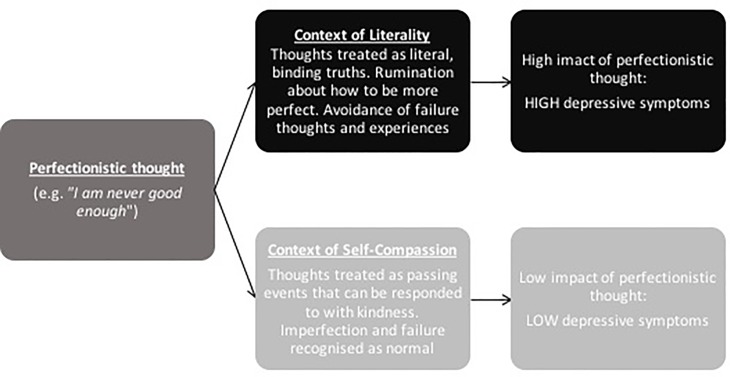
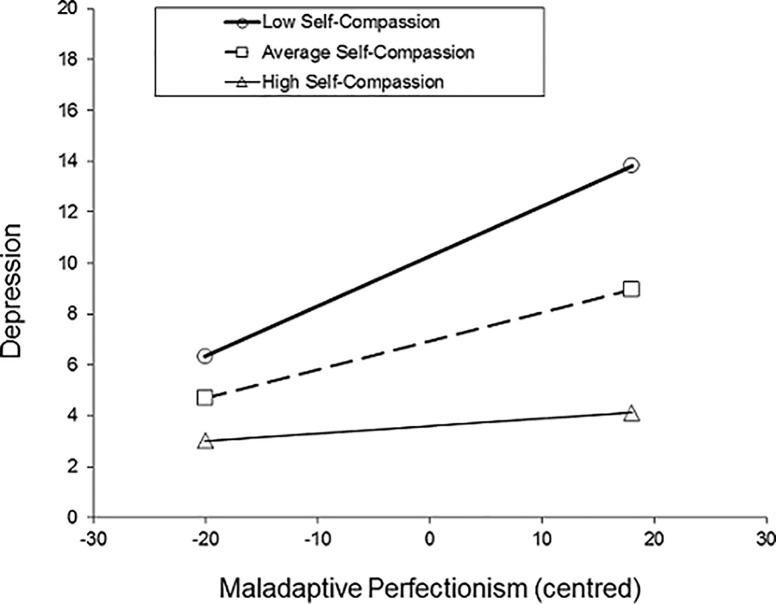
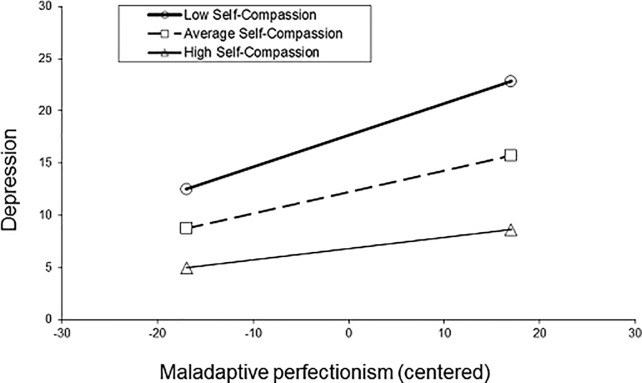
BACKGROUND: Psychological practitioners often seek to directly change the form or frequency of clients' maladaptive perfectionist thoughts, because such thoughts predict future depression. Indirect strategies, such as self-compassion interventions, that seek to change clients' relationships to difficult thoughts, rather than trying to change the thoughts directly could be just as effective. This study aimed to investigate whether self-compassion moderated, or weakened, the relationship between high perfectionism and high depression symptoms in both adolescence and adulthood. METHODS: The present study utilised anonymous self-report questionnaires to assess maladaptive perfectionism, depression, and self-compassion across two samples covering much of the lifespan. Questionnaires were administered in a high school setting for the adolescent sample (Study 1, Mage = 14.1 years, n = 541), and advertised through university and widely online to attract a convenience sample of adults (Study 2, Mage = 25.22 years, n = 515). RESULTS: Moderation analyses revealed that self-compassion reduced the strength of relationship between maladaptive perfectionism and depression in our adolescent Study 1 (β = -.15, p < .001, R2 = .021.) and our adult study 2 (β = -.14, p < .001, R2 = .020). LIMITATIONS: Cross-sectional self-reported data restricts the application of causal conclusions and also relies on accurate self-awareness and willingness to respond to questionnaire openly. CONCLUSIONS: The replication of this finding in two samples and across different age-appropriate measures suggests that self-compassion does moderate the link between perfectionism and depression. Self-compassion interventions may be a useful way to undermine the effects of maladaptive perfectionism, but future experimental or intervention research is needed to fully assess this important possibility.
Overview
The claims and statistics of this paper haven’t been checked yet.
Free: it reads the open-access text and checks the first 5 claims that cite a source we can check. Create a free account to check every claim.
Integrity signals
Registry
Cites
Statistics
Figures
Verification
Claims the paper makes
The claims and statistics of this paper haven’t been checked yet.
Free: it reads the open-access text and checks the first 5 claims that cite a source we can check. Create a free account to check every claim.
Claims other papers make about this one
Each is checked against this paper’s own text: does it say what the citing paper says it does?
The cited source says what the claim attributes to it.
In the citing paper
“Other studies have also demonstrated that self-compassion could buffer the effects of dysfunctional perfectionism on depressive moods.”
The cited source says what the claim attributes to it.
In the citing paper
“This buffering effect of self-compassion in the relationship between dysfunctional perfectionism and negative emotions is reported by several studies [39,40,45].”
Self-check
Percentages, sums and reported differences re-computed from the paper’s own numbers.
The self-check needs the paper’s full text.
Citations
Cites
Multiple regression: testing and interpreting interactions
(1992) · Choice Reviews Online · doi:10.5860/choice.29-3352 · Cited by 36,654
SPSS and SAS procedures for estimating indirect effects in simple mediation models
Preacher, K. J., & Hayes, A. F. (2004) · Behavior Research Methods, Instruments, & Computers · doi:10.3758/bf03206553 · Cited by 17,383 · cited 2×
“In both studies, we assessed moderation by conducting hierarchical multiple regression as recommended by Aiken and West [49] using the Preacher and Hayes PROCESS macros [50].”
Method(1991) · Cited by 7,187
The Development and Validation of a Scale to Measure Self-Compassion
NEFF, K. D. (2003) · Self and Identity · doi:10.1080/15298860309027 · Cited by 6,436 · cited 3×
“The Self-Compassion Scale [29] was used to measure levels of self-compassion.”
BackgroundMethodHenry, J. D., & Crawford, J. R. (2005) · British Journal of Clinical Psychology · doi:10.1348/014466505x29657 · Cited by 5,801
Self-Compassion: An Alternative Conceptualization of a Healthy Attitude Toward Oneself
NEFF, K. (2003) · Self and Identity · doi:10.1080/15298860309032 · Cited by 5,440 · cited 9×
“As noted by Neff [7], self-compassion is ‘a useful emotion regulation strategy, in which painful or distressing feelings are not avoided but are instead held in awareness with kindness, understanding, and a sense of shared humanity’ (p.”
BackgroundResultInfluentialLikert scales, levels of measurement, and the “laws” of statistics
Norman, G. (2010) · Advances in Health Sciences Education · doi:10.1007/s10459-010-9222-y · Cited by 4,850 · cited 1×
“However, as the sample size was large, transformation of the data did not produce any differences in results and therefore, non-transformed data was used in all analyses [51].”
MethodThe dimensions of perfectionism
Frost, R. O., Marten, P., Lahart, C., & Rosenblate, R. (1990) · Cognitive Therapy and Research · doi:10.1007/bf01172967 · Cited by 4,279 · cited 2×
“Perfectionism was measured using the combined score of four sub-scales from the Multidimensional Perfectionism Scale [9], as recommended by Kawamura and Frost [52].”
BackgroundMethodConstruction and factorial validation of a short form of the Self-Compassion Scale
Raes, F., Pommier, E., Neff, K. D., & Van Gucht, D. (2011) · Clinical Psychology & Psychotherapy · doi:10.1002/cpp.702 · Cited by 2,997
A pilot study and randomized controlled trial of the mindful self-compassion program
Neff, K. D., & Germer, C. K. (2013) · Journal of Clinical Psychology · doi:10.1002/jclp.21923 · Cited by 2,253
Cited by
Items 101–174 of 174
Fleming, D. J. M., & Dorsch, T. E. (2024) · International Journal of Sport and Exercise Psychology · doi:10.1080/1612197x.2024.2410282 · Cited by 3
“This notion is evidenced by the findings of empirical work examining the mediation effects of self-compassion between perfectionism and well-being (Stoeber et al., 2020), depression (Ferrari et al., 2018), and burnout (Turkal et al., 2018).”
Feizollahi, Z., Asadzadeh, H., Bakhtiarpour, S., & Farrokhi, N. (2022) · Journal of Health Reports and Technology · doi:10.5812/ijhls.119542 · Cited by 3
“Meanwhile,somestudieshaveelaboratedontheme-diating role of self-compassion (12).”
Self-Compassion in Adolescence
Bluth, K., & Clepper-Faith, M. (2023) · Mindfulness in behavioral health · doi:10.1007/978-3-031-22348-8_6 · Cited by 6
Mahon, C., Hamburger, D., Webb, J. B., Yager, Z., Howard, E., Booth, A., & Fitzgerald, A. (2023) · BMC Public Health · doi:10.1186/s12889-023-17002-x · Cited by 8
“Self-compassion represents a promising approach for supporting body appreciation and psychological wellbeing [25, 26].”
BackgroundThe Effects of Dichotomous Thinking on Depression in Japanese College Students
Kawabata, T., Abe, N., & Wakai, T. (2021) · Journal of Educational and Developmental Psychology · doi:10.5539/jedp.v11n1p28 · Cited by 4
“Ferrari et al. (2018) regarded perfectionism as a primary mechanism underpinning the development and maintenance of depression.”
BackgroundEffects of a Single-Session Intervention Targeting Perfectionism in College Students
Ward, H. E. (2022) · Graduate Student Journal of Psychology · doi:10.52214/gsjp.v19i.10051 · Cited by 8
Javier-Aliaga, D., Gómez, J. C. A., Calizaya-Milla, Y. E., & Saintila, J. (2025) · BMC Psychology · doi:10.1186/s40359-025-02760-7 · Cited by 3
“For example, in a cross-sectional study of 541 adolescents, they found a positive relationship between maladaptive perfection-ism and depression [22].”
Compassionate self-care for nurses and midwives: A sequential explanatory mixed methods study
Steen, M., Othman, S. M. E., Fereday, J. A., Briley, A. L., Xu, Q., & Vernon, R. (2025) · Applied Nursing Research · doi:10.1016/j.apnr.2025.151986 · Cited by 4
Genomics of Antarctic Fungi: A New Frontier
Hilário, H. O., Batista, T. M., & Franco, G. R. (2019) · Springer eBooks · doi:10.1007/978-3-030-18367-7_15 · Cited by 2
A Conceptual Analysis of Mental Health Maladaptation in Postpartum
DeFoor, M., & Amiri, A. (2023) · The Journal of Perinatal Education · doi:10.1891/jpe-2021-0018 · Cited by 5
Ellinas, E. H., Ark, T. K., Ferguson, C. C., & Zhang, B. (2023) · Frontiers in Psychology · doi:10.3389/fpsyg.2023.1188187 · Cited by 4
“The Depression Anxiety Stress Scale (DASS) (total summed score) was selected because of depression’s known positive association with both adaptive and maladaptive perfectionism (Limburg et al., 2017; Ferrari et al., 2018; Liu et al., 2022).”
MethodLin, C.-Y., & Wang, K. T. (2024) · Religions · doi:10.3390/rel15080965 · Cited by 5
Cavada, C. L., Iriarte, L., Herrero, M., Martínez‐Pampliega, A., & Anchía, R. J. (2024) · Current Psychology · doi:10.1007/s12144-024-06681-3 · Cited by 2
“…the relationship between the Inadequate-Self and depressive symptoms to a greater extent than in previous studies with representative samples (Körner et al., 2015; López et al., 2018), and similar those using convenience samples of students and adults (Ferrari et al., 2018). significant (Fig.”
Majör Depresif Bozuklukta Mükemmeliyetçilik
Say, G. (2020) · Psikiyatride Guncel Yaklasimlar - Current Approaches in Psychiatry · doi:10.18863/pgy.703132 · Cited by 8
Salazar, L. R., & Khandewal, P. (2020) · Advances in human resources management and organizational development book series · doi:10.4018/978-1-7998-4912-4.ch023 · Cited by 3
Alaloğlu, G., & Bahtiyar, B. (2020) · Psychological applications and trends · doi:10.36315/2020inpact005 · Cited by 4
Bidimensional Perfectionism and Psychological Distress: The Roles of Self-Esteem and Self-CompassionPreprint
Peony, C. H., & Lee, A. M. (2024) · medRxiv · doi:10.1101/2024.07.24.24310699 · Cited by 4
Akkuş, K., Vardar, M., Tunçel, A., & Sütcü, S. T. (2023) · Psychological Reports · doi:10.1177/00332941231206352 · Cited by 3
“Studies found a signi fi cant and negative association between perfectionism and self-compassion (Ferrari et al., 2018; Linnett & Kibowski, 2020).”
Güngören, F. E., & Aşçı, F. H. (2024) · Spor Bilimleri Dergisi · doi:10.17644/sbd.1307561 · Cited by 1
Wu, D. (2024) · Journal of Education Humanities and Social Sciences · doi:10.54097/n7kbnm79 · Cited by 1
“This claim was bolstered by a research by Marshall et al. [5], which shown that self-compassion in both adults and adolescents mitigated the perfectionism-depression relationship.”
ResultAhvan, E. R., Alizadeh, K. H., & Zarei, E. (2025) · Modern Care Journal · doi:10.5812/mcj-157988 · Cited by 1
Solska, A., Furmańska, J., & Szczęśniak, M. (2025) · Journal of Clinical Medicine · doi:10.3390/jcm14238288 · Cited by 3
“Research also indicates that practicing self-compassion can help individuals with maladaptive perfectionism reduce depressive symptoms or even prevent their onset [62–66].”
Perfectionism and athletes’ mental health: The mediating role of self-compassion
Turakka, S., White, R. G., Robazza, C., Keinonen, K., & Ruiz, M. C. (2026) · Performance Enhancement & Health · doi:10.1016/j.peh.2026.100431 · Cited by 2
Lu, H., Ren, Z., Meng, X., Sun, J., & Wu, Y. (2026) · Journal of Youth and Adolescence · doi:10.1007/s10964-026-02338-5 · Cited by 3
“Interventions that strengthen self-compassion, normalize imperfection, and help girls maintain stable self-worth even when external standards are not met may be especially effective in disrupting the pathway identified here (Ferrari et al., 2018).”
Molnar, D. S., Blackburn, M., Tacuri, N., Zinga, D., Hewitt, P. L., & Flett, G. L. (2026) · Journal of Psychoeducational Assessment · doi:10.1177/07342829261454877 · Cited by 1
“For example, for perfectionistic students, self-compassion is a promising protective factor for prevention and intervention (e.g., Ferrari et al., 2018; With et al., 2024).”
Examining Depression Levels Among Gifted Individuals
Alçay, A., & Ceyhan, E. (2026) · Gifted Child Quarterly · doi:10.1177/00169862261457574 · Cited by 1
Selbstmitgefühl im jugendlichen Alter: Überblick über die aktuelle Forschung
Bluth, K., Park, J., & Lathren, C. (2020) · Psychotherapie: Praxis · doi:10.1007/978-3-662-60318-5_6 · Cited by 2
Hendry, C. F., & Breitmeyer, A. M. (2022) · Journal of Child and Adolescent Counseling · doi:10.1080/23727810.2022.2040318 · Cited by 1
Begum, R., Parwez, S., Bibi, W., & Fatima, I. (2022) · Scandic Journal Of Advanced Research And Reviews · doi:10.55966/sjarr.2022.2.2.0032 · Cited by 1
Relationship Between Self-Compassion and Non-Suicidal Self Injury In Adolescents
Zahra, A., Mawarpury, M., Sari, K., & Sari, N. (2024) · International Conference on Psychology and Health Issues (ICoPHI) · doi:10.4108/eai.4-11-2023.2344828 · Cited by 2
“[7] explain that issues faced by adolescents such as high levels of stress and depression, the desire for perfection, feelings of isolation, shame, and perfectionism can be alleviated through self-compassion.”
BackgroundAlaloğlu, G., & Bahtiyar, B. (2020) · Advances in psychology and psychological trends · doi:10.36315/2021pad19 · Cited by 1
Notes from a Recovering Perfectionist
Scott, A. (2022) · Dance Major Journal · doi:10.5070/d510158903 · Cited by 1
Mohammadian, Y., Asl, E., Mahaki, B., & Ashouri, A. (2022) · International Journal of Preventive Medicine · doi:10.4103/ijpvm.ijpvm_310_20 · Cited by 2
“[40,41] The results showed that EDI‐P and subscales had a negative correlation with self‐compassion,[42,43] self‐esteem,[44,45] and eating self‐efficacy.”
Nariswari, A. A., & Muttaqin, D. (2023) · Humaniora · doi:10.21512/humaniora.v14i1.8318 · Cited by 8
“…are feeling pressure from the stigma acquired (Chan, Yung, & Nie, 2020), overestimating their shape and weight (Linardon et al., 2020), experiencing academic difficulties (Lahtinen et al., 2020), and do evaluations regarding perfectionism (Abdollahi, Allen, & Taheri, 2020; Ferrari et al., 2018).”
BackgroundInfluentialA multidimensional approach to perfectionism and self-compassionPreprint
Linnett, R. J., & Kibowski, F. (2018) · PsyArXiv (OSF Preprints) · doi:10.31234/osf.io/bcu37 · Cited by 1
Self-Compassion: The Way to a Compassionate World
Bhatia, R. (2018)
الکمالية العصابية والقلق الاجتماعي لدى مرتفعي ومنخفضي الشفقة بالذات من المراهقين
شحاته, غ. م. أ. (2019) · مجلة كلية التربية جامعة بنها · doi:10.21608/jfeb.2019.112473
Othman, S. M. E., Steen, M., McKellar, L. V., & Wepa, D. (2021) · doi:10.2196/preprints.33759
Salazar, L. R., & Khandewal, P. (2022) · IGI Global eBooks · doi:10.4018/978-1-6684-5594-4.ch040
برنامج إرشادی انتقائی فی تحسین الشفقة بالذات وخفض الضغوط النفسیة لدى أمهات أطفال اضطراب التوحد
حشیش, ح. إ. م. أ. (2022) · التربية (الأزهر) مجلة علمية محکمة للبحوث التربوية والنفسية والاجتماعية) · doi:10.21608/jsrep.2022.236226 · Cited by 1
الشفقة بالذات وعلاقتها بالتمکین المعرفی لدى أسر ذوی الإعاقة الفکریة المشخصین حدیثا
حنون, م. ف. م., & القرالة, ع. ا. م. (2022) · التربية (الأزهر) مجلة علمية محکمة للبحوث التربوية والنفسية والاجتماعية) · doi:10.21608/jsrep.2022.251382
KURTULUŞ, H. Y., Kurtuluş, E., & UYSAL, Y. A. Ö. (2022) · İnsan ve Toplum Bilimleri Araştırmaları Dergisi · doi:10.15869/itobiad.1068860
Risk and Protective Factors for Depression during Adolescence
Chen, T. (2023) · Journal of Education Humanities and Social Sciences · doi:10.54097/ehss.v8i.4248 · Cited by 1
Wegerer, M. (2023) · Verhaltenstherapie · doi:10.1159/000531483
النهوض الأكاديمي وعلاقته بالشفقة بالذات والرجاء كمتغير معدل لدى طلاب السنة الأولى الجامعية
المغني, أ. ع. ا. ع. (2023) · مجلة کلیة التربیة فى العلوم النفسیة · doi:10.21608/jfeps.2023.324751
(2024) · Verhaltenstherapie · doi:10.1159/000535963
Kaygı Duyarlılığı ve Sağlık Kaygısı Arasındaki İlişkide Öz-Şefkatin Aracı Rolü
TÜTÜNCÜ, S., & KOÇYİĞİT, E. G. (2024) · Mediterranean Journal of Humanities · doi:10.13114/mjh.1448819
Self-Compassion Sebagai Mediator Antara Perceived Stress dan Depresi Pada Emerging Adulthood
P, I. A. M. G. P. S., Wismanto, Y. B., & Rahayu, E. (2024) · PSIKODIMENSIA · doi:10.24167/psidim.v23i1.12189 · Cited by 4
Hanaei, N., Nejad, S. B., & Hashemi, S. E. (2024) · Journal of Woman Cultural Psychology روان شناسی فرهنگی زن · doi:10.61186/iau.1127505
Nurturing Student Autonomy: the role of Self-determination theory in Academic coaching
Lubennikova, E. V. (2025) · Coaching psychology: methodology, theory, practice · doi:10.31483/r-127431 · Cited by 1
Christians Have More Self-Compassion Than Atheists—But Also More Grandiose (Not Fragile) Narcissism
Magee, M. W. (2025) · Pastoral Psychology · doi:10.1007/s11089-025-01239-x
Shih, S. (2025) · American Journal of Education and Learning · doi:10.55284/ajel.v10i2.1482 · Cited by 2
Burnout and Self-Compassion Experiences of Non-Governmental Organization Employees
Erol, F. K., & Büyükbeşe, T. (2025) · OPUS Toplum Araştırmaları Dergisi · doi:10.26466/opusjsr.1685796
Merdad, N., Rashid, T., Faden, S. Y., Jebreen, K., Fekih‐Romdhane, F., & Hallit, S. R. (2025) · International Journal of Adolescence and Youth · doi:10.1080/02673843.2025.2543934
“The presence of self-compassion reduced the intensity of the association between perfectionism and depression among adolescents, while the presence of rumination exacerbated it (Ferrari et al., 2018; Flett et al., 2011).”
A Danish word the world needs to combat stress: Pyt
Helweg‐Larsen, M. (2019) · doi:10.64628/aai.sx96h3py9
Rahmat, M. R. (2024) · Emerald Group Publishing Limited eBooks · doi:10.1108/979-8-88730-501-120251006
Forgiveness and Physical Health: A Review of Theory and Evidence
Toussaint, L. L., Webb, J. R., Hirsch, J. K., Kohls, N., Offenbaecher, M., Dezutter, J., Nguyen, Q. A., Vallejo, M. Á., & Sirois, F. M. (2025) · Springer eBooks · doi:10.1007/978-3-031-89095-6_11
Kawasaki, N. (2026) · Advances in mental health and addiction · doi:10.1007/978-3-032-12438-8_5
Selcoe, G., & Hayes, B. (2026) · Educational Psychology in Practice · doi:10.1080/02667363.2026.2613042
“…et al., 1998; Freudenstein et al., 2012), SOP and anxiety (Hewitt et al., 2002), bullying and social hopelessness (Roxborough et al., 2012) and SOP and depression (Huggins et al., 2008; Lunn et al., 2023), although this relationship may be moderated by self-compassion (Ferrari et al., 2018).”
Does compassion affect shame emotions and mental health in individuals with ASD traits
Hiramatsu, Y., Asano, K., & Shimizu, E. (2026) · BMC Research Notes · doi:10.1186/s13104-026-07726-5
Song, Y., Wang, Z., Lin, J., Li, B., Zhang, H., Qiao, G., & Zhang, L. (2026) · BMC Psychology · doi:10.1186/s40359-026-04260-8
Combo, A. K., & Moon, C. (2026) · Current Psychology · doi:10.1007/s12144-026-09324-x
“Thus, responding to perfectionistic thoughts with self-compassion may diminish their impact, preventing them from causing negative emotions (Ferrari et al., 2018).”
Discrimination, Self‐Compassion, and Family Factors in Suicide Risk Among Asian Young Adults
Hsu, L.-C., Jang, J. Y., Shaikh, A. N., Suh, H. N., Chang, C. Y., & Wang, K. T. (2026) · Journal of Multicultural Counseling and Development · doi:10.1002/jmcd.70024
Zhao, H., & Huang, H. (2026) · BMC Psychology · doi:10.1186/s40359-026-04467-9 · Cited by 3
Albert, S., Santos, R. L., & Valadares, W. G. D. A. (2026) · Psicologia e Saúde em Debate · doi:10.22289/2446-922x.v12a1a52
Rudaz, M., Hall, T., & Fincham, F. D. (2026) · Journal of American College Health · doi:10.1080/07448481.2026.2673431
“28,30 Furthermore, Tobin and Dunkley 20 reported that self-critical perfectionism moderated the effects of specific facets of mindfulness (i.e., observing, nonreactivity) and self-compassion (i.e., self-kindness, mindfulness, over-identification) on general distress and anx-ious arousal over a…”
Silvestro, O., Vicent, M., Fuster‐Rico, A., & Gonzálvez, C. (2026) · Current Psychology · doi:10.1007/s12144-026-09590-9 · Cited by 1
“These character - istics may result in reduced levels of self-compassion and a feeling of never living up to the expectations (Ferrari et al., 2018).”
Gu, H., Xiao, Y., Ai, X., Fan, M., & Xia, T. (2026) · Journal of Clinical Psychology · doi:10.1002/jclp.70173
Othman, S. M. E., Javanmard, M., Roberts, L., Conlon, L., & Steen, M. (2026) · Cogent Mental Health · doi:10.1080/28324765.2026.2711571
“Evidence from broader populations demonstrates that higher self-compassion is associated with reduced psychological distress and improved emotional regulation (Delaney, 2018; Ferrari et al., 2018), suggesting potential applicability within infertility contexts.”
Self-compassion as a protective factor against maladaptive perfectionism and loneliness
Rozin, D. M., & Холмогорова, А. Б. (2026) · Journal of Modern Foreign Psychology · doi:10.17759/jmfp.2026150307
Salimi, Z., Ghanami, A., Akhlaghi, S., & Nejatifard, S. N. (2026) · Iranian Journal of Psychiatry and Behavioral Sciences · doi:10.5812/ijpbs-166054
Hu, P., Hao, X., Ding, X., Wu, J., & Fu, Z. (2026) · Behavioral Sciences · doi:10.3390/bs16111994
Metadata
- Authors
- Ferrari, M., Yap, K., Scott, N., Einstein, D. A., & Ciarrochi, J.
- Affiliations
- The University of Sydney (AU)
- Australian Catholic University (AU)
- RMIT University (AU)
- Macquarie University (AU)
- Corresponding author
- Ferrari, Madeleine
- Venue
- PLOS ONE
- Publisher
- Public Library of Science (PLoS)
- Published
- 2018-02-21
- Volume
- 13
- Issue
- 2
- Pages
- e0192022
- ISSN
- 1932-6203 (ISSN-L)
- PMC
- PMC5821438
- OpenAlex
- W2788088331
- Cited by
- 173
- References
- 65
- Citations by year
- 2026: 19 · 2025: 18 · 2024: 25 · 2023: 25 · 2022: 34 · 2021: 16 · 2020: 22 · 2019: 11 · 2018: 3
- FWCI
- 15.25
- Type
- journal article
- Language
- en
- Open access
- gold
- doi.org
- Licence
- Locations
- PLoS ONE (publishedVersion, cc-by)
- PubMed Central (publishedVersion, cc-by)
- PubMed (publishedVersion)
- RePEc: Research Papers in Economics (submittedVersion)
- RMIT Research Repository (RMIT University Library) (submittedVersion, other-oa)
- DOAJ (DOAJ: Directory of Open Access Journals) (submittedVersion)
- Figshare (submittedVersion, cc-by)
- Topics
- Social Sciences › Psychology › Clinical Psychology › Perfectionism, Procrastination, Anxiety Studies
- Social Sciences › Psychology › Clinical Psychology › Mindfulness and Compassion Interventions
- Social Sciences › Psychology › Experimental and Cognitive Psychology › Anxiety, Depression, Psychometrics, Treatment, Cognitive Processes
- Keywords
- self-compassion, maladaptive perfectionism, depression, moderation, adolescents, adulthood, self-compassion interventions, lifespan development
- MeSH terms
- Perfectionism, Adolescent, Adult, Child, Depression, Empathy, Female, Humans, Male, Young Adult
About these checks
Registry, retraction, Cites and statistics results are computed, not judged, with one exception: a printed reference that no index lists is read once by a model before it counts as a citation error. Claims are extracted by a model and kept only when their quote appears verbatim in the text; each cited source is then checked, with a model’s help, for whether it says what the claim relies on. Those verdicts can be wrong — read the claim’s quote and the cited source before relying on one.
Statistics and arithmetic are recomputed, not judged.
Confidence bands are shown only for fields calibrated on our annotated test set. None is calibrated yet, so no band is shown.
What counts as a claim ›How we measure confidence ›How we check this ›
Are you an author, or do you see a problem with this page? Request a review
Data sources
Bibliographic data: Semantic Scholar, OpenAlex, Crossref.
Contains information from the Semantic Scholar Academic Graph Datasets, made available under the ODC Attribution License (ODC-BY 1.0).
Semantic Scholar’s data is described in: Kinney, R., et al. (2023). The Semantic Scholar Open Data Platform. arXiv:2301.10140.
