

The DOI matches its Crossref record; 136 of the 136 references it cites were found in a registry or an index.
Risk factors for type 2 diabetes mellitus: An exposure-wide umbrella review of meta-analyses
Open accessAbstract
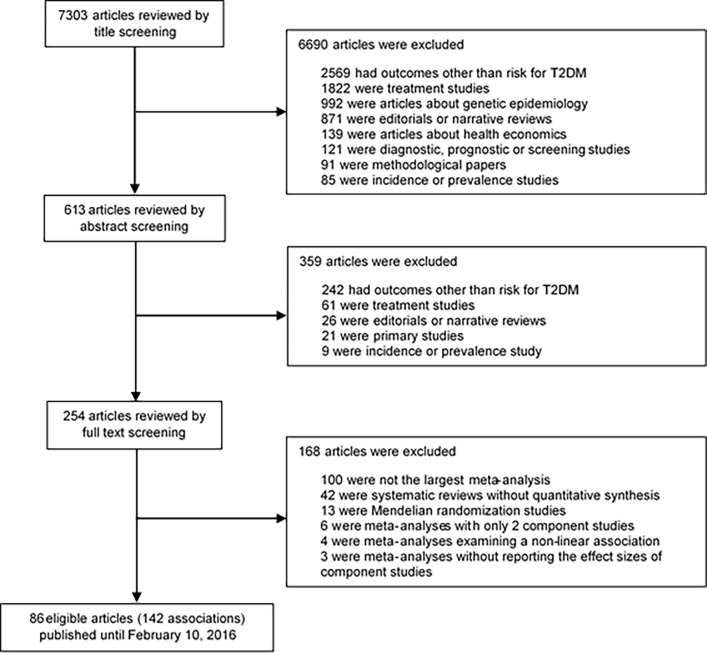
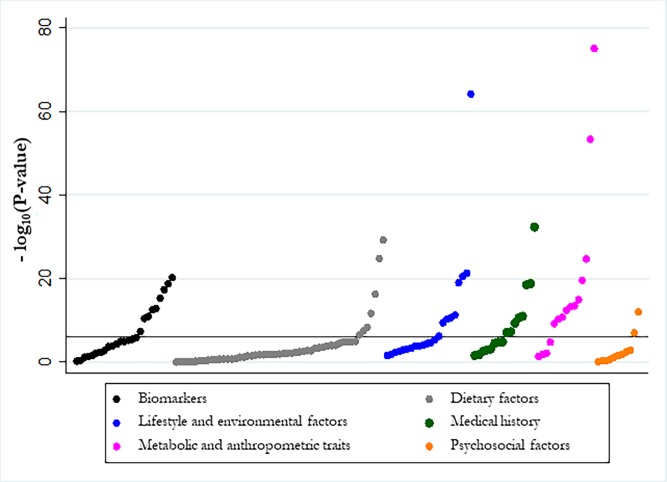
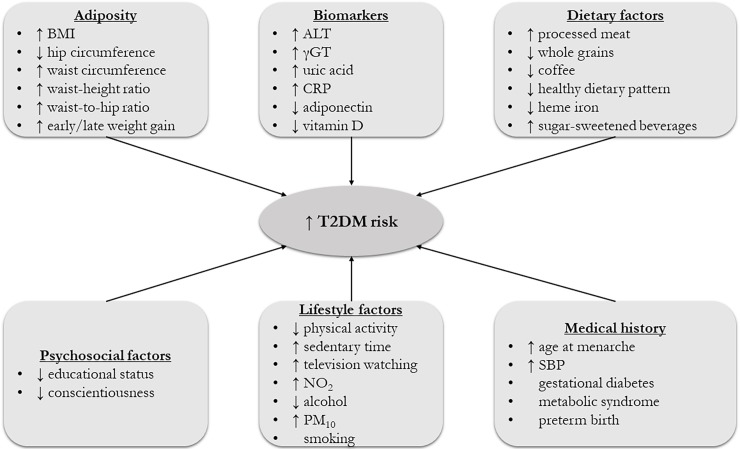
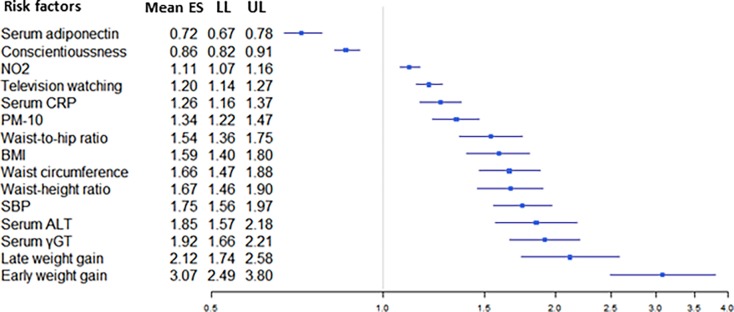
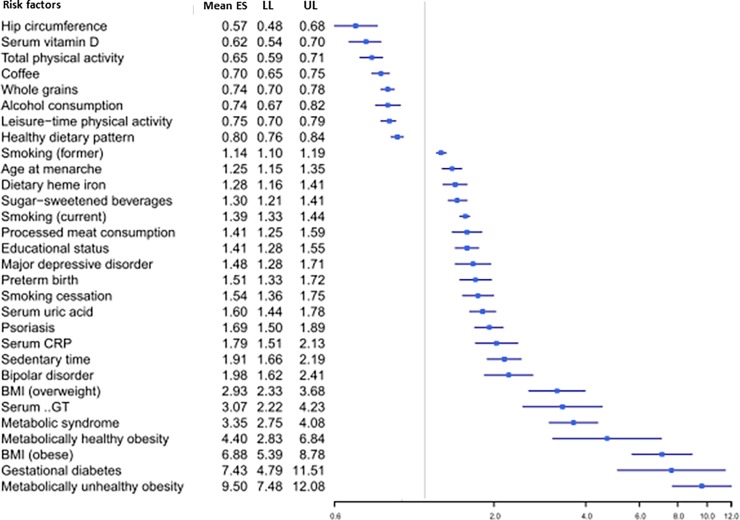
BACKGROUND: Type 2 diabetes mellitus (T2DM) is a global epidemic associated with increased health expenditure, and low quality of life. Many non-genetic risk factors have been suggested, but their overall epidemiological credibility has not been assessed. METHODS: We searched PubMed to capture all meta-analyses and Mendelian randomization studies for risk factors of T2DM. For each association, we estimated the summary effect size, its 95% confidence and prediction interval, and the I2 metric. We examined the presence of small-study effects and excess significance bias. We assessed the epidemiological credibility through a set of predefined criteria. RESULTS: We captured 86 eligible papers (142 associations) covering a wide range of biomarkers, medical conditions, and dietary, lifestyle, environmental and psychosocial factors. Adiposity, low hip circumference, serum biomarkers (increased level of alanine aminotransferase, gamma-glutamyl transferase, uric acid and C-reactive protein, and decreased level of adiponectin and vitamin D), an unhealthy dietary pattern (increased consumption of processed meat and sugar-sweetened beverages, decreased intake of whole grains, coffee and heme iron, and low adherence to a healthy dietary pattern), low level of education and conscientiousness, decreased physical activity, high sedentary time and duration of television watching, low alcohol drinking, smoking, air pollution, and some medical conditions (high systolic blood pressure, late menarche age, gestational diabetes, metabolic syndrome, preterm birth) presented robust evidence for increased risk of T2DM. CONCLUSIONS: A healthy lifestyle pattern could lead to decreased risk for T2DM. Future randomized clinical trials should focus on identifying efficient strategies to modify harmful daily habits and predisposing dietary patterns.
Overview
The claims and statistics of this paper haven’t been checked yet.
Run the check — free, no account needed. It reads the open-access text and checks the sources it cites.
Integrity signals
Registry
Cites
Statistics
Figures
Verification
Claims the paper makes
The claims and statistics of this paper haven’t been checked yet.
Run the check — free, no account needed. It reads the open-access text and checks the sources it cites.
Claims other papers make about this one
Each is checked against this paper’s own text: does it say what the citing paper says it does?
The check wasn’t confident either way, so it gives no verdict — never disputed.
In the citing paper
“Clinical guidelines recommend the monitoring of HbA1c every three months with frequent therapy modification until the glycemic goal is achieved [5].”
From Clinical Inertia in the Management of Type 2 Diabetes Mellitus: A Systematic Review (2023) · cites this paper as [5]
Experimental — accuracy not yet measuredIn the citing paper
“Obesity was associated with an increased risk of AD, DM, CHD, stroke and liver and bowel cancer by between 33% and 588%.11,77,81,85”
From Common risk factors for major noncommunicable disease, a systematic overview of reviews and commentary: the implied potential for targeted risk reduction (2019) · cites this paper as [77]
In the citing paper
“High adherence to a Mediterranean diet was shown to reduce risk across all five NCDs by between 4% and 36%,11,77,90,93,98”
From Common risk factors for major noncommunicable disease, a systematic overview of reviews and commentary: the implied potential for targeted risk reduction (2019) · cites this paper as [77]
In the citing paper
“higher levels of physical activity similarly resulted in risk reduction of between 13% and 45%.11,75,77,94”
From Common risk factors for major noncommunicable disease, a systematic overview of reviews and commentary: the implied potential for targeted risk reduction (2019) · cites this paper as [77]
Self-check
Percentages, sums and reported differences re-computed from the paper’s own numbers.
The self-check needs the paper’s full text.
Citations
Cites
Bias in meta-analysis detected by a simple, graphical test
Egger, M., Smith, G. D., Schneider, M., & Minder, C. (1997) · BMJ · doi:10.1136/bmj.315.7109.629 · Cited by 56,722
Meta-analysis in clinical trials
DerSimonian, R., & Laird, N. (1986) · Controlled Clinical Trials · doi:10.1016/0197-2456(86)90046-2 · Cited by 39,552
Quantifying heterogeneity in a meta‐analysis
Higgins, J. P. T., & Thompson, S. G. (2002) · Statistics in Medicine · doi:10.1002/sim.1186 · Cited by 36,763
International Diabetes Federation 2017
Carracher, A. M., Marathe, P. H., & Close, K. L. (2018) · Journal of Diabetes · doi:10.1111/1753-0407.12644 · Cited by 13,379
The metabolic phenotype in obesity: Fat mass, body fat distribution, and adipose tissue function
Goossens, G. H. (2017) · Obesity Facts · doi:10.1159/000471488 · Cited by 8,481
Sterne, J. A. C., Sutton, A. J., Ioannidis, J. P. A., Terrin, N., Jones, D. R., Lau, J., Carpenter, J., Rucker, G., Harbord, R. M., Schmid, C. H., et al. (2011) · BMJ · doi:10.1136/bmj.d4002 · Cited by 7,709
Obesity and insulin resistance
Kahn, B. B., & Flier, J. S. (2000) · Journal of Clinical Investigation · doi:10.1172/jci10842 · Cited by 3,345
Type 2 diabetes mellitus after gestational diabetes: a systematic review and meta-analysis
Bellamy, L., Casas, J.-P., Hingorani, A. D., & Williams, D. (2009) · The Lancet · doi:10.1016/s0140-6736(09)60731-5 · Cited by 3,253
Biswas, A., Oh, P. I., Faulkner, G. E., Bajaj, R. R., Silver, M. A., Mitchell, M. S., & Alter, D. A. (2015) · Annals of Internal Medicine · doi:10.7326/m14-1651 · Cited by 2,726
A Re-Evaluation of Random-Effects Meta-Analysis
Higgins, J. P. T., Thompson, S. G., & Spiegelhalter, D. J. (2009) · Journal of the Royal Statistical Society Series A: Statistics in Society · doi:10.1111/j.1467-985x.2008.00552.x · Cited by 2,569
Cited by
Sorted by citations
Pathophysiology of type 2 diabetes mellitus
Galicia-Garcia, U., Benito-Vicente, A., Jebari, S., Larrea-Sebal, A., Siddiqi, H., Uribe, K. B., Ostolaza, H., & Martín, C. (2020) · International Journal of Molecular Sciences · doi:10.3390/ijms21176275 · Cited by 3,360
“Obesity (body-mass index [BMI]≥30 kg/m2) is the strongest risk factor for T2DM [26,27] and is associated with metabolic abnormalities resulting in IR [28].”
BackgroundThe integrative biology of type 2 diabetes
Roden, M., & Shulman, G. I. (2019) · Nature · doi:10.1038/s41586-019-1797-8 · Cited by 1,167
Management and Prevention Strategies for Non-communicable Diseases (NCDs) and Their Risk Factors
Budrevičiūtė, A., Damiati, S., Sabir, D. K., Önder, K., Schuller‐Götzburg, P., Plakys, G., Katileviciute, A., Khoja, S. M., & Kodzius, R. (2020) · Frontiers in Public Health · doi:10.3389/fpubh.2020.574111 · Cited by 1,158
Neuenschwander, M., Ballon, A., Weber, K. S., Norat, T., Aune, D., Schwingshackl, L., & Schlesinger, S. (2019) · BMJ · doi:10.1136/bmj.l2368 · Cited by 531
Diabetes Mellitus in Saudi Arabia
Dawish, M. A. A., & Robert, A. A. (2019) · Springer eBooks · doi:10.1007/978-3-319-74365-3_45-1 · Cited by 446
Metadata
- Authors
- Bellou, V., Belbasis, L., Tzoulaki, I., & Evangelou, E.
- Affiliations
- University of Ioannina (GR)
- Venue
- PLOS ONE
- Publisher
- Public Library of Science (PLoS)
- Published
- 2018-03-20
- Volume
- 13
- Issue
- 3
- Pages
- e0194127
- ISSN
- 1932-6203 (ISSN-L)
- PMC
- PMC5860745
- OpenAlex
- W2789317488
- Cited by
- 713
- References
- 136
- Citations by year
- 2026: 58 · 2025: 72 · 2024: 116 · 2023: 115 · 2022: 117 · 2021: 97 · 2020: 82 · 2019: 46 · 2018: 10
- FWCI
- 9.04
- Type
- journal article
- Language
- en
- Open access
- gold
- doi.org
- Licence
- Locations
- PLoS ONE (publishedVersion, cc-by)
- PubMed Central (publishedVersion, cc-by)
- PubMed (publishedVersion)
- RePEc: Research Papers in Economics (submittedVersion)
- DOAJ (DOAJ: Directory of Open Access Journals) (submittedVersion, cc-by-sa)
- Spiral (Imperial College London) (submittedVersion, other-oa)
- Topics
- Health Sciences › Medicine › Endocrinology, Diabetes and Metabolism › Diabetes, Cardiovascular Risks, and Lipoproteins
- Health Sciences › Medicine › Endocrinology, Diabetes and Metabolism › Adipokines, Inflammation, and Metabolic Diseases
- Life Sciences › Biochemistry, Genetics and Molecular Biology › Genetics › Genetic Associations and Epidemiology
- Keywords
- type 2 diabetes, risk factors, non-genetic risk factors, adiposity, serum biomarkers, dietary habits, physical activity, sedentary behavior, alcohol consumption, smoking, air pollution, metabolic syndrome, gestational diabetes mellitus, preterm birth, educational attainment, conscientiousness, psychosocial factors, umbrella review of meta-analyses, Mendelian randomization
- MeSH terms
- Air Pollution, Diabetes Mellitus, Type 2, Diet, Humans, Life Style, Obesity, Risk Factors, Exercise
About these checks
Registry, retraction, Cites and statistics results are computed, not judged, with one exception: a printed reference that no index lists is read once by a model before it counts as a citation error. Claims are extracted by a model and kept only when their quote appears verbatim in the text; each cited source is then checked, with a model’s help, for whether it says what the claim relies on. Those verdicts can be wrong — read the claim’s quote and the cited source before relying on one.
Statistics and arithmetic are recomputed, not judged.
Confidence bands are shown only for fields calibrated on our annotated test set. None is calibrated yet, so no band is shown.
What counts as a claim ›How we measure confidence ›How we check this ›
Are you an author, or do you see a problem with this page? Request a review
