

The DOI matches its Crossref record; 64 of the 64 references it cites were found in a registry or an index.
Six-year positive effects of a mindfulness-based intervention on mindfulness, coping and well-being in medical and psychology students; Results from a randomized controlled trial
Open accessAbstract
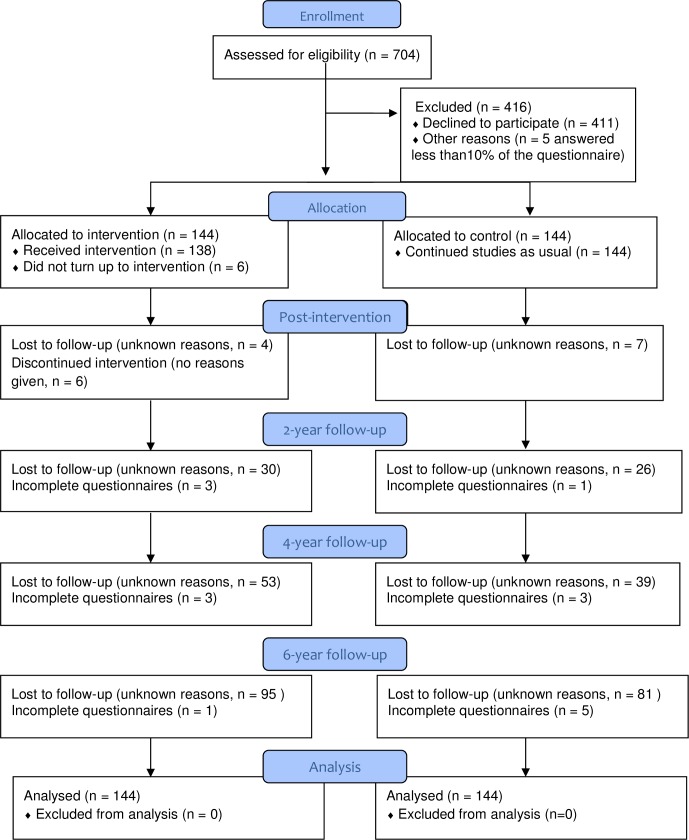
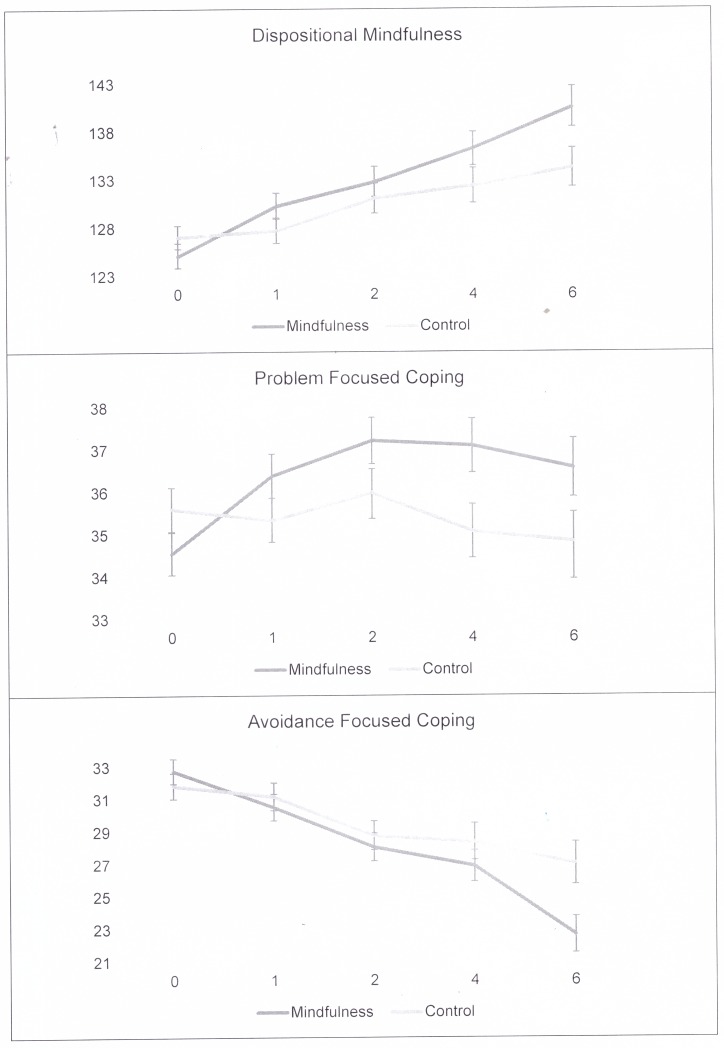
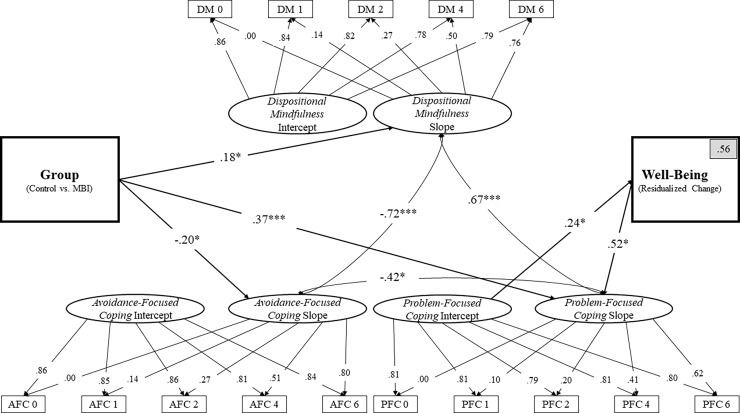
Longitudinal research investigating the enduring impact of mindfulness training is scarce. This study investigates the six-year effects of a seven-week mindfulness-based course, by studying intervention effects in the trajectory of dispositional mindfulness and coping skills, and the association between those change trajectories and subjective well-being at six-year follow-up. 288 Norwegian medical and psychology students participated in a randomized controlled trial. 144 received a 15-hour mindfulness course over seven weeks in the second or third semester with booster sessions twice yearly, while the rest continued their normal study curricula. Outcomes were subjective well-being, and dispositional mindfulness and coping assessed using the Five Facet Mindfulness Questionnaire and the Ways of Coping Checklist. Analyses were performed for the intention-to-treat sample, using latent growth curve models. At six-year follow-up, students receiving mindfulness training reported increased well-being. Furthermore, they reported greater increases in the trajectory of dispositional mindfulness and problem-focused coping along with greater decreases in the trajectory of avoidance-focused coping. Increases in problem-focused coping predicted increases in well-being. These effects were found despite relatively low levels of adherence to formal mindfulness practice. The findings demonstrate the viability of mindfulness training in the promotion of well-being and adaptive coping, which could contribute to the quality of care given, and to the resilience and persistence of health care professionals. TRIAL REGISTRATION: Clinicaltrials.gov NCT00892138.
Overview
The claims and statistics of this paper haven’t been checked yet.
Run the check — free, no account needed. It reads the open-access text and checks the sources it cites.
Integrity signals
Registry
Cites
Statistics
Figures
Verification
Claims the paper makes
The claims and statistics of this paper haven’t been checked yet.
Run the check — free, no account needed. It reads the open-access text and checks the sources it cites.
Claims other papers make about this one
Each is checked against this paper’s own text: does it say what the citing paper says it does?
The cited source doesn’t support the claim as written.
In the citing paper
“Furthermore, a systematic review of randomized controlled trials using the MBSR program (N=1,942; de Vibe et al., 2018) indicated a general decay of effects after 1 to 2 years, except for one study which included refresher sessions.”
From Mindfulness-based programs sustainably increase mental health: The role of cognitive fusion and mindfulness practice (2024) · cites this paper as de Vibe et al., 2018
Checked by a reasoning model — may be wrong.
Experimental — accuracy not yet measuredThe source backs part of the claim, not all of it — or backs it for a different population, condition or comparison.
In the citing paper
“To date, only a few published articles have reported long-term follow-up studies lasting more than two years in the general population, and these were based on student samples (see de Vibe et al., 2018; Solhaug et al., 2019).”
From Mindfulness-based programs sustainably increase mental health: The role of cognitive fusion and mindfulness practice (2024) · cites this paper as de Vibe et al., 2018
Experimental — accuracy not yet measuredThe source backs part of the claim, not all of it — or backs it for a different population, condition or comparison.
In the citing paper
“de Vibe et al., 2018) indicated a general decay of effects after 1 to 2 years, except for one study which included refresher sessions.”
From Mindfulness-based programs sustainably increase mental health: The role of cognitive fusion and mindfulness practice (2024) · cites this paper as de Vibe et al., 2018
Experimental — accuracy not yet measuredThe source backs part of the claim, not all of it — or backs it for a different population, condition or comparison.
In the citing paper
“These results are in line with the findings of prior studies measuring the effects of mindfulness-based programs on mindfulness, anxiety, well-being, and cognitive fusion in non-clinical populations (see de Vibe et al., 2018; Golden et al., 2020; Querstret et al., 2020; Ștefan et al., 2018; Tanay et al., 2012).”
From Mindfulness-based programs sustainably increase mental health: The role of cognitive fusion and mindfulness practice (2024) · cites this paper as de Vibe et al., 2018
Experimental — accuracy not yet measuredThe cited source says what the claim attributes to it.
In the citing paper
“Mindful individuals are more resilient to life stress (de Vibe et al., 2018), decreasing the likelihood of developing physical ailments such as cardiovascular disease and impaired immune systems (Murphy et al., 2012).”
From What is the mindful personality? Implications for physical and psychological health (2022) · cites this paper as de Vibe et al., 2018
The cited source says what the claim attributes to it.
In the citing paper
“and increased subjective well-being up to 6 years post-intervention (de Vibe et al., 2018).”
From Effects of a Mindfulness-Based Weight Loss Intervention on Long-term Psychological Well-being Among Adults with Obesity: Secondary Analyses from the Supporting Health by Integrating Nutrition and Exercise (SHINE) Trial (2022) · cites this paper as de Vibe et al., 2018
The cited source says what the claim attributes to it.
In the citing paper
“However, certain studies have shown that even if individuals reported low frequency formal mindfulness practice, practicing mindfulness had a lasting beneficial effect on well-being and adaptability (De Vibe et al., 2018).”
From Mindfulness-based programs sustainably increase mental health: The role of cognitive fusion and mindfulness practice (2024) · cites this paper as De Vibe et al., 2018
The cited source says what the claim attributes to it.
In the citing paper
“Few research studies have measured the sustainability of these effects after several years, but these studies also showed that in non-clinical populations (e.g., students), follow-up measures between one month and six years showed persistent effects on medical and psychology students' mindfulness, mental health, and coping abilities (de Vibe et al., 2018; Solhaug et al., 2019).”
From Mindfulness-based programs sustainably increase mental health: The role of cognitive fusion and mindfulness practice (2024) · cites this paper as de Vibe et al., 2018
Self-check
Percentages, sums and reported differences re-computed from the paper’s own numbers.
The self-check needs the paper’s full text.
Citations
Cites
1 retracted
Gotink, R. A., Chu, P., Busschbach, J. J. V., Benson, H., Fricchione, G. L., & Hunink, M. G. M. (2015) · PLOS ONE · doi:10.1371/journal.pone.0124344 · Cited by 539
RetractedHu, L., & Bentler, P. M. (1999) · Structural Equation Modeling A Multidisciplinary Journal · doi:10.1080/10705519909540118 · Cited by 108,788
The benefits of being present: Mindfulness and its role in psychological well-being
Brown, K. W., & Ryan, R. M. (2003) · Journal of Personality and Social Psychology · doi:10.1037/0022-3514.84.4.822 · Cited by 13,448
Using Self-Report Assessment Methods to Explore Facets of Mindfulness
Baer, R. A., Smith, G. T., Hopkins, J., Krietemeyer, J., & Toney, L. (2006) · Assessment · doi:10.1177/1073191105283504 · Cited by 7,511
Emotion regulation: affective, cognitive, and social consequences.
Gross, J. J. (2002) · Psychophysiology · doi:10.1017/s0048577201393198 · Cited by 4,890
Shapiro, S. L., Carlson, L. E., Astin, J. A., & Freedman, B. (2006) · Journal of Clinical Psychology · doi:10.1002/jclp.20237 · Cited by 4,002
Mindfulness: Theoretical Foundations and Evidence for its Salutary Effects
Brown, K. W., Ryan, R. M., & Creswell, J. D. (2007) · Psychological Inquiry · doi:10.1080/10478400701598298 · Cited by 3,654
Folkman, S., & Moskowitz, J. T. (2004) · Annual Review of Psychology · doi:10.1146/annurev.psych.55.090902.141456 · Cited by 3,485
Marsh, H. W., & Hocevar, D. (1985) · Psychological Bulletin · doi:10.1037/0033-2909.97.3.562 · Cited by 3,419
Dyrbye, L. N., Thomas, M. R., & Shanafelt, T. D. (2006) · Academic Medicine · doi:10.1097/00001888-200604000-00009 · Cited by 2,909
Research works printed but not linked: 1
- E Halland, 2015, Mindfulness training improves problem-focused coping in psychology and medical students, College Student Journal, 49, 387
Cited by
Sorted by citations
Galante, J., Friedrich, C., Dawson, A. F., Modrego-Alarcón, M., Gebbing, P., Delgado-Suárez, I., Gupta, R., Dean, L., Dalgleish, T., White, I. R., et al. (2021) · PLOS Medicine · doi:10.1371/journal.pmed.1003481 · Cited by 319
Suleiman‐Martos, N., Gomez‐Urquiza, J. L., Aguayo‐Estremera, R., Cañadas‐De La Fuente, G. A., De La Fuente‐Solana, E. I., & Albendín‐García, L. (2020) · Journal of Advanced Nursing · doi:10.1111/jan.14318 · Cited by 217
“However, the studies in question (Duarte & Pinto-Gouveia, 2016; Wong, Teng, Chee, Doshi, & Lim, 2018) reported high dropout rates, a pattern that has been repeated in other studies of healthcare workers (De Vibe et al., 2018; Shapiro, Astin, Bishop, & Cordova, 2005).”
ResultScheepers, R. A., Emke, H., Epstein, R. M., & Lombarts, K. M. J. M. H. (2019) · Medical Education · doi:10.1111/medu.14020 · Cited by 188
Spinelli, C., Wisener, M., & Khoury, B. (2019) · Journal of Psychosomatic Research · doi:10.1016/j.jpsychores.2019.03.003 · Cited by 170
Psychological interventions to foster resilience in healthcare students
Kunzler, A. M., Helmreich, I., König, J., Chmitorz, A., Wessa, M., Binder, H., & Lieb, K. (2020) · Cochrane Database of Systematic Reviews · doi:10.1002/14651858.cd013684 · Cited by 177
Metadata
- Authors
- de Vibe, M., Solhaug, I., Rosenvinge, J. H., Tyssen, R., Hanley, A., & Garland, E.
- Affiliations
- University Hospital of North Norway (NO)
- UiT The Arctic University of Norway (NO)
- University of Oslo (NO)
- University of Utah (US)
- Venue
- PLOS ONE
- Publisher
- Public Library of Science (PLoS)
- Published
- 2018-04-24
- Volume
- 13
- Issue
- 4
- Pages
- e0196053
- ISSN
- 1932-6203 (ISSN-L)
- PMC
- PMC5916495
- OpenAlex
- W2802699102
- Cited by
- 192
- References
- 64
- Citations by year
- 2026: 15 · 2025: 20 · 2024: 27 · 2023: 38 · 2022: 33 · 2021: 24 · 2020: 21 · 2019: 12 · 2018: 2
- FWCI
- 17.29
- Type
- journal article
- Language
- en
- Open access
- gold
- doi.org
- Licence
- public-domain
- creativecommons.org/publicdomain/zero/1.0/ (vor)
- Locations
- PLoS ONE (publishedVersion, public-domain)
- Europe PMC (PubMed Central) (publishedVersion, public-domain)
- PubMed Central (publishedVersion, public-domain)
- PubMed (publishedVersion)
- DOAJ (DOAJ: Directory of Open Access Journals) (submittedVersion, cc-by-sa)
- NORA - Norwegian Open Research Archives (submittedVersion, other-oa)
- Figshare (submittedVersion, cc-by)
- NORA - Norwegian Open Research Archives (submittedVersion, public-domain)
- Funders
- Norske Legeforening (NO) (08/4352)
- Norwegian Public Health Institute
- the Health Authority Region North, Norway
- Topics
- Social Sciences › Psychology › Clinical Psychology › Mindfulness and Compassion Interventions
- Social Sciences › Psychology › Social Psychology › Psychological Well-being and Life Satisfaction
- Social Sciences › Health › Religion, Spirituality, and Psychology
- Keywords
- mindfulness-based interventions, trait mindfulness, coping, subjective well-being, problem-focused coping, booster sessions, medical students, psychology students, longitudinal follow-up, healthcare workers, resilience
- MeSH terms
- Treatment Adherence and Compliance, Adaptation, Psychological, Adult, Female, Humans, Longitudinal Studies, Male, Norway, Stress, Psychological, Students, Health Occupations, Students, Medical, Mindfulness
About these checks
Registry, retraction, Cites and statistics results are computed, not judged, with one exception: a printed reference that no index lists is read once by a model before it counts as a citation error. Claims are extracted by a model and kept only when their quote appears verbatim in the text; each cited source is then checked, with a model’s help, for whether it says what the claim relies on. Those verdicts can be wrong — read the claim’s quote and the cited source before relying on one.
Statistics and arithmetic are recomputed, not judged.
Confidence bands are shown only for fields calibrated on our annotated test set. None is calibrated yet, so no band is shown.
What counts as a claim ›How we measure confidence ›How we check this ›
Are you an author, or do you see a problem with this page? Request a review
