

The DOI matches its Crossref record; 100 of the 100 references it cites were found in a registry or an index.
The anxiolytic effect of probiotics: A systematic review and meta-analysis of the clinical and preclinical literature
Open accessAbstract
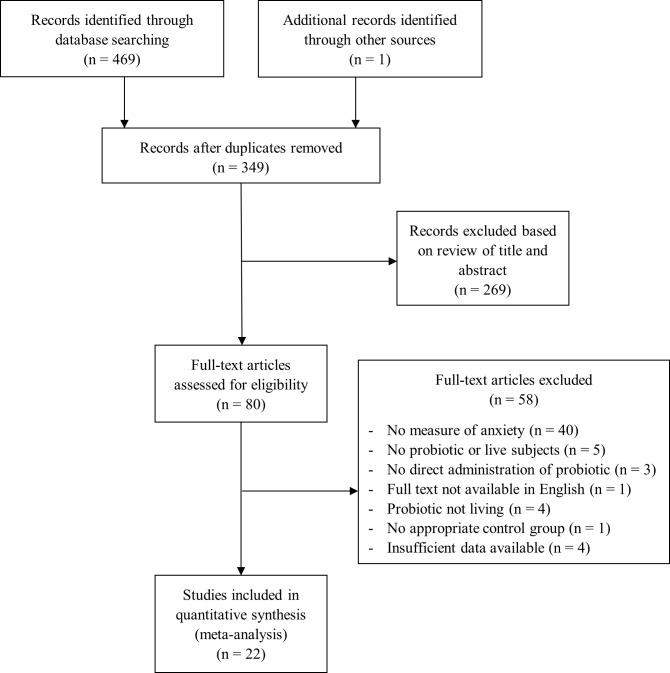
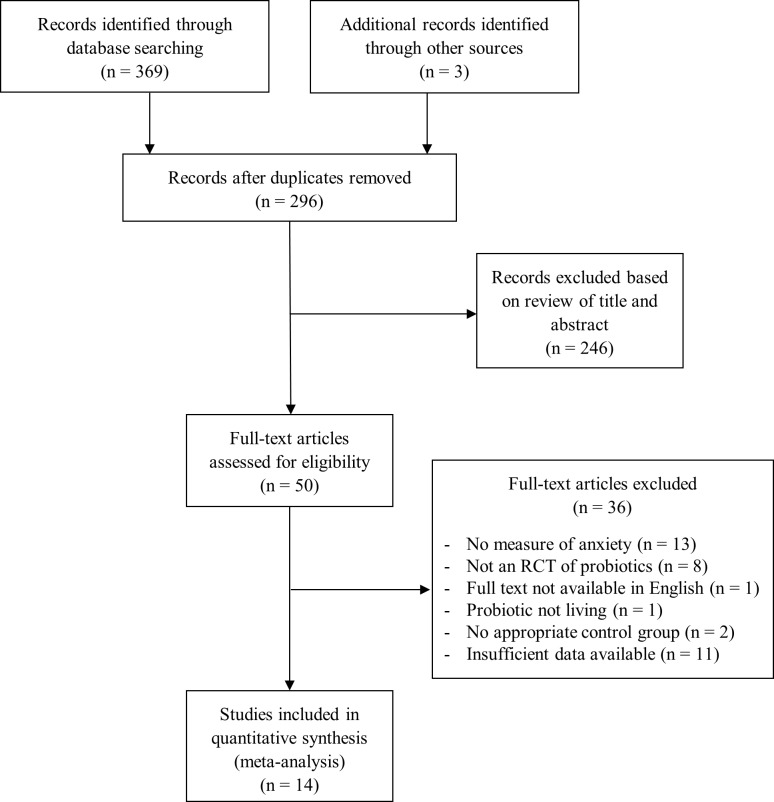
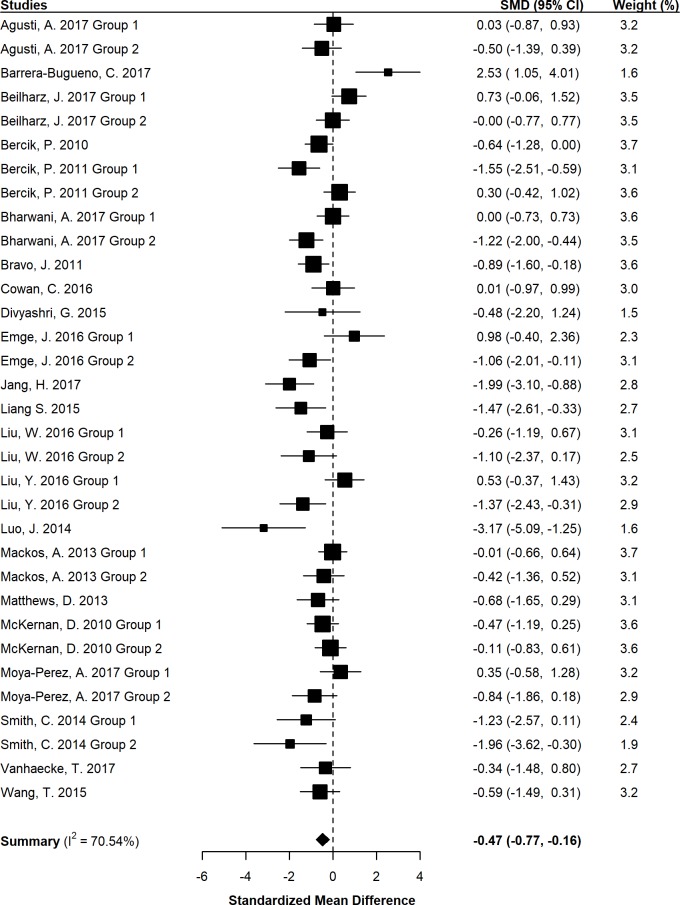
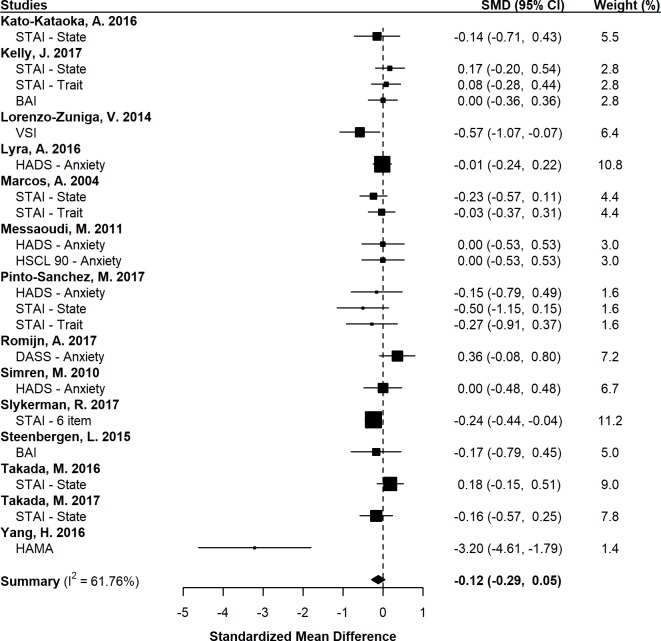
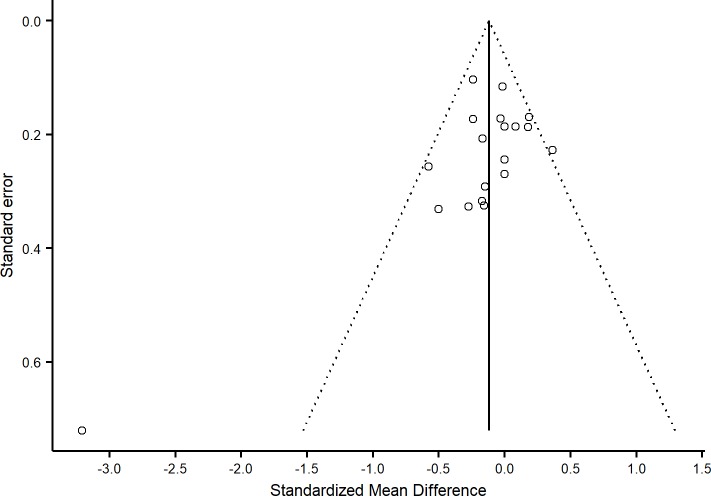
BACKGROUND: Probiotics have generated intensive research interest in recent years as a novel mode of treatment for physical and mental illness. Nevertheless, the anxiolytic potential of probiotics remains unclear. The present systematic review and meta-analysis aimed to evaluate the clinical and preclinical (animal model) evidence regarding the effect of probiotic administration on anxiety. METHODS: The PubMed, PsycINFO, and Web of Science databases were reviewed for preclinical and clinical studies that met the defined inclusion and exclusion criteria. The effects of probiotics on anxiety-like behavior and symptoms of anxiety were analyzed by meta-analyses. Separate subgroup analyses were conducted on diseased versus healthy animals, specific preclinical probiotic species, and clinical versus healthy human samples. RESULTS: Data were extracted from 22 preclinical studies (743 animals) and 14 clinical studies (1527 individuals). Overall, probiotics reduced anxiety-like behavior in animals (Hedges' g = -0.47, 95% CI -0.77 --0.16, p = 0.004). Subgroup analyses revealed a significant reduction only among diseased animals. Probiotic species-level analyses identified only Lactobacillus (L.) rhamnosus as an anxiolytic species, but these analyses were broadly under-powered. Probiotics did not significantly reduce symptoms of anxiety in humans (Hedges' g = -0.12, 95% CI -0.29-0.05, p = 0.151), and did not differentially affect clinical and healthy human samples. CONCLUSIONS: While preclinical (animal) studies suggest that probiotics may help reduce anxiety, such findings have not yet translated to clinical research in humans, perhaps due to the dearth of extant research with clinically anxious populations. Further investigation of probiotic treatment for clinically relevant anxiety is warranted, particularly with respect to the probiotic species L. rhamnosus.
Overview
The claims and statistics of this paper haven’t been checked yet.
Run the check — free, no account needed. It reads the open-access text and checks the sources it cites.
Integrity signals
Registry
Cites
Statistics
Figures
Verification
Claims the paper makes
The claims and statistics of this paper haven’t been checked yet.
Run the check — free, no account needed. It reads the open-access text and checks the sources it cites.
Claims other papers make about this one
Each is checked against this paper’s own text: does it say what the citing paper says it does?
In the citing paper
“More recently, a systematic review and meta-analysis of clinical and pre-clinical literature on the effects of probiotics on anxiety asserted that probiotics may help reduce anxiety [297].”
From International Society of Sports Nutrition Position Stand: Probiotics (2019) · cites this paper as [297]
In the citing paper
“Furthermore, probiotic supplementations, as Lactobacillus rhamnosus (JB-1), in already colonized mice, reduced anxiety- and depression-like behavior in steady-state conditions (92, 93).”
From The gut-brain axis: how microbiota and host inflammasome influence brain physiology and pathology (2020) · cites this paper as [92]
Self-check
Percentages, sums and reported differences re-computed from the paper’s own numbers.
The self-check needs the paper’s full text.
Citations
Cites
R: A Language and Environment for Statistical Computing
R Core Team (2000) · doi:10.32614/r.manuals · Cited by 355,893
Measuring inconsistency in meta-analyses
Higgins, J. P. T., Thompson, S. G., Deeks, J. J., & Altman, D. G. (2003) · BMJ · doi:10.1136/bmj.327.7414.557 · Cited by 63,139
Bias in meta-analysis detected by a simple, graphical test
Egger, M., Smith, G. D., Schneider, M., & Minder, C. (1997) · BMJ · doi:10.1136/bmj.315.7109.629 · Cited by 56,722
The Cochrane Collaboration's tool for assessing risk of bias in randomised trials
Higgins, J. P. T., Altman, D. G., Gotzsche, P. C., Juni, P., Moher, D., Oxman, A. D., Savovic, J., Schulz, K. F., Weeks, L., Sterne, J. A. C., et al. (2011) · BMJ · doi:10.1136/bmj.d5928 · Cited by 33,817
Liberati, A., Altman, D. G., Tetzlaff, J., Mulrow, C., Gøtzsche, P. C., Ioannidis, J. P. A., Clarke, M., Devereaux, P. J., Kleijnen, J., & Moher, D. (2009) · PLoS Medicine · doi:10.1371/journal.pmed.1000100 · Cited by 28,164
Dermyshi, E., Wang, Y., Yan, C., Hong, W., Qiu, G., Gong, X., & Zhang, T. (2017) · Neonatology · doi:10.1159/000454668 · Cited by 24,586
Sterne, J. A. C., Sutton, A. J., Ioannidis, J. P. A., Terrin, N., Jones, D. R., Lau, J., Carpenter, J., Rucker, G., Harbord, R. M., Schmid, C. H., et al. (2011) · BMJ · doi:10.1136/bmj.d4002 · Cited by 7,709
Power failure: why small sample size undermines the reliability of neuroscience
Button, K. S., Ioannidis, J. P. A., Mokrysz, C., Nosek, B. A., Flint, J., Robinson, E. S. J., & Munafò, M. R. (2013) · Nature Reviews Neuroscience · doi:10.1038/nrn3475 · Cited by 7,641
Changes of Intestinal Functions in Liver Cirrhosis
Fukui, H., & Wiest, R. (2016) · Inflammatory Intestinal Diseases · doi:10.1159/000444436 · Cited by 6,820
Diversity, stability and resilience of the human gut microbiota
Lozupone, C. A., Stombaugh, J. I., Gordon, J. I., Jansson, J. K., & Knight, R. (2012) · Nature · doi:10.1038/nature11550 · Cited by 5,533
Cited by
Sorted by citations
The pros, cons, and many unknowns of probiotics
Suez, J., Zmora, N., Segal, E., & Elinav, E. (2019) · Nature Medicine · doi:10.1038/s41591-019-0439-x · Cited by 1,398
The gut-brain axis: how microbiota and host inflammasome influence brain physiology and pathology
Rutsch, A., Kantsjö, J. B., & Ronchi, F. (2020) · Frontiers in Immunology · doi:10.3389/fimmu.2020.604179 · Cited by 821
Liu, R. T., Walsh, R. F. L., & Sheehan, A. E. (2019) · Neuroscience & Biobehavioral Reviews · doi:10.1016/j.neubiorev.2019.03.023 · Cited by 564
Health-Promoting Components in Fermented Foods: An Up-to-Date Systematic Review
Melini, F., Melini, V., Luziatelli, F., Ficca, A. G., & Ruzzi, M. (2019) · Nutrients · doi:10.3390/nu11051189 · Cited by 438
Probiotics and the microbiota-gut-brain axis: Focus on psychiatry
Mörkl, S., Butler, M. I., Holl, A., Cryan, J. F., & Dinan, T. G. (2020) · Current Nutrition Reports · doi:10.1007/s13668-020-00313-5 · Cited by 337
Metadata
- Authors
- Reis, D. J., Ilardi, S. S., & Punt, S. E. W.
- Affiliations
- University of Kansas (US)
- Corresponding author
- Reis, Daniel J.
- Venue
- PLOS ONE
- Publisher
- Public Library of Science (PLoS)
- Published
- 2018-06-20
- Volume
- 13
- Issue
- 6
- Pages
- e0199041
- ISSN
- 1932-6203 (ISSN-L)
- PMC
- PMC6010276
- OpenAlex
- W2809387633
- Cited by
- 123
- References
- 100
- Citations by year
- 2026: 8 · 2025: 18 · 2024: 19 · 2023: 18 · 2022: 13 · 2021: 14 · 2020: 16 · 2019: 14 · 2018: 2
- FWCI
- 1.16
- Type
- journal article
- Language
- en
- Open access
- gold
- doi.org
- Licence
- Locations
- PLoS ONE (publishedVersion, cc-by)
- Europe PMC (PubMed Central) (publishedVersion, cc-by)
- PubMed Central (publishedVersion, cc-by)
- PubMed (publishedVersion)
- RePEc: Research Papers in Economics (submittedVersion)
- DOAJ (DOAJ: Directory of Open Access Journals) (submittedVersion)
- Figshare (submittedVersion, cc-by)
- KU ScholarWorks (University of Kansas) (submittedVersion, cc-by)
- Topics
- Life Sciences › Agricultural and Biological Sciences › Food Science › Probiotics and Fermented Foods
- Health Sciences › Medicine › Complementary and alternative medicine › Medicinal Plant Extracts Effects
- Health Sciences › Medicine › Gastroenterology › Gastrointestinal motility and disorders
- Keywords
- probiotics, anxiety, anxiolytic effects, anxiety-like behavior, Lactobacillus rhamnosus, clinical anxiety, animal models of anxiety, gut microbiota, translational research
- MeSH terms
- Animals, Anxiety, Anxiety Disorders, Drug Evaluation, Preclinical, Exploratory Behavior, Female, Humans, Male, Research Design, Species Specificity, Anti-Anxiety Agents, Randomized Controlled Trials as Topic, Maze Learning, Probiotics, Mice, Rats, Lacticaseibacillus rhamnosus
About these checks
Registry, retraction, Cites and statistics results are computed, not judged, with one exception: a printed reference that no index lists is read once by a model before it counts as a citation error. Claims are extracted by a model and kept only when their quote appears verbatim in the text; each cited source is then checked, with a model’s help, for whether it says what the claim relies on. Those verdicts can be wrong — read the claim’s quote and the cited source before relying on one.
Statistics and arithmetic are recomputed, not judged.
Confidence bands are shown only for fields calibrated on our annotated test set. None is calibrated yet, so no band is shown.
What counts as a claim ›How we measure confidence ›How we check this ›
Are you an author, or do you see a problem with this page? Request a review
