

The DOI matches its Crossref record; 43 of the 45 references it cites were found in a registry or an index.
Questionable research practices in ecology and evolution
Open accessPublished version of a preprint
Abstract
We surveyed 807 researchers (494 ecologists and 313 evolutionary biologists) about their use of Questionable Research Practices (QRPs), including cherry picking statistically significant results, p hacking, and hypothesising after the results are known (HARKing). We also asked them to estimate the proportion of their colleagues that use each of these QRPs. Several of the QRPs were prevalent within the ecology and evolution research community. Across the two groups, we found 64% of surveyed researchers reported they had at least once failed to report results because they were not statistically significant (cherry picking); 42% had collected more data after inspecting whether results were statistically significant (a form of p hacking) and 51% had reported an unexpected finding as though it had been hypothesised from the start (HARKing). Such practices have been directly implicated in the low rates of reproducible results uncovered by recent large scale replication studies in psychology and other disciplines. The rates of QRPs found in this study are comparable with the rates seen in psychology, indicating that the reproducibility problems discovered in psychology are also likely to be present in ecology and evolution.
Overview
The claims and statistics of this paper haven’t been checked yet.
Run the check — free, no account needed. It reads the open-access text and checks the sources it cites.
Integrity signals
Registry
Cites
Statistics
Figures
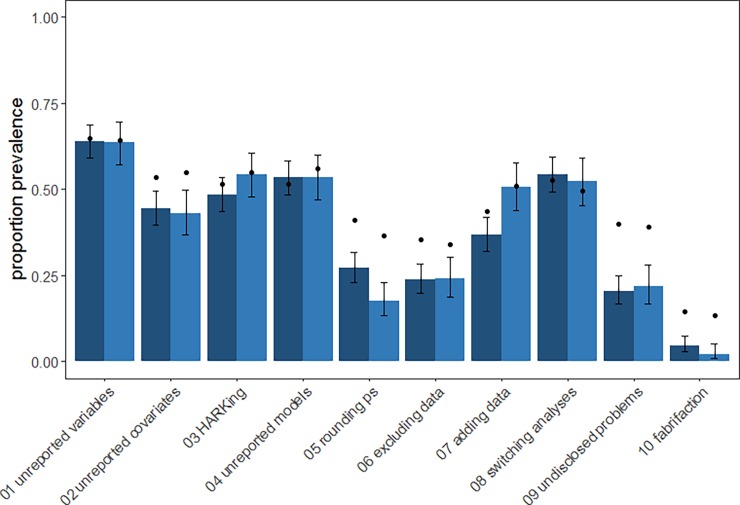
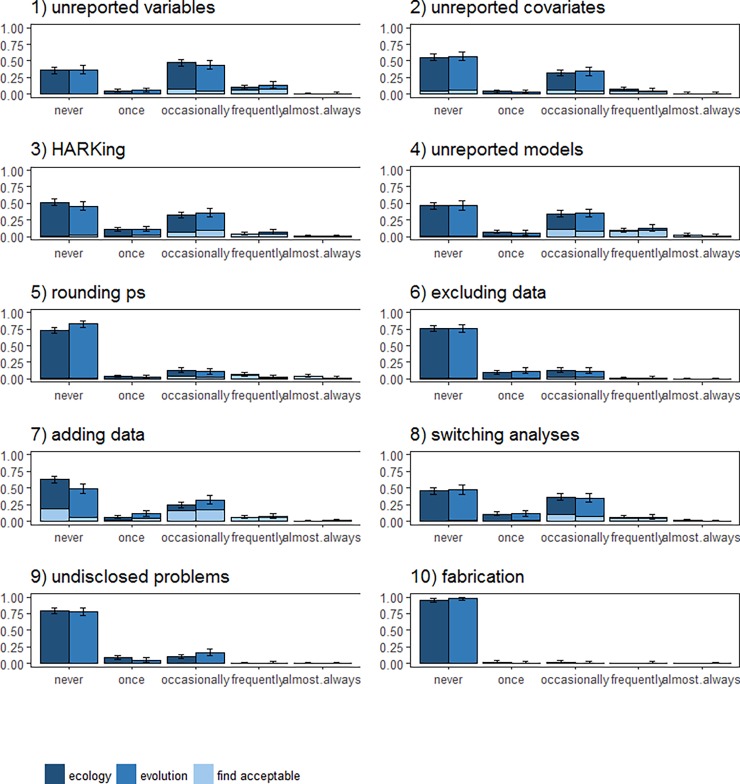
Verification
Claims the paper makes
The claims and statistics of this paper haven’t been checked yet.
Run the check — free, no account needed. It reads the open-access text and checks the sources it cites.
Claims other papers make about this one
Each is checked against this paper’s own text: does it say what the citing paper says it does?
The source backs part of the claim, not all of it — or backs it for a different population, condition or comparison.
In the citing paper
“however, researchers are often unfamiliar with the much larger systemic bias in the publication of research and in the reliability of certain findings and even of entire fields [33, 38–40].”
From The ARRIVE guidelines 2.0: Updated guidelines for reporting animal research (2020) · cites this paper as [39]
Experimental — accuracy not yet measured
Self-check
Percentages, sums and reported differences re-computed from the paper’s own numbers.
The self-check needs the paper’s full text.
Citations
Cites
R: A Language and Environment for Statistical Computing
R Core Team (2000) · doi:10.32614/r.manuals · Cited by 355,893
ggplot2: Elegant Graphics for Data Analysis
Wickham, H. (2009) · doi:10.1007/978-0-387-98141-3 · Cited by 14,447
Why Most Published Research Findings Are False
Ioannidis, J. P. A. (2005) · PLoS Medicine · doi:10.1371/journal.pmed.0020124 · Cited by 10,505
Estimating the reproducibility of psychological science
Open Science Collaboration (2015) · Science · doi:10.1126/science.aac4716 · Cited by 8,515
Simmons, J. P., Nelson, L. D., & Simonsohn, U. (2011) · Psychological Science · doi:10.1177/0956797611417632 · Cited by 6,567
Why Most Published Research Findings Are False
Ioannidis, J. P. A. (2005) · CHANCE · doi:10.1080/09332480.2005.10722754 · Cited by 4,702 · cited 1×
“However, the link between QRPs and irreproducibility is rooted in fundamental statistical theory [30] and so even in the absence of direct replication measures, a high prevalence of QRPs should alone raise sufficient concern to trigger editorial and institutional action.”
BackgroundMeasuring the Prevalence of Questionable Research Practices With Incentives for Truth Telling
John, L. K., Loewenstein, G., & Prelec, D. (2012) · Psychological Science · doi:10.1177/0956797611430953 · Cited by 2,239
A farewell to Bonferroni: the problems of low statistical power and publication bias
Nakagawa, S. (2004) · Behavioral Ecology · doi:10.1093/beheco/arh107 · Cited by 2,102
Self-citationThe preregistration revolution
Nosek, B. A., Ebersole, C. R., DeHaven, A. C., & Mellor, D. T. (2018) · Proceedings of the National Academy of Sciences · doi:10.1073/pnas.1708274114 · Cited by 1,998
HARKing: Hypothesizing after the results are known
Kerr, N. L. (1998) · Personality and Social Psychology Review · doi:10.1207/s15327957pspr0203_4 · Cited by 1,989
Pashler, H., & Wagenmakers, E. (2012) · Perspectives on Psychological Science · doi:10.1177/1745691612465253 · Cited by 1,321
Negative results are disappearing from most disciplines and countries
Fanelli, D. (2012) · Scientometrics · doi:10.1007/s11192-011-0494-7 · Cited by 1,248
Forstmeier, W., & Schielzeth, H. (2010) · Behavioral Ecology and Sociobiology · doi:10.1007/s00265-010-1038-5 · Cited by 1,154
The economics of reproducibility in preclinical research
Freedman, L. P., Cockburn, I. M., & Simcoe, T. S. (2015) · PLOS Biology · doi:10.1371/journal.pbio.1002165 · Cited by 1,055
An Agenda for Purely Confirmatory Research
Wagenmakers, E.-J., Wetzels, R., Borsboom, D., van der Maas, H. L. J., & Kievit, R. A. (2012) · Perspectives on Psychological Science · doi:10.1177/1745691612463078 · Cited by 1,042
Sterling, T. D. (1959) · Journal of the American Statistical Association · doi:10.1080/01621459.1959.10501497 · Cited by 964 · cited 2×
“The bias exists in many sciences [22], has been documented for decades in some disciplines (e.g., in psychology, see Sterling, 1959 [23]) and may be getting stronger across science, with a detectable increase in the proportion statistically significant results over the last 25 years [24].”
BackgroundThe natural selection of bad science
Smaldino, P. E., & McElreath, R. (2016) · Royal Society Open Science · doi:10.1098/rsos.160384 · Cited by 860
“Positive” results increase down the Hierarchy of the Sciences
Fanelli, D. (2010) · PLoS ONE · doi:10.1371/journal.pone.0010068 · Cited by 734
Sterling, T. D. (1959) · Journal of the American Statistical Association · doi:10.2307/2282137 · Cited by 524
Detecting and avoiding likely false‐positive findings – a practical guide
Forstmeier, W., Wagenmakers, E., & Parker, T. H. (2017) · Biological Reviews · doi:10.1111/brv.12315 · Cited by 436
Self-citationPublic Data Archiving in Ecology and Evolution: How Well Are We Doing?
Roche, D. G., Kruuk, L. E. B., Lanfear, R., & Binning, S. A. (2015) · PLOS Biology · doi:10.1371/journal.pbio.1002295 · Cited by 303
Data archiving in ecology and evolution: best practices
Whitlock, M. C. (2010) · Trends in Ecology & Evolution · doi:10.1016/j.tree.2010.11.006 · Cited by 283
Questionable Research Practices Revisited
Fiedler, K., & Schwarz, N. (2016) · Social Psychological and Personality Science · doi:10.1177/1948550615612150 · Cited by 279
The Chrysalis Effect: How Ugly Initial Results Metamorphosize Into Beautiful Articles
O’Boyle, E. H., Banks, G. C., & Gonzalez-Mulé, E. (2017) · Journal of Management · doi:10.1177/0149206314527133 · Cited by 246
Dynamic response of RNA editing to temperature in Drosophila
Rieder, L. E., Savva, Y. A., Reyna, M. A., Chang, Y.-J., Dorsky, J. S., Rezaei, A., & Reenan, R. A. (2015) · BMC Biology · doi:10.1186/s12915-014-0111-3 · Cited by 243
Publication bias in ecology and evolution: an empirical assessment using the ‘trim and fill’ method
JENNIONS, M. D., & MØLLER, A. P. (2002) · Biological Reviews · doi:10.1017/s1464793101005875 · Cited by 230
The Preregistration RevolutionPreprint
Nosek, B. A., Ebersole, C. R., DeHaven, A. C., & Mellor, D. T. (2017) · OSF Preprints (OSF Preprints) · doi:10.31219/osf.io/2dxu5 · Cited by 220
The "File Drawer Problem" of Non-Significant Results: Does It Apply to Biological Research?
Csada, R. D., James, P. C., & Espie, R. H. M. (1996) · Oikos · doi:10.2307/3546355 · Cited by 204
Transparency in Ecology and Evolution: Real Problems, Real Solutions
Parker, T. H., Forstmeier, W., Koricheva, J., Fidler, F., Hadfield, J. D., Chee, Y. E., Kelly, C. D., Gurevitch, J., & Nakagawa, S. (2016) · Trends in Ecology & Evolution · doi:10.1016/j.tree.2016.07.002 · Cited by 201
Self-citationQuestionable research practices among italian research psychologists
Agnoli, F., Wicherts, J. M., Veldkamp, C. L. S., Albiero, P., & Cubelli, R. (2017) · PLoS ONE · doi:10.1371/journal.pone.0172792 · Cited by 173
Kelly, C. D. (2006) · The Quarterly Review of Biology · doi:10.1086/506236 · Cited by 154
Schwab, A., Abrahamson, E., Starbuck, W. H., & Fidler, F. M. (2010) · Organization Science · doi:10.1287/orsc.1100.0557 · Cited by 129
Self-citationArchiving Primary Data: Solutions for Long-Term Studies
Mills, J. A., Teplitsky, C., Arroyo, B., Charmantier, A., Becker, P. H., Birkhead, T. R., Bize, P., Blumstein, D. T., Bonenfant, C., Boutin, S. A., et al. (2015) · Trends in Ecology & Evolution · doi:10.1016/j.tree.2015.07.006 · Cited by 120
Self-citationNakagawa, S., & Parker, T. H. (2015) · BMC Biology · doi:10.1186/s12915-015-0196-3 · Cited by 110
Self-citationLeBel, E. P., Borsboom, D., Giner‐Sorolla, R., Hasselman, F., Peters, K. R., Ratliff, K. A., & Smith, C. T. (2013) · Perspectives on Psychological Science · doi:10.1177/1745691613491437 · Cited by 106
Metaresearch for Evaluating Reproducibility in Ecology and Evolution
Fidler, F. M., Chee, Y. E., Wintle, B. C., Burgman, M. A., Mccarthy, M. A., & Gordon, A. (2016) · BioScience · doi:10.1093/biosci/biw159 · Cited by 106
Self-citationElevating The Status of Code in Ecology
Mislan, K. A. S., Heer, J., & White, E. P. (2015) · Trends in Ecology & Evolution · doi:10.1016/j.tree.2015.11.006 · Cited by 85
Striving for transparent and credible research: practical guidelines for behavioral ecologists
Ihle, M., Winney, I. S., Krystalli, A., & Croucher, M. (2017) · Behavioral Ecology · doi:10.1093/beheco/arx003 · Cited by 72
A survey of publication bias within evolutionary ecology
Cassey, P., Ewen, J. G., Blackburn, T. M., & Møller, A. P. (2004) · Proceedings of the Royal Society B Biological Sciences · doi:10.1098/rsbl.2004.0218 · Cited by 48
Empowering peer reviewers with a checklist to improve transparency
Parker, T. H., Griffith, S. C., Bronstein, J. L., Fidler, F. M., Foster, S., Fraser, H. S., Forstmeier, W., Gurevitch, J., Koricheva, J., Seppelt, R., et al. (2018) · Nature Ecology & Evolution · doi:10.1038/s41559-018-0545-z · Cited by 43
Self-citationWould Ecology Fail the Repeatability Test?
Schnitzer, S. A., & Carson, W. P. (2016) · BioScience · doi:10.1093/biosci/biv176 · Cited by 35
Mitigating the epidemic of type I error: ecology and evolution can learn from other disciplines
Parker, T. H., & Nakagawa, S. (2014) · Frontiers in Ecology and Evolution · doi:10.3389/fevo.2014.00076 · Cited by 12
Self-citationPreregistration and increased transparency will benefit science
Mellor, D. T. (2017) · European Science Editing · doi:10.31219/osf.io/xsfam · Cited by 3
Research works printed but not linked: 2
- Reuters T. Thomson Reuters Research Analytics Unveils 2013 Edition of Its Journal Citation Reports. PR Newswire. Ipswich, MA; 2013.
- G Schneider, 2017, NSM3: Functions and Datasets to Accompany Hollander, Wolfe, and Chicken, Nonparametric Statistical Methods
Cited by
Sorted by citations
The ARRIVE guidelines 2.0: Updated guidelines for reporting animal research
Percie du Sert, N., Hurst, V., Ahluwalia, A., Alam, S., Avey, M. T., Baker, M., Browne, W. J., Clark, A., Cuthill, I. C., Dirnagl, U., et al. (2020) · PLOS Biology · doi:10.1371/journal.pbio.3000410 · Cited by 5,939
The ARRIVE guidelines 2.0: Updated guidelines for reporting animal research
du Sert, N. P., Hurst, V., Ahluwalia, A., Alam, S., Avey, M. T., Baker, M., Browne, W. J., Clark, A., Cuthill, I. C., Dirnagl, U., et al. (2020) · Experimental Physiology · doi:10.1113/ep088870 · Cited by 3,547
The ARRIVE guidelines 2.0: Updated guidelines for reporting animal research*
Percie du Sert, N., Hurst, V., Ahluwalia, A., Alam, S., Avey, M. T., Baker, M., Browne, W. J., Clark, A., Cuthill, I. C., Dirnagl, U., et al. (2020) · Journal of Cerebral Blood Flow & Metabolism · doi:10.1177/0271678x20943823 · Cited by 1,443
The ARRIVE guidelines 2.0: Updated guidelines for reporting animal research
du Sert, N. P., Hurst, V., Ahluwalia, A., Alam, S., Avey, M. T., Baker, M., Browne, W. J., Clark, A., Cuthill, I. C., Dirnagl, U., et al. (2020) · British Journal of Pharmacology · doi:10.1111/bph.15193 · Cited by 1,152
The ARRIVE guidelines 2019: updated guidelines for reporting animal researchPreprint
du Sert, N. P., Hurst, V., Ahluwalia, A., Alam, S., Avey, M. T., Baker, M., Browne, W. J., Clark, A., Cuthill, I. C., Dirnagl, U., et al. (2019) · bioRxiv (Cold Spring Harbor Laboratory) · doi:10.1101/703181 · Cited by 1,044
Metadata
- Authors
- Fraser, H., Parker, T., Nakagawa, S., Barnett, A., & Fidler, F.
- Affiliations
- The University of Melbourne (AU)
- Whitman College (US)
- UNSW Sydney (AU)
- Corresponding author
- Fraser, Hannah
- Venue
- PLOS ONE
- Publisher
- Public Library of Science (PLoS)
- Published
- 2018-07-16
- Volume
- 13
- Issue
- 7
- Pages
- e0200303
- ISSN
- 1932-6203 (ISSN-L)
- PMC
- PMC6047784
- OpenAlex
- W2793861965
- Cited by
- 346
- References
- 45
- Citations by year
- 2026: 17 · 2025: 29 · 2024: 42 · 2023: 51 · 2022: 37 · 2021: 51 · 2020: 57 · 2019: 45 · 2018: 15
- FWCI
- 83.45
- Type
- journal article
- Language
- en
- Open access
- gold
- doi.org
- Licence
- Locations
- PLoS ONE (publishedVersion, cc-by)
- Europe PMC (PubMed Central) (publishedVersion, cc-by)
- PubMed Central (publishedVersion, cc-by)
- PubMed (publishedVersion)
- EcoEvoRxiv (submittedVersion, cc-by)
- RePEc: Research Papers in Economics (submittedVersion)
- DOAJ (DOAJ: Directory of Open Access Journals) (submittedVersion, cc-by-sa)
- Figshare (submittedVersion, cc-by)
- Minerva Access (University of Melbourne) (submittedVersion, cc-by)
- EcoEvoRxiv (submittedVersion)
- OSF Preprints (OSF Preprints) (submittedVersion)
- Funders
- Australian Research Council Future Fellowship (FT150100297)
- Topics
- Social Sciences › Education › Academic integrity and plagiarism
- Social Sciences › Decision Sciences › Statistics, Probability and Uncertainty › Meta-analysis and systematic reviews
- Social Sciences › Library and Information Sciences › Academic Publishing and Open Access
- Keywords
- questionable research practices, cherry-picking, p-hacking, HARKing, research integrity, reproducibility, ecology, evolutionary biology, replication study, statistical significance
- MeSH terms
- Ecology, Biological Evolution, Humans, Surveys and Questionnaires, Research, Research Design, Research Personnel, Statistics as Topic, Reproducibility of Results, Scientific Misconduct
About these checks
Registry, retraction, Cites and statistics results are computed, not judged, with one exception: a printed reference that no index lists is read once by a model before it counts as a citation error. Claims are extracted by a model and kept only when their quote appears verbatim in the text; each cited source is then checked, with a model’s help, for whether it says what the claim relies on. Those verdicts can be wrong — read the claim’s quote and the cited source before relying on one.
Statistics and arithmetic are recomputed, not judged.
Confidence bands are shown only for fields calibrated on our annotated test set. None is calibrated yet, so no band is shown.
What counts as a claim ›How we measure confidence ›How we check this ›
Are you an author, or do you see a problem with this page? Request a review
