

The DOI matches its Crossref record; 43 of the 45 references it cites were found in a registry or an index.
Questionable research practices in ecology and evolution
Open accessPublished version of a preprint
Abstract
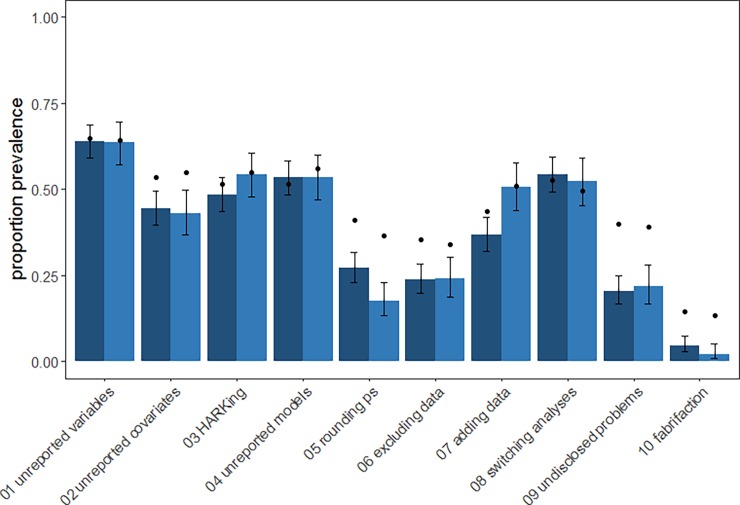
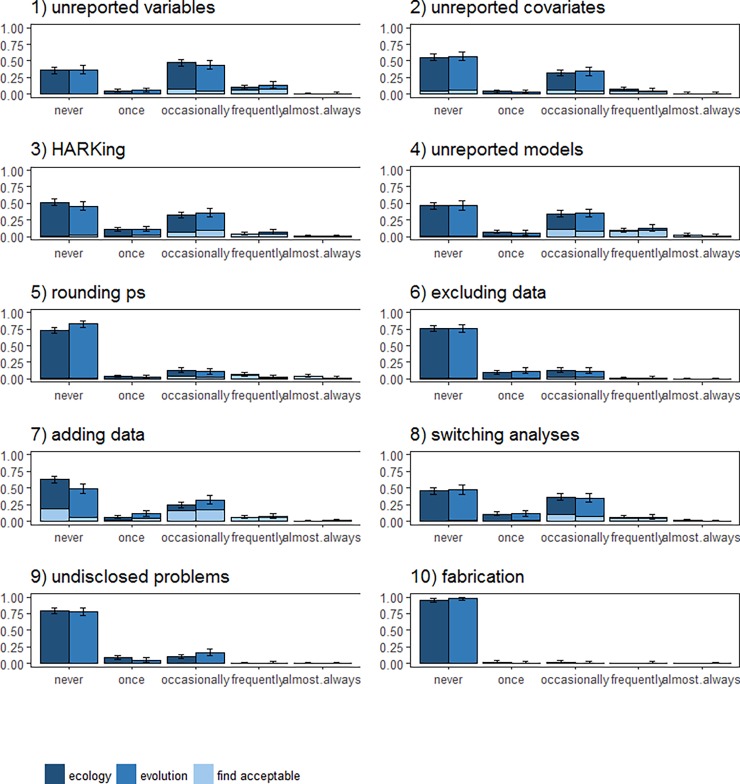
We surveyed 807 researchers (494 ecologists and 313 evolutionary biologists) about their use of Questionable Research Practices (QRPs), including cherry picking statistically significant results, p hacking, and hypothesising after the results are known (HARKing). We also asked them to estimate the proportion of their colleagues that use each of these QRPs. Several of the QRPs were prevalent within the ecology and evolution research community. Across the two groups, we found 64% of surveyed researchers reported they had at least once failed to report results because they were not statistically significant (cherry picking); 42% had collected more data after inspecting whether results were statistically significant (a form of p hacking) and 51% had reported an unexpected finding as though it had been hypothesised from the start (HARKing). Such practices have been directly implicated in the low rates of reproducible results uncovered by recent large scale replication studies in psychology and other disciplines. The rates of QRPs found in this study are comparable with the rates seen in psychology, indicating that the reproducibility problems discovered in psychology are also likely to be present in ecology and evolution.
Overview
The claims and statistics of this paper haven’t been checked yet.
Run the check — free, no account needed. It reads the open-access text and checks the sources it cites.
Integrity signals
Registry
Cites
Statistics
Figures
Verification
Claims the paper makes
The claims and statistics of this paper haven’t been checked yet.
Run the check — free, no account needed. It reads the open-access text and checks the sources it cites.
Claims other papers make about this one
Each is checked against this paper’s own text: does it say what the citing paper says it does?
The source backs part of the claim, not all of it — or backs it for a different population, condition or comparison.
In the citing paper
“however, researchers are often unfamiliar with the much larger systemic bias in the publication of research and in the reliability of certain findings and even of entire fields [33, 38–40].”
From The ARRIVE guidelines 2.0: Updated guidelines for reporting animal research (2020) · cites this paper as [39]
Experimental — accuracy not yet measured
Self-check
Percentages, sums and reported differences re-computed from the paper’s own numbers.
The self-check needs the paper’s full text.
Citations
Cites
R: A Language and Environment for Statistical Computing
R Core Team (2000) · doi:10.32614/r.manuals · Cited by 355,893
ggplot2: Elegant Graphics for Data Analysis
Wickham, H. (2009) · doi:10.1007/978-0-387-98141-3 · Cited by 14,447
Why Most Published Research Findings Are False
Ioannidis, J. P. A. (2005) · PLoS Medicine · doi:10.1371/journal.pmed.0020124 · Cited by 10,505
Estimating the reproducibility of psychological science
Open Science Collaboration (2015) · Science · doi:10.1126/science.aac4716 · Cited by 8,515
Simmons, J. P., Nelson, L. D., & Simonsohn, U. (2011) · Psychological Science · doi:10.1177/0956797611417632 · Cited by 6,567
Why Most Published Research Findings Are False
Ioannidis, J. P. A. (2005) · CHANCE · doi:10.1080/09332480.2005.10722754 · Cited by 4,702 · cited 1×
“However, the link between QRPs and irreproducibility is rooted in fundamental statistical theory [30] and so even in the absence of direct replication measures, a high prevalence of QRPs should alone raise sufficient concern to trigger editorial and institutional action.”
BackgroundMeasuring the Prevalence of Questionable Research Practices With Incentives for Truth Telling
John, L. K., Loewenstein, G., & Prelec, D. (2012) · Psychological Science · doi:10.1177/0956797611430953 · Cited by 2,239
A farewell to Bonferroni: the problems of low statistical power and publication bias
Nakagawa, S. (2004) · Behavioral Ecology · doi:10.1093/beheco/arh107 · Cited by 2,102
Self-citationThe preregistration revolution
Nosek, B. A., Ebersole, C. R., DeHaven, A. C., & Mellor, D. T. (2018) · Proceedings of the National Academy of Sciences · doi:10.1073/pnas.1708274114 · Cited by 1,998
HARKing: Hypothesizing after the results are known
Kerr, N. L. (1998) · Personality and Social Psychology Review · doi:10.1207/s15327957pspr0203_4 · Cited by 1,989
Research works printed but not linked: 2
- Reuters T. Thomson Reuters Research Analytics Unveils 2013 Edition of Its Journal Citation Reports. PR Newswire. Ipswich, MA; 2013.
- G Schneider, 2017, NSM3: Functions and Datasets to Accompany Hollander, Wolfe, and Chicken, Nonparametric Statistical Methods
Cited by
Sorted by citations
The ARRIVE guidelines 2.0: Updated guidelines for reporting animal research
Percie du Sert, N., Hurst, V., Ahluwalia, A., Alam, S., Avey, M. T., Baker, M., Browne, W. J., Clark, A., Cuthill, I. C., Dirnagl, U., et al. (2020) · PLOS Biology · doi:10.1371/journal.pbio.3000410 · Cited by 5,939
The ARRIVE guidelines 2.0: Updated guidelines for reporting animal research
du Sert, N. P., Hurst, V., Ahluwalia, A., Alam, S., Avey, M. T., Baker, M., Browne, W. J., Clark, A., Cuthill, I. C., Dirnagl, U., et al. (2020) · Experimental Physiology · doi:10.1113/ep088870 · Cited by 3,547
The ARRIVE guidelines 2.0: Updated guidelines for reporting animal research*
Percie du Sert, N., Hurst, V., Ahluwalia, A., Alam, S., Avey, M. T., Baker, M., Browne, W. J., Clark, A., Cuthill, I. C., Dirnagl, U., et al. (2020) · Journal of Cerebral Blood Flow & Metabolism · doi:10.1177/0271678x20943823 · Cited by 1,443
The ARRIVE guidelines 2.0: Updated guidelines for reporting animal research
du Sert, N. P., Hurst, V., Ahluwalia, A., Alam, S., Avey, M. T., Baker, M., Browne, W. J., Clark, A., Cuthill, I. C., Dirnagl, U., et al. (2020) · British Journal of Pharmacology · doi:10.1111/bph.15193 · Cited by 1,152
The ARRIVE guidelines 2019: updated guidelines for reporting animal researchPreprint
du Sert, N. P., Hurst, V., Ahluwalia, A., Alam, S., Avey, M. T., Baker, M., Browne, W. J., Clark, A., Cuthill, I. C., Dirnagl, U., et al. (2019) · bioRxiv (Cold Spring Harbor Laboratory) · doi:10.1101/703181 · Cited by 1,044
O’Dea, R. E., Lagisz, M., Jennions, M. D., Koricheva, J., Noble, D. W. A., Parker, T. H., Gurevitch, J., Page, M. J., Stewart, G. B., Moher, D., et al. (2021) · Biological reviews/Biological reviews of the Cambridge Philosophical Society · doi:10.1111/brv.12721 · Cited by 825
Self-citationRewriting results sections in the language of evidence
Muff, S., Nilsen, E. B., O’Hara, R. B., & Nater, C. R. (2021) · Trends in Ecology & Evolution · doi:10.1016/j.tree.2021.10.009 · Cited by 675
The ARRIVE guidelines 2.0: updated guidelines for reporting animal research
du Sert, N. P., Hurst, V., Ahluwalia, A., Alam, S., Avey, M. T., Baker, M., Browne, W. J., Clark, A., Cuthill, I. C., Dirnagl, U., et al. (2020) · The Journal of Physiology · doi:10.1113/jp280389 · Cited by 633
The ARRIVE guidelines 2.0: Updated guidelines for reporting animal research
du Sert, N. P., Hurst, V., Ahluwalia, A., Alam, S., Avey, M. T., Baker, M., Browne, W. J., Clark, A., Cuthill, I. C., Dirnagl, U., et al. (2020) · BMC Veterinary Research · doi:10.1186/s12917-020-02451-y · Cited by 531
The past, present and future of Registered Reports
Chambers, C. D., & Tzavella, L. (2021) · Nature Human Behaviour · doi:10.1038/s41562-021-01193-7 · Cited by 499
An Excess of Positive Results: Comparing the Standard Psychology Literature With Registered Reports
Scheel, A. M., Schijen, M., & Lakens, D. (2021) · Advances in Methods and Practices in Psychological Science · doi:10.1177/25152459211007467 · Cited by 417
Addressing context dependence in ecology
Catford, J. A., Wilson, J. R., Pyšek, P., Hulme, P. E., & Duncan, R. P. (2021) · Trends in Ecology & Evolution · doi:10.1016/j.tree.2021.09.007 · Cited by 367
du Sert, N. P., Hurst, V., Ahluwalia, A., Alam, S., Avey, M. T., Baker, M., Browne, W. J., Clark, A., Cuthill, I. C., Dirnagl, U., et al. (2020) · BMJ Open Science · doi:10.1136/bmjos-2020-100115 · Cited by 309
Xie, Y., Wang, K., & Kong, Y. (2021) · Science and Engineering Ethics · doi:10.1007/s11948-021-00314-9 · Cited by 205
Reducing bias, increasing transparency and calibrating confidence with preregistration
Hardwicke, T. E., & Wagenmakers, E. (2023) · Nature Human Behaviour · doi:10.1038/s41562-022-01497-2 · Cited by 205
Lessons From Pinocchio: Cues to Deception May Be Highly Exaggerated
Luke, T. J. (2019) · Perspectives on Psychological Science · doi:10.1177/1745691619838258 · Cited by 174
The ConTraSt database for analysing and comparing empirical studies of consciousness theories
Yaron, I., Melloni, L., Pitts, M., & Mudrik, L. (2022) · Nature Human Behaviour · doi:10.1038/s41562-021-01284-5 · Cited by 147
The replicability crisis and public trust in psychological science
Anvari, F., & Lakens, D. (2018) · Comprehensive Results in Social Psychology · doi:10.1080/23743603.2019.1684822 · Cited by 163
Evidence of questionable research practices in clinical prediction models
White, N. M., Parsons, R., Collins, P. G. S., & Barnett, A. G. (2023) · BMC Medicine · doi:10.1186/s12916-023-03048-6 · Cited by 149
Self-citationKarakochuk, C. D., Hess, S. Y., Moorthy, D., Namaste, S. M. L., Parker, M., Rappaport, A. I., Wegmüller, R., Dary, O., & the HEmoglobin MEasurement (HEME) Working Group (2019) · Annals of the New York Academy of Sciences · doi:10.1111/nyas.14003 · Cited by 151
Caldwell, A. R., Vigotsky, A. D., Nuckols, G. L., Boardley, I. D., Schmidt, J., Tenan, M. S., Škarabot, J., Radel, R., Naughton, M. R., Schoenfeld, B. J., et al. (2020) · Sports Medicine · doi:10.1007/s40279-019-01227-1 · Cited by 125
Modernizing the Bradford Hill criteria for assessing causal relationships in observational data
Cox, L. A. (2018) · Critical Reviews in Toxicology · doi:10.1080/10408444.2018.1518404 · Cited by 107
Isbell, D. R., BROWN, D., Chen, M., Derrick, D. J., Ghanem, R., Arvizu, M. N. G., Schnur, E., Zhang, M., & Plonsky, L. (2022) · Modern Language Journal · doi:10.1111/modl.12760 · Cited by 108
Meta-analysis challenges a textbook example of status signalling and demonstrates publication bias
Sánchez‐Tójar, A., Nakagawa, S., Sánchez-Fortún, M., Martin, D. A., Ramani, S., Girndt, A., Bókony, V., Kempenaers, B., Liker, A., Westneat, D. F., et al. (2018) · eLife · doi:10.7554/elife.37385 · Cited by 99
Self-citationBoth Questionable and Open Research Practices Are Prevalent in Education Research
Makel, M. C., Hodges, J., Cook, B. G., & Plucker, J. A. (2021) · Educational Researcher · doi:10.3102/0013189x211001356 · Cited by 97
Replications in Comparative Cognition: What Should We Expect and How Can We Improve?
Farrar, B. G., Boeckle, M., & Clayton, N. S. (2020) · Animal Behavior and Cognition · doi:10.26451/abc.07.01.02.2020 · Cited by 90
Casagrande, S., Stier, A., Monaghan, P., Loveland, J. L., Boner, W., Lupi, S., Trevisi, R., & Hau, M. (2020) · Journal of Experimental Biology · doi:10.1242/jeb.222513 · Cited by 89
Where Are the Self-Correcting Mechanisms in Science?
Vazire, S., & Holcombe, A. O. (2022) · Review of General Psychology · doi:10.1177/10892680211033912 · Cited by 81
Why and how we should join the shift from significance testing to estimation
Berner, D., & Amrhein, V. (2022) · Journal of Evolutionary Biology · doi:10.1111/jeb.14009 · Cited by 87
A protocol for reproducible functional diversity analyses
Palacio, F. X., Callaghan, C. T., Cardoso, P., Hudgins, E. J., Jarzyna, M. A., Ottaviani, G., Riva, F., Graco‐Roza, C., Shirey, V. M., & Mammola, S. (2022) · Ecography · doi:10.1111/ecog.06287 · Cited by 79
Prevalence of visual snow syndrome in the UK
Kondziella, D., Olsen, M. H., & Dreier, J. P. (2020) · European Journal of Neurology · doi:10.1111/ene.14150 · Cited by 82
The power of forecasts to advance ecological theory
Lewis, A. S. L., Rollinson, C. R., Allyn, A., Ashander, J., Brodie, S. J., Brookson, C. B., Collins, E. L., Dietze, M. C., Gallinat, A. S., Juvigny‐Khenafou, N. P. D., et al. (2022) · Methods in Ecology and Evolution · doi:10.1111/2041-210x.13955 · Cited by 87
Nakagawa, S., Ivimey‐Cook, E. R., Grainger, M., O’Dea, R. E., Burke, S., Drobniak, S. M., Gould, E., Macartney, E. L., Martinig, A. R., Morrison, K., et al. (2023) · Nature Communications · doi:10.1038/s41467-023-37039-1 · Cited by 76
Self-citationThe role of replication studies in ecology
Fraser, H. S., Barnett, A., Parker, T. H., & Fidler, F. M. (2020) · Ecology and Evolution · doi:10.1002/ece3.6330 · Cited by 74
Self-citationStudy preregistration: An evaluation of a method for transparent reporting
Toth, A. A., Banks, G. C., Mellor, D., O’Boyle, E. H., Dickson, A., Davis, D. J., DeHaven, A., Bochantin, J., & Borns, J. (2021) · Journal of Business and Psychology · doi:10.1007/s10869-020-09695-3 · Cited by 73
Towards open, reliable, and transparent ecology and evolutionary biology
O’Dea, R. E., Parker, T. H., Chee, Y. E., Čulina, A., Drobniak, S. M., Duncan, D. H., Fidler, F. M., Gould, E., Ihle, M., Kelly, C. D., et al. (2021) · BMC Biology · doi:10.1186/s12915-021-01006-3 · Cited by 82
Self-citationEmpirical evidence of widespread exaggeration bias and selective reporting in ecology
Kimmel, K. A., Avolio, M. L., & Ferraro, P. J. (2023) · Nature Ecology & Evolution · doi:10.1038/s41559-023-02144-3 · Cited by 85
Creative destruction in science
Tierney, W., Hardy, J. H., Ebersole, C. R., Leavitt, K., Viganola, D., Clemente, E. G., Gordon, M., Dreber, A., Johannesson, M., Pfeiffer, T., et al. (2020) · Organizational Behavior and Human Decision Processes · doi:10.1016/j.obhdp.2020.07.002 · Cited by 67
On the frequency, prevalence, and perceived severity of questionable research practices
Larsson, T., Plonsky, L., Sterling, S., Kytö, M., Yaw, K., & Wood, M. (2023) · Research Methods in Applied Linguistics · doi:10.1016/j.rmal.2023.100064 · Cited by 64
Incidence and prevalence of coma in the UK and the USA
Kondziella, D., Amiri, M., Othman, M., Beghi, E., Bodien, Y. G., Citerio, G., Giacino, J. T., Mayer, S. A., Lawson, T. N., Menon, D. K., et al. (2022) · Brain Communications · doi:10.1093/braincomms/fcac188 · Cited by 64
The benefits of preregistration and Registered Reports
Lakens, D., Mesquida, C., Rasti, S., & Ditroilo, M. (2024) · Evidence-Based Toxicology · doi:10.1080/2833373x.2024.2376046 · Cited by 93
The consequences of checking for zero‐inflation and overdispersion in the analysis of count data
Campbell, H. (2021) · Methods in Ecology and Evolution · doi:10.1111/2041-210x.13559 · Cited by 71
Rate and success of study replication in ecology and evolution
Kelly, C. D. (2019) · PeerJ · doi:10.7717/peerj.7654 · Cited by 60
Research Misconduct in Business and Management Studies: Causes, Consequences, and Possible Remedies
Tourish, D., & Craig, R. (2018) · Journal of Management Inquiry · doi:10.1177/1056492618792621 · Cited by 63
Bakker, B. N., Jaidka, K., Dorr, T. G., Fasching, N., & Yphtach Lelkes, B. (2021) · Journal of Communication · doi:10.1093/joc/jqab031 · Cited by 65
Yang, Y., Hillebrand, H., Lagisz, M., Cleasby, I. R., & Nakagawa, S. (2021) · Global Change Biology · doi:10.1111/gcb.15972 · Cited by 67
Self-citationEvidence synthesis for tackling research waste
Grainger, M. J., Bolam, F. C., Stewart, G. B., & Nilsen, E. B. (2020) · Nature Ecology & Evolution · doi:10.1038/s41559-020-1141-6 · Cited by 59
The problem with unadjusted multiple and sequential statistical testing
Albers, C. J. (2019) · Nature Communications · doi:10.1038/s41467-019-09941-0 · Cited by 57
Gould, E., Fraser, H. S., Parker, T. H., Nakagawa, S., Griffith, S. C., Vesk, P. A., Fidler, F. M., Hamilton, D. G., Abbey-Lee, R. N., Abbott, J. K., et al. (2025) · BMC Biology · doi:10.1186/s12915-024-02101-x · Cited by 79
Self-citationSampling bias exaggerates a textbook example of a trophic cascade
(2021) · doi:10.1111/ele.13915 · Cited by 56
Journals’ instructions to authors: A cross-sectional study across scientific disciplines
Malički, M., Aalbersberg, I. J., Bouter, L., & ter Riet, G. (2019) · PLOS ONE · doi:10.1371/journal.pone.0222157 · Cited by 56
Bias in science: natural and social
May, J. (2020) · Synthese · doi:10.1007/s11229-020-02937-0 · Cited by 60
Advances and challenges in ecological connectivity science
Liczner, A., Pither, R., Bennett, J., Bowman, J., Hall, K. R., Fletcher, R. J., Ford, A. T., Michalak, J., Rayfield, B., Wittische, J., et al. (2024) · Ecology and Evolution · doi:10.1002/ece3.70231 · Cited by 64
Mebane, C. A., Sumpter, J. P., Fairbrother, A., Augspurger, T. P., Canfield, T. J., Goodfellow, W. L., Guiney, P. D., LeHuray, A. P., Maltby, L., Mayfield, D. B., et al. (2019) · Integrated Environmental Assessment and Management · doi:10.1002/ieam.4119 · Cited by 58
Exploratory and confirmatory research in the open science era
Nilsen, E. B., Bowler, D. E., & Linnell, J. D. C. (2020) · Journal of Applied Ecology · doi:10.1111/1365-2664.13571 · Cited by 64
Bullock, J. M., McCracken, M. E., Bowes, M. J., Chapman, R. E., Graves, A. R., Hinsley, S. A., Hutchins, M. G., Nowakowski, M., Nicholls, D. J. E., Oakley, S., et al. (2021) · Agriculture Ecosystems & Environment · doi:10.1016/j.agee.2021.107582 · Cited by 51
Questionable Research Practices and Open Science in Quantitative Criminology
Chin, J. M., Pickett, J. T., Vazire, S., & Holcombe, A. O. (2021) · Journal of Quantitative Criminology · doi:10.1007/s10940-021-09525-6 · Cited by 66
Ryan, M. J., Akre, K. L., Baugh, A. T., Bernal, X. E., Lea, A. M., Leslie, C., Still, M. B., Wylie, D., & Rand, A. S. (2019) · The American Naturalist · doi:10.1086/704103 · Cited by 50
Making conservation science more reliable with preregistration and registered reports
Parker, T., Fraser, H. S., & Nakagawa, S. (2019) · Conservation Biology · doi:10.1111/cobi.13342 · Cited by 57
Self-citationA comprehensive meta-analysis of character education programs
Brown, M., McGrath, R. E., Bier, M. C., Johnson, K., & Berkowitz, M. W. (2022) · Journal of Moral Education · doi:10.1080/03057240.2022.2060196 · Cited by 123
Replication crisis or an opportunity to improve scientific production?
Navarro, M. D. F., Pascual‐Llobell, J., Pascual‐Soler, M., Perezgonzalez, J. D., & Berríos-Riquelme, J. (2020) · European Journal of Education · doi:10.1111/ejed.12417 · Cited by 55
Quantifying research waste in ecology
Purgar, M., Klanjšček, T., & Čulina, A. (2022) · Nature Ecology & Evolution · doi:10.1038/s41559-022-01820-0 · Cited by 49
Field, S. M., Wagenmakers, E.-J., Kiers, H. A. L., Hoekstra, R., Ernst, A. F., & van Ravenzwaaij, D. (2020) · Royal Society Open Science · doi:10.1098/rsos.181351 · Cited by 43
Do multiple experimenters improve the reproducibility of animal studies?
von Kortzfleisch, V. T., Ambrée, O., Karp, N. A., Meyer, N., Novak, J., Palme, R., Rosso, M., Touma, C., Würbel, H., Kaiser, S., et al. (2022) · PLoS Biology · doi:10.1371/journal.pbio.3001564 · Cited by 43
How expectations of confirmation influence students’ experimentation decisions in introductory labs
Smith, E. M., Stein, M. M., & Holmes, N. G. (2020) · Physical Review Physics Education Research · doi:10.1103/physrevphyseducres.16.010113 · Cited by 41
Four principles for improved statistical ecology
Popovic, G. C., Mason, T. J., Drobniak, S. M., Marques, T. A., Potts, J., Joo, R., Altwegg, R., Burns, C. C. I., Mccarthy, M. A., Johnston, A., et al. (2024) · Methods in Ecology and Evolution · doi:10.1111/2041-210x.14270 · Cited by 59
Self-citationBehavioural lateralization in a detour test is not repeatable in fishes
Roche, D. G., Amcoff, M., Morgan, R., Sundin, J., Andreassen, A. H., Finnøen, M. H., Lawrence, M. J., Henderson, E., Norin, T., Speers‐Roesch, B., et al. (2020) · Animal Behaviour · doi:10.1016/j.anbehav.2020.06.025 · Cited by 40
A How-to Guide for Open-Science Practices in Special Education Research
Cook, B. G., Fleming, J. I., Hart, S. A., Lane, K. L., Therrien, W. J., van Dijk, W., & Wilson, S. E. (2021) · Remedial and Special Education · doi:10.1177/07419325211019100 · Cited by 42
The impact of increasing turbidity on the predator–prey interactions of freshwater fishes
Zanghi, C., & Ioannou, C. C. (2024) · Freshwater Biology · doi:10.1111/fwb.14354 · Cited by 42
Nakagawa, S., Lagisz, M., Yang, Y., & Drobniak, S. M. (2024) · PLoS Biology · doi:10.1371/journal.pbio.3002423 · Cited by 41
Self-citationPrevalence of near-death experiences in people with and without REM sleep intrusion
Kondziella, D., Dreier, J. P., & Olsen, M. H. (2019) · PeerJ · doi:10.7717/peerj.7585 · Cited by 40
Wiik, E., Jones, J. P. G., Pynegar, E., Bottazzi, P., Asquith, N., Gibbons, J., & Kontoleon, A. V. (2020) · Conservation Biology · doi:10.1111/cobi.13508 · Cited by 36
Improving norms in research culture to incentivize transparency and rigor
Mellor, D. T. (2021) · Educational Psychologist · doi:10.1080/00461520.2021.1902329 · Cited by 40
Rabelo, A. L. A., Farias, J. E. M., Sarmet, M. M., Joaquim, T. C. R., Hoersting, R. C., Victorino, L., Modesto, J. G., & Pilati, R. (2019) · International Journal of Psychology · doi:10.1002/ijop.12632 · Cited by 34
Johnsson, J. I., & Näslund, J. (2018) · Reviews in Fish Biology and Fisheries · doi:10.1007/s11160-018-9532-3 · Cited by 34
Public perception of the vegetative state/unresponsive wakefulness syndrome: a crowdsourced study
Kondziella, D., Cheung, M., & Dutta, A. (2019) · PeerJ · doi:10.7717/peerj.6575 · Cited by 34
Towards Bayesian Model-Based Demography
Bijak, J. (2021) · Methodos series · doi:10.1007/978-3-030-83039-7 · Cited by 35
Damestoy, T., Brachi, B., Moreira, X., Jactel, H., Plomion, C., & Castagneyrol, B. (2018) · Tree Physiology · doi:10.1093/treephys/tpy149 · Cited by 31
Schneider, J. W., Allum, N., Andersen, J. P., Petersen, M. B., Madsen, E. B., Mejlgaard, N., & Zachariae, R. H. (2024) · PLoS ONE · doi:10.1371/journal.pone.0304342 · Cited by 34
Is less more? A commentary on the practice of ‘metric hacking’ in animal social network analysis
Webber, Q., Schneider, D., & Wal, E. V. (2020) · Animal Behaviour · doi:10.1016/j.anbehav.2020.08.011 · Cited by 27
Journal quality criteria: Measurement and significance
Kirillova, O. V., & Тихонова, Е. В. (2022) · Science Editor and Publisher · doi:10.24069/sep-22-39 · Cited by 32
Four steps to strengthen connectivity modeling
Riordan‐Short, E., Pither, R., & Pither, J. (2023) · Ecography · doi:10.1111/ecog.06766 · Cited by 33
A Guide and Toolbox to Replicability and Open Science in Entomology
Wittman, J. T., & Aukema, B. H. (2020) · Journal of Insect Science · doi:10.1093/jisesa/ieaa036 · Cited by 27
Are weak dispersers more vulnerable than strong dispersers to land use intensification?
Martin, A. E., Lockhart, J. K., & Fahrig, L. (2023) · Proceedings of the Royal Society B Biological Sciences · doi:10.1098/rspb.2022.0909 · Cited by 26
A community-led initiative for training in reproducible research
Auer, S., Haelterman, N. A. T., Weissgerber, T. L., Erlich, J. C., Susilaradeya, D., Julkowska, M., Gazda, M. A., Schwessinger, B., Jadavji, N. M., Reproducibility for Everyone Team, et al. (2021) · eLife · doi:10.7554/elife.64719 · Cited by 28
Testing an active intervention to deter researchers’ use of questionable research practices
Bruton, S. V., Brown, M., Sacco, D. F., & DIDLAKE, R. H. (2019) · Research Integrity and Peer Review · doi:10.1186/s41073-019-0085-3 · Cited by 23
The illusion of science in comparative cognitionPreprint
Farrar, B. G., & Ostojić, L. (2019) · PsyArXiv (OSF Preprints) · doi:10.31234/osf.io/hduyx · Cited by 28
Authier, M., Galatius, A., Gilles, A., & Spitz, J. (2020) · PeerJ · doi:10.7717/peerj.9436 · Cited by 24
The Academic, Societal and Animal Welfare Benefits of Open Science for Animal Science
Nawroth, C., & Krause, E. T. (2022) · Frontiers in Veterinary Science · doi:10.3389/fvets.2022.810989 · Cited by 25
Questionable research practices following pre-registrationPreprint
Ikeda, A., Xu, H.-Q., Fuji, N., Zhu, S., & Yamada, Y. (2019) · PsyArXiv (OSF Preprints) · doi:10.24602/sjpr.62.3_281 · Cited by 26
Multi-Scale Drivers of Immunological Variation and Consequences for Infectious Disease Dynamics
Becker, D. J., Downs, C. J., & Martin, L. B. (2019) · Integrative and Comparative Biology · doi:10.1093/icb/icz138 · Cited by 23
Spatiotemporal variation in drivers of parasitism in a wild wood mouse population
Sweeny, A. R., Albery, G. F., Venkatesan, S., Fenton, A., & Pedersen, A. B. (2021) · Functional Ecology · doi:10.1111/1365-2435.13786 · Cited by 22
Open Science and Single-Case Design Research
Cook, B. G., Johnson, A. H., Maggin, D. M., Therrien, W. J., Barton, E. E., Lloyd, J. W., Reichow, B., Talbott, E., & Travers, J. C. (2021) · Remedial and Special Education · doi:10.1177/0741932521996452 · Cited by 23
Norberg, J., Blenckner, T., Cornell, S., Petchey, O. L., & Hillebrand, H. (2022) · Ecology Letters · doi:10.1111/ele.13984 · Cited by 22
Cockburn, A. (2020) · Advances in the study of behavior · doi:10.1016/bs.asb.2019.11.002 · Cited by 22
The Challenges of Replicating Research on Endangered Species
Shaw, R. C., Greggor, A. L., & Plotnik, J. M. (2021) · Animal Behavior and Cognition · doi:10.26451/abc.08.02.10.2021 · Cited by 23
Harjes, J., Link, A., Weibulat, T., Triebel, D., & Rambold, G. (2020) · Database · doi:10.1093/database/baaa059 · Cited by 21
Heterogeneity estimates in a biased world
Hönekopp, J., & Linden, A. H. (2022) · PLoS ONE · doi:10.1371/journal.pone.0262809 · Cited by 25
Epistemology of Experimental Physics
Boyd, N. M. (2021) · Cambridge University Press eBooks · doi:10.1017/9781108885676 · Cited by 20
Chin, J. M., & Ibaviosa, C. M. (2022) · Science & Justice · doi:10.1016/j.scijus.2022.02.006 · Cited by 24
Metadata
- Authors
- Fraser, H., Parker, T., Nakagawa, S., Barnett, A., & Fidler, F.
- Affiliations
- The University of Melbourne (AU)
- Whitman College (US)
- UNSW Sydney (AU)
- Corresponding author
- Fraser, Hannah
- Venue
- PLOS ONE
- Publisher
- Public Library of Science (PLoS)
- Published
- 2018-07-16
- Volume
- 13
- Issue
- 7
- Pages
- e0200303
- ISSN
- 1932-6203 (ISSN-L)
- PMC
- PMC6047784
- OpenAlex
- W2793861965
- Cited by
- 346
- References
- 45
- Citations by year
- 2026: 17 · 2025: 29 · 2024: 42 · 2023: 51 · 2022: 37 · 2021: 51 · 2020: 57 · 2019: 45 · 2018: 15
- FWCI
- 83.45
- Type
- journal article
- Language
- en
- Open access
- gold
- doi.org
- Licence
- Locations
- PLoS ONE (publishedVersion, cc-by)
- Europe PMC (PubMed Central) (publishedVersion, cc-by)
- PubMed Central (publishedVersion, cc-by)
- PubMed (publishedVersion)
- EcoEvoRxiv (submittedVersion, cc-by)
- RePEc: Research Papers in Economics (submittedVersion)
- DOAJ (DOAJ: Directory of Open Access Journals) (submittedVersion, cc-by-sa)
- Figshare (submittedVersion, cc-by)
- Minerva Access (University of Melbourne) (submittedVersion, cc-by)
- EcoEvoRxiv (submittedVersion)
- OSF Preprints (OSF Preprints) (submittedVersion)
- Funders
- Australian Research Council Future Fellowship (FT150100297)
- Topics
- Social Sciences › Education › Academic integrity and plagiarism
- Social Sciences › Decision Sciences › Statistics, Probability and Uncertainty › Meta-analysis and systematic reviews
- Social Sciences › Library and Information Sciences › Academic Publishing and Open Access
- Keywords
- questionable research practices, cherry-picking, p-hacking, HARKing, research integrity, reproducibility, ecology, evolutionary biology, replication study, statistical significance
- MeSH terms
- Ecology, Biological Evolution, Humans, Surveys and Questionnaires, Research, Research Design, Research Personnel, Statistics as Topic, Reproducibility of Results, Scientific Misconduct
About these checks
Registry, retraction, Cites and statistics results are computed, not judged, with one exception: a printed reference that no index lists is read once by a model before it counts as a citation error. Claims are extracted by a model and kept only when their quote appears verbatim in the text; each cited source is then checked, with a model’s help, for whether it says what the claim relies on. Those verdicts can be wrong — read the claim’s quote and the cited source before relying on one.
Statistics and arithmetic are recomputed, not judged.
Confidence bands are shown only for fields calibrated on our annotated test set. None is calibrated yet, so no band is shown.
What counts as a claim ›How we measure confidence ›How we check this ›
Are you an author, or do you see a problem with this page? Request a review
