

Discovery and characterization of novel Aspergillus fumigatus mycoviruses
Open accessThe DOI matches its Crossref record; 27 of the 27 references it cites were found in a registry or an index.
Abstract
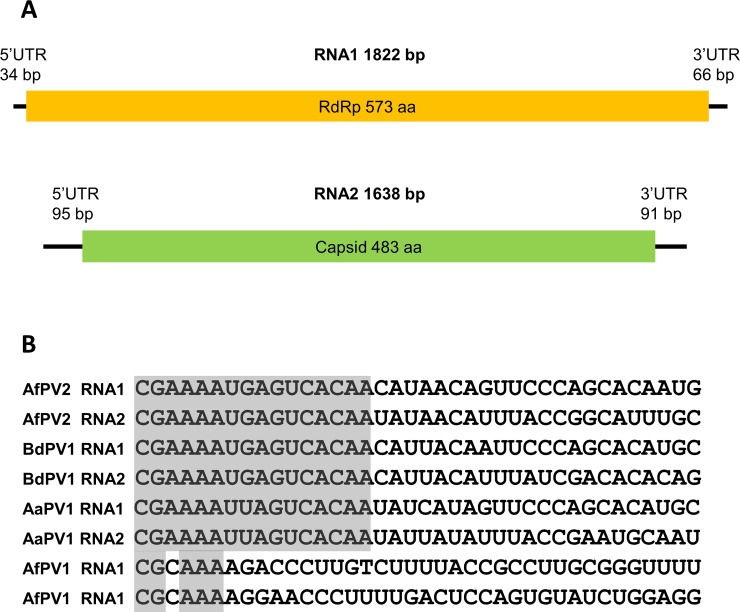
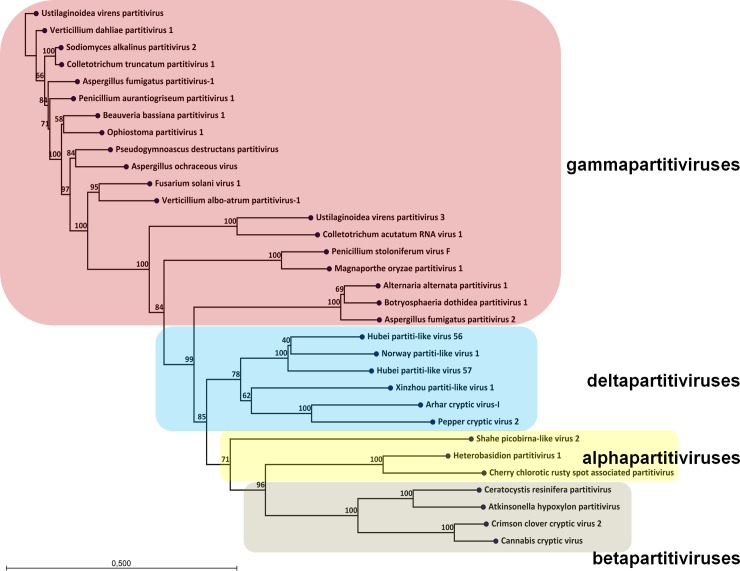
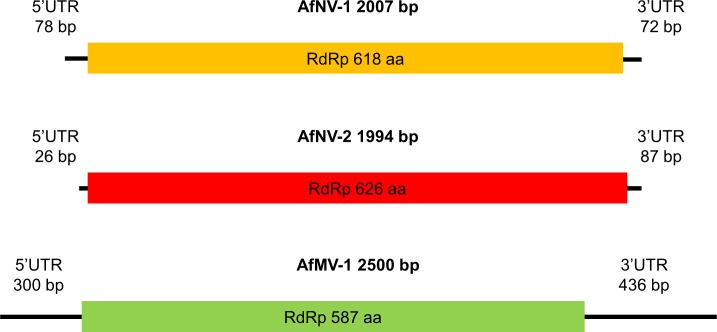
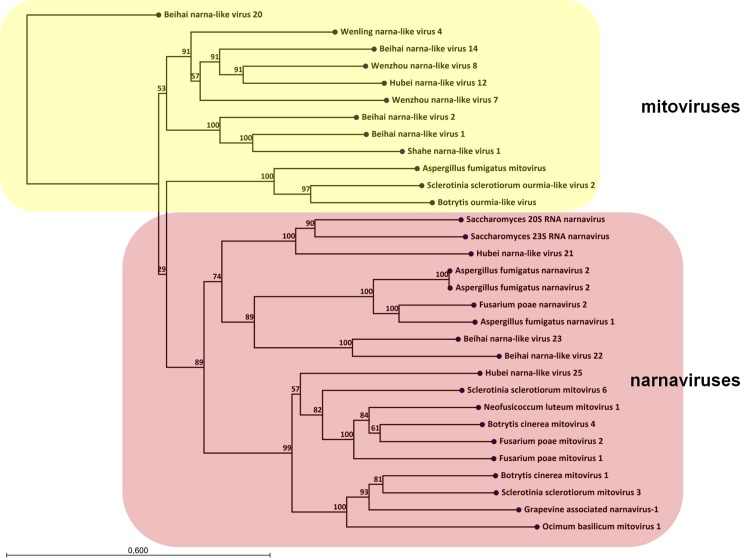
In the last few years, increasing numbers of viruses infecting fungi have been identified. In this study, we used an in silico approach for the analysis of deep RNA sequencing data in order to discover and characterize putative genomic ssRNA or dsRNA mycovirus sequences in Aspergillus fumigatus. RNA sequencing reads of A. fumigatus strains were mapped against the A. fumigatus Af293 reference genome. Unmapped reads were collected for de novo assembly. Contigs were analyzed by Blastx comparison with a mycovirus protein database. Assembled viral genomes were used as template for remapping of RNA sequencing reads. In total, deep RNA sequencing results from 11 A. fumigatus strains were analyzed for the presence of mycoviral genomic RNAs. In 9 out of 11 strains, putative mycoviral RNA genomes were identified. Three strains were infected with two different mycovirus species. Two strains were infected with Aspergillus fumigatus polymycovirus type-1 (AfuPmV-1). Four strains contained fully recovered genomic RNA of unknown narna-like viruses designated as Aspergillus fumigatus narnavirus-1 and Aspergillus fumigatus narnavirus-2 (AfuNV-1 and AfuNV-2). Both viruses showed 38% amino acid sequence identity to Beihai narna-like virus-21. Three strains contained partially recovered genomic RNA of an unknown narna-like virus. Two strains contained fully recovered genomic RNAs of an unknown partitivirus designated as Aspergillus fumigatus partitivirus-2 (AfuPV-2) which showed 50% amino acid sequence identity to Alternaria alternata partitivirus-1. Finally, one strain contained fully recovered genomic RNA of an unknown mitovirus designated as Aspergillus fumigatus mitovirus-1 (AfuMV-1) which showed 34% amino acid sequence identity to Sclerotina sclerotiorum mitovirus. In silico analysis of deep RNA sequencing results showed that a majority of the A. fumigatus strains used here were infected with mycoviruses. Four novel A. fumigatus RNA mycoviruses could be identified: two different Aspergillus fumigatus narna-like viruses, one Aspergillus fumigatus partitivirus, and one Aspergillus fumigatus mitovirus.
Overview
The claims and statistics of this paper haven’t been checked yet.
Free: it reads the open-access text and checks the first 5 claims that cite a source we can check. Create a free account to check every claim.
Integrity signals
Registry
Cites
Statistics
Figures
Verification
Claims the paper makes
The claims and statistics of this paper haven’t been checked yet.
Free: it reads the open-access text and checks the first 5 claims that cite a source we can check. Create a free account to check every claim.
Claims other papers make about this one
Each is checked against this paper’s own text: does it say what the citing paper says it does?
The cited source says what the claim attributes to it.
In the citing paper
“A. fumigatus is regularly reported to be infected by viruses (592, 593).”
From Aspergillus fumigatus and Aspergillosis in 2019 (2019) · cites this paper as [592]
Self-check
Percentages, sums and reported differences re-computed from the paper’s own numbers.
The self-check needs the paper’s full text.
Citations
Cites
50-plus years of fungal viruses
Ghabrial, S. A., Castón, J. R., Jiang, D., Nibert, M. L., & Suzuki, N. (2015) · Virology · doi:10.1016/j.virol.2015.02.034 · Cited by 753
Emergence of Azole Resistance in Aspergillus fumigatus and Spread of a Single Resistance Mechanism
Snelders, E., van der Lee, H. A. L., Kuijpers, J., Rijs, A. J. M. M., Varga, J., Samson, R. A., Mellado, E., Donders, A. R. T., Melchers, W. J. G., & Verweij, P. E. (2008) · PLoS Medicine · doi:10.1371/journal.pmed.0050219 · Cited by 727
Self-citationA geminivirus-related DNA mycovirus that confers hypovirulence to a plant pathogenic fungus
Yu, X., Li, B., Fu, Y., Jiang, D., Ghabrial, S. A., Li, G., Peng, Y., Xie, J., Cheng, J., Huang, J., et al. (2010) · Proceedings of the National Academy of Sciences · doi:10.1073/pnas.0913535107 · Cited by 562
Verweij, P. E., Chowdhary, A., Melchers, W. J. G., & Meis, J. F. (2016) · Clinical Infectious Diseases · doi:10.1093/cid/civ885 · Cited by 561 · cited 1×
“Pan-azole resistance has major consequences for the treatment of patients with invasive aspergillosis and causes a subsequent increase in mortality rate up to 90% [21, 22].”
BackgroundSelf-citationClinical Implications of Azole Resistance in Aspergillus fumigatus, the Netherlands, 2007–2009
van der Linden, J. W. M., Snelders, E., Kampinga, G. A., Rijnders, B. J. A., Mattsson, E., Debets-Ossenkopp, Y. J., Kuijper, E. J., Van Tiel, F. H., Melchers, W. J. G., & Verweij, P. E. (2011) · Emerging Infectious Diseases · doi:10.3201/eid1710.110226 · Cited by 446
Self-citationNew Insights into Mycoviruses and Exploration for the Biological Control of Crop Fungal Diseases
Xie, J., & Jiang, D. (2014) · Annual Review of Phytopathology · doi:10.1146/annurev-phyto-102313-050222 · Cited by 440
Extracellular transmission of a DNA mycovirus and its use as a natural fungicide
Yu, X., Li, B., Fu, Y., Xie, J., Cheng, J., Ghabrial, S. A., Li, G., Yi, X., & Jiang, D. (2013) · Proceedings of the National Academy of Sciences · doi:10.1073/pnas.1213755110 · Cited by 314
Marzano, S.-Y. L., Nelson, B. D., Ajayi-Oyetunde, O., Bradley, C. A., Hughes, T. J., Hartman, G. L., Eastburn, D. M., & Domier, L. L. (2016) · Journal of Virology · doi:10.1128/jvi.00357-16 · Cited by 261
Kotta-Loizou, I., & Coutts, R. H. A. (2017) · PLOS Pathogens · doi:10.1371/journal.ppat.1006183 · Cited by 169
Wingfield, L. K., Kotta‐Loizou, I., Özkan-Kotiloğlu, S., Gunning, A. P., & Coutts, R. H. A. (2015) · Proceedings of the National Academy of Sciences · doi:10.1073/pnas.1419225112 · Cited by 158
Cited by
Aspergillus fumigatus and Aspergillosis in 2019
Latgé, J.-P., & Chamilos, G. (2019) · Clinical Microbiology Reviews · doi:10.1128/cmr.00140-18 · Cited by 1,400
Analysis of the virome associated to grapevine downy mildew lesions reveals new mycovirus lineages
Chiapello, M., Rodríguez-Romero, J., Ayllón, M. A., & Turina, M. (2020) · Virus Evolution · doi:10.1093/ve/veaa058 · Cited by 164
Sutela, S., Forgia, M., Vainio, E. J., Chiapello, M., Daghino, S., Vallino, M., Martino, E. M. D., Girlanda, M., Perotto, S., & Turina, M. (2020) · Virus Evolution · doi:10.1093/ve/veaa076 · Cited by 137
Novel Mycoviruses Discovered in the Mycovirome of a Necrotrophic Fungus
Ruiz-Padilla, A., Rodríguez‐Romero, J., Gómez-Cid, I., Pacifico, D., & Ayllón, M. A. (2021) · mBio · doi:10.1128/mbio.03705-20 · Cited by 141
Fungal Viruses Unveiled: A Comprehensive Review of Mycoviruses
Hough, B., Steenkamp, E. T., Wingfield, B. D., & Read, D. A. (2023) · Viruses · doi:10.3390/v15051202 · Cited by 145
Metadata
- Authors
- Zoll, J., Verweij, P. E., & Melchers, W. J. G.
- Affiliations
- Radboud University Medical Center (NL)
- Corresponding author
- Zoll, Jan
- Venue
- PLOS ONE
- Publisher
- Public Library of Science (PLoS)
- Published
- 2018-07-25
- Volume
- 13
- Issue
- 7
- Pages
- e0200511
- ISSN
- 1932-6203 (ISSN-L)
- PMC
- PMC6059430
- OpenAlex
- W2883827605
- Cited by
- 49
- References
- 27
- Citations by year
- 2026: 2 · 2025: 2 · 2024: 4 · 2023: 8 · 2022: 4 · 2021: 10 · 2020: 15 · 2019: 4
- FWCI
- 5.15
- Type
- journal article
- Language
- en
- Open access
- gold
- doi.org
- Licence
- Locations
- PLoS ONE (publishedVersion, cc-by)
- Europe PMC (PubMed Central) (publishedVersion, cc-by)
- PubMed Central (publishedVersion, cc-by)
- PubMed (publishedVersion)
- Radboud Repository (Radboud University) (submittedVersion)
- DOAJ (DOAJ: Directory of Open Access Journals) (submittedVersion, cc-by-sa)
- Radboud Repository (Radboud University) (submittedVersion, other-oa)
- Topics
- Life Sciences › Immunology and Microbiology › Virology › Plant and Fungal Interactions Research
- Life Sciences › Immunology and Microbiology › Virology › Bacteriophages and microbial interactions
- Life Sciences › Agricultural and Biological Sciences › Plant Science › Plant Pathogens and Fungal Diseases
- Keywords
- Aspergillus fumigatus, mycoviruses, partitivirus, mitovirus, virus discovery, viral genome recovery, de novo assembly
- MeSH terms
- Fungal Viruses, Aspergillus fumigatus, Phylogeny, RNA Viruses, RNA, Viral, Genome, Viral, Sequence Analysis, RNA, Computational Biology, Genomics, High-Throughput Nucleotide Sequencing
About these checks
Registry, retraction, Cites and statistics results are computed, not judged, with one exception: a printed reference that no index lists is read once by a model before it counts as a citation error. Claims are extracted by a model and kept only when their quote appears verbatim in the text; each cited source is then checked, with a model’s help, for whether it says what the claim relies on. Those verdicts can be wrong — read the claim’s quote and the cited source before relying on one.
Statistics and arithmetic are recomputed, not judged.
Confidence bands are shown only for fields calibrated on our annotated test set. None is calibrated yet, so no band is shown.
What counts as a claim ›How we measure confidence ›How we check this ›
Are you an author, or do you see a problem with this page? Request a review
How to cite
Cite CoChat for the checks on this page, and the paper for its own findings.
- This page
- CoChat. (2026). Citation check: Discovery and characterization of novel Aspergillus fumigatus mycoviruses. https://app.cochat.ai/papers/10.1371/journal.pone.0200511
- The paper
- Zoll, J., Verweij, P. E., & Melchers, W. J. G. (2018). Discovery and characterization of novel Aspergillus fumigatus mycoviruses. PLOS ONE. https://doi.org/10.1371/journal.pone.0200511
Data sources
Bibliographic data: Semantic Scholar, OpenAlex, Crossref.
Contains information from the Semantic Scholar Academic Graph Datasets, made available under the ODC Attribution License (ODC-BY 1.0).
Semantic Scholar’s data is described in: Kinney, R., et al. (2023). The Semantic Scholar Open Data Platform. arXiv:2301.10140.
