

The DOI matches its Crossref record; 50 of the 51 references it cites were found in a registry or an index, and 1 are not checked yet.
Fibromyalgia diagnosis and biased assessment: Sex, prevalence and bias
Open accessAbstract
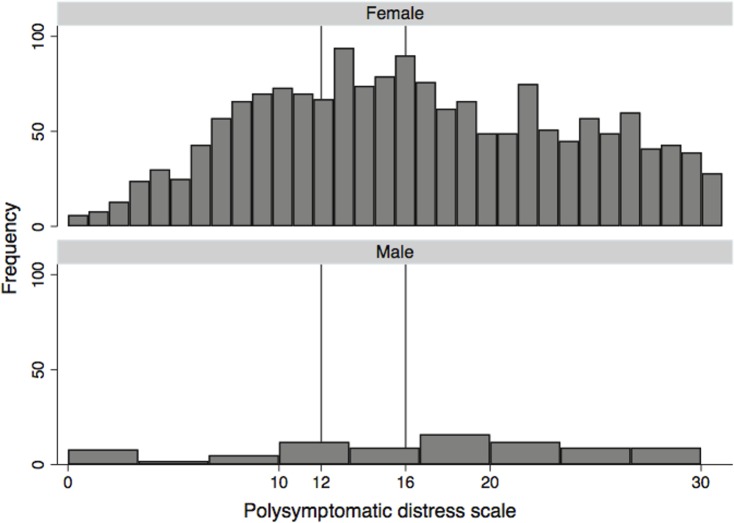
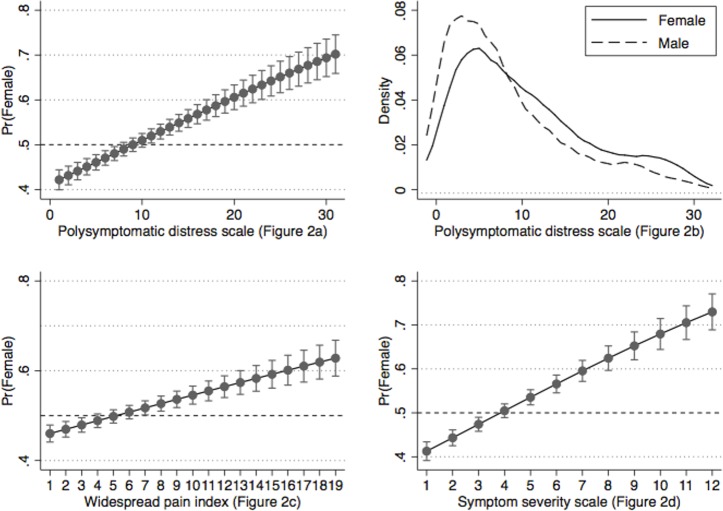
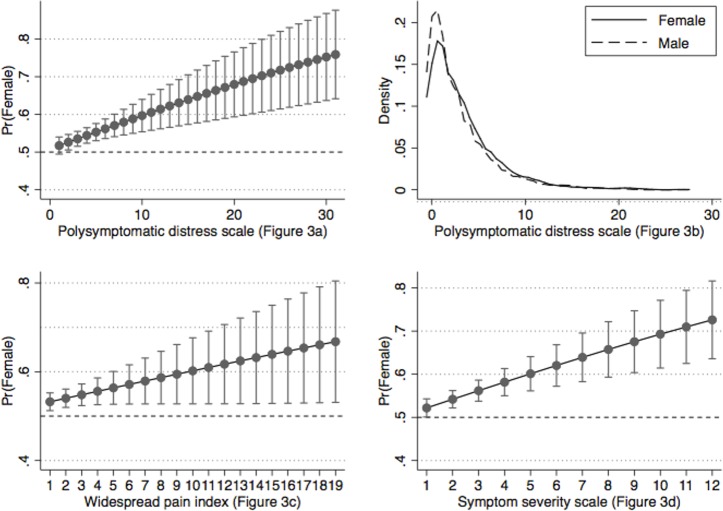
PURPOSE: Multiple clinical and epidemiological studies have provided estimates of fibromyalgia prevalence and sex ratio, but different criteria sets and methodology, as well as bias, have led to widely varying (0.4%->11%) estimates of prevalence and female predominance (>90% to <61%). In general, studies have failed to distinguish Criteria based fibromyalgia (CritFM) from Clinical fibromyalgia (ClinFM). In the current study we compare CritFM with ClinFM to investigate gender and other biases in the diagnosis of fibromyalgia. METHODS: We used a rheumatic disease databank and 2016 fibromyalgia criteria to study prevalence and sex ratios in a selection biased sample of 1761 referred and diagnosed fibromyalgia patients and in an unbiased sample of 4342 patients with no diagnosis with respect to fibromyalgia. We compared diagnostic and clinical variables according to gender, and we reanalyzed a German population study (GPS) (n = 2435) using revised 2016 criteria for fibromyalgia. RESULTS: In the selection-biased sample of referred patients with fibromyalgia, more than 90% were women. However, when an unselected sample of rheumatoid arthritis (RA) patients was studied for the presence of fibromyalgia, women represented 58.7% of fibromyalgia cases. Women had slightly more symptoms than men, including generalized pain (36.8% vs. 32.4%), count of 37 symptoms (4.7 vs. 3.7) and mean polysymptomatic distress scores (10.2 vs. 8.2). We also found a linear relation between the probability of being females and fibromyalgia and fibromyalgia severity. Women in the GPS represented 59.2% of cases. DISCUSSION: The perception of fibromyalgia as almost exclusively (≥90%) a women's disorder is not supported by data in unbiased studies. Using validated self-report criteria and unbiased selection, the female proportion of fibromyalgia cases was ≤60% in the unbiased studies, and the observed CritFM prevalence of fibromyalgia in the GPS was ~2%. ClinFM is the public face of fibromyalgia, but is severely affected by selection and confirmation bias in the clinic and publications, underestimating men with fibromyalgia and overestimating women. We recommend the use of 2016 fibromyalgia criteria for clinical diagnosis and epidemiology because of its updated scoring and generalized pain requirement. Fibromyalgia and generalized pain positivity, widespread pain (WPI), symptom severity scale (SSS) and polysymptomatic distress (PSD) scale should always be reported.
Overview
The claims and statistics of this paper haven’t been checked yet.
Run the check — free, no account needed. It reads the open-access text and checks the sources it cites.
Integrity signals
Registry
Cites
Statistics
Figures
Verification
Claims the paper makes
The claims and statistics of this paper haven’t been checked yet.
Run the check — free, no account needed. It reads the open-access text and checks the sources it cites.
Claims other papers make about this one
Each is checked against this paper’s own text: does it say what the citing paper says it does?
The cited source doesn’t support the claim as written.
In the citing paper
“Notably, the authors showed a greater impact of pain on male patients with FMS in terms of stronger experience and more catastrophizing thoughts about pain than in women with FMS.”
From Pain and small fiber pathology in men with fibromyalgia syndrome (2024) · cites this paper as [55]
Checked by a reasoning model — may be wrong.
Experimental — accuracy not yet measuredThe cited source says what the claim attributes to it.
In the citing paper
“In a few studies, characteristics of FMS pain were investigated in both sexes, and a higher symptom load including more cases with generalized pain was reported in women than in men.38,55”
From Pain and small fiber pathology in men with fibromyalgia syndrome (2024) · cites this paper as [55]
The check wasn’t confident either way, so it gives no verdict — never disputed.
In the citing paper
“Earlier studies38,55 also showed high FIQ scores in male patients with FMS indicating a great impact on pain, which is in line with our results.”
From Pain and small fiber pathology in men with fibromyalgia syndrome (2024) · cites this paper as [55]
Experimental — accuracy not yet measured
Self-check
Percentages, sums and reported differences re-computed from the paper’s own numbers.
The self-check needs the paper’s full text.
Citations
Cites
(1992) · PubMed · Cited by 33,716
The MOS 36-ltem Short-Form Health Survey (SF-36): I. Conceptual Framework and Item Selection
Ware, J. E., & Sherbourne, C. D. (1992) · Medical Care · doi:10.1097/00005650-199206000-00002 · Cited by 30,033
The american college of rheumatology 1990 criteria for the classification of fibromyalgia
Wolfe, F., Smythe, H. A., Yunus, M. B., Bennett, R. M., Bombardier, C., Goldenberg, D. L., Tugwell, P., Campbell, S. M., Abeles, M., Clark, P., et al. (1990) · Arthritis & Rheumatism · doi:10.1002/art.1780330203 · Cited by 9,563
Self-citationVandenbroucke, J. P., von Elm, E., Altman, D. G., Gøtzsche, P. C., Mulrow, C. D., Pocock, S. J., Poole, C., Schlesselman, J. J., Egger, M., & Initiative, F. T. S. (2007) · PLoS Medicine · doi:10.1371/journal.pmed.0040297 · Cited by 8,613
Confirmation Bias: A Ubiquitous Phenomenon in Many Guises
Nickerson, R. S. (1998) · Review of General Psychology · doi:10.1037/1089-2680.2.2.175 · Cited by 7,267
Wolfe, F., Clauw, D. J., Fitzcharles, M., Goldenberg, D. L., Katz, R. S., Mease, P., Russell, A. S., Russell, I. J., Winfield, J. B., & Yunus, M. B. (2010) · Arthritis Care & Research · doi:10.1002/acr.20140 · Cited by 3,952
Self-citationVandenbroucke, J. P., Elm, E. V., Altman, D. G., Gøtzsche, P. C., Mulrow, C. D., Pocock, S. J., Poole, C., Schlesselman, J. J., Egger, M., & initiative, F. T. S. (2007) · Annals of Internal Medicine · doi:10.7326/0003-4819-147-8-200710160-00010-w1 · Cited by 3,543
2016 revisions to the 2010/2011 fibromyalgia diagnostic criteria
Wolfe, F., Clauw, D. J., Fitzcharles, M.-A., Goldenberg, D. L., Häuser, W., Katz, R. L., Mease, P. J., Russell, A. S., Russell, I. J., & Walitt, B. (2016) · Seminars in Arthritis and Rheumatism · doi:10.1016/j.semarthrit.2016.08.012 · Cited by 2,232
Self-citationWOLFE, F., CLAUW, D. J., FITZCHARLES, M.-A., GOLDENBERG, D. L., HÄUSER, W., KATZ, R. S., MEASE, P., RUSSELL, A. S., RUSSELL, I. J., & WINFIELD, J. B. (2011) · The Journal of Rheumatology · doi:10.3899/jrheum.100594 · Cited by 1,499
Self-citationThe dimensions of health outcomes: the health assessment questionnaire, disability and pain scales.
Fries, J. F., Spitz, P. W., & Young, D. Y. (1982) · PubMed · Cited by 1,312
Research works printed but not linked: 1
- W Häuser, 2017, Epidemiology, FIBROMYALGIA: Pain
Cited by
Sorted by citations
Psychological impact of fibromyalgia: current perspectives
Galvez-Sánchez, C. M., Duschek, S., & del Paso, G. A. R. (2019) · Psychology Research and Behavior Management · doi:10.2147/prbm.s178240 · Cited by 366
Diagnostic Criteria for Fibromyalgia: Critical Review and Future Perspectives
Galvez-Sánchez, C. M., & Reyes del Paso, G. A. (2020) · Journal of Clinical Medicine · doi:10.3390/jcm9041219 · Cited by 241
Kleykamp, B. A., Ferguson, M. C., McNicol, E., Bixho, I., Arnold, L. M., Edwards, R. R., Fillingim, R., Grol-Prokopczyk, H., Turk, D. C., & Dworkin, R. H. (2021) · Seminars in Arthritis and Rheumatism · doi:10.1016/j.semarthrit.2020.10.006 · Cited by 202
Petersen, M. W., Schröder, A., Jørgensen, T., Ørnbøl, E., Meinertz Dantoft, T., Eliasen, M., Benros, M. E., & Fink, P. (2020) · Scientific Reports · doi:10.1038/s41598-020-60318-6 · Cited by 170
Pain in Women: A Perspective Review on a Relevant Clinical Issue that Deserves Prioritization
Casale, R., Atzeni, F., Bazzichi, L., Beretta, G., Costantini, E., Sacerdote, P., & Tassorelli, C. (2021) · Pain and Therapy · doi:10.1007/s40122-021-00244-1 · Cited by 159
Metadata
- Authors
- Wolfe, F., Walitt, B., Perrot, S., Rasker, J. J., & Häuser, W.
- Affiliations
- University of Kansas (US)
- Georgetown University (US)
- Hôpital Cochin (FR)
- University of Twente (NL)
- Klinikum Saarbrücken (DE)
- Corresponding author
- Wolfe, Frederick
- Venue
- PLOS ONE
- Publisher
- Public Library of Science (PLoS)
- Published
- 2018-09-13
- Volume
- 13
- Issue
- 9
- Pages
- e0203755
- ISSN
- 1932-6203 (ISSN-L)
- PMC
- PMC6136749
- OpenAlex
- W2890457018
- Cited by
- 346
- References
- 51
- Citations by year
- 2026: 45 · 2025: 43 · 2024: 51 · 2023: 58 · 2022: 47 · 2021: 45 · 2020: 39 · 2019: 17 · 2018: 1
- FWCI
- 20.26
- Type
- journal article
- Language
- en
- Open access
- gold
- doi.org
- Licence
- public-domain
- creativecommons.org/publicdomain/zero/1.0/ (vor)
- Locations
- PLoS ONE (publishedVersion, public-domain)
- Europe PMC (PubMed Central) (publishedVersion, public-domain)
- PubMed Central (publishedVersion, public-domain)
- PubMed (publishedVersion)
- RePEc: Research Papers in Economics (submittedVersion)
- DOAJ (DOAJ: Directory of Open Access Journals) (submittedVersion, cc-by-sa)
- Figshare (submittedVersion, cc-by)
- mediaTUM – the media and publications repository of the Technical University Munich (Technical University Munich) (submittedVersion)
- University of Twente Research Information (submittedVersion, cc-by)
- Topics
- Health Sciences › Medicine › Psychiatry and Mental health › Fibromyalgia and Chronic Fatigue Syndrome Research
- Health Sciences › Medicine › Psychiatry and Mental health › Psychosomatic Disorders and Their Treatments
- Health Sciences › Health Professions › Physical Therapy, Sports Therapy and Rehabilitation › Musculoskeletal pain and rehabilitation
- Keywords
- fibromyalgia, sex bias, prevalence, sex ratio, diagnostic criteria, selection bias, confirmation bias, gender differences, rheumatoid arthritis, pain symptoms
- MeSH terms
- Aged, Arthritis, Rheumatoid, Female, Fibromyalgia, Germany, Humans, Longitudinal Studies, Male, Middle Aged, Pain, Severity of Illness Index, Sex Factors, Prevalence, Databases, Factual, Self Report, Sexism
About these checks
Registry, retraction, Cites and statistics results are computed, not judged, with one exception: a printed reference that no index lists is read once by a model before it counts as a citation error. Claims are extracted by a model and kept only when their quote appears verbatim in the text; each cited source is then checked, with a model’s help, for whether it says what the claim relies on. Those verdicts can be wrong — read the claim’s quote and the cited source before relying on one.
Statistics and arithmetic are recomputed, not judged.
Confidence bands are shown only for fields calibrated on our annotated test set. None is calibrated yet, so no band is shown.
What counts as a claim ›How we measure confidence ›How we check this ›
Are you an author, or do you see a problem with this page? Request a review
