

The DOI matches its Crossref record; 82 of the 83 references it cites were found in a registry or an index.
Moral licensing, instrumental apology and insincerity aversion: Taking Immanuel Kant to the lab
Open accessAbstract
Moral licensing, equivalently called "self-licensing", is the instrumental use of a Good Act to cover up a Bad Act. This paper's thesis is that "instrumental apology" i.e., bad-faith apology, is a case of moral licensing. A decision maker may issue an apology (Good Act) after committing a Bad Act, but if the decision maker uses the apology instrumentally, he or she is using the apology to justify the Bad Act. Hence, the apology is insincere. Sincerity is the fine line between a good-faith apology or, more generally, a Good Act, on one hand, and an instrumental apology or, more generally, moral licensing, on the other. In this light, moral licensing should be separated from genuine apology that attains moral equilibrium, which is called in the literature moral "self-regulation' and "conscience accounting." According to Kantian ethics, not just the consequences of an act matter, but also the sincerity with which the act was conducted. This pits Kant against the utilitarian view, which downplays intentions and focuses on consequences. We take Kant to the lab. Participants play a modified ultimatum game, where proposers in some treatments have the option of issuing apology messages and responders have both costly and costless options for rewarding or punishing proposers. We introduce different treatments of the apology message to allow responders to form doubts about the sincerity of the apology messages. Our results support the Kantian position: responders, once they become suspicious of the sincerity of the proposers' apology, exhibit "insincerity aversion" and punish proposers.
Overview
The claims and statistics of this paper haven’t been checked yet.
Run the check — free, no account needed. It reads the open-access text and checks the sources it cites.
Integrity signals
Registry
Cites
Statistics
Figures
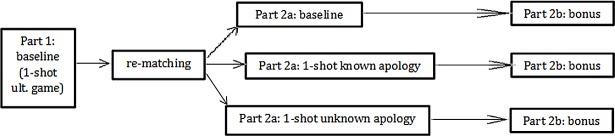
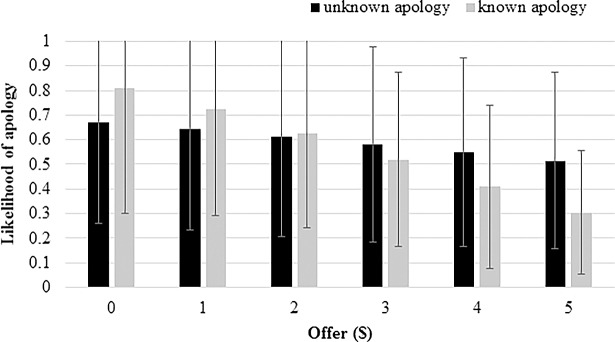
Verification
Claims the paper makes
The claims and statistics of this paper haven’t been checked yet.
Run the check — free, no account needed. It reads the open-access text and checks the sources it cites.
Self-check
Percentages, sums and reported differences re-computed from the paper’s own numbers.
The self-check needs the paper’s full text.
Citations
Cites
z-Tree: Zurich toolbox for ready-made economic experiments
Fischbacher, U. (2007) · Experimental Economics · doi:10.1007/s10683-006-9159-4 · Cited by 9,524
Impure Altruism and Donations to Public Goods: A Theory of Warm-Glow Giving
Andreoni, J. (1990) · The Economic Journal · doi:10.2307/2234133 · Cited by 5,825
An experimental analysis of ultimatum bargaining
Güth, W., Schmittberger, R., & Schwarze, B. (1982) · Journal of Economic Behavior & Organization · doi:10.1016/0167-2681(82)90011-7 · Cited by 4,864
Incorporating Fairness into Game Theory and Economics
Rabin, M. (2011) · Princeton University Press eBooks · doi:10.2307/j.ctvcm4j8j.15 · Cited by 4,614
The Handbook of experimental economics
(1995) · Choice Reviews Online · doi:10.5860/choice.33-1645 · Cited by 3,769
Incentives and Prosocial Behavior
Bénabou, R., & Tirole, J. (2006) · American Economic Review · doi:10.1257/aer.96.5.1652 · Cited by 3,357
Subject pool recruitment procedures: organizing experiments with ORSEE
Greiner, B. (2015) · Journal of the Economic Science Association · doi:10.1007/s40881-015-0004-4 · Cited by 2,195
Advances in Behavioral Economics
(2004) · Princeton University Press eBooks · doi:10.1515/9781400829118 · Cited by 1,770
Does Studying Economics Inhibit Cooperation?
Frank, R. H., Gilovich, T. D., & Regan, D. T. (1993) · The Journal of Economic Perspectives · doi:10.1257/jep.7.2.159 · Cited by 1,561
Charness, G., & Dufwenberg, M. A. (2006) · Econometrica · doi:10.1111/j.1468-0262.2006.00719.x · Cited by 1,502
Goodwill: A reexamination of the construct and its measurement
McCroskey, J. C., & Teven, J. J. (1999) · Communication Monographs · doi:10.1080/03637759909376464 · Cited by 1,236 · cited 1×
“In the psychological literature, psychologists have studied the consequences of insincere apologies as opposed to sincere ones [34, 35], and have also recorded that insincere gestures usually engender negative outcomes [36–39].”
Washing Away Your Sins: Threatened Morality and Physical Cleansing
Zhong, C., & Liljenquist, K. A. (2006) · Science · doi:10.1126/science.1130726 · Cited by 1,201
Moral Self‐Licensing: When Being Good Frees Us to Be Bad
Merritt, A. C., Effron, D. A., & Monin, B. (2010) · Social and Personality Psychology Compass · doi:10.1111/j.1751-9004.2010.00263.x · Cited by 1,139
Moral credentials and the expression of prejudice.
Monin, B., & Miller, D. T. (2001) · Journal of Personality and Social Psychology · doi:10.1037/0022-3514.81.1.33 · Cited by 1,086
Do Green Products Make Us Better People?
Mažar, N., & Zhong, C. (2010) · Psychological Science · doi:10.1177/0956797610363538 · Cited by 1,022
Contagion and Differentiation in Unethical Behavior: The Effect of One Bad Apple on the Barrel
Gino, F., Ayal, S., & Dan Ariely, C. (2009) · Psychological Science · doi:10.1111/j.1467-9280.2009.02306.x · Cited by 998
Licensing Effect in Consumer Choice
Khan, U. R., & Dhar, R. (2006) · Journal of Marketing Research · doi:10.1509/jmkr.43.2.259 · Cited by 963
Sinning Saints and Saintly Sinners: The Paradox of Moral Self-Regulation
Sachdeva, S. S., Iliev, R. I., & Medin, D. L. (2009) · Psychological Science · doi:10.1111/j.1467-9280.2009.02326.x · Cited by 833
Detrimental effects of sanctions on human altruism
Fehr, E., & Rockenbach, B. (2003) · Nature · doi:10.1038/nature01474 · Cited by 800
Erat, S., & Uri Gneezy, B. (2011) · Management Science · doi:10.1287/mnsc.1110.1449 · Cited by 714
Consistency Versus Licensing Effects of Past Moral Behavior
Mullen, E., & Monin, B. (2015) · Annual Review of Psychology · doi:10.1146/annurev-psych-010213-115120 · Cited by 427
Self-serving altruism? The lure of unethical actions that benefit others
Gino, F., Ayal, S., & Dan Ariely, C. (2013) · Journal of Economic Behavior & Organization · doi:10.1016/j.jebo.2013.04.005 · Cited by 342
Dishonesty in the Name of Equity
Gino, F., & Pierce, L. (2009) · Psychological Science · doi:10.1111/j.1467-9280.2009.02421.x · Cited by 325
Would I lie to you? On social preferences and lying aversion
Hurkens, S., & Kartik, N. (2008) · Experimental Economics · doi:10.1007/s10683-008-9208-2 · Cited by 295
Public Confession and Forgiveness
Weiner, B. L., Graham, S., Peter, O., & Zmuidinas, M. (1991) · Journal of Personality · doi:10.1111/j.1467-6494.1991.tb00777.x · Cited by 286
Citizenship and Counterproductive Work Behavior: A Moral Licensing View
Klotz, A. C., & Bolino, M. C. (2012) · Academy of Management Review · doi:10.5465/amr.2011.0109 · Cited by 266
Endorsing Obama licenses favoring Whites
Effron, D. A., Cameron, J. S., & Monin, B. (2009) · Journal of Experimental Social Psychology · doi:10.1016/j.jesp.2009.02.001 · Cited by 248
Ren, H., & Gray, B. (2009) · Academy of Management Review · doi:10.5465/amr.2009.35713307 · Cited by 245
Why Do We Hate Hypocrites? Evidence for a Theory of False Signaling
Jordan, J., Sommers, R., Bloom, P., & Rand, D. G. (2017) · Psychological Science · doi:10.1177/0956797616685771 · Cited by 245
The social psychology of morality: Exploring the causes of good and evil.
(2011) · American Psychological Association eBooks · doi:10.1037/13091-000 · Cited by 242
Rejection of unfair offers in the ultimatum game is no evidence of strong reciprocity
Yamagishi, T., Horita, Y., Mifune, N., Hashimoto, H., Li, Y., Shinada, M., Miura, A., Inukai, K., Takagishi, H., & Šimunović, D. (2012) · Proceedings of the National Academy of Sciences · doi:10.1073/pnas.1212126109 · Cited by 236
Motivated Bayesians: Feeling Moral While Acting Egoistically
Gino, F., Norton, M. I., & Weber, R. A. (2016) · Journal of Economic Perspectives · doi:10.1257/jep.30.3.189 · Cited by 208
The Social psychology of morality: exploring the causes of good and evil
(2012) · Choice Reviews Online · doi:10.5860/choice.49-4763 · Cited by 186
Do sincere apologies need to be costly? Test of a costly signaling model of apology
Ohtsubo, Y., & Watanabe, E. (2008) · Evolution and Human Behavior · doi:10.1016/j.evolhumbehav.2008.09.004 · Cited by 177
The pot calling the kettle black: Distancing response to ethical dissonance.
Barkan, R., Ayal, S., Gino, F., & Dan Ariely, C. (2012) · Journal of Experimental Psychology General · doi:10.1037/a0027588 · Cited by 176
Honest rationales for dishonest behavior.
Ayal, S., & Gino, F. (2011) · American Psychological Association eBooks · doi:10.1037/13091-008 · Cited by 170
Conscience Accounting: Emotion Dynamics and Social Behavior
Uri Gneezy, B., Imas, A., & Madarász, K. (2014) · Management Science · doi:10.1287/mnsc.2014.1942 · Cited by 164
It’s the Thought That Counts: On Perceiving How Helpers Decide to Lend a Hand
Ames, D. R., Flynn, F. J., & Weber, E. U. (2004) · Personality and Social Psychology Bulletin · doi:10.1177/0146167203261890 · Cited by 148
Zwolinski, M. (2008) · Business Ethics Quarterly · doi:10.5840/beq200818327 · Cited by 146
Please accept my sincerest apologies: examining follower reactions to leader apology
Basford, T. E., Offermann, L. R., & Behrend, T. S. (2014) · Journal of Business Ethics · doi:10.1007/s10551-012-1613-y · Cited by 133
Victims' Responses to Apologies: The Effects of Offender Responsibility and Offense Severity
Bennett, M., & Earwaker, D. (1994) · The Journal of Social Psychology · doi:10.1080/00224545.1994.9712196 · Cited by 107
MORAL CLEANSING AND MORAL LICENSES: EXPERIMENTAL EVIDENCE
Brañas‐Garza, P., Bucheli, M., Espinosa, M. P., & García‐Muñoz, T. (2013) · Economics and Philosophy · doi:10.1017/s0266267113000199 · Cited by 106
Fair and unfair punishers coexist in the Ultimatum Game
Brañas‐Garza, P., Espín, A. M., Exadaktylos, F., & Herrmann, B. (2014) · Scientific Reports · doi:10.1038/srep06025 · Cited by 103
Gender differences in moral judgment and the evaluation of gender-specified moral agents
Capraro, V., & Sippel, J. (2017) · Cognitive Processing · doi:10.1007/s10339-017-0822-9 · Cited by 103
Belmi, P. R. V., & Pfeffer, J. (2015) · Academy of Management Discoveries · doi:10.5465/amd.2014.0015 · Cited by 96
ten Brinke, L., & Adams, G. S. (2015) · Organizational Behavior and Human Decision Processes · doi:10.1016/j.obhdp.2015.05.003 · Cited by 95
Building and rebuilding trust with promises and apologies
Eric Schniter, A., Sheremeta, R. M., & Sznycer, D. (2012) · Journal of Economic Behavior & Organization · doi:10.1016/j.jebo.2012.09.011 · Cited by 88
Fairness in the Mail and Opportunism in the Internet: A Newspaper Experiment on Ultimatum Bargaining
Güth, W., & Sutter, M. (2003) · German Economic Review · doi:10.1111/1468-0475.00081 · Cited by 77
Apologies as Signals: With Evidence from a Trust Game
Ho, B. (2011) · Management Science · doi:10.1287/mnsc.1110.1410 · Cited by 76
Advances in Health Economics and Health Services Research
(2010) · Advances in health economics and health services research · doi:10.1108/s0731-2199(2010)0000022019 · Cited by 76
Benevolent Characteristics Promote Cooperative Behaviour among Humans
Capraro, V., Smyth, C., Mylona, K., & Niblo, G. A. (2014) · PLoS ONE · doi:10.1371/journal.pone.0102881 · Cited by 73
The Missionary Position: Mother Teresa in Theory and Practice
Loudon, M. (1996) · BMJ · doi:10.1136/bmj.312.7022.64a · Cited by 72
Does sorry work? The impact of apology laws on medical malpractice
Ho, B., & Liu, E. (2011) · Journal of Risk and Uncertainty · doi:10.1007/s11166-011-9126-0 · Cited by 71
Moral balance: The effect of prior behaviour on decision in moral conflict
Nisan, M., & Horenczyk, G. (1990) · British Journal of Social Psychology · doi:10.1111/j.2044-8309.1990.tb00884.x · Cited by 71
Abeler, J., Calaki, J., Andree, K., & Basek, C. (2010) · Economics Letters · doi:10.1016/j.econlet.2010.01.033 · Cited by 69
EUVOLUNTARY OR NOT, EXCHANGE IS JUST
Munger, M. C. (2011) · Social Philosophy and Policy · doi:10.1017/s0265052510000269 · Cited by 68
On the acceptance of apologies
Fischbacher, U., & Utikal, V. (2013) · Games and Economic Behavior · doi:10.1016/j.geb.2013.09.003 · Cited by 66
The Wizard of Lies: Bernie Madoff and the Death of Trust
Henriques, D. B. (2011) · Cited by 64
Short- and long-run goals in ultimatum bargaining: impatience predicts spite-based behavior
Espín, A. M., Exadaktylos, F., Herrmann, B., & Brañas‐Garza, P. (2015) · Frontiers in Behavioral Neuroscience · doi:10.3389/fnbeh.2015.00214 · Cited by 46
Neural Correlates of Receiving an Apology and Active Forgiveness: An fMRI Study
Strang, S., Utikal, V., Fischbacher, U., Weber, B., & Falk, A. (2014) · PLoS ONE · doi:10.1371/journal.pone.0087654 · Cited by 41
The Missionary Position: Mother Teresa in Theory and Practice
Hitchens, C. (1995) · Cited by 41
Kantian Ethics and Economics: Autonomy, Dignity, and Character
White, M. D. (2011) · Stanford University Press eBooks · doi:10.11126/stanford/9780804768948.001.0001 · Cited by 39
Zheng, X., van Dijke, M., Leunissen, J. M., Giurge, L. M., & Cremer, D. D. (2016) · Human Relations · doi:10.1177/0018726715611236 · Cited by 38
Banki, S. (2010) · Small Group Research · doi:10.1177/1046496410364065 · Cited by 37
Kantian ethics and economics: autonomy, dignity, and character
(2012) · Choice Reviews Online · doi:10.5860/choice.49-2798 · Cited by 33
“Si él lo necesita”: Gypsy fairness in Vallecas
Brañas‐Garza, P., Cobo‐Reyes, R., & Domínguez, A. (2006) · Experimental Economics · doi:10.1007/s10683-006-9126-0 · Cited by 32
Behavioural Differences and Neural Substrates of Altruistic and Spiteful Punishment
Yamagishi, T., Li, Y., Fermin, A. S. R., Kanai, R., Takagishi, H., Matsumoto, Y., Kiyonari, T., & Sakagami, M. (2017) · Scientific Reports · doi:10.1038/s41598-017-15188-w · Cited by 30
Promises and lies: can observers detect deception in written messages
Chen, J., & Houser, D. E. (2016) · Experimental Economics · doi:10.1007/s10683-016-9488-x · Cited by 28
Ethics in economics: an introduction to moral frameworks
Wight, J. B. (2015) · Choice Reviews Online · doi:10.5860/choice.192422 · Cited by 28
Robinson, R. M. (2017) · Journal of Business Ethics · doi:10.1007/s10551-017-3671-7 · Cited by 27
Khalil, E. L. (2017) · Philosophy · doi:10.1017/s003181911700033x · Cited by 26
Self-citationA Theory of Tasteful and Distasteful Transactions
Khalil, E. L., & Marciano, A. (2018) · Kyklos · doi:10.1111/kykl.12164 · Cited by 23
Self-citationEilam, O., & Suleiman, R. (2004) · European Journal of Social Psychology · doi:10.1002/ejsp.227 · Cited by 20
van Dijke, M., & Cremer, D. D. (2011) · Journal of Economic Psychology · doi:10.1016/j.joep.2011.03.014 · Cited by 15
Advances in health economics and health services research
(2008) · Advances in health economics and health services research · doi:10.1016/s0731-2199(08)19012-4 · Cited by 15
SELF-DECEPTION AS A WEIGHTLESS MASK
Khalil, E. L. (2016) · Facta Universitatis Series Philosophy Sociology Psychology and History · Cited by 14
Self-citationThe Handbook of Experimental Economics
Roth, A. E., & Kagel, J. H. (2021) · Project Muse (Johns Hopkins University) · Cited by 10
“Please Accept My Sincerest Apologies:” Examining Follower Reactions to Leader Apology
Basford, T. E., & Offermann, L. R. (2012) · Academy of Management Proceedings · doi:10.5465/ambpp.2012.21 · Cited by 9
Economists: cheaters with altruistic instincts
Muñoz‐Izquierdo, N., de Liaño, B. G.-G., Rin-Sánchez, F. D., & Pascual‐Ezama, D. (2014) · Munich Personal RePEc Archive (Ludwig Maximilian University of Munich) · Cited by 6
A Moral Licensing Perspective of Abusive Supervision and Career Consequences
Yu, L., & Duffy, M. K. (2016) · Academy of Management Proceedings · doi:10.5465/ambpp.2016.15269abstract · Cited by 4
Emotion expression, decision-making and well-being
Xiao, E. (2008) · Advances in health economics and health services research · doi:10.1016/s0731-2199(08)20007-5 · Cited by 2
Family Support Provision: A Moral Licensing Perspective
Li, A., Mai, K., & Bagger, J. (2015) · Academy of Management Proceedings · doi:10.5465/ambpp.2015.10208abstract · Cited by 1
Cited by
Panigoro, S. S., Sutandyo, N., Witjaksono, F., Siregar, N. C., Ramli, R., Hariani, R., Pangarsa, E. A., Prajoko, Y. W., Puruhita, N., Hamdani, W., et al. (2021) · Frontiers in Endocrinology · doi:10.3389/fendo.2021.745236 · Cited by 40
Framed National Images Influence Policy Attitudes Among Targeted Foreign Citizens
Rhee, K., Crabtree, C. D., & Horiuchi, Y. (2021) · Political Behavior · doi:10.1007/s11109-022-09849-4 · Cited by 36
Tolessa, L., Sendo, E. G., Dinegde, N. G., & Desalew, A. (2021) · International Journal of Women s Health · doi:10.2147/ijwh.s292588 · Cited by 30
A Theory of Tasteful and Distasteful Transactions
Khalil, E. L., & Marciano, A. (2018) · Kyklos · doi:10.1111/kykl.12164 · Cited by 23
Self-citationCarnevale, J. B., & Gangloff, K. A. (2022) · Journal of Business Ethics · doi:10.1007/s10551-022-05138-6 · Cited by 15
Metadata
- Authors
- Khalil, E. L., & Feltovich, N.
- Affiliations
- Monash University (AU)
- Corresponding author
- Khalil, Elias L.
- Feltovich, Nick
- Venue
- PLOS ONE
- Publisher
- Public Library of Science (PLoS)
- Published
- 2018-11-08
- Volume
- 13
- Issue
- 11
- Pages
- e0206878
- ISSN
- 1932-6203 (ISSN-L)
- PMC
- PMC6224065
- OpenAlex
- W2899638763
- Cited by
- 17
- References
- 83
- Citations by year
- 2026: 5 · 2025: 3 · 2024: 1 · 2022: 3 · 2021: 3 · 2020: 1 · 2018: 1
- FWCI
- 1.81
- Type
- journal article
- Language
- en
- Open access
- gold
- doi.org
- Licence
- Locations
- PLoS ONE (publishedVersion, cc-by)
- Europe PMC (PubMed Central) (publishedVersion, cc-by)
- PubMed (publishedVersion)
- PubMed Central (publishedVersion, cc-by)
- Monash University Research Portal (Monash University) (submittedVersion, other-oa)
- RePEc: Research Papers in Economics (submittedVersion)
- DOAJ (DOAJ: Directory of Open Access Journals) (submittedVersion)
- Figshare (submittedVersion, cc-by)
- Funders
- Monash University (grant #1758024)
- Topics
- Social Sciences › Economics, Econometrics and Finance › Economics and Econometrics › Experimental Behavioral Economics Studies
- Life Sciences › Neuroscience › Cognitive Neuroscience › Psychology of Moral and Emotional Judgment
- Social Sciences › Business, Management and Accounting › Organizational Behavior and Human Resource Management › Ethics in Business and Education
- Keywords
- moral licensing, Kantian ethics, sincerity, moral self-regulation, ultimatum game, punishment, utilitarianism
- MeSH terms
- Affect, Decision Making, Emotions, Female, Humans, Interpersonal Relations, Male, Morals, Social Behavior, Ethical Theory
About these checks
Registry, retraction, Cites and statistics results are computed, not judged, with one exception: a printed reference that no index lists is read once by a model before it counts as a citation error. Claims are extracted by a model and kept only when their quote appears verbatim in the text; each cited source is then checked, with a model’s help, for whether it says what the claim relies on. Those verdicts can be wrong — read the claim’s quote and the cited source before relying on one.
Statistics and arithmetic are recomputed, not judged.
Confidence bands are shown only for fields calibrated on our annotated test set. None is calibrated yet, so no band is shown.
What counts as a claim ›How we measure confidence ›How we check this ›
Are you an author, or do you see a problem with this page? Request a review
Data sources
Bibliographic data: Semantic Scholar, OpenAlex, Crossref.
Contains information from the Semantic Scholar Academic Graph Datasets, made available under the ODC Attribution License (ODC-BY 1.0).
Semantic Scholar’s data is described in: Kinney, R., et al. (2023). The Semantic Scholar Open Data Platform. arXiv:2301.10140.
