

The DOI matches its Crossref record; 89 of the 89 references it cites were found in a registry or an index.
A systematic study of microdosing psychedelics
Open accessPublished version of a preprint
Abstract
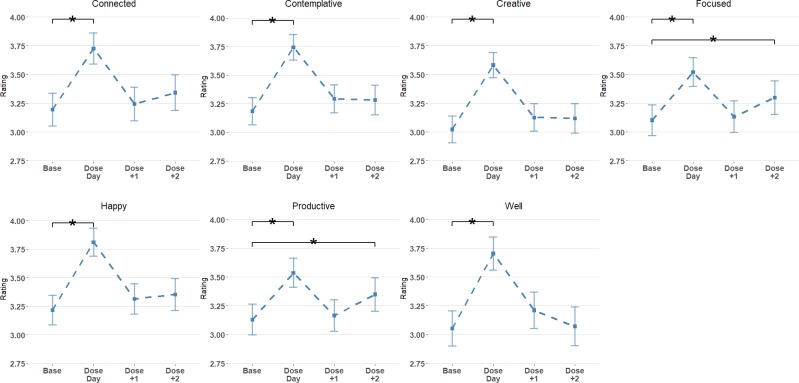
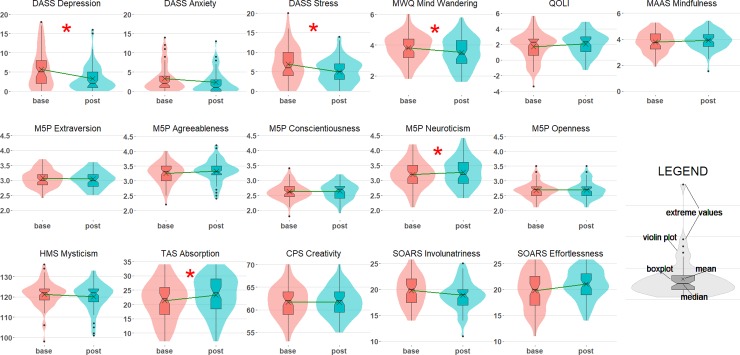
The phenomenon of 'microdosing', that is, regular ingestion of very small quantities of psychedelic substances, has seen a rapid explosion of popularity in recent years. Individuals who microdose report minimal acute effects from these substances yet claim a range of long-term general health and wellbeing benefits. There have been no published empirical studies of microdosing and the current legal and bureaucratic climate makes direct empirical investigation of the effects of psychedelics difficult. In Study One we conducted a systematic, observational investigation of individuals who microdose. We tracked the experiences of 98 microdosing participants, who provided daily ratings of psychological functioning over a six week period. 63 of these additionally completed a battery of psychometric measures tapping mood, attention, wellbeing, mystical experiences, personality, creativity, and sense of agency, at baseline and at completion of the study. Analyses of daily ratings revealed a general increase in reported psychological functioning across all measures on dosing days but limited evidence of residual effects on following days. Analyses of pre and post study measures revealed reductions in reported levels of depression and stress; lower levels of distractibility; increased absorption; and increased neuroticism. To better understand these findings, in Study Two we investigated pre-existing beliefs and expectations about the effects of microdosing in a sample of 263 naïve and experienced microdosers, so as to gauge expectancy bias. All participants believed that microdosing would have large and wide-ranging benefits in contrast to the limited outcomes reported by actual microdosers. Notably, the effects believed most likely to change were unrelated to the observed pattern of reported outcomes. The current results suggest that dose controlled empirical research on the impacts of microdosing on mental health and attentional capabilities are needed.
Overview
The claims and statistics of this paper haven’t been checked yet.
Run the check — free, no account needed. It reads the open-access text and checks the sources it cites.
Integrity signals
Registry
Cites
Statistics
Figures
Verification
Claims the paper makes
The claims and statistics of this paper haven’t been checked yet.
Run the check — free, no account needed. It reads the open-access text and checks the sources it cites.
Claims other papers make about this one
Each is checked against this paper’s own text: does it say what the citing paper says it does?
The cited source says what the claim attributes to it.
In the citing paper
“therapeutic benefit of low doses of psychedelics remains to be demonstrated in a well-controlled clinical study”
From Psychedelics and Other Psychoplastogens for Treating Mental Illness. (2021) · cites this paper as [249]
The cited source says what the claim attributes to it.
In the citing paper
“the data on human psychedelic microdosing are equivocal”
From Psychedelics and Other Psychoplastogens for Treating Mental Illness. (2021) · cites this paper as [249]
The cited source says what the claim attributes to it.
In the citing paper
“but other studies did not find this effect in a general population sample (12) and a general sample without individuals diagnosed with a mood, anxiety, substance use, psychotic or dissociative disorder (13).”
From Trait mindfulness and personality characteristics in a microdosing ADHD sample: a naturalistic prospective survey study (2023) · cites this paper as [13]
The cited source says what the claim attributes to it.
In the citing paper
“Though one prospective (survey) study investigating adults (excluding individuals with mood, anxiety, substance use, psychotic or dissociative disorders) did not find a change in mindfulness scores after MD (13)”
From Trait mindfulness and personality characteristics in a microdosing ADHD sample: a naturalistic prospective survey study (2023) · cites this paper as [13]
The cited source says what the claim attributes to it.
In the citing paper
“though other studies investigating healthy individuals did not find this effect (13, 29).”
From Trait mindfulness and personality characteristics in a microdosing ADHD sample: a naturalistic prospective survey study (2023) · cites this paper as [13]
The cited source says what the claim attributes to it.
In the citing paper
“but was increased in a sample consisting of adults without mood, anxiety, substance use, and psychotic or dissociative disorders (13).”
From Trait mindfulness and personality characteristics in a microdosing ADHD sample: a naturalistic prospective survey study (2023) · cites this paper as [13]
The cited source says what the claim attributes to it.
In the citing paper
“The discrepancy between the findings by Polito and Stevenson (13) and the current study could potentially be explained by different sample characteristics as they excluded individuals with certain mental disorders, such as mood and anxiety disorders.”
From Trait mindfulness and personality characteristics in a microdosing ADHD sample: a naturalistic prospective survey study (2023) · cites this paper as [13]
The cited source says what the claim attributes to it.
In the citing paper
“The finding that mindfulness was enhanced in MD individuals is in line with previous studies reporting this association (6, 11), but in contrast to one previous prospective MD study that did not find any changes in mindfulness after 6 weeks of MD (13).”
From Trait mindfulness and personality characteristics in a microdosing ADHD sample: a naturalistic prospective survey study (2023) · cites this paper as [13]
Self-check
Percentages, sums and reported differences re-computed from the paper’s own numbers.
The self-check needs the paper’s full text.
Citations
Cites
The benefits of being present: Mindfulness and its role in psychological well-being
Brown, K. W., & Ryan, R. M. (2003) · Journal of Personality and Social Psychology · doi:10.1037/0022-3514.84.4.822 · Cited by 13,448
A general and simple method for obtaining R 2 from generalized linear mixed‐effects models
Nakagawa, S., & Schielzeth, H. (2013) · Methods in Ecology and Evolution · doi:10.1111/j.2041-210x.2012.00261.x · Cited by 10,356
(1995) · Cited by 6,909
nlme: Linear and Nonlinear Mixed Effects Models
Pinheiro, J., R Core Team, & Bates, D. (1999) · doi:10.32614/cran.package.nlme · Cited by 6,867
Wandering minds: the default network and stimulus-independent thought
Mason, M. F., Norton, M. I., Van Horn, J. D., Wegner, D. M., Grafton, S. T., & Macrae, C. N. (2007) · Science · doi:10.1126/science.1131295 · Cited by 2,792
A wandering mind is an unhappy mind
Killingsworth, M. A., & Gilbert, D. T. (2010) · Science · doi:10.1126/science.1192439 · Cited by 2,575
Goodman and Gilman's The Pharmacological Basis of Therapeutics
Hastings, R. C. (1996) · JAMA · doi:10.1001/jama.1996.03540120077042 · Cited by 2,375
Griffiths, R. R., Johnson, M. W., Carducci, M. A., Umbricht, A., Richards, W. A., Richards, B. D., Cosimano, M. P., & Klinedinst, M. A. (2016) · Journal of Psychopharmacology · doi:10.1177/0269881116675513 · Cited by 2,201
Tellegen, A., & Atkinson, G. (1974) · Journal of Abnormal Psychology · doi:10.1037/h0036681 · Cited by 2,196
Nichols, D. E. (2016) · Pharmacological Reviews · doi:10.1124/pr.115.011478 · Cited by 1,762
Research works printed but not linked: 4
- S. Grof, 1972, Varieties of transpersonal experiences: Observations from LSD psychotherapy, The Journal of Transpersonal Psychology, 4, 45
- R. Glatter, 2015, LSD Microdosing: The New Job Enhancer In Silicon Valley And Beyond?, Forbes
- Camps R. Cosmetic Consciousness: Cross-sectional exploration of the microdosing community and empirical examination of anecdotal benefits [Internet]. 2017. Available: https://www.researchgate.net/publication/319442972_Cosmetic_Consciousness_Cross-sectional_exploration_of_the_microdosing_community_and_empirical_examination_of_anecdotal_benefits
- D. Nichols, 2016, Psychedelics, Pharmacol Rev, 68, 264, 10.1124/pr.115.011478 · DOI · Paper page
Cited by
Sorted by citations
Default Mode Network Modulation by Psychedelics: A Systematic Review
Gattuso, J. J., Perkins, D., Ruffell, S., Lawrence, A. J., Hoyer, D., Jacobson, L. H., Timmermann, C., Castle, D., Rossell, S. L., Downey, L. A., et al. (2023) · International Journal of Neuropsychopharmacology · doi:10.1093/ijnp/pyac074 · Cited by 256
“Micro-dosing of psychedelics (particularly LSD and psilocybin), which generally involves taking sub-hallucinogenic doses, has been reported to lead to decreased mind-wandering (Polito and Stevenson, 2019), which at the neural level is reflected by reduced DMN activity.”
BackgroundPsychedelics in Psychiatry: Neuroplastic, Immunomodulatory, and Neurotransmitter Mechanisms
Inserra, A., De Gregorio, D., & Gobbi, G. (2021) · Pharmacological Reviews · doi:10.1124/pharmrev.120.000056 · Cited by 232
Aday, J. S., Davis, A. K., Mitzkovitz, C. M., Bloesch, E. K., & Davoli, C. C. (2021) · ACS Pharmacology & Translational Science · doi:10.1021/acsptsci.1c00014 · Cited by 224
Kuypers, K. P. C., Ng, L., Erritzøe, D., Knudsen, G. M., Nichols, C. D., Nichols, D. E., Pani, L., Soula, A., & Nutt, D. (2019) · Journal of Psychopharmacology · doi:10.1177/0269881119857204 · Cited by 227
“Interestingly, these variables were not those that participants most expected to change, suggesting that long-term changes may be due to biological changes and not only expectations (Polito and Stevenson, 2019).”
BackgroundSelf-blinding citizen science to explore psychedelic microdosing
Szigeti, B., Kartner, L., Blemings, A., Rosas, F., Feilding, A., Nutt, D. J., Carhart-Harris, R. L., & Erritzoe, D. (2021) · eLife · doi:10.7554/elife.62878 · Cited by 192
Metadata
- Authors
- Polito, V., & Stevenson, R. J.
- Affiliations
- Macquarie University (AU)
- Corresponding author
- Polito, Vince
- Venue
- PLoS ONE
- Publisher
- Public Library of Science (PLoS)
- Published
- 2019-02-06
- Volume
- 14
- Issue
- 2
- Pages
- e0211023
- ISSN
- 1932-6203 (ISSN-L)
- PMC
- PMC6364961
- OpenAlex
- W2895986834
- Cited by
- 235
- References
- 87
- Citations by year
- 2026: 19 · 2025: 31 · 2024: 36 · 2023: 30 · 2022: 32 · 2021: 39 · 2020: 29 · 2019: 18
- FWCI
- 34.45
- Type
- journal article
- Language
- en
- Open access
- gold
- doi.org
- Licence
- Locations
- PLoS ONE (publishedVersion, cc-by)
- Europe PMC (PubMed Central) (publishedVersion, cc-by)
- PubMed Central (publishedVersion, cc-by)
- PubMed (publishedVersion)
- DOAJ (DOAJ: Directory of Open Access Journals) (submittedVersion, cc-by-sa)
- Topics
- Social Sciences › Psychology › Clinical Psychology › Psychedelics and Drug Studies
- Social Sciences › Psychology › Social Psychology › Paranormal Experiences and Beliefs
- Social Sciences › Psychology › Social Psychology › Psychological Well-being and Life Satisfaction
- Keywords
- microdosing, psychedelics, psychological functioning, mood, depression, stress, attention, distractibility, absorption, neuroticism, creativity, mystical experience, sense of agency, expectancy bias, mental health, well-being
- MeSH terms
- Patient Reported Outcome Measures, Adult, Attention, Culture, Dose-Response Relationship, Drug, Female, Hallucinogens, Humans, Male, Mental Health, Middle Aged, Personality, Psychometrics, Empirical Research, Young Adult
About these checks
Registry, retraction, Cites and statistics results are computed, not judged, with one exception: a printed reference that no index lists is read once by a model before it counts as a citation error. Claims are extracted by a model and kept only when their quote appears verbatim in the text; each cited source is then checked, with a model’s help, for whether it says what the claim relies on. Those verdicts can be wrong — read the claim’s quote and the cited source before relying on one.
Statistics and arithmetic are recomputed, not judged.
Confidence bands are shown only for fields calibrated on our annotated test set. None is calibrated yet, so no band is shown.
What counts as a claim ›How we measure confidence ›How we check this ›
Are you an author, or do you see a problem with this page? Request a review
