

Integrative systematic review of psychodrama psychotherapy research: Trends and methodological implications
Open accessThe DOI matches its Crossref record; 103 of the 103 references it cites were found in a registry or an index.
Abstract
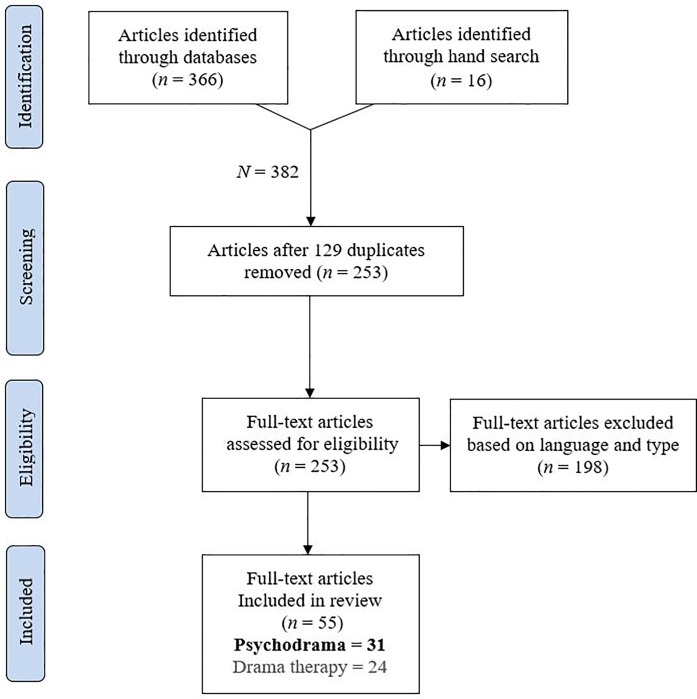
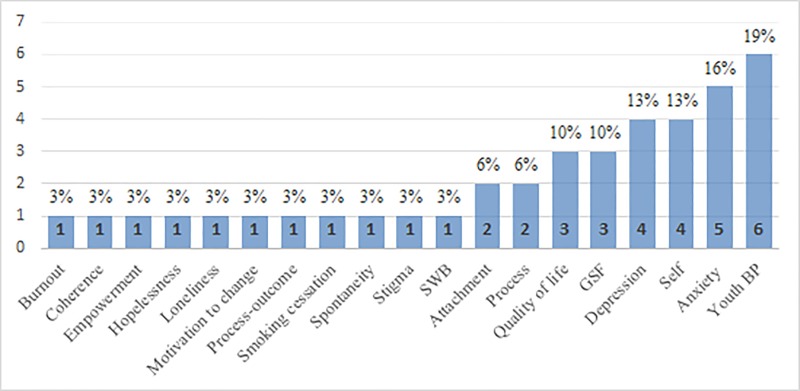
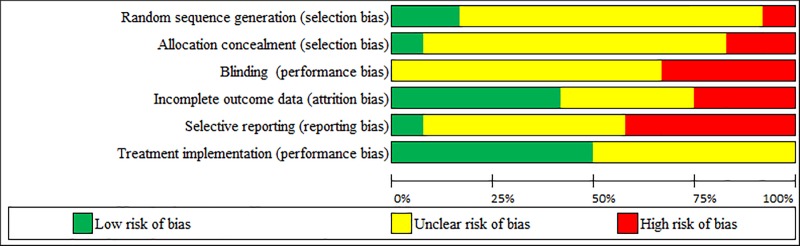
BACKGROUND: Psychodrama is an experiential psychotherapy in which guided role-play is used to gain insights and work on personal and interpersonal problems and possible solutions. Despite the wealth of literature describing clinical work, psychodrama intervention research is relatively scarce compared to other psychotherapies and psychological interventions. OBJECTIVE: For this reason we implemented the integrative approach to systematic review that authorizes the combination of publications with diverse methodologies and all types of participants, interventions, comparisons, and outcomes. Our aim was to produce a comprehensive summary of psychodrama intervention research in the last decade that critically evaluates methodological issues to inform future studies. METHODS: We searched four major electronic databases (PsycINFO, PubMEd, Scopus by Elsevier, and Web of Science) for peer-reviewed articles on psychodrama interventions published in English between 1 January 2007 and 31 December 2017. The quality of qualitative and mixed methods studies was assessed on the basis of pre-established guidelines, and the risk of bias was assessed for all quantitative randomized control studies, consistent with the PRISMA protocol. FINDINGS: The database search and a hand search resulted in 31 psychodrama intervention publications. Overall, these studies examined the effects of psychodrama on more than 20 different outcomes and most studies had adult clients. The next largest group was adolescents, whereas only two studies involved children. Thus psychodrama intervention research in the last decade suggests there are promising results in all methodologies, and highlights the need to enhance methodological as well as reporting quality and to theorize and examine modality-specific mechanisms that lead to therapeutic change. Recommendations to improve methodology, transparency, and specificity in reporting future psychodrama and other psychotherapy research are discussed.
Overview
The claims and statistics of this paper haven’t been checked yet.
Free: it reads the open-access text and checks the first 5 claims that cite a source we can check. Create a free account to check every claim.
Integrity signals
Registry
Cites
Statistics
Figures
Verification
Claims the paper makes
The claims and statistics of this paper haven’t been checked yet.
Free: it reads the open-access text and checks the first 5 claims that cite a source we can check. Create a free account to check every claim.
Claims other papers make about this one
Each is checked against this paper’s own text: does it say what the citing paper says it does?
The source backs part of the claim, not all of it — or backs it for a different population, condition or comparison.
In the citing paper
“Since previous systematic reviews have mainly focused on the impact of the effects of CATs interventions on certain outcomes (e.g., Van Lith, 2016; Koch et al., 2019; Orkibi and Feniger-Schaal, 2019; De Witte et al., 2020b; Feniger-Schaal and Orkibi, 2020), it is worthwhile gaining more insights into how, why, and when CATs interventions lead to certain outcomes.”
From From Therapeutic Factors to Mechanisms of Change in the Creative Arts Therapies: A Scoping Review (2021) · cites this paper as Orkibi and Feniger-Schaal, 2019
Experimental — accuracy not yet measuredThe source backs part of the claim, not all of it — or backs it for a different population, condition or comparison.
In the citing paper
“Along with ACT, another treatment method (psychodrama) was applied to treat the disorder of social anxiety, which was directly associated with the disorder of people because of its display nature [12].”
From Assessing the Effects of Acceptance-commitment and Psychodrama Therapies in Nurses With Social Anxiety Disorder. (2023) · cites this paper as [12]
Experimental — accuracy not yet measured
Self-check
Percentages, sums and reported differences re-computed from the paper’s own numbers.
The self-check needs the paper’s full text.
Citations
Cites
The Cochrane Collaboration's tool for assessing risk of bias in randomised trials
Higgins, J. P. T., Altman, D. G., Gotzsche, P. C., Juni, P., Moher, D., Oxman, A. D., Savovic, J., Schulz, K. F., Weeks, L., Sterne, J. A. C., et al. (2011) · BMJ · doi:10.1136/bmj.d5928 · Cited by 33,817
Liberati, A., Altman, D. G., Tetzlaff, J., Mulrow, C., Gøtzsche, P. C., Ioannidis, J. P. A., Clarke, M., Devereaux, P. J., Kleijnen, J., & Moher, D. (2009) · PLoS Medicine · doi:10.1371/journal.pmed.1000100 · Cited by 28,164
Dermyshi, E., Wang, Y., Yan, C., Hong, W., Qiu, G., Gong, X., & Zhang, T. (2017) · Neonatology · doi:10.1159/000454668 · Cited by 24,451
Designing and Conducting Mixed Methods Research
Robinson, P. (2007) · Australian and New Zealand Journal of Public Health · doi:10.1111/j.1753-6405.2007.00096.x · Cited by 23,258
Research Design: Qualitative, Quantitative, and Mixed Methods Approaches
Creswell, J. W. (1994) · Cited by 21,325
Research design: qualitative, quantitative, and mixed methods approaches
Caldas, M. P. (2003) · Revista de Administração Contemporânea · doi:10.1590/s1415-65552003000100015 · Cited by 18,745
Research Design: Qualitative, Quantitative, and Mixed Methods Approaches
Sloane-Seale, A. (2009) · Canadian Journal of University Continuing Education · doi:10.21225/d54s3d · Cited by 14,328
The integrative review: updated methodology
Whittemore, R., & Knafl, K. (2005) · Journal of Advanced Nursing · doi:10.1111/j.1365-2648.2005.03621.x · Cited by 10,241
Cohen, J. (1992) · Psychological Bulletin · doi:10.1037//0033-2909.112.1.155 · Cited by 8,771
Jacobson, N. S., & Truax, P. (1991) · Journal of Consulting and Clinical Psychology · doi:10.1037/0022-006x.59.1.12 · Cited by 7,770
Research works printed but not linked: 2
- Tarashoeva G, Marinova-Djambazova P, Kojuharov H. Effectiveness of psychodrama therapy in patients with panic disorders: Final results. International Journal of Psychotherapy. 2017; 21(2): 55– 66.
- Moreno JL. The third psychiatric revolution and the scope of psychodrama. Group psychotherapy. 1964; 17(2–3): 149– 71.
Cited by
From Therapeutic Factors to Mechanisms of Change in the Creative Arts Therapies: A Scoping Review
de Witte, M., Orkibi, H., Zarate, R., Karkou, V., Sajnani, N., Malhotra, B., Ho, R. T. H., Kaimal, G., Baker, F. A., & Koch, S. C. (2021) · Frontiers in Psychology · doi:10.3389/fpsyg.2021.678397 · Cited by 366
Self-citationCreative Adaptability: Conceptual Framework, Measurement, and Outcomes in Times of Crisis
Orkibi, H. (2021) · Frontiers in Psychology · doi:10.3389/fpsyg.2020.588172 · Cited by 104
“For example, an intervention for either prevention or treatment may rely on the positive psychodrama framework (Orkibi, 2019) to draw on the value of CA as a personal resource.”
BackgroundSelf-citationIntegrative systematic review of drama therapy intervention research.
Feniger‐Schaal, R., & Orkibi, H. (2020) · Psychology of Aesthetics Creativity and the Arts · doi:10.1037/aca0000257 · Cited by 128
Self-citationMittmann, G., Barnard, A., Krammer, I., Martins, D., & Dias, J. (2022) · Proceedings of the ACM on Human-Computer Interaction · doi:10.1145/3549505 · Cited by 72
“Exposure to the arts in general [47] as well as principles from drama and movement therapy [48, 49] are potent tools to improve mental health.”
BackgroundUsing mobile brain/body imaging to advance research in arts, health, and related therapeutics
King, J. L., & Parada, F. J. (2021) · European Journal of Neuroscience · doi:10.1111/ejn.15313 · Cited by 59
“However, the lack of scientific evidence to buttress these claims, perhaps stemming from a lack of clear research strategies, remains a challenge (Kubovy, 2019; Orkibi & Feniger- Schaal, 2019).”
Background
Metadata
- Authors
- Orkibi, H., & Feniger-Schaal, R.
- Affiliations
- University of Haifa (IL)
- Corresponding author
- Orkibi, Hod
- ORCID
- Orkibi, Hod
- Venue
- PLOS ONE
- Publisher
- Public Library of Science (PLoS)
- Published
- 2019-02-19
- Volume
- 14
- Issue
- 2
- Pages
- e0212575
- ISSN
- 1932-6203 (ISSN-L)
- PMC
- PMC6380607
- OpenAlex
- W2915861607
- Semantic Scholar
- 456a9473d7996a0096a56951467f19337b140477
- Cited by
- 151
- References
- 94
- Citations by year
- 2026: 10 · 2025: 21 · 2024: 14 · 2023: 27 · 2022: 19 · 2021: 33 · 2020: 21 · 2019: 4
- FWCI
- 2.97
- Type
- journal article
- Language
- en
- Open access
- gold
- doi.org
- Licence
- Locations
- PLoS ONE (publishedVersion, cc-by)
- Europe PMC (PubMed Central) (publishedVersion, cc-by)
- PubMed Central (publishedVersion, cc-by)
- PubMed (publishedVersion)
- RePEc: Research Papers in Economics (acceptedVersion)
- DOAJ (DOAJ: Directory of Open Access Journals) (submittedVersion, cc-by-sa)
- Figshare (submittedVersion, cc-by)
- Topics
- Social Sciences › Psychology › Social Psychology › Psychology, Coaching, and Therapy
- Social Sciences › Psychology › Clinical Psychology › Psychotherapy Techniques and Applications
- Social Sciences › Psychology › Clinical Psychology › Art Therapy and Mental Health
- Keywords
- psychodrama, experiential therapy, role play, methodological quality, risk of bias, reporting quality, therapeutic mechanisms, adolescents, children, adults
- MeSH terms
- Crisis Intervention, Humans, Psychodrama, Bias, Treatment Outcome, Qualitative Research
About these checks
Registry, retraction, Cites and statistics results are computed, not judged, with one exception: a printed reference that no index lists is read once by a model before it counts as a citation error. Claims are extracted by a model and kept only when their quote appears verbatim in the text; each cited source is then checked, with a model’s help, for whether it says what the claim relies on. Those verdicts can be wrong — read the claim’s quote and the cited source before relying on one.
Statistics and arithmetic are recomputed, not judged.
Confidence bands are shown only for fields calibrated on our annotated test set. None is calibrated yet, so no band is shown.
What counts as a claim ›How we measure confidence ›How we check this ›
Are you an author, or do you see a problem with this page? Request a review
How to cite
Cite CoChat for the checks on this page, and the paper for its own findings.
- This page
- CoChat. (2026). Citation check: Integrative systematic review of psychodrama psychotherapy research: Trends and methodological implications. https://app.cochat.ai/papers/10.1371/journal.pone.0212575
- The paper
- Orkibi, H., & Feniger-Schaal, R. (2019). Integrative systematic review of psychodrama psychotherapy research: Trends and methodological implications. PLOS ONE. https://doi.org/10.1371/journal.pone.0212575
Data sources
Bibliographic data: Semantic Scholar, OpenAlex, Crossref.
Contains information from the Semantic Scholar Academic Graph Datasets, made available under the ODC Attribution License (ODC-BY 1.0).
Semantic Scholar’s data is described in: Kinney, R., et al. (2023). The Semantic Scholar Open Data Platform. arXiv:2301.10140.
