

Integrative systematic review of psychodrama psychotherapy research: Trends and methodological implications
Open accessThe DOI matches its Crossref record; 103 of the 103 references it cites were found in a registry or an index.
Abstract
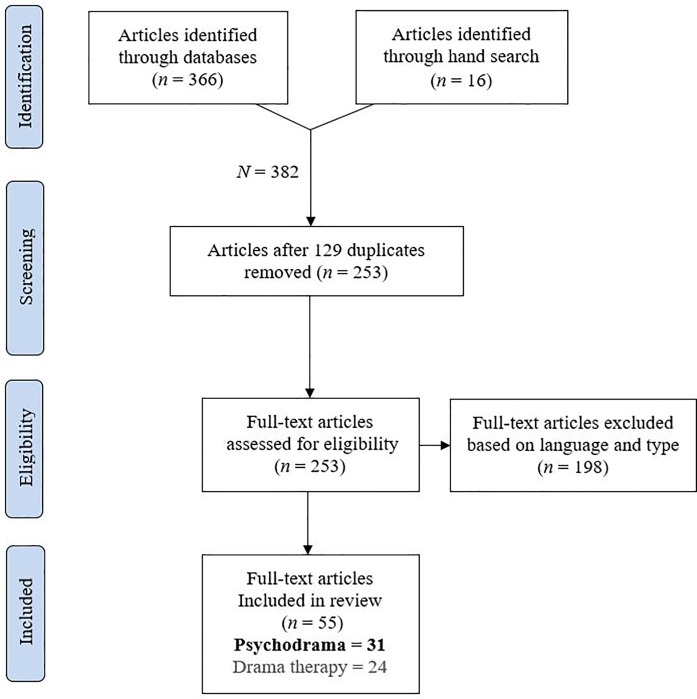
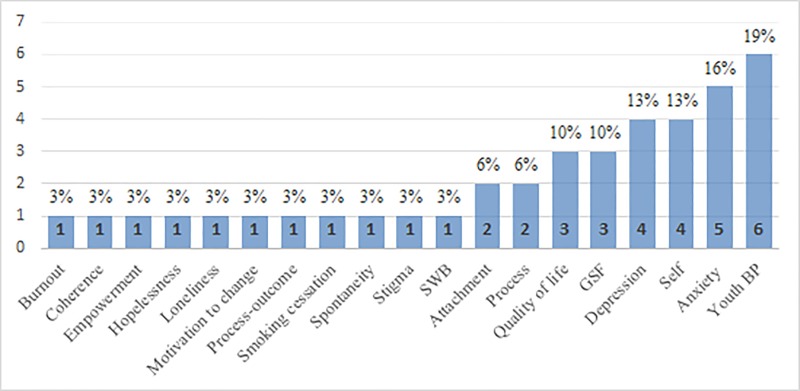
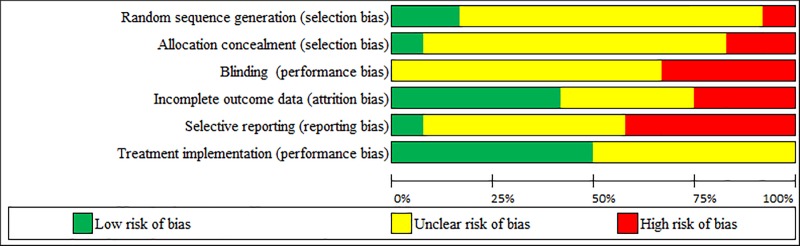
BACKGROUND: Psychodrama is an experiential psychotherapy in which guided role-play is used to gain insights and work on personal and interpersonal problems and possible solutions. Despite the wealth of literature describing clinical work, psychodrama intervention research is relatively scarce compared to other psychotherapies and psychological interventions. OBJECTIVE: For this reason we implemented the integrative approach to systematic review that authorizes the combination of publications with diverse methodologies and all types of participants, interventions, comparisons, and outcomes. Our aim was to produce a comprehensive summary of psychodrama intervention research in the last decade that critically evaluates methodological issues to inform future studies. METHODS: We searched four major electronic databases (PsycINFO, PubMEd, Scopus by Elsevier, and Web of Science) for peer-reviewed articles on psychodrama interventions published in English between 1 January 2007 and 31 December 2017. The quality of qualitative and mixed methods studies was assessed on the basis of pre-established guidelines, and the risk of bias was assessed for all quantitative randomized control studies, consistent with the PRISMA protocol. FINDINGS: The database search and a hand search resulted in 31 psychodrama intervention publications. Overall, these studies examined the effects of psychodrama on more than 20 different outcomes and most studies had adult clients. The next largest group was adolescents, whereas only two studies involved children. Thus psychodrama intervention research in the last decade suggests there are promising results in all methodologies, and highlights the need to enhance methodological as well as reporting quality and to theorize and examine modality-specific mechanisms that lead to therapeutic change. Recommendations to improve methodology, transparency, and specificity in reporting future psychodrama and other psychotherapy research are discussed.
Overview
The claims and statistics of this paper haven’t been checked yet.
Free: it reads the open-access text and checks the first 5 claims that cite a source we can check. Create a free account to check every claim.
Integrity signals
Registry
Cites
Statistics
Figures
Verification
Claims the paper makes
The claims and statistics of this paper haven’t been checked yet.
Free: it reads the open-access text and checks the first 5 claims that cite a source we can check. Create a free account to check every claim.
Claims other papers make about this one
Each is checked against this paper’s own text: does it say what the citing paper says it does?
The source backs part of the claim, not all of it — or backs it for a different population, condition or comparison.
In the citing paper
“Since previous systematic reviews have mainly focused on the impact of the effects of CATs interventions on certain outcomes (e.g., Van Lith, 2016; Koch et al., 2019; Orkibi and Feniger-Schaal, 2019; De Witte et al., 2020b; Feniger-Schaal and Orkibi, 2020), it is worthwhile gaining more insights into how, why, and when CATs interventions lead to certain outcomes.”
From From Therapeutic Factors to Mechanisms of Change in the Creative Arts Therapies: A Scoping Review (2021) · cites this paper as Orkibi and Feniger-Schaal, 2019
Experimental — accuracy not yet measuredThe source backs part of the claim, not all of it — or backs it for a different population, condition or comparison.
In the citing paper
“Along with ACT, another treatment method (psychodrama) was applied to treat the disorder of social anxiety, which was directly associated with the disorder of people because of its display nature [12].”
From Assessing the Effects of Acceptance-commitment and Psychodrama Therapies in Nurses With Social Anxiety Disorder. (2023) · cites this paper as [12]
Experimental — accuracy not yet measured
Self-check
Percentages, sums and reported differences re-computed from the paper’s own numbers.
The self-check needs the paper’s full text.
Citations
Cites
The Cochrane Collaboration's tool for assessing risk of bias in randomised trials
Higgins, J. P. T., Altman, D. G., Gotzsche, P. C., Juni, P., Moher, D., Oxman, A. D., Savovic, J., Schulz, K. F., Weeks, L., Sterne, J. A. C., et al. (2011) · BMJ · doi:10.1136/bmj.d5928 · Cited by 33,817
Liberati, A., Altman, D. G., Tetzlaff, J., Mulrow, C., Gøtzsche, P. C., Ioannidis, J. P. A., Clarke, M., Devereaux, P. J., Kleijnen, J., & Moher, D. (2009) · PLoS Medicine · doi:10.1371/journal.pmed.1000100 · Cited by 28,164
Dermyshi, E., Wang, Y., Yan, C., Hong, W., Qiu, G., Gong, X., & Zhang, T. (2017) · Neonatology · doi:10.1159/000454668 · Cited by 24,451
Designing and Conducting Mixed Methods Research
Robinson, P. (2007) · Australian and New Zealand Journal of Public Health · doi:10.1111/j.1753-6405.2007.00096.x · Cited by 23,258
Research Design: Qualitative, Quantitative, and Mixed Methods Approaches
Creswell, J. W. (1994) · Cited by 21,325
Research design: qualitative, quantitative, and mixed methods approaches
Caldas, M. P. (2003) · Revista de Administração Contemporânea · doi:10.1590/s1415-65552003000100015 · Cited by 18,745
Research Design: Qualitative, Quantitative, and Mixed Methods Approaches
Sloane-Seale, A. (2009) · Canadian Journal of University Continuing Education · doi:10.21225/d54s3d · Cited by 14,328
The integrative review: updated methodology
Whittemore, R., & Knafl, K. (2005) · Journal of Advanced Nursing · doi:10.1111/j.1365-2648.2005.03621.x · Cited by 10,241
Cohen, J. (1992) · Psychological Bulletin · doi:10.1037//0033-2909.112.1.155 · Cited by 8,771
Jacobson, N. S., & Truax, P. (1991) · Journal of Consulting and Clinical Psychology · doi:10.1037/0022-006x.59.1.12 · Cited by 7,770
(2006) · Cited by 7,081
Using Effect Size—or Why the P Value Is Not Enough
Sullivan, G. M., & Feinn, R. (2012) · Journal of Graduate Medical Education · doi:10.4300/jgme-d-12-00156.1 · Cited by 5,553
Single-Case Research Designs: Methods for Clinical and Applied Settings
Kazdin, A. E. (1982) · Cited by 4,040
Testing moderator and mediator effects in counseling psychology research.
Frazier, P. A., Tix, A. P., & Barron, K. E. (2004) · Journal of Counseling Psychology · doi:10.1037/0022-0167.51.1.115 · Cited by 4,037
An effect size primer: A guide for clinicians and researchers.
Ferguson, C. J. (2009) · Professional Psychology: Research and Practice · doi:10.1037/a0015808 · Cited by 3,467
Bergin and Garfield's Handbook of Psychotherapy and Behavior Change
Lambert, M. J. (2003) · Cited by 3,383
Methley, A. M., Campbell, S., Chew-Graham, C., McNally, R., & Cheraghi-Sohi, S. (2014) · BMC Health Services Research · doi:10.1186/s12913-014-0579-0 · Cited by 2,706
Single-case research designs: Methods for clinical and applied settings
Hayes, S. C. (1983) · Journal of Behavior Therapy and Experimental Psychiatry · doi:10.1016/0005-7916(83)90018-6 · Cited by 2,677
Levitt, H. M., Bamberg, M., Creswell, J. W., Frost, D. M., Josselson, R., & Suárez-Orozco, C. (2018) · American Psychologist · doi:10.1037/amp0000151 · Cited by 2,286
Flexible Imputation of Missing Data
van Buuren, S. (2012) · doi:10.1201/b11826 · Cited by 2,022
Intention-to-treat concept: A review
Gupta, S. (2011) · Perspectives in Clinical Research · doi:10.4103/2229-3485.83221 · Cited by 1,921
Ishtiaq, M. (2019) · English Language Teaching · doi:10.5539/elt.v12n5p40 · Cited by 1,732
How important are the common factors in psychotherapy? An update
Wampold, B. E. (2015) · World Psychiatry · doi:10.1002/wps.20238 · Cited by 1,728
Appelbaum, M., Cooper, H., Kline, R. B., Mayo-Wilson, E., Nezu, A. M., & Rao, S. M. (2018) · American Psychologist · doi:10.1037/amp0000191 · Cited by 1,449
Single-Case Designs Technical Documentation.
Kratochwill, T. R., Hitchcock, J. H., Horner, R., Levin, J., Odom, S. L., Rindskopf, D. M., & Shadish, W. R. (2010) · Cited by 1,345
Appraising the Evidence: Reviewing Disparate Data Systematically
Hawker, S., Payne, S., Kerr, C., Hardey, M., & Powell, J. (2002) · Qualitative Health Research · doi:10.1177/1049732302238251 · Cited by 1,216
Munn, Z., Stern, C., Aromataris, E., Lockwood, C., & Jordan, Z. (2018) · BMC Medical Research Methodology · doi:10.1186/s12874-017-0468-4 · Cited by 1,164
(1992) · Choice Reviews Online · doi:10.5860/choice.29-5971 · Cited by 1,061
Understanding how and why psychotherapy leads to change
Kazdin, A. E. (2009) · Psychotherapy Research · doi:10.1080/10503300802448899 · Cited by 728
Who Shall Survive? Foundations of Sociometry, Group Psychotherapy and Sociodrama
Smith, E. R., & Moreno, J. L. (1953) · The American Catholic Sociological Review · doi:10.2307/3706701 · Cited by 638
Reviewing the methodology of an integrative review
Hopia, H., Latvala, E., & Liimatainen, L. (2016) · Scandinavian Journal of Caring Sciences · doi:10.1111/scs.12327 · Cited by 459
The Effects of Music on Pain: A Meta-Analysis
Lee, J. H. (2016) · Journal of Music Therapy · doi:10.1093/jmt/thw012 · Cited by 347
Runco, M., Pritzker, S., Reiter-Palmon, R., & Selart, M. (2011) · Elsevier eBooks · doi:10.1016/c2009-1-03751-4 · Cited by 321
Hermeneutic Single-Case Efficacy Design
Elliott, R. (2002) · Psychotherapy Research · doi:10.1080/713869614 · Cited by 300
Galván, J. (2017) · doi:10.4324/9781315266091 · Cited by 291
Reporting Guidelines for Music-based Interventions
Robb, S. L., Carpenter, J. S., & Burns, D. S. (2011) · Journal of Health Psychology · doi:10.1177/1359105310374781 · Cited by 261
Moreno, J. L. (1946) · Beacon House eBooks · doi:10.1037/11506-000 · Cited by 215
(2012) · Choice Reviews Online · doi:10.5860/choice.49-3009 · Cited by 210
Writing Literature Reviews: A Guide for Students of the Social and Behavioral Sciences
Galván, J. L. (1999) · Medical Entomology and Zoology · Cited by 209
Cochrane’s risk of bias tool in the context of psychotherapy outcome research
Munder, T., & Barth, J. (2018) · Psychotherapy Research · doi:10.1080/10503307.2017.1411628 · Cited by 174
The essential Moreno: Writings on psychodrama, group method, and spontaneity.
Moreno, J., & Fox, J. (1987) · doi:10.1037/027607 · Cited by 173
Quantitative and Qualitative Methods in Psychotherapy Research
(2014) · Routledge eBooks · doi:10.4324/9780203386071 · Cited by 162
Zhao, K., Bai, Z. G., Bo, A., & Chi, I. (2016) · International Journal of Geriatric Psychiatry · doi:10.1002/gps.4494 · Cited by 161
Lambert, M. J., & Ogles, B. M. (2009) · Psychotherapy Research · doi:10.1080/10503300902849483 · Cited by 159
The essential Moreno: Writings on psychodrama, group method, and spontaneity.
Moreno, J. L., & Fox, J. (1987) · Cited by 159
Reporting Guidelines for Music-Based Interventions
Robb, S. L., Burns, D. S., & Carpenter, J. S. (2011) · Music and Medicine · doi:10.1177/1943862111420539 · Cited by 147
Ten Have, T. R., Normand, S.-L. T., Marcus, S. M., Brown, C. H., Lavori, P., & Duan, N. (2008) · Psychiatric Annals · doi:10.3928/00485713-20081201-10 · Cited by 146
Laird, K. T., Tanner-Smith, E. E., Russell, A. C., Hollon, S. D., & Walker, L. S. (2017) · Clinical Psychology Review · doi:10.1016/j.cpr.2016.11.001 · Cited by 141
Focus On Psychodrama: The Therapeutic Aspects of Psychodrama
Kellermann, P. F. (1992) · Medical Entomology and Zoology · Cited by 137
The effectiveness of psychodramatic techniques: A meta-analysis.
Kipper, D. A., & Ritchie, T. D. (2003) · Group Dynamics: Theory, Research, and Practice · doi:10.1037/1089-2699.7.1.13 · Cited by 132
Integrative systematic review of drama therapy intervention research.
Feniger‐Schaal, R., & Orkibi, H. (2020) · Psychology of Aesthetics Creativity and the Arts · doi:10.1037/aca0000257 · Cited by 128
Self-citationMeasuring Treatment Fidelity in a Rehabilitation Intervention Study
Hildebrand, M. W., Host, H. H., Binder, E. F., Carpenter, B., Freedland, K. E., Morrow-Howell, N., Baum, C. M., Doré, P., & Lenze, E. J. (2012) · American Journal of Physical Medicine & Rehabilitation · doi:10.1097/phm.0b013e31824ad462 · Cited by 107
Moderators, mediators and mechanisms of change in psychotherapy
Kazdin, A. E. (2014) · Quantitative and Qualitative Methods in Psychotherapy Research · doi:10.4324/9780203386071-6 · Cited by 99
Özbaş, A. A., & Tel, H. (2015) · Palliative & Supportive Care · doi:10.1017/s1478951515001121 · Cited by 83
Linking trauma to posttraumatic growth and mental health through emotional and cognitive creativity.
Orkibi, H., & Ram-Vlasov, N. (2019) · Psychology of Aesthetics Creativity and the Arts · doi:10.1037/aca0000193 · Cited by 83
Self-citationDevelopment of sense of coherence during two group interventions.
Kähönen, K., Näätänen, P., Tolvanen, A., & Salmela-Aro, K. (2012) · Scandinavian Journal of Psychology · doi:10.1111/sjop.12020 · Cited by 76
The effects of psychodrama on young adults’ attachment styles
Doğan, T. (2010) · The Arts in Psychotherapy · doi:10.1016/j.aip.2010.02.001 · Cited by 67
Kisbu-Sakarya, Y., MacKinnon, D. P., & Aiken, L. S. (2013) · Educational and Psychological Measurement · doi:10.1177/0013164412450574 · Cited by 57
Mcvea, C., Gow, K., & Lowe, R. (2011) · Psychotherapy Research · doi:10.1080/10503307.2011.577823 · Cited by 51
Denton, W. H., Johnson, S. M., & Burleson, B. R. (2009) · Journal of Couple & Relationship Therapy · doi:10.1080/15332690903048820 · Cited by 50
The effect of drama-based group therapy on aspects of mental illness stigma
Orkibi, H., Bar, N., & Eliakim, I. (2014) · The Arts in Psychotherapy · doi:10.1016/j.aip.2014.08.006 · Cited by 49
Self-citationEvaluation of Geese Theatre’s Re-Connect Program: Addressing Resettlement Issues in Prison
Harkins, L., Pritchard, C., Haskayne, D., Watson, A., & Beech, A. R. (2010) · International Journal of Offender Therapy and Comparative Criminology · doi:10.1177/0306624x10370452 · Cited by 49
The effect of psychotherapy in patients with PD: A controlled study
Sproesser, E., Viana, M. A., Quagliato, E. M. A. B., & de Souza, E. A. P. (2010) · Parkinsonism & Related Disorders · doi:10.1016/j.parkreldis.2009.08.008 · Cited by 48
Outcome Research In Classical Psychodrama
Kellermann, P. F. (1987) · Small Group Behavior · doi:10.1177/104649648701800402 · Cited by 46
Psychodrama : Advances in Theory and Practice
Baim, C., Burmeister, J., & Maciel, M. (2007) · doi:10.4324/9780203961100 · Cited by 45
Gatta, M., Lara, D. Z., Lara, D. C., Andrea, S., Paolo, T. C., Giovanni, C., Rosaria, S., Carolina, B., & PierAntonio, B. (2010) · The Arts in Psychotherapy · doi:10.1016/j.aip.2010.04.010 · Cited by 43
Balancing statistical and clinical significance in evaluating treatment effects
Leung, W. (2001) · Postgraduate medical journal · doi:10.1136/pmj.77.905.201 · Cited by 41
Entre Dos Mundos/Between Two Worlds: Youth Violence Prevention for Acculturating Latino Families
Smokowski, P. R., & Bacallao, M. L. (2008) · Research on Social Work Practice · doi:10.1177/1049731508315989 · Cited by 41
Smokowski, P. R., & Bacallao, M. L. (2008) · Small Group Research · doi:10.1177/1046496408326771 · Cited by 40
The four-phase CBN Psychodrama Model: A manualized approach for practice and research
Azoulay, B., & Orkibi, H. (2015) · The Arts in Psychotherapy · doi:10.1016/j.aip.2014.12.012 · Cited by 39
Self-citationOrkibi, H., Azoulay, B., Snir, S., & Regev, D. (2017) · Clinical Psychology & Psychotherapy · doi:10.1002/cpp.2103 · Cited by 38
Self-citationAkinsola, E. F., & Udoka, P. A. (2013) · Psychology · doi:10.4236/psych.2013.43a037 · Cited by 36
Biolcati, R., Agostini, F., & Mancini, G. (2017) · Research in Psychotherapy Psychopathology Process and Outcome · doi:10.4081/ripppo.2017.272 · Cited by 36
Ronk, F. R., Hooke, G. R., & Page, A. C. (2016) · BMC Psychiatry · doi:10.1186/s12888-016-0895-5 · Cited by 36
Karataş, Z. (2011) · Educational Sciences Theory & Practice · Cited by 36
Psychodrama Since Moreno : Innovations in Theory and Practice
Holmes, P., Karp, M., & Watson, M. (2005) · Routledge eBooks · doi:10.4324/9780203977187 · Cited by 35
Psychodrama as a social work modality.
Konopik, D. A., & Cheung, M. (2013) · Social work · doi:10.1093/sw/sws054 · Cited by 35
Karataş, Z., & Gökçakan, Z. (2009) · PubMed · Cited by 33
Ang, K., Hepgul, N., Gao, W., & Higginson, I. J. (2017) · Palliative Medicine · doi:10.1177/0269216317717369 · Cited by 32
Theory of Spontaneity-Creativity
Moreno, J. (1955) · Sociometry · doi:10.2307/2785848 · Cited by 30
Högberg, G., & Hällström, T. (2008) · Clinical Child Psychology and Psychiatry · doi:10.1177/1359104507088348 · Cited by 26
González, A.-J., Martins, P., & de Lima, M. P. (2018) · Frontiers in Psychology · doi:10.3389/fpsyg.2018.01662 · Cited by 26
Orkibi, H., Azoulay, B., Regev, D., & Snir, S. (2017) · The Arts in Psychotherapy · doi:10.1016/j.aip.2017.04.001 · Cited by 25
Self-citationMenichetti, J., Giusti, L., Fossati, I., & Vegni, E. A. M. (2015) · European Journal of Cancer Care · doi:10.1111/ecc.12412 · Cited by 25
Karataş, Z., & Gökçakan, Z. (2009) · Educational Sciences Theory & Practice · Cited by 22
Quantitative and qualitative methods for psychotherapy research
Lutz, W., & Knox, S. (2014) · Routledge eBooks · doi:10.4324/9780203386071-1 · Cited by 21
Psychodrama and the Emotional State of Women Dealing with Infertility
Terzioğlu, C., & Özkan, B. (2017) · Sexuality and Disability · doi:10.1007/s11195-017-9514-8 · Cited by 20
Adaptation, Adaptiveness, and Creativity
Cohen, L. (2011) · Elsevier eBooks · doi:10.1016/b978-0-12-375038-9.00002-9 · Cited by 17
Group Psychodrama for Korean College Students
Chae, S., & Kim, S. (2017) · Journal of College Student Psychotherapy · doi:10.1080/87568225.2016.1239512 · Cited by 16
Vural, P., Akkaya, C., Küçükparlak, İ., Ercan, İ., & Eracar, N. (2014) · The Arts in Psychotherapy · doi:10.1016/j.aip.2014.02.004 · Cited by 16
The effect of psychodrama on people living with HIV/AIDS
Karabilgin, Ö. S., Gökengin, G. B., Doğaner, İ., & Gökengin, D. (2012) · European Journal of Psychotherapy & Counselling · doi:10.1080/13642537.2012.734529 · Cited by 15
Orkibi, H. (2018) · The Arts in Psychotherapy · doi:10.1016/j.aip.2018.04.004 · Cited by 15
Self-citation[Preface: genetics and psychiatry].
Uluşahin, A. (2009) · PubMed · Cited by 15
Quantitative and qualitative methods in psychotherapy research
Carnevale, K., & Hayes, J. (2016) · Psychotherapy Research · doi:10.1080/10503307.2015.1104423 · Cited by 14
Effects of Psychodrama Practice on University Students' Subjective Well- Being and Hopelessness
Akif, M. (2014) · Cited by 14
Oğuzhanoğlu, N. K., Sözeri-Varma, G., Karadağ, F., Tümkaya, S., Efe, M., & Kıroğlu, Y. (2014) · PubMed · Cited by 14
Effects of Psychodrama Practice on University Students’ Subjective Well-Being and Hopelessness
Karataş, Z. (2014) · Education and Science · doi:10.15390/es.2014.1267 · Cited by 13
The Effectiveness of Psychodrama in Improving Quality of Life among Opiate-dependent Male Patients
Dehnavi, S., Bajelan, M., Parde, S. J., KhodaViren, H., & Mohebbi-Dehnavi, Z. (2016) · DOAJ (DOAJ: Directory of Open Access Journals) · Cited by 13
Intensive Clinic Intervention Plus Psychodrama in Smoking Cessation and Effects on Cessation Outcome
Aytemur, Z. A., PİŞMİŞOĞLU, B., Kılınç, O., Pişmişoğlu, E., Nrs., Hacıevliyagil, S. S., & Karaman, C. (2012) · Turkiye Klinikleri Journal of Medical Sciences · doi:10.5336/medsci.2011-23965 · Cited by 12
Evaluation Of The Effectiveness Of Anger Management Education Enriched With Psychodrama
Bilge, A. (2017) · Journal of Psychiatric Nursing · doi:10.14744/phd.2017.08760 · Cited by 9
Current trends in psychodrama : Eclectic and analytic dimensions
Hug, E. (1997) · The Arts in Psychotherapy · doi:10.1016/s0197-4556(96)00046-9 · Cited by 4
A pilot study on an analytic psychodrama group for cancer patients and family members
Alby, F., Angelici, G., Picinotti, S., & Zucchermaglio, C. (2017) · IRIS Research product catalog (Sapienza University of Rome) · doi:10.13133/1974-4854/16668 · Cited by 3
Jarrett, J. E. (2013) · Technometrics · doi:10.1080/00401706.2013.852875
Research works printed but not linked: 2
- Tarashoeva G, Marinova-Djambazova P, Kojuharov H. Effectiveness of psychodrama therapy in patients with panic disorders: Final results. International Journal of Psychotherapy. 2017; 21(2): 55– 66.
- Moreno JL. The third psychiatric revolution and the scope of psychodrama. Group psychotherapy. 1964; 17(2–3): 149– 71.
Cited by
From Therapeutic Factors to Mechanisms of Change in the Creative Arts Therapies: A Scoping Review
de Witte, M., Orkibi, H., Zarate, R., Karkou, V., Sajnani, N., Malhotra, B., Ho, R. T. H., Kaimal, G., Baker, F. A., & Koch, S. C. (2021) · Frontiers in Psychology · doi:10.3389/fpsyg.2021.678397 · Cited by 366
Self-citationCreative Adaptability: Conceptual Framework, Measurement, and Outcomes in Times of Crisis
Orkibi, H. (2021) · Frontiers in Psychology · doi:10.3389/fpsyg.2020.588172 · Cited by 104
“For example, an intervention for either prevention or treatment may rely on the positive psychodrama framework (Orkibi, 2019) to draw on the value of CA as a personal resource.”
BackgroundSelf-citationIntegrative systematic review of drama therapy intervention research.
Feniger‐Schaal, R., & Orkibi, H. (2020) · Psychology of Aesthetics Creativity and the Arts · doi:10.1037/aca0000257 · Cited by 128
Self-citationMittmann, G., Barnard, A., Krammer, I., Martins, D., & Dias, J. (2022) · Proceedings of the ACM on Human-Computer Interaction · doi:10.1145/3549505 · Cited by 72
“Exposure to the arts in general [47] as well as principles from drama and movement therapy [48, 49] are potent tools to improve mental health.”
BackgroundUsing mobile brain/body imaging to advance research in arts, health, and related therapeutics
King, J. L., & Parada, F. J. (2021) · European Journal of Neuroscience · doi:10.1111/ejn.15313 · Cited by 59
“However, the lack of scientific evidence to buttress these claims, perhaps stemming from a lack of clear research strategies, remains a challenge (Kubovy, 2019; Orkibi & Feniger- Schaal, 2019).”
Background
Metadata
- Authors
- Orkibi, H., & Feniger-Schaal, R.
- Affiliations
- University of Haifa (IL)
- Corresponding author
- Orkibi, Hod
- ORCID
- Orkibi, Hod
- Venue
- PLOS ONE
- Publisher
- Public Library of Science (PLoS)
- Published
- 2019-02-19
- Volume
- 14
- Issue
- 2
- Pages
- e0212575
- ISSN
- 1932-6203 (ISSN-L)
- PMC
- PMC6380607
- OpenAlex
- W2915861607
- Semantic Scholar
- 456a9473d7996a0096a56951467f19337b140477
- Cited by
- 151
- References
- 94
- Citations by year
- 2026: 10 · 2025: 21 · 2024: 14 · 2023: 27 · 2022: 19 · 2021: 33 · 2020: 21 · 2019: 4
- FWCI
- 2.97
- Type
- journal article
- Language
- en
- Open access
- gold
- doi.org
- Licence
- Locations
- PLoS ONE (publishedVersion, cc-by)
- Europe PMC (PubMed Central) (publishedVersion, cc-by)
- PubMed Central (publishedVersion, cc-by)
- PubMed (publishedVersion)
- RePEc: Research Papers in Economics (acceptedVersion)
- DOAJ (DOAJ: Directory of Open Access Journals) (submittedVersion, cc-by-sa)
- Figshare (submittedVersion, cc-by)
- Topics
- Social Sciences › Psychology › Social Psychology › Psychology, Coaching, and Therapy
- Social Sciences › Psychology › Clinical Psychology › Psychotherapy Techniques and Applications
- Social Sciences › Psychology › Clinical Psychology › Art Therapy and Mental Health
- Keywords
- psychodrama, experiential therapy, role play, methodological quality, risk of bias, reporting quality, therapeutic mechanisms, adolescents, children, adults
- MeSH terms
- Crisis Intervention, Humans, Psychodrama, Bias, Treatment Outcome, Qualitative Research
About these checks
Registry, retraction, Cites and statistics results are computed, not judged, with one exception: a printed reference that no index lists is read once by a model before it counts as a citation error. Claims are extracted by a model and kept only when their quote appears verbatim in the text; each cited source is then checked, with a model’s help, for whether it says what the claim relies on. Those verdicts can be wrong — read the claim’s quote and the cited source before relying on one.
Statistics and arithmetic are recomputed, not judged.
Confidence bands are shown only for fields calibrated on our annotated test set. None is calibrated yet, so no band is shown.
What counts as a claim ›How we measure confidence ›How we check this ›
Are you an author, or do you see a problem with this page? Request a review
Data sources
Bibliographic data: Semantic Scholar, OpenAlex, Crossref.
Contains information from the Semantic Scholar Academic Graph Datasets, made available under the ODC Attribution License (ODC-BY 1.0).
Semantic Scholar’s data is described in: Kinney, R., et al. (2023). The Semantic Scholar Open Data Platform. arXiv:2301.10140.
