

Algorithmic bias amplifies opinion fragmentation and polarization: A bounded confidence model
Open accessThe DOI matches its Crossref record; 57 of the 57 references it cites were found in a registry or an index.
Abstract
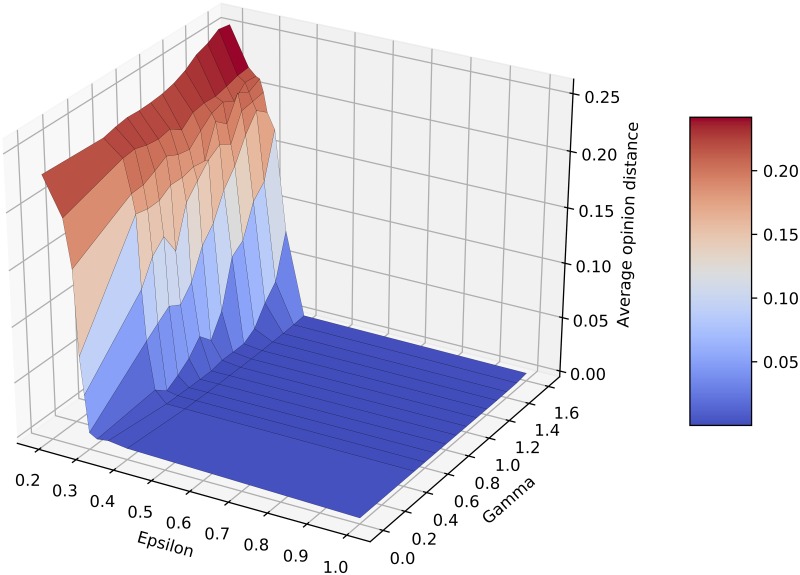
The flow of information reaching us via the online media platforms is optimized not by the information content or relevance but by popularity and proximity to the target. This is typically performed in order to maximise platform usage. As a side effect, this introduces an algorithmic bias that is believed to enhance fragmentation and polarization of the societal debate. To study this phenomenon, we modify the well-known continuous opinion dynamics model of bounded confidence in order to account for the algorithmic bias and investigate its consequences. In the simplest version of the original model the pairs of discussion participants are chosen at random and their opinions get closer to each other if they are within a fixed tolerance level. We modify the selection rule of the discussion partners: there is an enhanced probability to choose individuals whose opinions are already close to each other, thus mimicking the behavior of online media which suggest interaction with similar peers. As a result we observe: a) an increased tendency towards opinion fragmentation, which emerges also in conditions where the original model would predict consensus, b) increased polarisation of opinions and c) a dramatic slowing down of the speed at which the convergence at the asymptotic state is reached, which makes the system highly unstable. Fragmentation and polarization are augmented by a fragmented initial population.
Overview
The claims and statistics of this paper haven’t been checked yet.
Free: it reads the open-access text and checks the first 5 claims that cite a source we can check. Create a free account to check every claim.
Integrity signals
Registry
Cites
Statistics
Figures



Verification
Claims the paper makes
The claims and statistics of this paper haven’t been checked yet.
Free: it reads the open-access text and checks the first 5 claims that cite a source we can check. Create a free account to check every claim.
Self-check
Percentages, sums and reported differences re-computed from the paper’s own numbers.
The self-check needs the paper’s full text.
Citations
Cites
Emergence of Scaling in Random Networks
Barabási, A.-L., & Albert, R. (1999) · Science · doi:10.1126/science.286.5439.509 · Cited by 36,135
(2011) · Cited by 4,430
Epidemic processes in complex networks
Pastor-Satorras, R., Castellano, C., Van Mieghem, P., & Vespignani, A. (2015) · Reviews of Modern Physics · doi:10.1103/revmodphys.87.925 · Cited by 3,697
Exposure to ideologically diverse news and opinion on Facebook
Bakshy, E., Messing, S., & Adamic, L. A. (2015) · Science · doi:10.1126/science.aaa1160 · Cited by 3,245 · cited 1×
“The variety of interactions of a person (family, school, work, hobby, etc.) may contribute to diversification of information sources [14], nevertheless, regarding political views homophily seems particularly strong [15].”
BackgroundThe spreading of misinformation online
Del Vicario, M., Bessi, A., Zollo, F., Petroni, F., Scala, A., Caldarelli, G., Stanley, H. E., & Quattrociocchi, W. (2016) · Proceedings of the National Academy of Sciences · doi:10.1073/pnas.1517441113 · Cited by 2,407
Opinion Dynamics and Bounded Confidence Models, Analysis and Simulation
Hegselmann, R., & Krause, U. (2002) · RePEc: Research Papers in Economics · Cited by 2,362
Mixing beliefs among interacting agents
Deffuant, G., Neau, D., Amblard, F., & Weisbuch, G. (2000) · Advances in Complex Systems · doi:10.1142/s0219525900000078 · Cited by 2,165 · cited 4×
“The original bounded confidence model [17] considers a population of N individuals, where each individual i holds a continuous opinion x i ∈ [0 , 1].”
BackgroundMethodInfluentialPrior, M. (2007) · Cambridge University Press eBooks · doi:10.1017/cbo9781139878425 · Cited by 1,582
(2007) · Choice Reviews Online · doi:10.5860/choice.45-1733 · Cited by 1,178
Colleoni, E., Rozza, A., & Arvidsson, A. (2014) · Journal of Communication · doi:10.1111/jcom.12084 · Cited by 1,151
Research works printed but not linked: 2
- K Purcell, 2010, Understanding the participatory news consumer, Pew Internet and American Life Project, 1, 19
- MW Macy, 2003, Polarization in dynamic networks: A Hopfield model of emergent structure, Dynamic social network modeling and analysis, 162
Cited by
Items 101–135 of 135
Coevolutionary opinion dynamics with sparse interactions in open-ended societies
Bao, H., Neal, Z. P., & Banzhaf, W. (2022) · Complex & Intelligent Systems · doi:10.1007/s40747-022-00810-w · Cited by 2
Effect of recommending users and opinions on the network connectivity and idea generation process
Pandey, S., & Sayama, H. (2024) · Northeast Journal of Complex Systems · doi:10.22191/nejcs/vol6/iss1/1 · Cited by 3
“Sirbu et al. [34] have used a modified bounded confidence model to demonstrate that algorithmic biases, introduced to increase social network platform usage, can lead to polarization and fragmentation of the network.”
Social Networks, Supportive Communication, and Health Outcomes
Wright, K. B. (2024) · Springer eBooks · doi:10.1007/978-981-97-0821-5_25-1 · Cited by 2
Epistemic Diversity and Explanatory Adequacy in Distributed Information Processing
Mertzani, A., Pitt, J. V., Nowak, A. K., & Michalak, T. (2022) · Lecture notes in computer science · doi:10.1007/978-3-031-20845-4_2 · Cited by 2
Sabra, I., & Elkadi, M. (2022) · Journal of Law and Emerging Technologies · doi:10.54873/jolets.v2i1.70 · Cited by 2
Impact of varied friendships and influence weights on opinion dynamics
Li, D., Qian, W., Sun, X., & Han, D. (2023) · Europhysics Letters (EPL) · doi:10.1209/0295-5075/acf520 · Cited by 1
Structure-Attribute Similarity Interplay in Diffusion Dynamics on Social Networks
Citraro, S., Pansanella, V., & Rossetti, G. (2025) · Lecture notes in computer science · doi:10.1007/978-3-031-78980-9_27 · Cited by 1
Ungruh, R., & Pera, M. S. (2026) · ACM Conference on User Modeling, Adaptation and Personalization (UMAP) · doi:10.1145/3774935.3806148 · Cited by 1
“Yet, suggestions may be unsuitable [73, 112, 118] and children’s interactions with RS can reinforce problematic behaviors [14, 42, 107].”
Quantifying opinion homophily in online social networks from a bounded confidence perspective
Luan, Y., Ancona, C., Bernardo, C., Pansanella, V., Iudice, F. L., Rossetti, G., Vasca, F., Wu, X., & Altafini, C. (2026) · Communications Physics · doi:10.1038/s42005-026-02760-y · Cited by 2
YSocial: An artificial intelligence powered social media virtual twin
Rossetti, G., Stella, M., Cazabet, R., Abramski, K., Citraro, S., Cau, E., Failla, A., Morini, V., & Pansanella, V. (2026) · Big Data & Society · doi:10.1177/20539517261431576 · Cited by 4
Albayrak, O. (2023) · Akademisyen Kitabevi eBooks · doi:10.37609/akya.2693 · Cited by 3
A Formal Model for Polarization under Confirmation Bias in Social NetworksPreprint
Alvim, M. S., Amorim, B., Knight, S., Quintero, S., & Valencia, F. (2021) · arXiv (Cornell University) · doi:10.48550/arxiv.2112.09542 · Cited by 1
Le rapport aux autres cultures : la parole à des étudiants du collégial
Landry, D., Malenfant-Veilleux, A., & Roy, S. (2020) · Bibliothèque et Archives nationales du Québec (Québec government)
Artificial awareness, as an innovative learning method and its application in science and technology
Adamski, A. G., & Julia, A. (2023) · Annals of Biomedical Science and Engineering · doi:10.29328/journal.abse.1001020
Effect of External Biases on Opinion Formation in a Cooperative Network
Thota, V., Kamthe, A. N., & Tripathy, T. (2023) · Indian Control Conference · doi:10.1109/icc61519.2023.10442556
Amplification pipelines: the role of feedback loops in recommender system bias
Lente, C. T. (2023) · Digital Library of Theses and Dissertations (Universidade de São Paulo) · doi:10.11606/d.45.2023.tde-25032024-124902
Social Media Networks, Social Support, and Misinformation During Crisis Situations
Wright, K. B. (2024) · Wiley eBooks · doi:10.1002/9781394184972.ch2 · Cited by 1
Point spectrum as a profile of beliefs in conflict models
Koshmanenko, V. D., & Сатур, О. (2024) · Modeling Control and Information Technologies · doi:10.31713/mcit.2024.076
Gubanov, D. (2025) · Lecture notes in computer science · doi:10.1007/978-3-031-88036-0_2
Opinion dynamics with highly oscillating opinions
Vargas-Pérez, V. A., Giráldez-Cru, J., & Cordón, Ó. (2026) · Neurocomputing · doi:10.1016/j.neucom.2026.133567
Cyclic opinion dynamics with adaptive confidence and expressed-private opinion duality
Zhu, S., Zhang, X., Wang, X., Dai, Q., Li, H., & Yang, J. (2025) · Europhysics Letters (EPL) · doi:10.1209/0295-5075/ae23f6
ابوصالحة, م. ا. ع. (2025) · مجلة کلية الآداب بقنا · doi:10.21608/qarts.2025.423837.2311
Additional file 1 of Modeling algorithmic bias: simplicial complexes and evolving network topologies
Pansanella, V., Rossetti, G., & Milli, L. (2022) · Figshare · doi:10.6084/m9.figshare.20499861
Misinformation & Disinformation in Canadian Society. \nA system analysis & futures study
Havelin, M. (2021) · OCAD University Open Research Repository (OCAD University) · Cited by 6
Tashbolotov, B., & Shambetova, B. (2025) · Preprints.org · doi:10.20944/preprints202512.2568.v1
Sosiaalisen median algoritmien vaikutus poliittiseen polarisaatioon
Saari, J. (2025) · Tampere University Institutional Repository (Tampere University)
LLMs and Cognition: From Representation Biases to a Theory of Mind
Rossetti, G., Abramski, K., Cau, E., Pansanella, V., & Stella, M. (2026) · Springer eBooks · doi:10.1007/978-3-031-61050-9_22-1
Yang, C., Zhao, S., & Song, R. (2026) · International Journal of Human-Computer Interaction · doi:10.1080/10447318.2026.2674286
Николаевич, Ч. А., & Chumikova, S. Y. (2026) · Наука. Общество. Оборона · doi:10.24412/2311-1763-2026-2-15-15
Tareaf, R. B. (2026) · arXiv (Cornell University) · doi:10.48550/arxiv.2609.12444
Democracy under Algorithmic Power: Governmentality and Control in The Digital Public Sphere
Amalia, I., Sutrisna, A. C., & Sulistyowati, T. (2026) · Indonesian Journal of Innovation Multidisipliner Research · doi:10.69693/ijim.v4i3.2107
Studie algoritmické personalizace obsahu a vzniku sociálních bublin na vybraných platformách
Mařecová, V. (2026) · DSpace VŠB-TUO (VŠB-TUO)
Response-Aware Coarse-Graining in Summary-Mediated Opinion DynamicsPreprint
Araújo, R. E. (2026) · arXiv (Cornell University) · doi:10.48550/arxiv.2609.05560
“Distribution-valued media inputs, global medians, fixed broadcasts, recommenders, and LLM-agent populations cover adjacent mechanisms [10, 13, 26, 27, 52–54].”
Azizi, H. (2023) · The Atrium (University of Guelph)
Bajuwaiber, N. (2026) · Telematics and Informatics Reports · doi:10.1016/j.teler.2026.100384
Metadata
- Authors
- Sîrbu, A., Pedreschi, D., Giannotti, F., & Kertész, J.
- Affiliations
- University of Pisa (IT)
- Istituto di Scienza e Tecnologie dell'Informazione "Alessandro Faedo" (IT)
- Budapest University of Technology and Economics (HU)
- Corresponding author
- Sîrbu, Alina
- Venue
- PLOS ONE
- Publisher
- Public Library of Science (PLoS)
- Published
- 2019-03-05
- Volume
- 14
- Issue
- 3
- Pages
- e0213246
- ISSN
- 1932-6203 (ISSN-L)
- PMC
- PMC6400382
- OpenAlex
- W2790854217
- Cited by
- 112
- References
- 56
- Citations by year
- 2026: 11 · 2025: 14 · 2024: 19 · 2023: 18 · 2022: 22 · 2021: 13 · 2020: 11 · 2019: 3
- FWCI
- 5.67
- Type
- journal article
- Language
- en
- Open access
- gold
- doi.org
- Licence
- Locations
- PLoS ONE (publishedVersion, cc-by)
- Europe PMC (PubMed Central) (publishedVersion, cc-by)
- PubMed Central (publishedVersion, cc-by)
- PubMed (publishedVersion)
- arXiv (Cornell University) (submittedVersion)
- Scuola Normale Superiore di Pisa (submittedVersion, cc-by)
- RePEc: Research Papers in Economics (submittedVersion)
- CINECA IRIS Institutial research information system (University of Pisa) (submittedVersion, cc-by)
- Archivio istituzionale della ricerca (Alma Mater Studiorum Università di Bologna) (submittedVersion)
- ISTI Open Portal (submittedVersion, other-oa)
- DOAJ (DOAJ: Directory of Open Access Journals) (submittedVersion, cc-by-sa)
- Open Research (Auckland University of Technology) (submittedVersion, cc-by)
- arXiv (Cornell University)
- Funders
- H2020 Future and Emerging Technologies (641191)
- Topics
- Physical Sciences › Physics and Astronomy › Statistical and Nonlinear Physics › Opinion Dynamics and Social Influence
- Social Sciences › Communication › Social Media and Politics
- Social Sciences › Sociology and Political Science › Media Influence and Politics
- Keywords
- algorithmic bias, opinion dynamics, bounded confidence model, opinion fragmentation, political polarization, social media, information filtering, convergence rate, consensus formation
- MeSH terms
- Algorithms, Computer Simulation, Humans, Models, Theoretical, Probability, Public Opinion
About these checks
Registry, retraction, Cites and statistics results are computed, not judged, with one exception: a printed reference that no index lists is read once by a model before it counts as a citation error. Claims are extracted by a model and kept only when their quote appears verbatim in the text; each cited source is then checked, with a model’s help, for whether it says what the claim relies on. Those verdicts can be wrong — read the claim’s quote and the cited source before relying on one.
Statistics and arithmetic are recomputed, not judged.
Confidence bands are shown only for fields calibrated on our annotated test set. None is calibrated yet, so no band is shown.
What counts as a claim ›How we measure confidence ›How we check this ›
Are you an author, or do you see a problem with this page? Request a review
Data sources
Bibliographic data: Semantic Scholar, OpenAlex, Crossref.
Contains information from the Semantic Scholar Academic Graph Datasets, made available under the ODC Attribution License (ODC-BY 1.0).
Semantic Scholar’s data is described in: Kinney, R., et al. (2023). The Semantic Scholar Open Data Platform. arXiv:2301.10140.
