

Algorithmic bias amplifies opinion fragmentation and polarization: A bounded confidence model
Open accessThe DOI matches its Crossref record; 57 of the 57 references it cites were found in a registry or an index.
Abstract
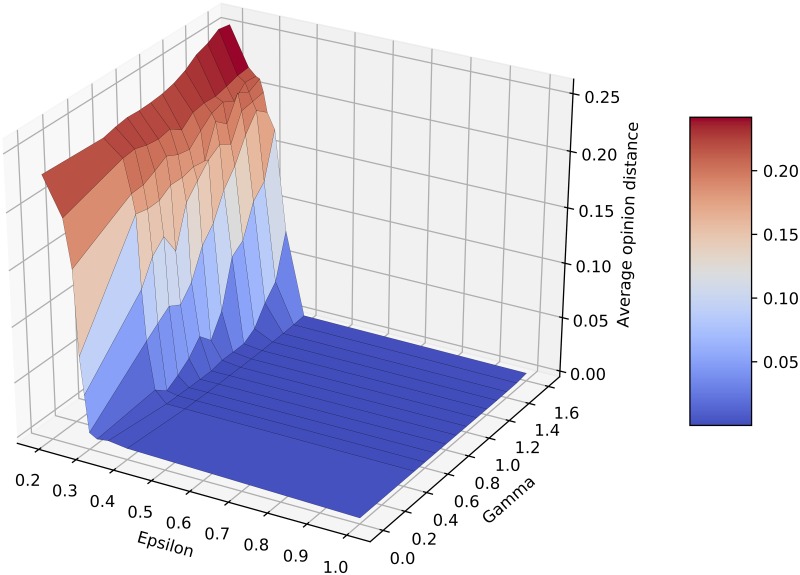
The flow of information reaching us via the online media platforms is optimized not by the information content or relevance but by popularity and proximity to the target. This is typically performed in order to maximise platform usage. As a side effect, this introduces an algorithmic bias that is believed to enhance fragmentation and polarization of the societal debate. To study this phenomenon, we modify the well-known continuous opinion dynamics model of bounded confidence in order to account for the algorithmic bias and investigate its consequences. In the simplest version of the original model the pairs of discussion participants are chosen at random and their opinions get closer to each other if they are within a fixed tolerance level. We modify the selection rule of the discussion partners: there is an enhanced probability to choose individuals whose opinions are already close to each other, thus mimicking the behavior of online media which suggest interaction with similar peers. As a result we observe: a) an increased tendency towards opinion fragmentation, which emerges also in conditions where the original model would predict consensus, b) increased polarisation of opinions and c) a dramatic slowing down of the speed at which the convergence at the asymptotic state is reached, which makes the system highly unstable. Fragmentation and polarization are augmented by a fragmented initial population.
Overview
The claims and statistics of this paper haven’t been checked yet.
Free: it reads the open-access text and checks the first 5 claims that cite a source we can check. Create a free account to check every claim.
Integrity signals
Registry
Cites
Statistics
Figures



Verification
Claims the paper makes
The claims and statistics of this paper haven’t been checked yet.
Free: it reads the open-access text and checks the first 5 claims that cite a source we can check. Create a free account to check every claim.
Self-check
Percentages, sums and reported differences re-computed from the paper’s own numbers.
The self-check needs the paper’s full text.
Citations
Cites
Emergence of Scaling in Random Networks
Barabási, A.-L., & Albert, R. (1999) · Science · doi:10.1126/science.286.5439.509 · Cited by 36,135
(2011) · Cited by 4,430
Epidemic processes in complex networks
Pastor-Satorras, R., Castellano, C., Van Mieghem, P., & Vespignani, A. (2015) · Reviews of Modern Physics · doi:10.1103/revmodphys.87.925 · Cited by 3,697
Exposure to ideologically diverse news and opinion on Facebook
Bakshy, E., Messing, S., & Adamic, L. A. (2015) · Science · doi:10.1126/science.aaa1160 · Cited by 3,245 · cited 1×
“The variety of interactions of a person (family, school, work, hobby, etc.) may contribute to diversification of information sources [14], nevertheless, regarding political views homophily seems particularly strong [15].”
BackgroundThe spreading of misinformation online
Del Vicario, M., Bessi, A., Zollo, F., Petroni, F., Scala, A., Caldarelli, G., Stanley, H. E., & Quattrociocchi, W. (2016) · Proceedings of the National Academy of Sciences · doi:10.1073/pnas.1517441113 · Cited by 2,407
Opinion Dynamics and Bounded Confidence Models, Analysis and Simulation
Hegselmann, R., & Krause, U. (2002) · RePEc: Research Papers in Economics · Cited by 2,362
Mixing beliefs among interacting agents
Deffuant, G., Neau, D., Amblard, F., & Weisbuch, G. (2000) · Advances in Complex Systems · doi:10.1142/s0219525900000078 · Cited by 2,165 · cited 4×
“The original bounded confidence model [17] considers a population of N individuals, where each individual i holds a continuous opinion x i ∈ [0 , 1].”
BackgroundMethodInfluentialPrior, M. (2007) · Cambridge University Press eBooks · doi:10.1017/cbo9781139878425 · Cited by 1,582
(2007) · Choice Reviews Online · doi:10.5860/choice.45-1733 · Cited by 1,178
Colleoni, E., Rozza, A., & Arvidsson, A. (2014) · Journal of Communication · doi:10.1111/jcom.12084 · Cited by 1,151
Research works printed but not linked: 2
- K Purcell, 2010, Understanding the participatory news consumer, Pew Internet and American Life Project, 1, 19
- MW Macy, 2003, Polarization in dynamic networks: A Hopfield model of emergent structure, Dynamic social network modeling and analysis, 162
Cited by
Online misinformation about climate change
Treen, K. M. D., Williams, H. T. P., & O'Neill, S. J. (2020) · WIREs Climate Change · doi:10.1002/wcc.665 · Cited by 441
Recent advances in opinion propagation dynamics: a 2020 survey
Noorazar, H. (2020) · The European Physical Journal Plus · doi:10.1140/epjp/s13360-020-00541-2 · Cited by 177
Marks, J., Copland, E., Loh, E., Sunstein, C. R., & Sharot, T. (2019) · Cognition · doi:10.1016/j.cognition.2018.10.003 · Cited by 124
Evolution and impact of bias in human and machine learning algorithm interaction
Sun, W., Nasraoui, O., & Shafto, P. (2020) · PLOS ONE · doi:10.1371/journal.pone.0235502 · Cited by 116
From classical to modern opinion dynamics
Noorazar, H., Vixie, K. R., Talebanpour, A., & Hu, Y. (2020) · International Journal of Modern Physics C · doi:10.1142/s0129183120501016 · Cited by 133
“In [46], the DW version of the bounded confidence model (i.”
BackgroundMethodPedreschi, D., Pappalardo, L., Ferragina, E., Baeza-Yates, R., Barabási, A.-L., Dignum, F., Dignum, V., Eliassi-Rad, T., Giannotti, F., Kertész, J., et al. (2025) · Artificial Intelligence · doi:10.1016/j.artint.2024.104244 · Cited by 102
Self-citationAhmmad, M., Shahzad, K., Iqbal, A., & Latif, M. (2025) · Societies · doi:10.3390/soc15110301 · Cited by 113
“Simulation models highlight how small initial biases are magnified by recommender systems, producing polarization cascades at the network level [2,10,38].”
The Effect of People Recommenders on Echo Chambers and Polarization
Cinus, F., Minici, M., Monti, C., & Bonchi, F. (2022) · Proceedings of the International AAAI Conference on Web and Social Media · doi:10.1609/icwsm.v16i1.19275 · Cited by 65
Stavropoulos, V., Motti-Stefanidi, F., & Griffiths, M. D. (2022) · European Psychologist · doi:10.1027/1016-9040/a000451 · Cited by 73
A model of opinion and propagation structure polarization in social media
Prasetya, H. A., & Murata, T. (2020) · Computational Social Networks · doi:10.1186/s40649-019-0076-z · Cited by 71
Emergence of polarization in a voter model with personalized information
Marzo, G. D., Zaccaria, A., & Castellano, C. (2020) · Physical Review Research · doi:10.1103/physrevresearch.2.043117 · Cited by 56
Opinion dynamics: Statistical physics and beyond
Starnini, M., Baumann, F., Galla, T., Garcia, D., Íñiguez, G., Karsai, M., Lorenz, J., & Sznajd-Weron, K. (2026) · Reviews of Modern Physics · doi:10.1103/j1zg-ddqv · Cited by 71
Peralta, A. F., Neri, M., Kertész, J., & Íñiguez, G. (2021) · Physical review. E · doi:10.1103/physreve.104.044312 · Cited by 75
“While the role of algorithmic bias has been recently modeled in an array of concrete scenarios [18, 22, 25], a general theoretical framework systematically linking social dynamics, network structure and algorithmic filtering has been missing so far.”
BackgroundSelf-citationThe Closed Loop Between Opinion Formation and Personalized Recommendations
Rossi, W. S., Polderman, J. W., & Frasca, P. (2021) · IEEE Transactions on Control of Network Systems · doi:10.1109/tcns.2021.3105616 · Cited by 82
“in relation to filter bubbles [22] and polarization [23].”
BackgroundThe complex link between filter bubbles and opinion polarization
Keijzer, M. A., & Mäs, M. (2022) · Data Science · doi:10.3233/ds-220054 · Cited by 59
The drivers of online polarization: Fitting models to data
Valensise, C. M., Cinelli, M., & Quattrociocchi, W. (2023) · Information Sciences · doi:10.1016/j.ins.2023.119152 · Cited by 61
Chen, T., Li, Q., Yang, J., Cong, G., & Li, G. (2019) · Mathematics · doi:10.3390/math7100917 · Cited by 47
“[31] modified the well-known continuous opinion dynamics model of bounded confidence to enhance probability to choose individuals whose opinions were already close to each other, thus mimicking the behavior of online media, which suggests interaction with similar peers.”
BackgroundExpert responsibility in AI development
Hedlund, M., & Persson, E. (2024) · AI & SOCIETY · doi:10.1007/s00146-022-01498-9 · Cited by 39
“…unintended consequence of this effect is the generation of the ‘echo chamber’, which affects the process of opinion formation in detrimental ways: by inducing fragmentation and clustering of opinions, and by intensifying polarisation and increasing distance between opinions (Sirbu et al. 2019: 2).”
ARTIFICIAL INTELLIGENCE’S ALGORITHMIC BIAS: ETHICAL AND LEGAL ISSUES
Kharitonova, Y. S., Savina, V. S., & Pagnini, F. (2021) · Вестник Пермского университета Юридические науки · doi:10.17072/1995-4190-2021-53-488-515 · Cited by 81
Röchert, D., Shahi, G. K., Neubaum, G., Roß, B., & Stieglitz, S. (2021) · Online Social Networks and Media · doi:10.1016/j.osnem.2021.100164 · Cited by 50
“in the flow of information can strengthen the fragmentation of information consumers and their opinion polarization [64].”
Interdisciplinary Lessons Learned While Researching Fake News
Sample, C., Jensen, M. J., Scott, K. M., McAlaney, J., Fitchpatrick, S., Brockinton, A., Ormrod, D., & Ormrod, A. (2020) · Frontiers in Psychology · doi:10.3389/fpsyg.2020.537612 · Cited by 42
Bounded-confidence model of opinion dynamics with heterogeneous node-activity levels
Li, G. J., & Porter, M. A. (2023) · Physical Review Research · doi:10.1103/physrevresearch.5.023179 · Cited by 45
Amazeen, M. A., Vasquez, R. A., Krishna, A., Ji, Y. G., Su, C. C., & Cummings, J. J. (2023) · Science Communication · doi:10.1177/10755470231217536 · Cited by 33
“There is the issue of engagement echo chambers that easily form in the online and social media spheres, by default of their own mechanisms and algorithms, and act as a never-ending misinformation loop (Sirbu et al., 2019).”
BackgroundThe new denial: climate solution misinformation on social media
Nicolosi, E., Medina, R., Brewer, S., Vorkink, M., & Allred, A. (2025) · Global Sustainability · doi:10.1017/sus.2025.10016 · Cited by 31
“Increased polarization of viewpoints (Vicario et al, 2016) and engaging (over truthful) content (Sirbu et al, 2019) in online social networks further exacerbate polarization.”
Positive algorithmic bias cannot stop fragmentation in homophilic networks
Blex, C., & Yasseri, T. (2020) · Journal of Mathematical Sociology · doi:10.1080/0022250x.2020.1818078 · Cited by 38
“Sirbu et al. (2019) modify this model by making the probability of two individuals interacting proportional to their opinion difference.”
Effect of collaborative-filtering-based recommendation algorithms on opinion polarization
Bellina, A., Castellano, C., Pineau, P., Iannelli, G., & Marzo, G. D. (2023) · Physical review. E · doi:10.1103/physreve.108.054304 · Cited by 36
“[23] Alina Sirbu, Dino Pedreschi, Fosca Giannotti, and János Kertesz, “Algorithmic bias amplifies opinion fragmentation and polarization: A bounded confidence model,” PLOS ONE 14, 1–20 (2019).”
BackgroundMass media impact on opinion evolution in biased digital environments: a bounded confidence model
(2023) · doi:10.1038/s41598-023-39725-y · Cited by 26
Self-citationA principle‐based approach to AI: The case for European Union and Italy
Corea, F., Fossa, F., Loreggia, A., Quintarelli, S., & Sapienza, S. (2023) · AI & SOCIETY · doi:10.1007/s00146-022-01453-8 · Cited by 25
“Previous studies (Sirbu et al. 2019a) have shown how AI systems can help members of a community to reach consensus through a reduced number of interactions but can also lead to strengthening and root divisions over time (Sirbu et al. 2019b).”
BackgroundSuccess-driven opinion formation determines social tensions
Chica, M., Perc, M., & Santos, F. C. (2024) · iScience · doi:10.1016/j.isci.2024.109254 · Cited by 26
Clustering and stubbornness regulate the formation of echo chambers in personalised opinion dynamics
Botte, N., Ryckebusch, J., & Rocha, L. E. C. (2022) · Physica A Statistical Mechanics and its Applications · doi:10.1016/j.physa.2022.127423 · Cited by 30
Brede, M. (2019) · Complexity · doi:10.1155/2019/1486909 · Cited by 29
Freedom and Constraint in Digital Environments: Implications for the Self
Talaifar, S., & Lowery, B. S. (2022) · Perspectives on Psychological Science · doi:10.1177/17456916221098036 · Cited by 24
“Although scholars of the early Internet believed that the Internet would usher in a similar era of homogenization that includes the entire world (McLuhan & Fiore, 1968), the Internet instead seems to be homogenizing people into polarized niches (Geschke et al., 2019; Sîrbu et al., 2019).”
BackgroundShaping opinions in social networks with shadow banning
Chen, Y.-S., & Zaman, T. R. (2024) · PLoS ONE · doi:10.1371/journal.pone.0299977 · Cited by 30
Multihop Trust Evaluation Using Memory Integrity in Wireless Sensor Networks
Desai, S. S., & Nene, M. J. (2021) · IEEE Transactions on Information Forensics and Security · doi:10.1109/tifs.2021.3101051 · Cited by 21
Borrelli, D., Iandoli, L., Ramírez-Márquez, J. E., & Lipizzi, C. (2021) · IEEE Transactions on Computational Social Systems · doi:10.1109/tcss.2021.3094775 · Cited by 24
Control Strategies for Recommendation Systems in Social Networks
Sprenger, B., Pasquale, G. D., Soloperto, R., Lygeros, J., & Dörfler, F. (2024) · IEEE Control Systems Letters · doi:10.1109/lcsys.2024.3400701 · Cited by 19
How social rewiring preferences bridge polarized communities
Borges, H. M., de Vasconcelos, V. V. L., & Pinheiro, F. L. (2024) · Chaos Solitons & Fractals · doi:10.1016/j.chaos.2024.114594 · Cited by 24
“While past works focused on identifying underlying mechanisms that can lead to social polarization, both in opinion composition [8–11] and in respect to the structural organization of communities [12–17], few works have looked into how dynamical processes on already structurally polarized…”
BackgroundOpinion formation on social networks with algorithmic bias: dynamics and bias imbalance
Peralta, A. F., Kertész, J., & Íñiguez, G. (2021) · Journal of Physics Complexity · doi:10.1088/2632-072x/ac340f · Cited by 26
“Previous modeling efforts [19] have been made to consider algorithmic bias in bounded confidence models [20], where the opinion variable of individuals is a real continuous variable on an interval.”
BackgroundSelf-citationModeling algorithmic bias: simplicial complexes and evolving network topologies
Pansanella, V., Rossetti, G., & Milli, L. (2022) · Applied Network Science · doi:10.1007/s41109-022-00495-7 · Cited by 25
“Although personalization is essential in information-rich environments to allow people to find what they are looking for and increase user engagement, there is great concern about the negative consequences of algorithmic filtering both from institutions and scientists (Sîrbu et al. 2019).”
BackgroundMethodInfluentialDong, J., Hu, J., Zhao, Y., & Peng, Y. (2024) · Applied Soft Computing · doi:10.1016/j.asoc.2024.111583 · Cited by 17
Bias in social interactions and emergence of extremism in complex social networks
Nguyen, V. X., Xiao, G., Zhou, J., Li, G., & Li, B. (2020) · Chaos An Interdisciplinary Journal of Nonlinear Science · doi:10.1063/5.0009943 · Cited by 16
Lee, S. Y., & Kim, J.-H. (2022) · Telematics and Informatics · doi:10.1016/j.tele.2022.101922 · Cited by 16
A Theoretical Examination of Homophily Beyond Focus Theory: Causes, Consequences, and New Directions
Au, A. (2023) · SAGE Open · doi:10.1177/21582440231173915 · Cited by 20
Navigating the Social Media Maze
Singha, S. (2024) · Advances in media, entertainment and the arts (AMEA) book series · doi:10.4018/979-8-3693-3767-7.ch005 · Cited by 13
Filter bubble effect in the multistate voter model
Iannelli, G., Marzo, G. D., & Castellano, C. (2022) · Chaos An Interdisciplinary Journal of Nonlinear Science · doi:10.1063/5.0079135 · Cited by 18
The physics of news, rumors, and opinions
Caldarelli, G., Artime, O., Fischetti, G., Guarino, S., Nowak, A. K., Saracco, F., Holme, P., & Domenico, M. D. (2026) · Physics Reports · doi:10.1016/j.physrep.2026.05.002 · Cited by 29
A Multi-agent Model for Polarization Under Confirmation Bias in Social Networks
Alvim, M. S., Amorim, B., Knight, S., Quintero, S., & Valencia, F. (2021) · Lecture notes in computer science · doi:10.1007/978-3-030-78089-0_2 · Cited by 16
Polarization in Social Media: A Virtual Worlds-Based Approach
Jacob, D., & Banisch, S. (2023) · Journal of Artificial Societies and Social Simulation · doi:10.18564/jasss.5170 · Cited by 12
“Others have developed extensions upon the basic premise to model social interactions online (Del Vicario et al. 2017; Sîrbu et al. 2019).”
BackgroundValidating Argument-Based Opinion Dynamics with Survey Experiments
Banisch, S., & Shamon, H. (2024) · Journal of Artificial Societies and Social Simulation · doi:10.18564/jasss.5305 · Cited by 14
Modeling the Complex Network of Social Interactions
Kertész, J., Török, J., Murase, Y., Jo, H.-H., & Kaski, K. K. (2020) · Computational social sciences · doi:10.1007/978-3-030-54936-7_1 · Cited by 14
Self-citationMultidimensional Model of Opinion Dynamics in Social Networks: Polarization Indices
Gubanov, D., Petrov, I. V., & Chkhartishvili, A. G. (2021) · Automation and Remote Control · doi:10.1134/s0005117921100167 · Cited by 12
A Formal Model for Polarization under Confirmation Bias in Social Networks
Alvim, M. S., Amorim, B., Knight, S., Quintero, S., & Valencia, F. (2023) · Logical Methods in Computer Science · doi:10.46298/lmcs-19(1:18)2023 · Cited by 12
Identifying Political Polarization in Social Media: A Literature Review
Rum, S. N. M., Mohamed, R., & Asfarian, A. (2023) · Journal of Advanced Research in Applied Sciences and Engineering Technology · doi:10.37934/araset.34.1.8089 · Cited by 14
Toward a Formal Model for Group Polarization in Social Networks
Alvim, M. S., Knight, S., & Valencia, F. (2019) · Lecture notes in computer science · doi:10.1007/978-3-030-31175-9_24 · Cited by 19
Distribution of Forward-Looking Responsibility in the EU Process on AI Regulation
Hedlund, M. (2022) · Frontiers in Human Dynamics · doi:10.3389/fhumd.2022.703510 · Cited by 12
Selective agreement, not sycophancy: investigating opinion dynamics in LLM interactions
Cau, E., Pansanella, V., Pedreschi, D., & Rossetti, G. (2025) · EPJ Data Science · doi:10.1140/epjds/s13688-025-00579-1 · Cited by 9
Self-citationTrends and topics: Characterizing echo chambers’ topological stability and in-group attitudes
Cau, E., Morini, V., & Rossetti, G. (2024) · PLOS complex systems. · doi:10.1371/journal.pcsy.0000008 · Cited by 10
Shin, Y. A., Constantino, S. M., Beckage, B., & LaCasse, K. M. (2025) · Current Opinion in Behavioral Sciences · doi:10.1016/j.cobeha.2025.101528 · Cited by 13
From Mean-Field to Complex Topologies: Network Effects on the Algorithmic Bias Model
Pansanella, V., Rossetti, G., & Milli, L. (2022) · Studies in computational intelligence · doi:10.1007/978-3-030-93413-2_28 · Cited by 14
“In [13] the discussed AB model results focus only on the mean-field scenario, i.”
BackgroundMethodInfluentialАхременко, А. С., & Викторовна, Б. Е. (2021) · Monitoring obŝestvennogo mneniâ: èkonomičeskie i socialʹnye peremeny · doi:10.14515/monitoring.2021.6.2111 · Cited by 10
Epistemic bubbles and echo chambers in the progress of science
Albuquerque, U. P. (2025) · Ethnobiology and Conservation · doi:10.15451/ec2025-11-14-38-1-19 · Cited by 7
Haddadan, S., Menghini, C., Riondato, M., & Upfal, E. (2022) · Data Mining and Knowledge Discovery · doi:10.1007/s10618-022-00875-8 · Cited by 8
“…lack of diversity, and lack of fairness in recommender systems (Baeza-Yates 2020; Fu et al. 2020; Resnick et al. 2013; Aridor et al. 2020; Ge et al. 2020; Geyik et al. 2019; Singh and Joachims 2018; Zhu et al. 2018; Yao and Huang 2017; Jiang et al. 2019; Sîrbu et al. 2019; Blex and Yasseri 2022).”
BackgroundA Social Network Model for Analysis of Public Opinion Formation Process
Rabiee, H., Ladani, B. T., & Sahafizadeh, E. (2024) · IEEE Transactions on Computational Social Systems · doi:10.1109/tcss.2024.3435908 · Cited by 7
Echo chamber formation sharpened by priority users
Ferraz de Arruda, H., Andrade Oliveira, K., & Moreno, Y. (2024) · iScience · doi:10.1016/j.isci.2024.111098 · Cited by 6
“However, inadvertently promoting these users may trigger unknown macroscopic effects in the system, especially regarding opinion dynamics.”
Manipulation, Algorithm Design, and the Multiple Dimensions of Autonomy
Sass, R. (2024) · Philosophy & Technology · doi:10.1007/s13347-024-00796-y · Cited by 9
“Start with the widely reported claim that some news aggregators and social networks employ algorithms optimized to “hook” users on content that is most likely to sustain traffic on their sites (Huszár et al., 2022; Sîrbu et al., 2019).”
Inference of Interaction Kernels in Mean-Field Models of Opinion Dynamics
Chu, W., Li, Q., & Porter, M. A. (2024) · SIAM Journal on Applied Mathematics · doi:10.1137/22m1544415 · Cited by 10
Simplex bounded confidence model for opinion fusion and evolution in higher-order interaction
Ye, D., Lin, H., Jiang, H., Du, L., Li, H., Chen, Q., Wang, Y., & Liu, Y. (2025) · Expert Systems with Applications · doi:10.1016/j.eswa.2025.126551 · Cited by 8
Algorithmic bias amplification via temporal effects: The case of PageRank in evolving networks
Cui, M., Mariani, M. S., & Medo, M. (2021) · Communications in Nonlinear Science and Numerical Simulation · doi:10.1016/j.cnsns.2021.106029 · Cited by 8
Social Media Misinformation About Extreme Weather Events and Climate Change
Wright, K. B. (2022) · Wiley eBooks · doi:10.1002/9781119751847.ch9 · Cited by 6
An overview of opinion polarization: models, drivers, and strategic solutions
Liu, S., Wu, Z., & Martínez, L. (2025) · Information Processing & Management · doi:10.1016/j.ipm.2025.104433 · Cited by 10
Towards a Social Artificial Intelligence
Pedreschi, D., Dignum, F. P. M., Morini, V., Pansanella, V., & Cornacchia, G. (2023) · Lecture notes in computer science · doi:10.1007/978-3-031-24349-3_21 · Cited by 5
Self-citationVoter-like Dynamics with Conflicting Preferences on Modular Networks
Zimmaro, F., Contucci, P., & Kertész, J. (2023) · Entropy · doi:10.3390/e25060838 · Cited by 7
“Even though this bias is a characteristic of the node, it is fundamentally different from other kinds of biases, such as the confirmation or algorithmic ones [17, 18, 19], since those are dependent on the node’s current opinion.”
BackgroundSelf-citationCompeting Imaginaries and Partisan Divides in the Data Rhetoric of Advocacy Organizations
Darian, S., Dym, B., & Voida, A. (2023) · Proceedings of the ACM on Human-Computer Interaction · doi:10.1145/3610050 · Cited by 5
“In recent years, the many entities involved in political campaigns have exacerbated the rift between people with conservative and liberal values [45], with waves of populism spreading across the world [17, 105], fueled in part by algorithmic polarization [106, 109].”
BackgroundFalk, J., Eichler, E., Windt, K., & Hütt, M. ‐. (2022) · Scientific Reports · doi:10.1038/s41598-022-06880-7 · Cited by 5
Navigation Services and Urban Sustainability
Cornacchia, G., Nanni, M., Pedreschi, D., & Pappalardo, L. (2023) · Fluctuation and Noise Letters · doi:10.1142/s0219477524500160 · Cited by 5
Self-citationA Bounded-Confidence Model of Opinion Dynamics with Heterogeneous Node-Activity LevelsPreprint
Li, G. J., & Porter, M. A. (2022) · SocArXiv (OSF Preprints) · doi:10.31235/osf.io/r6asm · Cited by 5
Opinion Dynamics With Social Confirmation Effect: An Adaptive Hegselmann-Krause Model
Shahbazi, F., Kebriaei, H., & Yaghmaei, A. (2025) · IEEE Transactions on Computational Social Systems · doi:10.1109/tcss.2025.3611520 · Cited by 5
Chiriatti, M., Ganapini, M. B., Panai, E., & Riva, G. (2026) · Harvard Data Science Review · doi:10.1162/99608f92.53f091e6 · Cited by 5
Lu, Q., Chen, T., Duan, H., Zhou, X., & Lin, Z. T. (2026) · Journal of Travel Research · doi:10.1177/00472875261441570 · Cited by 4
Effects of relative homophily and relative heterophily on opinion dynamics in coevolving networks
Wu, Y., & Guo, P. (2024) · Physica A Statistical Mechanics and its Applications · doi:10.1016/j.physa.2024.129835 · Cited by 6
Modeling the Co-evolving Polarization of Opinion and News Propagation Structure in Social Media
Prasetya, H. A., & Murata, T. (2018) · Studies in computational intelligence · doi:10.1007/978-3-030-05414-4_25 · Cited by 5
Boyd, M., & Wilson, N. (2020) · Policy Quarterly · doi:10.26686/pq.v16i1.6355 · Cited by 5
“Also, modelling studies demonstrate that these algorithms can prevent populations converging on agreed beliefs (Sirbu et al., 2019).”
BackgroundUtilizing Structural Network Positions to Diversify People Recommendations on Twitter
Olshannikova, E., Skenderi, E., Olsson, T., Koivunen, S., & Huhtamäki, J. (2022) · Advances in Human-Computer Interaction · doi:10.1155/2022/6584394 · Cited by 4
Revitalisasi Nilai-Nilai Toleransi di Media Sosial dengan Ajaran Pendidikan Islam
Darisman, D., Faiz, A., & Kurniawaty, I. (2022) · EDUKATIF JURNAL ILMU PENDIDIKAN · doi:10.31004/edukatif.v4i5.3901 · Cited by 4
Emergent Instabilities in Algorithmic Feedback LoopsPreprint
Burghardt, K., & Lerman, K. (2022) · arXiv (Cornell University) · doi:10.48550/arxiv.2201.07203 · Cited by 5
“All rights reserved. people into filter bubbles (Ge et al. 2020; Sirbu et al. 2019) or reducing the diversity of recommended content in online platforms (Chaney, Stewart, and Engelhardt 2018; Mansoury et al. 2020).”
BackgroundClimate Change Denial & Skepticism: A Review of the Literature
Weddig, C. (2022) · doi:10.35650/mw.3043.d.2022 · Cited by 5
Transparency in a Digitally Intertwined World: A Hybrid Approach to Consumers’ Protection
Montalbano, L. (2021) · Open Journal of Social Sciences · doi:10.4236/jss.2021.98031 · Cited by 5
Predicting the Performance of Facebook Advertisements About Climate Change Using Self-report Data
Goldberg, M. H., Remshard, M., Commerçon, F. A., Ozaksut, J., Lee, S., Rosenthal, S. A., & Leiserowitz, A. (2024) · Environmental Communication · doi:10.1080/17524032.2024.2441936 · Cited by 3
Partisan Confidence Model for Group Polarization
Kooshkaki, A. R., Bolouki, S., Etesami, S. R., & Mohebbi, A. (2023) · IEEE Transactions on Network Science and Engineering · doi:10.1109/tnse.2023.3255819 · Cited by 3
A Spectral-Based Model for Describing Social Polarization in Online Communities
Kinoshita, T., & Aida, M. (2022) · IEICE Transactions on Communications · doi:10.1587/transcom.2021mep0001 · Cited by 4
“Some models have also been proposed to investigate the effect of recommendation functions on polarization [18], [19].”
BackgroundInfluence of Opinion Formation on Polarization in Social Networks
Das, S., Dutta, S. M., Chakraborty, S., & Biswas, S. (2023) · International Conference on Computing, Communication and Networking Technologies (ICCCNT) · doi:10.1109/icccnt56998.2023.10307862 · Cited by 5
Network-based computational communication
Huang, M. D., Wang, J.-L., & Zhang, Z.-K. (2025) · Europhysics Letters (EPL) · doi:10.1209/0295-5075/ade337 · Cited by 3
Polarization and Belief Convergence of Agents in Strongly-Connected Influence GraphsPreprint
Alvim, M. S., Amorim, B., Knight, S., Quintero, S., & Valencia, F. (2020) · arXiv (Cornell University) · doi:10.48550/arxiv.2012.02703 · Cited by 4
“There is a growing interest in the development of models for the analysis of polarization [5–7, 10, 12, 13, 15, 16, 21, 22, 25–27].”
BackgroundMethodCross-platform impact of social media algorithmic adjustments on public discoursePreprint
Gravino, P., Sardo, R. L., & Brugnoli, E. (2024) · arXiv (Cornell University) · doi:10.48550/arxiv.2405.00008 · Cited by 5
Cyberpsychology of Mass Consciousness Management in the Modern State
Yakovlev, M. V. (2024) · Discourse-P · doi:10.17506/18179568_2024_21_3_42 · Cited by 2
Symbolic cryptoviolence in on-line social networks
Domingo‐Ferrer, J. (2025) · Ethics and Information Technology · doi:10.1007/s10676-025-09855-0 · Cited by 2
“As a side effect, this introduces an algorithmic bias that increases fragmentation and polarization in the social debate (Sîrbu et al. 2019).”
Tayie, S. S. (2025) · Comunicar · doi:10.5281/zenodo.16122005 · Cited by 4
Testing the impact of fallacies and contrarian claims in climate change misinformation
Lieu, R., Hayes, O. R., & Cook, J. (2025) · British Journal of Psychology · doi:10.1111/bjop.70049 · Cited by 3
Su, K.-P., Chen, S. H.-C., & Chang, J. P. (2026) · Current Opinion in Psychiatry · doi:10.1097/yco.0000000000001082 · Cited by 2
AI-driven personalisation in social media marketing: Opportunities and ethical challenges
Παπαγεωργίου, Κ., & Milioris, K. (2026) · Marketing · doi:10.5937/mkng2601039p · Cited by 2
Metadata
- Authors
- Sîrbu, A., Pedreschi, D., Giannotti, F., & Kertész, J.
- Affiliations
- University of Pisa (IT)
- Istituto di Scienza e Tecnologie dell'Informazione "Alessandro Faedo" (IT)
- Budapest University of Technology and Economics (HU)
- Corresponding author
- Sîrbu, Alina
- Venue
- PLOS ONE
- Publisher
- Public Library of Science (PLoS)
- Published
- 2019-03-05
- Volume
- 14
- Issue
- 3
- Pages
- e0213246
- ISSN
- 1932-6203 (ISSN-L)
- PMC
- PMC6400382
- OpenAlex
- W2790854217
- Cited by
- 112
- References
- 56
- Citations by year
- 2026: 11 · 2025: 14 · 2024: 19 · 2023: 18 · 2022: 22 · 2021: 13 · 2020: 11 · 2019: 3
- FWCI
- 5.67
- Type
- journal article
- Language
- en
- Open access
- gold
- doi.org
- Licence
- Locations
- PLoS ONE (publishedVersion, cc-by)
- Europe PMC (PubMed Central) (publishedVersion, cc-by)
- PubMed Central (publishedVersion, cc-by)
- PubMed (publishedVersion)
- arXiv (Cornell University) (submittedVersion)
- Scuola Normale Superiore di Pisa (submittedVersion, cc-by)
- RePEc: Research Papers in Economics (submittedVersion)
- CINECA IRIS Institutial research information system (University of Pisa) (submittedVersion, cc-by)
- Archivio istituzionale della ricerca (Alma Mater Studiorum Università di Bologna) (submittedVersion)
- ISTI Open Portal (submittedVersion, other-oa)
- DOAJ (DOAJ: Directory of Open Access Journals) (submittedVersion, cc-by-sa)
- Open Research (Auckland University of Technology) (submittedVersion, cc-by)
- arXiv (Cornell University)
- Funders
- H2020 Future and Emerging Technologies (641191)
- Topics
- Physical Sciences › Physics and Astronomy › Statistical and Nonlinear Physics › Opinion Dynamics and Social Influence
- Social Sciences › Communication › Social Media and Politics
- Social Sciences › Sociology and Political Science › Media Influence and Politics
- Keywords
- algorithmic bias, opinion dynamics, bounded confidence model, opinion fragmentation, political polarization, social media, information filtering, convergence rate, consensus formation
- MeSH terms
- Algorithms, Computer Simulation, Humans, Models, Theoretical, Probability, Public Opinion
About these checks
Registry, retraction, Cites and statistics results are computed, not judged, with one exception: a printed reference that no index lists is read once by a model before it counts as a citation error. Claims are extracted by a model and kept only when their quote appears verbatim in the text; each cited source is then checked, with a model’s help, for whether it says what the claim relies on. Those verdicts can be wrong — read the claim’s quote and the cited source before relying on one.
Statistics and arithmetic are recomputed, not judged.
Confidence bands are shown only for fields calibrated on our annotated test set. None is calibrated yet, so no band is shown.
What counts as a claim ›How we measure confidence ›How we check this ›
Are you an author, or do you see a problem with this page? Request a review
Data sources
Bibliographic data: Semantic Scholar, OpenAlex, Crossref.
Contains information from the Semantic Scholar Academic Graph Datasets, made available under the ODC Attribution License (ODC-BY 1.0).
Semantic Scholar’s data is described in: Kinney, R., et al. (2023). The Semantic Scholar Open Data Platform. arXiv:2301.10140.
