

The DOI matches its Crossref record; 103 of the 104 references it cites were found in a registry or an index.
Codon and amino acid content are associated with mRNA stability in mammalian cells
Open accessAbstract
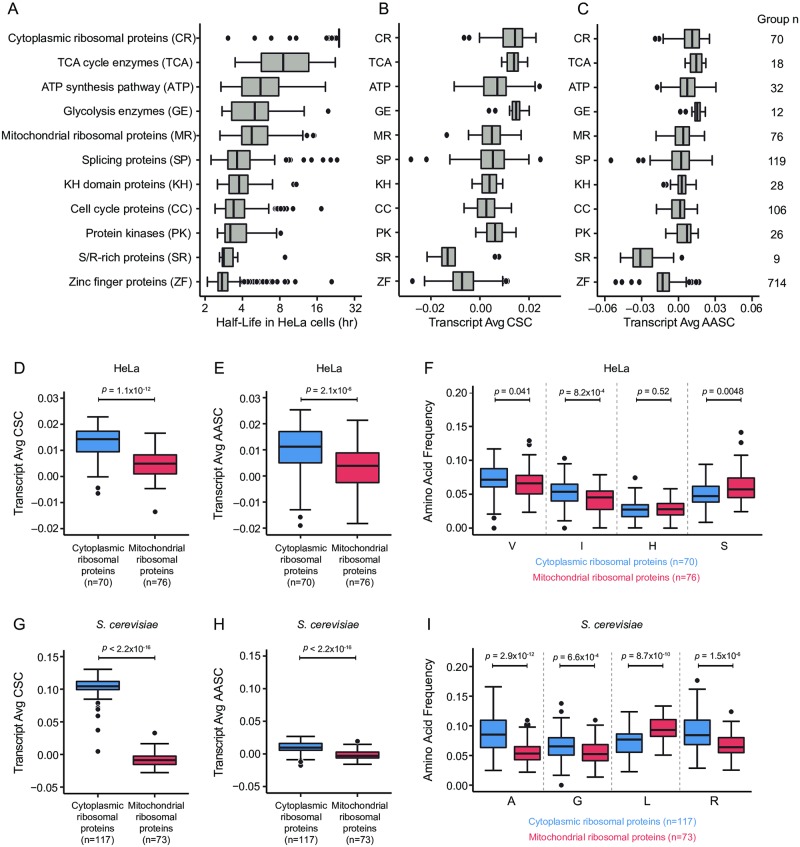
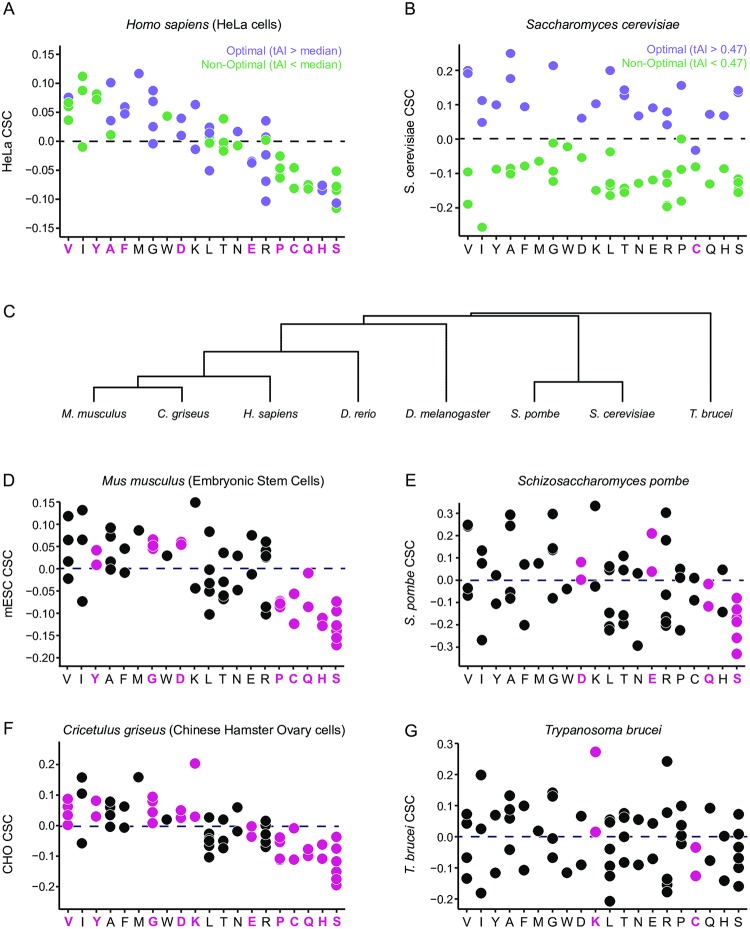
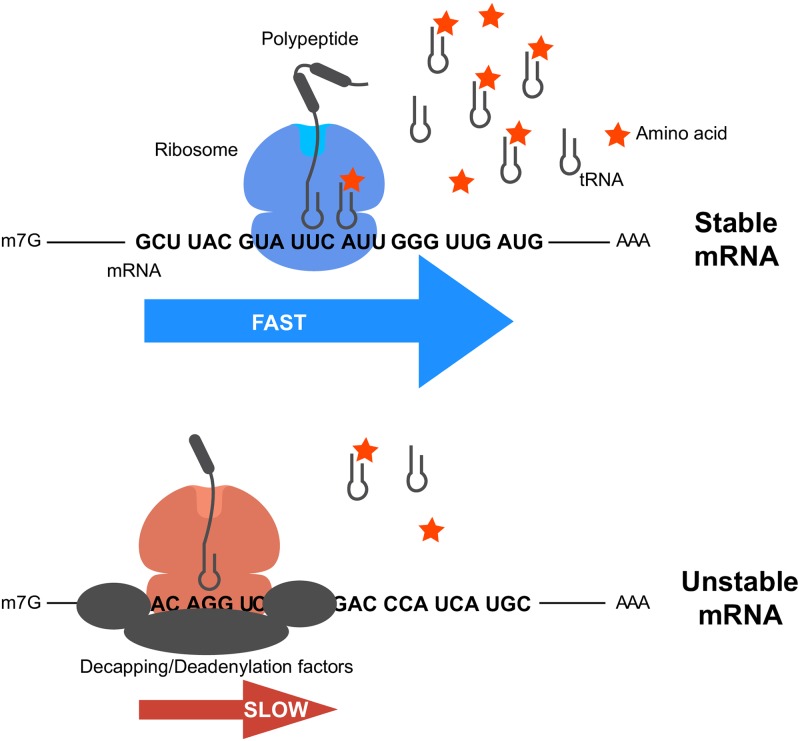
Messenger RNA (mRNA) degradation plays a critical role in regulating transcript levels in the cell and is a major control point for modulating gene expression. In yeast and other model organisms, codon identity is a powerful determinant of transcript stability, contributing broadly to impact half-lives. General principles governing mRNA stability are poorly understood in mammalian systems. Importantly, however, the degradation machinery is highly conserved, thus it seems logical that mammalian transcript half-lives would also be strongly influenced by coding determinants. Herein we characterize the contribution of coding sequence towards mRNA decay in human and Chinese Hamster Ovary cells. In agreement with previous studies, we observed that synonymous codon usage impacts mRNA stability in mammalian cells. Surprisingly, however, we also observe that the amino acid content of a gene is an additional determinant correlating with transcript stability. The impact of codon and amino acid identity on mRNA decay appears to be associated with underlying tRNA and intracellular amino acid concentrations. Accordingly, genes of similar physiological function appear to coordinate their mRNA stabilities in part through codon and amino acid content. Together, these results raise the possibility that intracellular tRNA and amino acid levels interplay to mediate coupling between translational elongation and mRNA degradation rate in mammals.
Overview
The claims and statistics of this paper haven’t been checked yet.
Run the check — free, no account needed. It reads the open-access text and checks the sources it cites.
Integrity signals
Registry
Cites
Statistics
Figures
Verification
Claims the paper makes
The claims and statistics of this paper haven’t been checked yet.
Run the check — free, no account needed. It reads the open-access text and checks the sources it cites.
Claims other papers make about this one
Each is checked against this paper’s own text: does it say what the citing paper says it does?
The cited source says what the claim attributes to it.
In the citing paper
“Prior work has demonstrated strong relationships between codon usage and mRNA half-life23,78.”
From Predicting RNA-seq coverage from DNA sequence as a unifying model of gene regulation (2025) · cites this paper as [78]
The check wasn’t confident either way, so it gives no verdict — never disputed.
In the citing paper
“Although we generally do not find determinants of mRNA half-life in the 3′ UTR attributions, we do observe a correlation between codon-aggregated gradient saliencies of gene exon coverage and MPRA measurements from a previous publication78 (Pearson’ R = 0.59) (Supplementary Fig. 11a).”
From Predicting RNA-seq coverage from DNA sequence as a unifying model of gene regulation (2025) · cites this paper as [78]
Experimental — accuracy not yet measured
Self-check
Percentages, sums and reported differences re-computed from the paper’s own numbers.
The self-check needs the paper’s full text.
Citations
Cites
R: A Language and Environment for Statistical Computing
R Core Team (2000) · doi:10.32614/r.manuals · Cited by 355,893
Transcript-level expression analysis of RNA-seq experiments with HISAT, StringTie and Ballgown
Pertea, M., Kim, D., Pertea, G. M., Leek, J. T., & Salzberg, S. L. (2016) · Nature Protocols · doi:10.1038/nprot.2016.095 · Cited by 6,819
Global quantification of mammalian gene expression control
Schwanhäusser, B., Busse, D., Li, N., Dittmar, G., Schuchhardt, J., Wolf, J., Chen, W., & Selbach, M. (2011) · Nature · doi:10.1038/nature10098 · Cited by 6,566
Interactive Tree Of Life (iTOL) v4: recent updates and new developments
Letunić, I., & Peer Bork, B. (2019) · Nucleic Acids Research · doi:10.1093/nar/gkz239 · Cited by 5,988
Tight control of gene expression in mammalian cells by tetracycline-responsive promoters.
Gossen, M., & Bujard, H. (1992) · Proceedings of the National Academy of Sciences · doi:10.1073/pnas.89.12.5547 · Cited by 4,943 · cited 1×
“…test whether changes in mRNA levels reflect changes in stability, we shut off transcription of reporter mRNAs by doxy-cycline treatment in HEK293 Tet-off cells, which express a tetracycline-regulated transcription activator that is inactive in the presence of tetracycline or doxycycline [50].”
Liao, Y., Smyth, G. K., & Shi, W. (2019) · Nucleic Acids Research · doi:10.1093/nar/gkz114 · Cited by 2,927
Post-transcriptional gene regulation by mRNA modifications
Zhao, B. S., Roundtree, I. A., & He, C. (2016) · Nature Reviews Molecular Cell Biology · doi:10.1038/nrm.2016.132 · Cited by 2,469
MODOMICS: a database of RNA modification pathways. 2017 update
Boccaletto, P., Machnicka, M. A., Purta, E., Piątkowski, P., Bagiński, B., Wirecki, T. K., de Crécy‐Lagard, V., Ross, R. L., Limbach, P. A., Kötter, A., et al. (2017) · Nucleic Acids Research · doi:10.1093/nar/gkx1030 · Cited by 1,767
Serine, glycine and one-carbon units: cancer metabolism in full circle
Locasale, J. W. (2013) · Nature reviews. Cancer · doi:10.1038/nrc3557 · Cited by 1,727
The highways and byways of mRNA decay
Garneau, N. L., Wilusz, J., & Wilusz, C. J. (2007) · Nature Reviews Molecular Cell Biology · doi:10.1038/nrm2104 · Cited by 1,294
Cited by
Sorted by citations
Roles of mRNA poly(A) tails in regulation of eukaryotic gene expression
Passmore, L. A., & Coller, J. (2021) · Nature Reviews Molecular Cell Biology · doi:10.1038/s41580-021-00417-y · Cited by 590
Self-citationPredicting RNA-seq coverage from DNA sequence as a unifying model of gene regulation
Linder, J., Srivastava, D., Yuan, H., Agarwal, V., & Kelley, D. R. (2025) · Nature Genetics · doi:10.1038/s41588-024-02053-6 · Cited by 265
Theoretical basis for stabilizing messenger RNA through secondary structure design
Wayment-Steele, H. K., Kim, D. S., Choe, C. A., Nicol, J. J., Wellington-Oguri, R., Watkins, A. M., Parra Sperberg, R. A., Huang, P.-S., Participants, E., & Das, R. (2021) · Nucleic Acids Research · doi:10.1093/nar/gkab764 · Cited by 197
Direct epitranscriptomic regulation of mammalian translation initiation through N4-acetylcytidine
Arango, D., Sturgill, D. M., Yang, R., Kanai, T., Bauer, P., Roy, J., Wang, Z., Hosogane, M., Schiffers, S., & Oberdoerffer, S. (2022) · Molecular Cell · doi:10.1016/j.molcel.2022.05.016 · Cited by 175
The genetic and biochemical determinants of mRNA degradation rates in mammals
Agarwal, V., & Kelley, D. R. (2022) · Genome Biology · doi:10.1186/s13059-022-02811-x · Cited by 155
Metadata
- Authors
- Forrest, M. E., Pinkard, O., Martin, S., Sweet, T. J., Hanson, G., & Coller, J.
- Affiliations
- Case Western Reserve University (US)
- Corresponding author
- Coller, Jeff
- Venue
- PLOS ONE
- Publisher
- Public Library of Science (PLoS)
- Published
- 2020-02-13
- Volume
- 15
- Issue
- 2
- Pages
- e0228730
- ISSN
- 1932-6203 (ISSN-L)
- PMC
- PMC7018022
- OpenAlex
- W3006243445
- Cited by
- 116
- References
- 104
- Citations by year
- 2026: 15 · 2025: 23 · 2024: 25 · 2023: 15 · 2022: 12 · 2021: 15 · 2020: 9
- FWCI
- 4.14
- Type
- journal article
- Language
- en
- Open access
- gold
- doi.org
- Licence
- Locations
- PLoS ONE (publishedVersion, cc-by)
- Europe PMC (PubMed Central) (publishedVersion, cc-by)
- PubMed Central (publishedVersion, cc-by)
- PubMed (publishedVersion)
- DOAJ (DOAJ: Directory of Open Access Journals) (submittedVersion, cc-by-sa)
- Figshare (submittedVersion, cc-by)
- Funders
- National Institutes of Health (GM125086)
- National Institute of General Medical Sciences (GM118018, T32GM136570)
- Topics
- Life Sciences › Biochemistry, Genetics and Molecular Biology › Molecular Biology › RNA and protein synthesis mechanisms
- Life Sciences › Biochemistry, Genetics and Molecular Biology › Molecular Biology › RNA Research and Splicing
- Life Sciences › Biochemistry, Genetics and Molecular Biology › Molecular Biology › RNA modifications and cancer
- Keywords
- mRNA stability, mRNA degradation, codon usage, synonymous codons, amino acid content, transcript half-life, translation elongation, gene expression regulation, mammalian cells, CHO cells
- MeSH terms
- Amino Acids, Animals, Codon, Cricetulus, Half-Life, Cricetinae, HeLa Cells, Humans, RNA, Messenger, RNA, Transfer, Open Reading Frames, CHO Cells, RNA Stability
About these checks
Registry, retraction, Cites and statistics results are computed, not judged, with one exception: a printed reference that no index lists is read once by a model before it counts as a citation error. Claims are extracted by a model and kept only when their quote appears verbatim in the text; each cited source is then checked, with a model’s help, for whether it says what the claim relies on. Those verdicts can be wrong — read the claim’s quote and the cited source before relying on one.
Statistics and arithmetic are recomputed, not judged.
Confidence bands are shown only for fields calibrated on our annotated test set. None is calibrated yet, so no band is shown.
What counts as a claim ›How we measure confidence ›How we check this ›
Are you an author, or do you see a problem with this page? Request a review
