

The Virtual Operative Assistant: An explainable artificial intelligence tool for simulation-based training in surgery and medicine
Open accessThe DOI matches its Crossref record; 48 of the 49 references it cites were found in a registry or an index, and 1 are not checked yet.
Abstract
Simulation-based training is increasingly being used for assessment and training of psychomotor skills involved in medicine. The application of artificial intelligence and machine learning technologies has provided new methodologies to utilize large amounts of data for educational purposes. A significant criticism of the use of artificial intelligence in education has been a lack of transparency in the algorithms' decision-making processes. This study aims to 1) introduce a new framework using explainable artificial intelligence for simulation-based training in surgery, and 2) validate the framework by creating the Virtual Operative Assistant, an automated educational feedback platform. Twenty-eight skilled participants (14 staff neurosurgeons, 4 fellows, 10 PGY 4-6 residents) and 22 novice participants (10 PGY 1-3 residents, 12 medical students) took part in this study. Participants performed a virtual reality subpial brain tumor resection task on the NeuroVR simulator using a simulated ultrasonic aspirator and bipolar. Metrics of performance were developed, and leave-one-out cross validation was employed to train and validate a support vector machine in Matlab. The classifier was combined with a unique educational system to build the Virtual Operative Assistant which provides users with automated feedback on their metric performance with regards to expert proficiency performance benchmarks. The Virtual Operative Assistant successfully classified skilled and novice participants using 4 metrics with an accuracy, specificity and sensitivity of 92, 82 and 100%, respectively. A 2-step feedback system was developed to provide participants with an immediate visual representation of their standing related to expert proficiency performance benchmarks. The educational system outlined establishes a basis for the potential role of integrating artificial intelligence and virtual reality simulation into surgical educational teaching. The potential of linking expertise classification, objective feedback based on proficiency benchmarks, and instructor input creates a novel educational tool by integrating these three components into a formative educational paradigm.
Overview
The claims and statistics of this paper haven’t been checked yet.
Free: it reads the open-access text and checks the first 5 claims that cite a source we can check. Create a free account to check every claim.
Integrity signals
Registry
Cites
Statistics
Figures
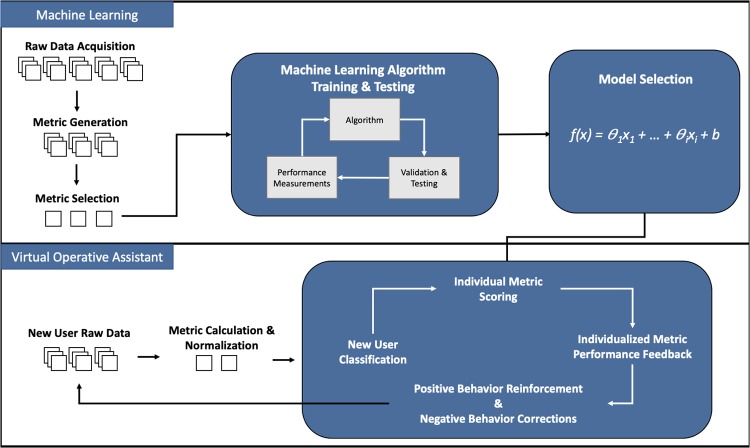
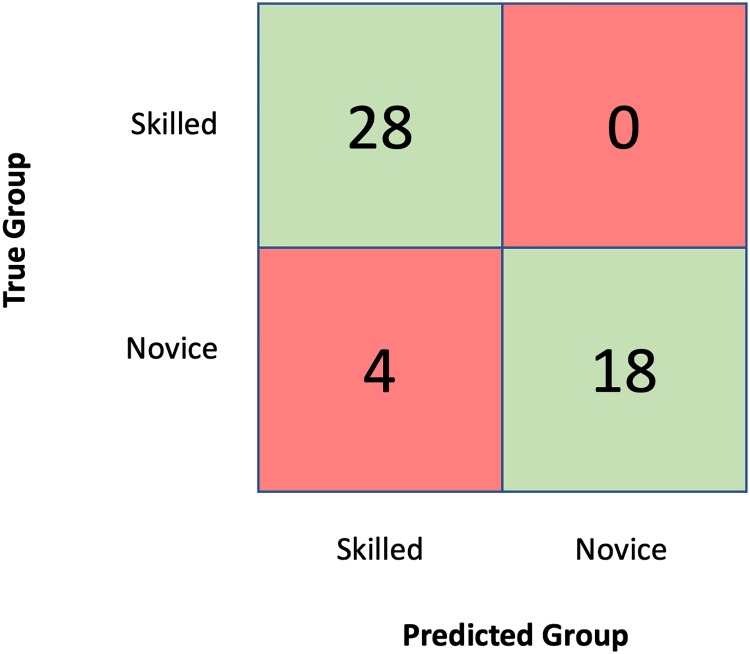
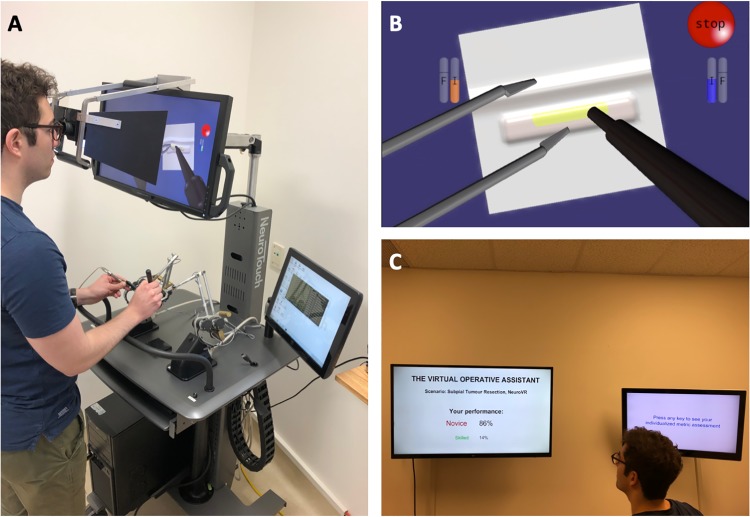

Verification
Claims the paper makes
The claims and statistics of this paper haven’t been checked yet.
Free: it reads the open-access text and checks the first 5 claims that cite a source we can check. Create a free account to check every claim.
Claims other papers make about this one
Each is checked against this paper’s own text: does it say what the citing paper says it does?
The cited source says what the claim attributes to it.
In the citing paper
“Various uses were described, including surgical simulation with a virtual operative assistant [132], simulated patient physician medical interviews [120–123, 130], and interactions with avatars as standardized patients during clinical interviews [124–126].”
From Artificial intelligence in undergraduate medical education: an updated scoping review (2025) · cites this paper as [132]
The check wasn’t confident either way, so it gives no verdict — never disputed.
In the citing paper
“Simulation-based GenAI learning has been shown to enhance AI readiness and reinforce core nursing concepts [18].”
From Effects of generative artificial intelligence (GenAI) patient simulation on perceived clinical competency among global nursing undergraduates: a cross-over randomised controlled trial (2025) · cites this paper as [18]
Experimental — accuracy not yet measuredIn the citing paper
“AI simulations can adapt to a learner's performance, providing personalized, dynamic feedback that helps students practice clinical skills, refine decision-making, and improve their diagnostic reasoning in a controlled, risk-free environment [107].”
From Formative assessment and feedback in medical education: A practical guide: AMEE Guide No. 189 (2026) · cites this paper as [107]
Self-check
Percentages, sums and reported differences re-computed from the paper’s own numbers.
The self-check needs the paper’s full text.
Citations
Cites
Deep learning in neural networks: an overview
Schmidhuber, J. (2015) · Neural Networks · doi:10.1016/j.neunet.2014.09.003 · Cited by 18,570
The perceptron: A probabilistic model for information storage and organization in the brain.
Rosenblatt, F. (1958) · Psychological Review · doi:10.1037/h0042519 · Cited by 12,280 · cited 1×
“The system relies on a single processing unit known as the perceptron.[19] Building from this, the authors outline the rationale for employing the perceptron (also known as the linear Support Vector Machine) in this study in the S1 Appendix in S1 File.”
MethodSupervised Machine Learning: A Review of Classification Techniques
Kotsiantis, S. B. (2007) · Informatica · Cited by 6,007
Large-Scale Machine Learning with Stochastic Gradient Descent
Bottou, L. (2010) · Proceedings of COMPSTAT'2010 · doi:10.1007/978-3-7908-2604-3_16 · Cited by 5,795 · cited 1×
“[24, 25] An iterative cost reduction approach is employed during training,[26] whereby the algorithm alters values of the weights (θ) for each metric in order to reach the greatest predictive accuracy.”
MethodA guide to deep learning in healthcare
Esteva, A., Robicquet, A., Ramsundar, B., Kuleshov, V., DePristo, M., Chou, K., Cui, C., Corrado, G., Thrun, S., & Dean, J. (2019) · Nature Medicine · doi:10.1038/s41591-018-0316-z · Cited by 5,312
Cognitive load theory, learning difficulty, and instructional design
Sweller, J. (1994) · Learning and Instruction · doi:10.1016/0959-4752(94)90003-5 · Cited by 3,801 · cited 1×
“Following the principles of cognitive load theory,[31] the Virtual Operative Assistant aims to limit the amount of information immediately provided to the user to facilitate learning.”
MethodDeo, R. C. (2015) · Circulation · doi:10.1161/circulationaha.115.001593 · Cited by 3,466
Toward integrating feature selection algorithms for classification and clustering
Liu, H., & Yu, L. (2005) · IEEE Transactions on Knowledge and Data Engineering · doi:10.1109/tkde.2005.66 · Cited by 2,706
Feature Selection: A Data Perspective
Li, J., Cheng, K., Wang, S., Morstatter, F., Trevino, R. P., Tang, J., & Liu, H. (2018) · ACM Computing Surveys · doi:10.1145/3136625 · Cited by 2,442
Score normalization in multimodal biometric systems
Jain, A., Nandakumar, K., & Ross, A. (2005) · Pattern Recognition · doi:10.1016/j.patcog.2005.01.012 · Cited by 2,154
Research works printed but not linked: 1
- Norman D. The design of everyday things: Revised and expanded edition: Constellation; 2013.
Cited by
A scoping review of artificial intelligence in medical education: BEME Guide No. 84
Gordon, M., Daniel, M., Ajiboye, A., Uraiby, H., Xu, N. Y., Bartlett, R., Hanson, J., Haas, M., Spadafore, M., Grafton-Clarke, C., et al. (2024) · Medical Teacher · doi:10.1080/0142159x.2024.2314198 · Cited by 679
Artificial Intelligence for Student Assessment: A Systematic Review
González-Calatayud, V., Prendes-Espinosa, P., & Roig-Vila, R. (2021) · Applied Sciences · doi:10.3390/app11125467 · Cited by 503
“[11] used AI for simulation-based training in medicine, and they created a Virtual Operative Assistant to give automatic feedback to students based on metrics of”
MethodOkunlaya, R. O., Syed Abdullah, N., & Alias, R. A. (2022) · Library Hi Tech · doi:10.1108/lht-07-2021-0242 · Cited by 333
Applications of Explainable Artificial Intelligence in Diagnosis and Surgery
Zhang, Y., Weng, Y., & Lund, J. (2022) · Diagnostics · doi:10.3390/diagnostics12020237 · Cited by 368
“24 [49] 2020 Surgery training SVM Accuracy: 92% Sensitivity: 100% Specificity: 82% Virtual operative assistant Feature relevance No”
BackgroundAlmasri, F. (2024) · Research in Science Education · doi:10.1007/s11165-024-10176-3 · Cited by 361
“…2014; Nasution & Education, 2023), scoring and providing personalized feedback on stu - dents’ assignments (Azcona et al., 2019; Maestrales et al., 2021; Mirchi et al., 2020), and predicting student performance (Blikstein et al., 2014; Buenaño-Fernández et al., 2019; Jiao et al., 2022a, b).”
Metadata
- Authors
- Mirchi, N., Bissonnette, V., Yilmaz, R., Ledwos, N., Winkler-Schwartz, A., & Del Maestro, R. F.
- Affiliations
- Montreal Neurological Institute and Hospital (CA)
- Corresponding author
- Mirchi, Nykan
- Venue
- PLOS ONE
- Publisher
- Public Library of Science (PLoS)
- Published
- 2020-02-27
- Volume
- 15
- Issue
- 2
- Pages
- e0229596
- ISSN
- 1932-6203 (ISSN-L)
- PMC
- PMC7046231
- OpenAlex
- W3007803772
- Cited by
- 296
- References
- 48
- Citations by year
- 2026: 39 · 2025: 63 · 2024: 67 · 2023: 39 · 2022: 47 · 2021: 29 · 2020: 12
- FWCI
- 29.02
- Type
- journal article
- Language
- en
- Open access
- gold
- doi.org
- Licence
- Locations
- PLoS ONE (publishedVersion, cc-by)
- PubMed Central (publishedVersion, cc-by)
- PubMed (publishedVersion)
- RePEc: Research Papers in Economics (submittedVersion)
- DOAJ (DOAJ: Directory of Open Access Journals) (submittedVersion, cc-by-sa)
- Figshare (submittedVersion, cc-by)
- Funders
- Di Giovanni Foundation
- Topics
- Health Sciences › Medicine › Surgery › Surgical Simulation and Training
- Social Sciences › Education › Simulation-Based Education in Healthcare
- Health Sciences › Medicine › Health Informatics › Artificial Intelligence in Healthcare and Education
- Keywords
- explainable AI, surgical simulation training, virtual surgery, neurosurgical training, brain tumor resection, support vector machine, formative assessment
- MeSH terms
- Simulation Training, Virtual Reality, Algorithms, Artificial Intelligence, Brain Neoplasms, Computer Simulation, Education, Medical, Female, Humans, Male, Neurosurgery, Surgery, Computer-Assisted, Support Vector Machine
About these checks
Registry, retraction, Cites and statistics results are computed, not judged, with one exception: a printed reference that no index lists is read once by a model before it counts as a citation error. Claims are extracted by a model and kept only when their quote appears verbatim in the text; each cited source is then checked, with a model’s help, for whether it says what the claim relies on. Those verdicts can be wrong — read the claim’s quote and the cited source before relying on one.
Statistics and arithmetic are recomputed, not judged.
Confidence bands are shown only for fields calibrated on our annotated test set. None is calibrated yet, so no band is shown.
What counts as a claim ›How we measure confidence ›How we check this ›
Are you an author, or do you see a problem with this page? Request a review
How to cite
Cite CoChat for the checks on this page, and the paper for its own findings.
- This page
- CoChat. (2026). Citation check: The Virtual Operative Assistant: An explainable artificial intelligence tool for simulation-based training in surgery and medicine. https://app.cochat.ai/papers/10.1371/journal.pone.0229596
- The paper
- Mirchi, N., Bissonnette, V., Yilmaz, R., Ledwos, N., Winkler-Schwartz, A., & Del Maestro, R. F. (2020). The Virtual Operative Assistant: An explainable artificial intelligence tool for simulation-based training in surgery and medicine. PLOS ONE. https://doi.org/10.1371/journal.pone.0229596
Data sources
Bibliographic data: Semantic Scholar, OpenAlex, Crossref.
Contains information from the Semantic Scholar Academic Graph Datasets, made available under the ODC Attribution License (ODC-BY 1.0).
Semantic Scholar’s data is described in: Kinney, R., et al. (2023). The Semantic Scholar Open Data Platform. arXiv:2301.10140.
