

Opening the black box of artificial intelligence for clinical decision support: A study predicting stroke outcome
Open accessPublished version of a preprint
The DOI matches its Crossref record; 51 of the 51 references it cites were found in a registry or an index.
Abstract
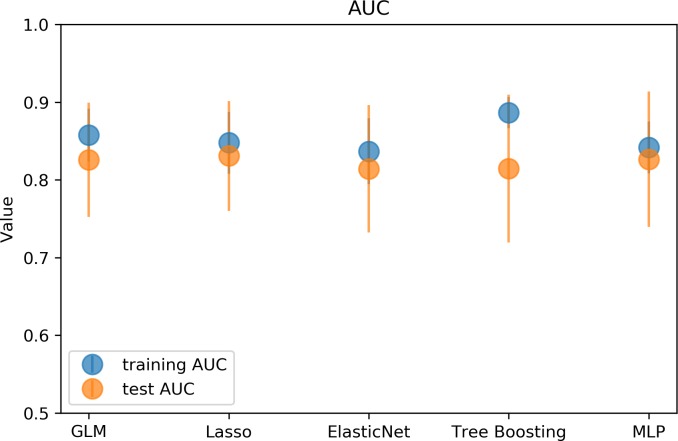
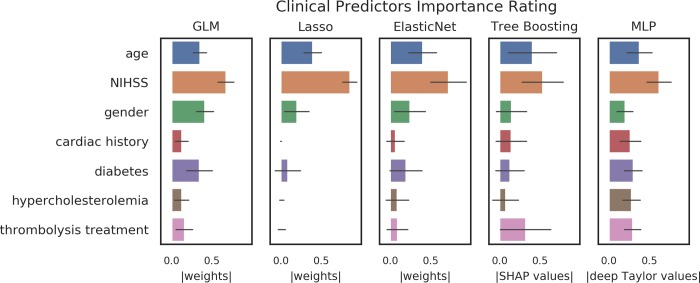
State-of-the-art machine learning (ML) artificial intelligence methods are increasingly leveraged in clinical predictive modeling to provide clinical decision support systems to physicians. Modern ML approaches such as artificial neural networks (ANNs) and tree boosting often perform better than more traditional methods like logistic regression. On the other hand, these modern methods yield a limited understanding of the resulting predictions. However, in the medical domain, understanding of applied models is essential, in particular, when informing clinical decision support. Thus, in recent years, interpretability methods for modern ML methods have emerged to potentially allow explainable predictions paired with high performance. To our knowledge, we present in this work the first explainability comparison of two modern ML methods, tree boosting and multilayer perceptrons (MLPs), to traditional logistic regression methods using a stroke outcome prediction paradigm. Here, we used clinical features to predict a dichotomized 90 days post-stroke modified Rankin Scale (mRS) score. For interpretability, we evaluated clinical features' importance with regard to predictions using deep Taylor decomposition for MLP, Shapley values for tree boosting and model coefficients for logistic regression. With regard to performance as measured by Area under the Curve (AUC) values on the test dataset, all models performed comparably: Logistic regression AUCs were 0.83, 0.83, 0.81 for three different regularization schemes; tree boosting AUC was 0.81; MLP AUC was 0.83. Importantly, the interpretability analysis demonstrated consistent results across models by rating age and stroke severity consecutively amongst the most important predictive features. For less important features, some differences were observed between the methods. Our analysis suggests that modern machine learning methods can provide explainability which is compatible with domain knowledge interpretation and traditional method rankings. Future work should focus on replication of these findings in other datasets and further testing of different explainability methods.
Overview
The claims and statistics of this paper haven’t been checked yet.
Free: it reads the open-access text and checks the first 5 claims that cite a source we can check. Create a free account to check every claim.
Integrity signals
Registry
Cites
Statistics
Figures
Verification
Claims the paper makes
The claims and statistics of this paper haven’t been checked yet.
Free: it reads the open-access text and checks the first 5 claims that cite a source we can check. Create a free account to check every claim.
Claims other papers make about this one
Each is checked against this paper’s own text: does it say what the citing paper says it does?
The cited source says what the claim attributes to it.
In the citing paper
“Building on earlier efforts that compared different model outputs [70] or validated the intuitiveness of visual explanations (like those from LRP) [48,49], recent studies have begun to experimentally test the impact of different explanation strategies on user performance and reliance.”
From Explainable AI for Clinical Decision Support Systems: Literature Review, Key Gaps, and Research Synthesis (2025) · cites this paper as [70]
Self-check
Percentages, sums and reported differences re-computed from the paper’s own numbers.
The self-check needs the paper’s full text.
Citations
Cites
XGBoost: A Scalable Tree Boosting System
Chen, T., & Guestrin, C. (2016) · Proceedings of the 22nd ACM SIGKDD International Conference on Knowledge Discovery and Data Mining · doi:10.1145/2939672.2939785 · Cited by 54,569
A Unified Approach to Interpreting Model Predictions
Lundberg, S., & Lee, S.-I. (2017) · arXiv · doi:10.48550/arxiv.1705.07874 · Cited by 23,707
"Why Should I Trust You?": Explaining the Predictions of Any Classifier
Ribeiro, M. T., Singh, S., & Guestrin, C. (2016) · Proceedings of the 22nd ACM SIGKDD International Conference on Knowledge Discovery and Data Mining · doi:10.1145/2939672.2939778 · Cited by 17,555
Visualizing and understanding convolutional networks
Zeiler, M. D., & Fergus, R. (2014) · Lecture Notes in Computer Science · doi:10.1007/978-3-319-10590-1_53 · Cited by 15,839
Advances in Neural Information Processing Systems 29
Teymur, O., Zygalakis, K., & Calderhead, B. (2016) · Cited by 13,887
A Caution Regarding Rules of Thumb for Variance Inflation Factors
O’brien, R. M. (2007) · Quality & Quantity · doi:10.1007/s11135-006-9018-6 · Cited by 11,217
Rudin, C. (2019) · Nature Machine Intelligence · doi:10.1038/s42256-019-0048-x · Cited by 10,561 · cited 1×
“a method which inherently provides information about feature importance, such as the weights of linear regression [36].”
MethodSantos, A. G., da Rocha, G. O., & de Andrade, J. B. (2019) · Scientific Reports · doi:10.1038/s41598-018-37186-2 · Cited by 8,495
XGBoost: A Scalable Tree Boosting System
Chen, T., & Guestrin, C. (2016) · arXiv · doi:10.48550/arxiv.1603.02754 · Cited by 7,104
Peeking Inside the Black-Box: A Survey on Explainable Artificial Intelligence (XAI)
Adadi, A., & Berrada, M. (2018) · IEEE Access · doi:10.1109/access.2018.2870052 · Cited by 6,294
Research works printed but not linked: 1
- Csáji BC. Approximation with Artificial Neural Networks. 2001; 45.
Cited by
Items 101–188 of 188
Sheng, S., Li, A., Liu, X., Shen, T., Zhou, W., Lv, X., Shen, Y., Wang, C., Ma, Q., Qu, L., et al. (2024) · BMC Nephrology · doi:10.1186/s12882-024-03844-z · Cited by 13
Chen, C., Zhang, W., Pan, Y., & Li, Z. (2025) · International Journal of Medical Informatics · doi:10.1016/j.ijmedinf.2025.105807 · Cited by 11
Prada, E. J. A., & Mosquera, C. D. C. (2025) · Physical and Engineering Sciences in Medicine · doi:10.1007/s13246-025-01593-3 · Cited by 11
Kornblith, A. E., Singh, C., Devlin, G., Addo, N., Streck, C. J., Holmes, J. F., Kuppermann, N., Grupp‐Phelan, J., Fineman, J. R., Butte, A. J., et al. (2022) · PLOS Digital Health · doi:10.1371/journal.pdig.0000076 · Cited by 10
Automated Detection of Pediatric Foreign Body Aspiration from Chest X‐rays Using Machine Learning
Truong, B., Zapala, M. A., Kammen, B. F., & Luu, K. (2024) · The Laryngoscope · doi:10.1002/lary.31338 · Cited by 7
Mwogosi, A., & Mambile, C. (2024) · Information Technology and People · doi:10.1108/itp-04-2023-0347 · Cited by 6
Reed, R. A., Morgan, A. S., Zeitlin, J. A., Jarreau, P., Torchin, H., Pierrat, V., Ancel, P., & Khoshnood, B. (2021) · Frontiers in Pediatrics · doi:10.3389/fped.2020.585868 · Cited by 7
Sarrias, O. R., Gónzalez-Deza, C., Rodríguez, J., Iriarte, O. A., Atienza, Á. V., Lizundia, T. Z., Beristain, O. S., & Pastor, A. A. (2023) · Cancers · doi:10.3390/cancers15174206 · Cited by 6
Three simple steps to improve the interpretability of EEG-SVM studies
Joucla, C., Gabriel, D., Ortega, J., & Haffen, É. (2022) · Journal of Neurophysiology · doi:10.1152/jn.00221.2022 · Cited by 9
Wittrup, E. M., Reavey-Cantwell, J. F., Pandey, A. S., Rivet, D. J., & Najarian, K. (2025) · BMC Medical Imaging · doi:10.1186/s12880-025-01864-1 · Cited by 5
Explainable AI in Health Care: Trust and Transparency in AI-Powered Medical Diagnosis
Mohammed, Z. K. (2025) · Artificial intelligence · doi:10.5772/intechopen.1011279 · Cited by 17
Timing the Ischemic Stroke by Multiparametric Quantitative Magnetic Resonance Imaging
McGarry, B. L., & Kauppinen, R. A. (2021) · Exon Publications eBooks · doi:10.36255/exonpublications.stroke.timingischemicstroke.2021 · Cited by 7
Artificial intelligence, machine learning, and reproducibility in stroke research
Romoli, M., & Caliandro, P. (2024) · European Stroke Journal · doi:10.1177/23969873241275863 · Cited by 7
XGBoost for Interpretable Alzheimer’s Decision Support
Kadem, M., Noseworthy, M., & Doyle, T. (2023) · Proceedings of the AAAI Symposium Series · doi:10.1609/aaaiss.v1i1.27491 · Cited by 2
Haupt, M., & Maurer, M. H. (2026) · European Journal of Radiology Artificial Intelligence · doi:10.1016/j.ejrai.2026.100098 · Cited by 9
Predictive Analysis of Stroke Prediction by using Machine Learning Implementations
Mohapatra, S. K., Jain, A., & Anshika (2023) · IEEE International Conference on Contemporary Computing and Communications (InC4) · doi:10.1109/inc457730.2023.10262959 · Cited by 4
Clinical decision support systems for diabetic foot ulcers: a scoping review
Garcês, T. S., de Araújo, A. L., Sousa, G. J. B., Cestari, V. R. F., Florêncio, R. S., Mattos, S. M., Damasceno, L. L. V., Santiago, J. C. D. S., Pessoa, V. L. M. D. P., Pereira, M. L. D., et al. (2023) · Revista da Escola de Enfermagem da USP · doi:10.1590/1980-220x-reeusp-2023-0218en · Cited by 29
Ding, S., Zhang, S., Hu, X., & Zou, N. (2024) · Journal of Biomedical Informatics · doi:10.1016/j.jbi.2024.104671 · Cited by 10
Wang, L., Wang, L.-Y., Sung, M., Lin, Y.-C., Liu, C., & Chen, C. (2024) · Diagnostics · doi:10.3390/diagnostics14141571 · Cited by 5
Zhai, S.-M., Wang, X., Zhang, H., & Zuo, Y.-Q. (2025) · Scientific Reports · doi:10.1038/s41598-025-19959-8 · Cited by 5
Artificial intelligence for anemia screening, diagnosis, and management
Olawade, D. B., Adeniji, Y. J., Olatunbosun, F. A., Egbon, E., & David-Olawade, A. C. (2025) · Current Research in Translational Medicine · doi:10.1016/j.retram.2025.103560 · Cited by 9
Früh, A. M., Frey, D., Hilbert, A., Jelgersma, C., Uhl, C., Nissimov, N., Truckenmueller, P., Wasilewski, D., Rallios, D., Hoppe, M. W., et al. (2024) · Brain and Spine · doi:10.1016/j.bas.2024.102827 · Cited by 3
Self-citationOptimal mean arterial pressure for favorable neurological outcomes in patients after cardiac arrest
Lee, S., Lee, K.-S., Han, K. S., Song, J., Lee, S. W., & Kim, S. J. (2025) · Journal of Intensive Care · doi:10.1186/s40560-025-00814-x · Cited by 3
Evolutionary artificial neural network for temperature control in a batch polymerization reactor
Sánchez-Ruíz, F. J., Hernandez, E. A., Terrones-Salgado, J., & Quiroz, L. J. F. (2023) · Ingenius · doi:10.17163/ings.n30.2023.07 · Cited by 4
Why Do Tree Ensemble Approximators Not Outperform the Recursive-Rule eXtraction Algorithm?
Onishi, S., Nishimura, M., Fujimura, R., & Hayashi, Y. (2024) · Machine Learning and Knowledge Extraction · doi:10.3390/make6010031 · Cited by 6
Research on bronze wine vessel classification using improved SSA-CBAM-GNNs
Wang, W., Miao, S., & Liao, Y. (2024) · PLoS ONE · doi:10.1371/journal.pone.0295690 · Cited by 4
Kang, M., Rossetti, S. C., Lowenthal, G., Knaplund, C., Zhou, L., Schnock, K. O., Cato, K., & Dykes, P. C. (2024) · JAMIA Open · doi:10.1093/jamiaopen/ooae092 · Cited by 6
Obmann, D., Münch, P., Graf, B. M., von Jouanne-Diedrich, H. K., & Zausig, Y. A. (2025) · Scientific Reports · doi:10.1038/s41598-025-00830-9 · Cited by 4
Tzepkenlis, A., Camardella, C., Leonardis, D., Mazzoleni, S., & Frisoli, A. (2025) · International Conference on Rehabilitation Robotics · doi:10.1109/icorr66766.2025.11063176 · Cited by 3
Computational Analysis of Air Quality and the Potential of Rich Indian Tradition for Healthcare 4.0
Rastogi, R., Saxena, M., Sagar, S., Tandon, N., Rajeshwari, T., Singh, B., Garg, P., Singh, M., Singh, K., Dhamija, L., et al. (2021) · International Journal of Reliable and Quality E-Healthcare · doi:10.4018/ijrqeh.2021070103 · Cited by 3
Ramouz, A., Adeliansedehi, A., Khajeh, E., März, K., Michael, D., Wagner, M., Müller-Stich, B. P., Mehrabi, A., & Majlesara, A. (2024) · Cancers · doi:10.3390/cancers17010052 · Cited by 2
Augusto, I. C. M., António, N., Marreiros, A., Ramalhete, S., & Nzwalo, H. (2026) · Neurorehabilitation · doi:10.1177/10538135261420819 · Cited by 2
A User-Centered Design of Explainable AI for Clinical Decision Support
Salimiparsa, M., Lizotte, D. J., & Sedig, K. (2021) · doi:10.21428/594757db.62860442 · Cited by 2
Bruno, P., Calimeri, F., & Greco, G. (2021) · Springer eBooks · doi:10.1007/978-3-030-58080-3_32-1 · Cited by 2
Wu, J., Zhang, Q., Tao, L., & Lu, X. (2022) · Journal of Information & Knowledge Management · doi:10.1142/s0219649222500794 · Cited by 2
Pahwa, B., Tayal, A., & Garg, K. (2024) · World Neurosurgery · doi:10.1016/j.wneu.2024.01.059 · Cited by 2
Nantinda, T., Gamundani, A. M., & Kanyama, M. N. (2024) · International Conference on Artificial Intelligence, Big Data, Computing and Data Communication Systems (icABCD) · doi:10.1109/icabcd62167.2024.10645285 · Cited by 2
Neurosurgery, Explainable AI, and Legal Liability
Matulionytė, R., Molina, E. S., & Ieva, A. D. (2024) · Advances in experimental medicine and biology · doi:10.1007/978-3-031-64892-2_34 · Cited by 3
Leng, W., Yang, C., Kou, M., Zhang, K., & Liu, X. (2025) · Journal of Medical Systems · doi:10.1007/s10916-025-02185-0 · Cited by 2
Hilbert, A., Akay, E. M. Z., Carlisle, B. G., Madai, V. I., Mutke, M. A., & Frey, D. (2022) · Research Square · doi:10.21203/rs.3.rs-1706474/v3 · Cited by 3
Self-citationHilbert, A., Baskan, D., Rieger, J., Wagner, C., Sehlen, S., García‐Rudolph, A., Kelleher, J. D., Dengler, N. F., Kossen, T., Madai, V. I., et al. (2022) · medRxiv · doi:10.1101/2022.11.20.22282517 · Cited by 2
Self-citationExtending Variability-Aware Model Selection with Bias Detection in Machine Learning Projects
Tavares, C., do Nascimento, N. M., Alencar, P., & Cowan, D. D. (2023) · IEEE International Conference on Big Data (BigData) · doi:10.1109/bigdata59044.2023.10386105 · Cited by 3
Sistemas de apoio à decisão clínica em úlceras de pé diabético:revisão de escopo
Garcês, T. S., de Araújo, A. L., Sousa, G. J. B., Cestari, V. R. F., Florêncio, R. S., Mattos, S. M., Damasceno, L. L. V., Santiago, J. C. D. S., Pessoa, V. L. M. D. P., Pereira, M. L. D., et al. (2023) · Revista da Escola de Enfermagem da USP · doi:10.1590/1980-220x-reeusp-2023-0218pt · Cited by 1
VAE-CNN for Coronary Artery Disease Prediction
Louridi, N., Ouahidi, A. E., Benic, C., Douzi, S., & Ouahidi, B. E. (2024) · Information systems engineering and management · doi:10.1007/978-3-031-65014-7_15 · Cited by 1
Sun, Y., Li, J., He, H., Xing, G., Liu, Z., Meng, Q., Xu, M., Huang, L., Pan, Z., Liao, J., et al. (2024) · Nutrition Metabolism and Cardiovascular Diseases · doi:10.1016/j.numecd.2024.103841 · Cited by 1
Choe, J., Oh, Y., Park, C., Kim, Y., Wang, C., & Min, S. D. (2025) · Scientific Reports · doi:10.1038/s41598-025-32036-4 · Cited by 3
Luo, Z.-C., Guo, H.-Y., Tang, X., Chen, X.-R., Zhang, C.-Y., Cui, Y.-T., Zuo, J., Li, H.-R., Hou, X.-M., Chen, H., et al. (2026) · World Journal of Gastrointestinal Oncology · doi:10.4251/wjgo.v18.i2.114782 · Cited by 1
Social determinants of healthy aging: An investigation using the all of us cohort
Chen, W., Lee, Y.-A., Tang, H., Li, C., Lu, Y., Huang, Y., Yin, R., Armstrong, M. J., Yang, Y., Štiglic, G., et al. (2026) · PLoS ONE · doi:10.1371/journal.pone.0342292 · Cited by 2
Towards Automated Variability-Aware Machine-Learning-Based Modeling Analysis
Tavares, C., do Nascimento, N. M., Alencar, P., & Cowan, D. D. (2021) · IEEE International Conference on Big Data (BigData) · doi:10.1109/bigdata52589.2021.9671894 · Cited by 1
Explainable Deep Learning Models for Healthcare Decision Support
(2023) · International Journal of Advances in Computer Science and Technology · doi:10.30534/ijacst/2023/0112102023 · Cited by 4
Explainable machine learning for coronary artery disease risk assessment and prevention
Louridi, N., Douzi, S., & Ouahidi, B. E. (2023) · Data & Metadata · doi:10.56294/dm202365 · Cited by 1
COPD発症・進展の分子メカニズム COPD発症・進展にかかわる好中球,マクロファージの関与 (特集 COPD--生命予後の改善を目指して) -- (COPD発症の病因・危険因子)
大林, 王., & 滝澤, 始. (2011) · Institutional Repositories DataBase (IRDB)
Bruno, P., Calimeri, F., & Greco, G. (2022) · Springer eBooks · doi:10.1007/978-3-030-64573-1_32
Li, J., Liu, S., Hu, Y., Zhu, L., Mao, Y., & Liu, J. (2022) · doi:10.2196/preprints.38082
Explainable machine learning for decision support in healthcare: A scoping review (Preprint)Preprint
Shulha, M., Rahimi, S. A., Sandhu, A., Sharma, G., D’Souza, V., Harmouche, R., & Hovdebo, J. (2022) · doi:10.2196/preprints.39196
Hilbert, A., Akay, E. M. Z., Carlisle, B. G., Madai, V. I., Mutke, M. A., & Frey, D. (2022) · Research Square · doi:10.21203/rs.3.rs-1706474/v2
Self-citationHilbert, A., Akay, E. M. Z., Carlisle, B. G., Madai, V. I., Mutke, M. A., & Frey, D. (2022) · Research Square · doi:10.21203/rs.3.rs-1706474/v1 · Cited by 1
Self-citationVisual Analytics Tools for the Study of Complex Problems in Engineering and Biomedicine
Díaz, I., Enguita, J. M., Cuadrado, A. A., García-Pérez, D., & González, A. (2023) · IFIP advances in information and communication technology · doi:10.1007/978-3-031-34171-7_36
Zhan, H., Han, G., Wei, C., & Li, Z. (2023) · Journal of Shanghai Jiaotong University (Science) · doi:10.1007/s12204-023-2628-5 · Cited by 1
Artificial intelligence and deep learning in molecular testing
Levy, J., & Vaickus, L. J. (2023) · Elsevier eBooks · doi:10.1016/b978-0-12-822824-1.00002-x
A Multidisciplinary Explanation of Healthcare AI Uses, Trends, and Possibilities
Vats, S., & Dixit, A. (2023) · The Springer series in applied machine learning · doi:10.1007/978-3-031-41925-6_6
Supervised Learning Algorithms
Nagaraj, A. (2023) · BENTHAM SCIENCE PUBLISHERS eBooks · doi:10.2174/9789815179453123010005 · Cited by 1
Development and validation of a machine learning model to predict the risk of liver fibrosisPreprint
zhou, W., Liu, D., Wei, K., & Yu, N. (2023) · Research Square · doi:10.21203/rs.3.rs-3635118/v1
BioAutoML: Democratizing Machine Learning in Life Sciences
Bonidia, R. P. (2024) · Digital Library of Theses and Dissertations (Universidade de São Paulo) · doi:10.11606/t.55.2024.tde-01042024-092414
Social Determinants of Healthy Aging: An Investigation using the All of Us CohortPreprint
Chen, W., Lee, Y.-A., Tang, H., Li, C., Lu, Y., Huang, Y., Yin, R., Armstrong, M. J., Yang, Y., Štiglic, G., et al. (2025) · medRxiv · doi:10.1101/2025.01.02.25319907
Yin, Z., Gong, Y., He, J., Ren, L., Li, X., Hu, X., Pan, Y., & Yu, H. (2025) · IEEE Access · doi:10.1109/access.2025.3538280
Cramer, S., de Llanes, E. G., Bäcker, J., Manz, R., Meyer, P., Müller, D., Hinske, L. C., Raffler, J., & Soto‐Rey, I. (2025) · doi:10.2196/preprints.73124
Tavares, C., do Nascimento, N. M., Alencar, P., & Cowan, D. (2025) · IEEE Access · doi:10.1109/access.2025.3558218
Zhang, J., Tang, J., Li, J., Liu, X., Sun, Y., & Wang, P. (2026) · Canadian Respiratory Journal · doi:10.1155/carj/1423700 · Cited by 1
Wu, Y., Xiang, C., Jia, M., & Fang, Y. (2022) · Figshare · doi:10.6084/m9.figshare.20401192
Wallisch, C., Agibetov, A., Dunkler, D., Haller, M., Samwald, M., Dorffner, G., & Heinze, G. (2021) · Figshare · doi:10.6084/m9.figshare.17284184
Wallisch, C., Agibetov, A., Dunkler, D., Haller, M., Samwald, M., Dorffner, G., & Heinze, G. (2021) · Figshare · doi:10.6084/m9.figshare.17284181
Additional file 1 of Patient similarity analytics for explainable clinical risk prediction
Fang, H. S. A., Tan, N. C., Tan, W. Y., Oei, R. W., Lee, M. L., & Hsu, W. (2021) · Figshare · doi:10.6084/m9.figshare.14897350
Wallisch, C., Agibetov, A., Dunkler, D., Haller, M., Samwald, M., Dorffner, G., & Heinze, G. (2021) · Figshare · doi:10.6084/m9.figshare.17284178
Li, Y., Deng, H., & Gu, Y. (2025) · Diagnostics · doi:10.3390/diagnostics16010103
Salman, S., Phadke, R. A., Kumar, R., Momin, A. A., & Tavakkoli, A. (2026) · Research Square · doi:10.21203/rs.3.rs-8457654/v1
Zhang, G., Jin, Y., Wang, M., Han, X., Tu, Y., Li, Z., Zhao, X., & Zhang, Q. (2026) · Frontiers in Neuroscience · doi:10.3389/fnins.2025.1753071
Revolutionizing Stroke Prediction Framework: A Deep Learning Approach Using Real-Time EEG Data
Ghodke, V. N., Hossain, A. K. M. B., Babu, R. T. S., & Kumar, R. D. (2026) · Lecture notes in networks and systems · doi:10.1007/978-981-96-6095-7_14
Huang, J., Peng, S., Xiang, T., Zhang, Y., Dong, Y., Wang, Q., & Liu, X. (2026) · Brain Network Disorders · doi:10.1016/j.bnd.2025.12.003
Heart failure risk prediction based on machine learning and interpretability analysis
Li, H. (2026) · Frontiers in Medicine · doi:10.3389/fmed.2026.1801693 · Cited by 3
Xing, Y., Zhang, L. J., & Zhao, Q. (2026) · Frontiers in Cardiovascular Medicine · doi:10.3389/fcvm.2026.1801899 · Cited by 1
Naheed, Q. U. A., Sanyour, K., & Hammad, O. (2026) · Lecture notes in computer science · doi:10.1007/978-3-032-29842-3_33
Theilen, R., Kramer, T., Scharffenberg, M., Jung, I.-C., Zerlik, M., de Abreu, M. G., Sepehr, S., KOCH, T., Sedlmayr, B., Huhle, R., et al. (2026) · Journal of Clinical Monitoring and Computing · doi:10.1007/s10877-026-01464-6
Zheng, C., & Zhang, J. (2026) · Physica Medica · doi:10.1016/j.ejmp.2026.105880
Katipoğlu, B., & Karaman, F. (2026) · Journal of the American Medical Directors Association · doi:10.1016/j.jamda.2026.106381
Naman, T., Cheng, H., Yu, X., & Guo, Z. (2026) · BMC Medical Informatics and Decision Making · doi:10.1186/s12911-026-03693-w
Generative adversarial network-based data augmentation for abdominal aortic aneurysm detection
Mayer, J., & Toma, M. (2026) · doi:10.20935/medimaging8459
Metadata
- Authors
- Zihni, E., Madai, V. I., Livne, M., Galinovic, I., Khalil, A. A., Fiebach, J. B., & Frey, D.
- Affiliations
- Charité – Universitätsmedizin Berlin (DE)
- Center for Stroke Research Berlin (DE)
- Corresponding author
- Madai, Vince Istvan
- ORCID
- Venue
- PLOS ONE
- Publisher
- Public Library of Science (PLoS)
- Published
- 2020-04-06
- Volume
- 15
- Issue
- 4
- Pages
- e0231166
- ISSN
- 1932-6203 (ISSN-L)
- PMC
- PMC7135268
- OpenAlex
- W3014245704
- Cited by
- 187
- References
- 50
- Citations by year
- 2026: 20 · 2025: 26 · 2024: 34 · 2023: 31 · 2022: 30 · 2021: 35 · 2020: 10
- FWCI
- 10.41
- Type
- journal article
- Language
- en
- Open access
- gold
- doi.org
- Licence
- Locations
- PLoS ONE (publishedVersion, cc-by)
- medRxiv (acceptedVersion, cc-by-nc-nd)
- PubMed Central (publishedVersion, cc-by)
- PubMed (publishedVersion)
- Arrow - TU Dublin (Technological University Dublin) (submittedVersion, cc-by-nc-sa)
- RePEc: Research Papers in Economics (submittedVersion)
- DOAJ (DOAJ: Directory of Open Access Journals) (submittedVersion, cc-by-sa)
- Refubium (Universitätsbibliothek der Freien Universität Berlin) (submittedVersion, cc-by)
- Universitätsbibliothek der FU Berlin Hochschulschriftenstelle u. Dokumentenserver (cc-by)
- Funders
- Deutsche Forschungsgemeinschaft
- Bundesministerium für Bildung und Forschung (PREDICTioN2020)
- Topics
- Physical Sciences › Computer Science › Artificial Intelligence › Explainable Artificial Intelligence (XAI)
- Health Sciences › Health Professions › Health Information Management › Artificial Intelligence in Healthcare
- Physical Sciences › Computer Science › Artificial Intelligence › Machine Learning in Healthcare
- Keywords
- explainable AI, clinical decision support, stroke outcome prediction, modified Rankin Scale, gradient boosting decision tree, multilayer perceptron, logistic regression, feature importance, Shapley value, stroke severity, age
- MeSH terms
- Clinical Decision-Making, Supervised Machine Learning, Aged, Aged, 80 and over, Female, Forecasting, Humans, Male, Middle Aged, Prognosis, Retrospective Studies, Logistic Models, Neural Networks, Computer, Outcome Assessment, Health Care, Area Under Curve, Stroke
About these checks
Registry, retraction, Cites and statistics results are computed, not judged, with one exception: a printed reference that no index lists is read once by a model before it counts as a citation error. Claims are extracted by a model and kept only when their quote appears verbatim in the text; each cited source is then checked, with a model’s help, for whether it says what the claim relies on. Those verdicts can be wrong — read the claim’s quote and the cited source before relying on one.
Statistics and arithmetic are recomputed, not judged.
Confidence bands are shown only for fields calibrated on our annotated test set. None is calibrated yet, so no band is shown.
What counts as a claim ›How we measure confidence ›How we check this ›
Are you an author, or do you see a problem with this page? Request a review
Data sources
Bibliographic data: Semantic Scholar, OpenAlex, Crossref.
Contains information from the Semantic Scholar Academic Graph Datasets, made available under the ODC Attribution License (ODC-BY 1.0).
Semantic Scholar’s data is described in: Kinney, R., et al. (2023). The Semantic Scholar Open Data Platform. arXiv:2301.10140.
