

Opening the black box of artificial intelligence for clinical decision support: A study predicting stroke outcome
Open accessPublished version of a preprint
The DOI matches its Crossref record; 51 of the 51 references it cites were found in a registry or an index.
Abstract
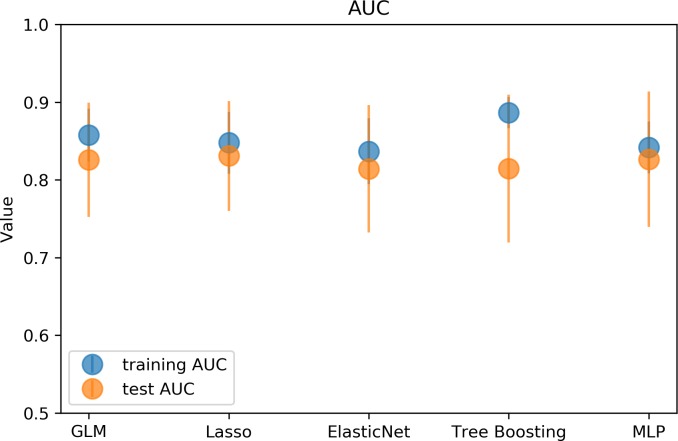
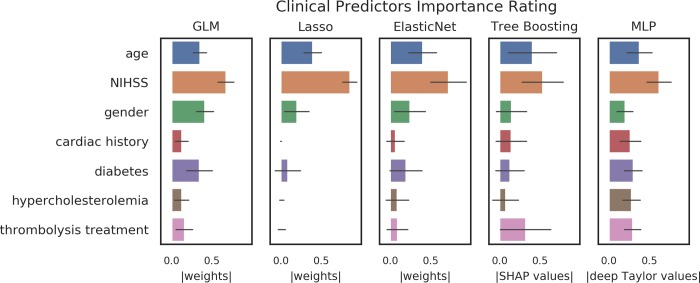
State-of-the-art machine learning (ML) artificial intelligence methods are increasingly leveraged in clinical predictive modeling to provide clinical decision support systems to physicians. Modern ML approaches such as artificial neural networks (ANNs) and tree boosting often perform better than more traditional methods like logistic regression. On the other hand, these modern methods yield a limited understanding of the resulting predictions. However, in the medical domain, understanding of applied models is essential, in particular, when informing clinical decision support. Thus, in recent years, interpretability methods for modern ML methods have emerged to potentially allow explainable predictions paired with high performance. To our knowledge, we present in this work the first explainability comparison of two modern ML methods, tree boosting and multilayer perceptrons (MLPs), to traditional logistic regression methods using a stroke outcome prediction paradigm. Here, we used clinical features to predict a dichotomized 90 days post-stroke modified Rankin Scale (mRS) score. For interpretability, we evaluated clinical features' importance with regard to predictions using deep Taylor decomposition for MLP, Shapley values for tree boosting and model coefficients for logistic regression. With regard to performance as measured by Area under the Curve (AUC) values on the test dataset, all models performed comparably: Logistic regression AUCs were 0.83, 0.83, 0.81 for three different regularization schemes; tree boosting AUC was 0.81; MLP AUC was 0.83. Importantly, the interpretability analysis demonstrated consistent results across models by rating age and stroke severity consecutively amongst the most important predictive features. For less important features, some differences were observed between the methods. Our analysis suggests that modern machine learning methods can provide explainability which is compatible with domain knowledge interpretation and traditional method rankings. Future work should focus on replication of these findings in other datasets and further testing of different explainability methods.
Overview
The claims and statistics of this paper haven’t been checked yet.
Free: it reads the open-access text and checks the first 5 claims that cite a source we can check. Create a free account to check every claim.
Integrity signals
Registry
Cites
Statistics
Figures
Verification
Claims the paper makes
The claims and statistics of this paper haven’t been checked yet.
Free: it reads the open-access text and checks the first 5 claims that cite a source we can check. Create a free account to check every claim.
Claims other papers make about this one
Each is checked against this paper’s own text: does it say what the citing paper says it does?
The cited source says what the claim attributes to it.
In the citing paper
“Building on earlier efforts that compared different model outputs [70] or validated the intuitiveness of visual explanations (like those from LRP) [48,49], recent studies have begun to experimentally test the impact of different explanation strategies on user performance and reliance.”
From Explainable AI for Clinical Decision Support Systems: Literature Review, Key Gaps, and Research Synthesis (2025) · cites this paper as [70]
Self-check
Percentages, sums and reported differences re-computed from the paper’s own numbers.
The self-check needs the paper’s full text.
Citations
Cites
XGBoost: A Scalable Tree Boosting System
Chen, T., & Guestrin, C. (2016) · Proceedings of the 22nd ACM SIGKDD International Conference on Knowledge Discovery and Data Mining · doi:10.1145/2939672.2939785 · Cited by 54,569
A Unified Approach to Interpreting Model Predictions
Lundberg, S., & Lee, S.-I. (2017) · arXiv · doi:10.48550/arxiv.1705.07874 · Cited by 23,707
"Why Should I Trust You?": Explaining the Predictions of Any Classifier
Ribeiro, M. T., Singh, S., & Guestrin, C. (2016) · Proceedings of the 22nd ACM SIGKDD International Conference on Knowledge Discovery and Data Mining · doi:10.1145/2939672.2939778 · Cited by 17,555
Visualizing and understanding convolutional networks
Zeiler, M. D., & Fergus, R. (2014) · Lecture Notes in Computer Science · doi:10.1007/978-3-319-10590-1_53 · Cited by 15,839
Advances in Neural Information Processing Systems 29
Teymur, O., Zygalakis, K., & Calderhead, B. (2016) · Cited by 13,887
A Caution Regarding Rules of Thumb for Variance Inflation Factors
O’brien, R. M. (2007) · Quality & Quantity · doi:10.1007/s11135-006-9018-6 · Cited by 11,217
Rudin, C. (2019) · Nature Machine Intelligence · doi:10.1038/s42256-019-0048-x · Cited by 10,561 · cited 1×
“a method which inherently provides information about feature importance, such as the weights of linear regression [36].”
MethodSantos, A. G., da Rocha, G. O., & de Andrade, J. B. (2019) · Scientific Reports · doi:10.1038/s41598-018-37186-2 · Cited by 8,495
XGBoost: A Scalable Tree Boosting System
Chen, T., & Guestrin, C. (2016) · arXiv · doi:10.48550/arxiv.1603.02754 · Cited by 7,104
Peeking Inside the Black-Box: A Survey on Explainable Artificial Intelligence (XAI)
Adadi, A., & Berrada, M. (2018) · IEEE Access · doi:10.1109/access.2018.2870052 · Cited by 6,294
Research works printed but not linked: 1
- Csáji BC. Approximation with Artificial Neural Networks. 2001; 45.
Cited by
Loh, H. W., Ooi, C. P., Seoni, S., Barua, P. D., Molinari, F., & Acharya, U. R. (2022) · Computer Methods and Programs in Biomedicine · doi:10.1016/j.cmpb.2022.107161 · Cited by 734
Antoniadi, A. M., Du, Y., Guendouz, Y., Wei, L., Mazo, C., Becker, B. A., & Mooney, C. (2021) · Applied Sciences · doi:10.3390/app11115088 · Cited by 629
Wang, K., Tian, J., Zheng, C., Yang, H., Ren, J., Liu, Y., Han, Q., & Zhang, Y. (2021) · Computers in Biology and Medicine · doi:10.1016/j.compbiomed.2021.104813 · Cited by 361
A Survey of Decision Trees: Concepts, Algorithms, and Applications
Mienye, I. D., & Jere, N. (2024) · IEEE Access · doi:10.1109/access.2024.3416838 · Cited by 353
Wani, N. A., Kumar, R., & Bedi, J. (2024) · Computer Methods and Programs in Biomedicine · doi:10.1016/j.cmpb.2023.107879 · Cited by 300
Ho, I. M. K., Cheong, K. Y., & Weldon, A. (2021) · PLOS ONE · doi:10.1371/journal.pone.0249423 · Cited by 208
“Nevertheless, deep learning techniques such as MLPR are regarded as “black box”, which can limit further analysis on features’ importance or the logic of the algorithm leading to prediction [84].”
MethodNasarian, E., Alizadehsani, R., Acharya, U. R., & Tsui, K.-L. (2024) · Information Fusion · doi:10.1016/j.inffus.2024.102412 · Cited by 207
Li, J., Liu, S., Hu, Y., Zhu, L., Mao, Y., & Liu, J. (2022) · Journal of Medical Internet Research · doi:10.2196/38082 · Cited by 199
Xu, Q., Xie, W., Liao, B., Hu, C., Qin, L., Yang, Z., Xiong, H., Lyu, Y., Zhou, Y., & Luo, A. (2023) · Journal of Healthcare Engineering · doi:10.1155/2023/9919269 · Cited by 161
Ethical Framework for Harnessing the Power of AI in Healthcare and Beyond
Nasir, S., Khan, R. A., & Bai, S. (2024) · IEEE Access · doi:10.1109/access.2024.3369912 · Cited by 152
Martinez-Ríos, E. A., Montesinos, L., Alfaro-Ponce, M., & Pecchia, L. (2021) · Biomedical Signal Processing and Control · doi:10.1016/j.bspc.2021.102813 · Cited by 174
Woodman, R. J., & Mangoni, A. A. (2023) · Aging Clinical and Experimental Research · doi:10.1007/s40520-023-02552-2 · Cited by 129
Wang, L., Zhang, Z., Wang, D., Cao, W., Zhou, X., Zhang, P., Liu, J., Fan, X., & Tian, F. (2023) · Frontiers in Computer Science · doi:10.3389/fcomp.2023.1187299 · Cited by 104
AI for Decision Support: Balancing Accuracy, Transparency, and Trust Across Sectors
Kővári, A. (2024) · Information · doi:10.3390/info15110725 · Cited by 221
Heijman, J., Sutanto, H., Crijns, H. J. G. M., Nattel, S., & Trayanova, N. A. (2021) · Cardiovascular Research · doi:10.1093/cvr/cvab138 · Cited by 109
XGBoost-Based Framework for Smoking-Induced Noncommunicable Disease Prediction
Davagdorj, K., Pham, V.-H., Theera‐Umpon, N., & Ryu, K. H. (2020) · International Journal of Environmental Research and Public Health · doi:10.3390/ijerph17186513 · Cited by 100
Artificial intelligence in stroke imaging: Current and future perspectives
Yedavalli, V. S., Tong, E., Martin, D., Yeom, K. W., & Forkert, N. D. (2020) · Clinical Imaging · doi:10.1016/j.clinimag.2020.09.005 · Cited by 111
Wani, N. A., Kumar, R., & Bedi, J. (2024) · Engineering Applications of Artificial Intelligence · doi:10.1016/j.engappai.2024.108939 · Cited by 98
Explainable deep learning in healthcare: A methodological survey from an attribution view
Jin, D., Sergeeva, E., Weng, W., Chauhan, G., & Szolovits, P. (2022) · WIREs Mechanisms of Disease · doi:10.1002/wsbm.1548 · Cited by 72
Alaka, S. A., Menon, B. K., Brobbey, A., Williamson, T. S., Goyal, M., Demchuk, A. M., Hill, M. D., & Sajobi, T. T. (2020) · Frontiers in Neurology · doi:10.3389/fneur.2020.00889 · Cited by 104
Ogami, C., Tsuji, Y., Seki, H., Kawano, H., To, H., Matsumoto, Y., & Hosono, H. (2021) · CPT Pharmacometrics & Systems Pharmacology · doi:10.1002/psp4.12643 · Cited by 92
Artificial Intelligence for Clinical Decision Support in Acute Ischemic Stroke: A Systematic Review
Akay, E. M. Z., Hilbert, A., Carlisle, B. G., Madai, V. I., Mutke, M. A., & Frey, D. (2023) · Stroke · doi:10.1161/strokeaha.122.041442 · Cited by 77
Self-citationOlawade, D. B., Plabon, S. B., Ojo, A., Ogunbona, M. A., Makanjuola, B. D., & Olasilola, R. (2026) · International Journal of Medical Informatics · doi:10.1016/j.ijmedinf.2026.106362 · Cited by 109
AI Applications in Adult Stroke Recovery and Rehabilitation: A Scoping Review Using AI
Senadheera, I., Hettiarachchi, P., Haslam, B. S., Nawaratne, R., Sheehan, J., Lockwood, K. J., Alahakoon, D., & Carey, L. M. (2024) · Sensors · doi:10.3390/s24206585 · Cited by 111
Αθανασίου, Μ., Sfrintzeri, K., Zarkogianni, K., Thanopoulou, A. C., & Nikita, K. S. (2020) · IEEE International Conference on Bioinformatics and Bioengineering (BIBE) · doi:10.1109/bibe50027.2020.00146 · Cited by 101
Chandrabhatla, A. S., Kuo, E. A., Sokolowski, J. D., Kellogg, R. T., Park, M. S., & Mastorakos, P. (2023) · Journal of Clinical Medicine · doi:10.3390/jcm12113755 · Cited by 79
Explainable machine learning practices: opening another black box for reliable medical AI
Ratti, E., & Graves, M. (2022) · AI and Ethics · doi:10.1007/s43681-022-00141-z · Cited by 61
“However, domain knowledge seems required in medicine, given that medical decisions are shaped by that knowledge [39].”
BackgroundExplainable Artificial Intelligence Based Framework for Non-Communicable Diseases Prediction
Davagdorj, K., Bae, J.-W., Pham, V.-H., Theera-Umpon, N., & Ryu, K. H. (2021) · IEEE Access · doi:10.1109/access.2021.3110336 · Cited by 60
Safaei, N., Safaei, B., Seyedekrami, S., Talafidaryani, M., Masoud, A., Wang, S., Li, Q., & Moqri, M. (2022) · PLoS ONE · doi:10.1371/journal.pone.0262895 · Cited by 85
Chowdhury, M. Z. I., Leung, A. A. C., Walker, R. L., Sikdar, K. C., O’Beirne, M., Quan, H., & Turin, T. C. (2023) · Scientific Reports · doi:10.1038/s41598-022-27264-x · Cited by 84
Dengler, N. F., Madai, V. I., Unteroberdörster, M., Zihni, E., Brune, S. C., Hilbert, A., Livne, M., Wolf, S., Vajkoczy, P., & Frey, D. (2021) · Neurosurgical Review · doi:10.1007/s10143-020-01453-6 · Cited by 63
Self-citationLuo, H., Xiang, C., Zeng, L., Li, S., Xue, M., Xiong, L., Liu, Y., Wen, C., Cui, Y., Du, L., et al. (2024) · Scientific Reports · doi:10.1038/s41598-024-67844-7 · Cited by 77
Unveiling Explainable AI in Healthcare: Current Trends, Challenges, and Future Directions
Noor, A. A., Manzoor, A., Mazhar Qureshi, M. D., Qureshi, M. A., & Rashwan, W. (2025) · WIREs Data Mining and Knowledge Discovery · doi:10.1002/widm.70018 · Cited by 52
Feature extraction approaches for biological sequences: a comparative study of mathematical features
Bonidia, R. P., Sampaio, L. D. H., Domingues, D. S., Paschoal, A. R., Lopes, F. M., de Carvalho, A. C. P. L. F., & Sanches, D. S. (2021) · Briefings in Bioinformatics · doi:10.1093/bib/bbab011 · Cited by 54
Zhang, X., Han, L., Sobeih, T., Han, L., Dempsey‐Hibbert, N., Lechareas, S., Tridente, A., Chen, H., White, S. J., & Zhang, D. (2022) · IEEE Journal of Biomedical and Health Informatics · doi:10.1109/jbhi.2022.3220813 · Cited by 57
Malfatti, L. H., Zampar, A., Galvão, A. C., Robazza, W. D. S., & Boiago, M. M. (2021) · LWT · doi:10.1016/j.lwt.2021.111720 · Cited by 43
Explainable AI-driven intelligent system for precision forecasting in cardiovascular disease
Bilal, A., Alzahrani, A., Almohammadi, K., Saleem, M., Farooq, M. S., & Sarwar, R. (2025) · Frontiers in Medicine · doi:10.3389/fmed.2025.1596335 · Cited by 71
Kim, K. H., Koo, H., Lee, B., Yoon, S., & Sohn, M. (2021) · Journal of the Korean Physical Society · doi:10.1007/s40042-021-00202-2 · Cited by 43
Salimparsa, M., Sedig, K., Lizotte, D. J., Abdullah, S. S., Chalabianloo, N., & Muanda, F. T. (2025) · Informatics · doi:10.3390/informatics12040119 · Cited by 39
“Building on earlier efforts that compared different model outputs [70] or validated the intuitiveness of visual explanations (like those from LRP) [48,49], recent studies have begun to experimentally test the impact of different explanation strategies on user performance and reliance.”
Oberste, L., & Heinzl, A. (2022) · IEEE Transactions on Artificial Intelligence · doi:10.1109/tai.2022.3227225 · Cited by 39
The Virtues of Interpretable Medical AI
Hatherley, J. J., Sparrow, R., & Howard, M. (2023) · Cambridge Quarterly of Healthcare Ethics · doi:10.1017/s0963180122000664 · Cited by 49
Zheng, D., Hao, X., Khan, M., Wang, L., Li, F., Xiang, N., Kang, F., Hämäläinen, T., Cong, F., Song, K., et al. (2022) · Frontiers in Cardiovascular Medicine · doi:10.3389/fcvm.2022.959649 · Cited by 34
Artificial intelligence in health care: preparing for the fifth Industrial Revolution
Sung, J. J. �., Stewart, C. L., & Freedman, B. (2020) · The Medical Journal of Australia · doi:10.5694/mja2.50755 · Cited by 38
Chen, Y., Kao, Y., Hsu, C., Chen, C., Ma, Y., Shen, Y., Liu, T., Hsu, S., Lin, H., Wang, J., et al. (2021) · Academic Emergency Medicine · doi:10.1111/acem.14339 · Cited by 31
Machine learning for early dynamic prediction of functional outcome after stroke
Klug, J., Leclerc, G., Dirren, E., & Carrera, E. (2024) · Communications Medicine · doi:10.1038/s43856-024-00666-w · Cited by 44
Unveiling Explainable AI in Healthcare: Current Trends, Challenges, and Future Directions
Aziz, N. A., Manzoor, A., Mazhar Qureshi, M. D., Qureshi, M. A., & Rashwan, W. (2024) · doi:10.1101/2024.08.10.24311735 · Cited by 30
“• In [51] demonstrated the effectiveness of collective inference using ante-hoc and posthoc XAI methods, and in [22], various XAI methods were employed to explain distinct ML models.”
BackgroundMethodInfluentialIslam, U., Mehmood, G., Al‐Atawi, A. A., Khan, F. N., Alwageed, H. S., & Cascone, L. (2024) · Journal of Neuroscience Methods · doi:10.1016/j.jneumeth.2024.110210 · Cited by 29
Automated deep learning in ophthalmology: AI that can build AI
O’Byrne, C., Abbas, A., Korot, E., & Keane, P. A. (2021) · Current Opinion in Ophthalmology · doi:10.1097/icu.0000000000000779 · Cited by 32
Chen, H., Damarjati, C., Putra, K. T., Chen, H.-M., Hsieh, C., Lin, H., Wu, M., & Chen, C. (2022) · Information Processing & Management · doi:10.1016/j.ipm.2021.102855 · Cited by 28
Briggs, E., de Kamps, M., Hamilton, W. T., Johnson, O. A., McInerney, C. D., & Neal, R. D. (2022) · Cancers · doi:10.3390/cancers14205023 · Cited by 32
The Virtues of Interpretable Medical Artificial Intelligence
Hatherley, J. J., Sparrow, R., & Howard, M. (2022) · Cambridge Quarterly of Healthcare Ethics · doi:10.1017/s0963180122000305 · Cited by 40
Explainable AI for Sensor Signal Interpretation to Revolutionize Human Health Monitoring: A Review
Alharthi, A. S., Alqurashi, A., Alharbi, T. E. A., Alammar, M. M., Aldosari, N., Bouchekara, H. R. E. H., Sha’aban, Y. A., Shahriar, M. S., & Ayidh, A. A. (2025) · IEEE Access · doi:10.1109/access.2025.3585764 · Cited by 46
Patient similarity analytics for explainable clinical risk prediction
Fang, H. S. A., Tan, N. C., Tan, W. Y., Oei, R. W., Lee, M. L., & Hsu, W. (2021) · BMC Medical Informatics and Decision Making · doi:10.1186/s12911-021-01566-y · Cited by 39
Appropriate use of machine learning in healthcare
Ozaydin, B., Berner, E. S., & Cimino, J. J. (2021) · Intelligence-Based Medicine · doi:10.1016/j.ibmed.2021.100041 · Cited by 34
Prediction of Hemorrhagic Transformation after Ischemic Stroke Using Machine Learning
Choi, J.-M., Seo, S.-Y., Kim, P.-J., Kim, Y.-S., Lee, S., Sohn, J., Kim, D., Lee, J., & Kim, C. (2021) · Journal of Personalized Medicine · doi:10.3390/jpm11090863 · Cited by 29
Murugan, C., Ramamoorthy, S., Kuppuswamy, G. P., Murugan, R. K., Sivalingam, Y., & Sundaramurthy, A. (2021) · International Journal of Biological Macromolecules · doi:10.1016/j.ijbiomac.2021.10.144 · Cited by 31
Abujaber, A. A., Nashwan, A. J., & Fadlalla, A. M. (2022) · Informatics in Medicine Unlocked · doi:10.1016/j.imu.2022.101090 · Cited by 33
Predicting Hospital Stay Length Using Explainable Machine Learning
Alsinglawi, B. S., Alnajjar, F., Alorjani, M. S., Alshari, O., Munoz, M. N., & Mubin, O. (2024) · IEEE Access · doi:10.1109/access.2024.3421295 · Cited by 34
Salman, S. G., Phadke, R. A., Kumar, R., Momin, A. A., & Tavakkoli, A. (2026) · Spine Deformity · doi:10.1007/s43390-026-01365-3 · Cited by 29
Mutke, M. A., Madai, V. I., Hilbert, A., Zihni, E., Potreck, A., Weyland, C. S., Möhlenbruch, M. A., Heiland, S., Ringleb, P. A., Nagel, S., et al. (2022) · Frontiers in Neurology · doi:10.3389/fneur.2022.737667 · Cited by 23
Self-citationArtificial Intelligence and Its Application in Cardiovascular Disease Management
Namasivayam, V., Senguttuvan, N., Saravanan, V., Palaniappan, S., & Kathiravan, M. K. (2022) · Springer eBooks · doi:10.1007/978-981-16-5993-5_9 · Cited by 26
Zhou, H., Bai, H. X., Jiao, Z., Cui, B., Wu, J., Zheng, H., Yang, H., & Liao, W. (2023) · European Journal of Radiology · doi:10.1016/j.ejrad.2023.111136 · Cited by 24
Prada, E. J. A., & García, J. F. C. (2024) · Sensors · doi:10.3390/s24227193 · Cited by 21
Prostate cancer management with lifestyle intervention: From knowledge graph to Chatbot
Chen, Y., Sinha, B., Ye, F., Tang, T., Wu, R., He, M., Zheng, X., & Shen, B. (2022) · Clinical and Translational Discovery · doi:10.1002/ctd2.29 · Cited by 16
Frey, D., Hilbert, A., Früh, A. M., Madai, V. I., Kossen, T., Kiewitz, J., Sommerfeld, J., Vajkoczy, P., Unteroberdörster, M., Zihni, E., et al. (2023) · Neurosurgical Review · doi:10.1007/s10143-023-02114-0 · Cited by 18
Self-citationChicco, D., & Jurman, G. (2021) · IEEE Access · doi:10.1109/access.2021.3084063 · Cited by 18
Probing machine-learning classifiers using noise, bubbles, and reverse correlation
Thoret, E., Andrillon, T., Léger, D., & Pressnitzer, D. (2020) · Journal of Neuroscience Methods · doi:10.1016/j.jneumeth.2021.109297 · Cited by 19
Zihni, E., McGarry, B. L., & Kelleher, J. D. (2022) · Exon Publications eBooks · doi:10.36255/exon-publications-digital-health-explainable-decisions · Cited by 26
Self-citationSudharson, D., Retheneka, S. O., Yogeswari, L., Logita, S. J., Shankari, S. U., & Surraya, S. M. N. (2022) · International Conference on Inventive Research in Computing Applications (ICIRCA) · doi:10.1109/icirca54612.2022.9985761 · Cited by 14
DT-CTNet: A clinically interpretable diagnosis model for fetal distress
Zhang, Y., Deng, Y., Zhang, X., Jiao, P., Zhang, X., & Zhao, Z. (2023) · Biomedical Signal Processing and Control · doi:10.1016/j.bspc.2023.105190 · Cited by 17
GMM‐LIME explainable machine learning model for interpreting sensor‐based human gait
Mulwa, M. M., Mwangi, R. W., & Mindila, A. (2024) · Engineering Reports · doi:10.1002/eng2.12864 · Cited by 24
Herrgårdh, T., Madai, V. I., Kelleher, J. D., Magnusson, R., Gustafsson, M., Milani, L. A., Gennemark, P., & Cedersund, G. (2021) · NeuroImage Clinical · doi:10.1016/j.nicl.2021.102694 · Cited by 19
Self-citationWu, Y., Xiang, C., Jia, M., & Fang, Y. (2022) · BMC Geriatrics · doi:10.1186/s12877-022-03295-x · Cited by 14
Predictive self-organizing neural networks for in-home detection of Mild Cognitive Impairment
Teh, S. K., Rawtaer, I., & Tan, A. (2022) · Expert Systems with Applications · doi:10.1016/j.eswa.2022.117538 · Cited by 17
Features and explainable methods for cytokines analysis of Dry Eye Disease in HIV infected patients
Curia, F. (2021) · Healthcare Analytics · doi:10.1016/j.health.2021.100001 · Cited by 16
Vendrame, A., Cappelletto, C., Chiovati, P., Vinante, L., Parvej, M., Caroli, A., Pirrone, G., Barresi, L., Drigo, A., & Avanzo, M. (2023) · Applied Sciences · doi:10.3390/app13084962 · Cited by 13
Medenica, V., Ivanović, L., & Milošević, N. (2024) · Applied Neuropsychology Adult · doi:10.1080/23279095.2024.2364229 · Cited by 19
Brusini, L., Cruciani, F., Dallaglio, G., Zajac, T., Galazzo, I. B., Zucchelli, M., & Menegaz, G. (2024) · IEEE Journal of Translational Engineering in Health and Medicine · doi:10.1109/jtehm.2024.3430035 · Cited by 14
Priya, S., Aggarwal, T., Ward, C. E., Bathla, G., Jacob, M., Gerke, A. K., Hoffman, E. A., & Nagpal, P. (2021) · Journal of Clinical Medicine · doi:10.3390/jcm10091921 · Cited by 12
Ortiz, J. A., Lledó, B., Morales, R., Máñez-Grau, Á., Cascales, A., Rodríguez-Arnedo, A., Castillo, J. C., Bernabeu, A., & Bernabeu, R. (2024) · Reproductive Biology and Endocrinology · doi:10.1186/s12958-024-01271-1 · Cited by 12
Artificial intelligence in stroke risk assessment and management via retinal imaging
Khalafi, P., Morsali, S., Hamidi, S., Ashayeri, H., Sobhi, N., Pedrammehr, S., & Jafarizadeh, A. (2025) · Frontiers in Computational Neuroscience · doi:10.3389/fncom.2025.1490603 · Cited by 17
Nelde, A., Klammer, M. G., Nolte, C. H., Stengl, H., Krämer, M., von Rennenberg, R., Meisel, A., Scheibe, F., Endres, M., Scheitz, J. F., et al. (2023) · Journal of Neurology · doi:10.1007/s00415-023-11718-x · Cited by 16
Sonalitha, E., Nurdewanto, B., Zubair, A., Asriningtias, S. R., Yudhistiro, K., & Mujahidin, I. (2020) · International Seminar on Research of Information Technology and Intelligent Systems (ISRITI) · doi:10.1109/isriti51436.2020.9315406 · Cited by 11
Thieme, A., Rajamohan, A. M., Cooper, B., Groombridge, H., Simister, R. J., Wong, B., Woznitza, N., Pinnock, M. A., Wetscherek, M. T., Morrison, C. P., et al. (2025) · ACM Transactions on Computer-Human Interaction · doi:10.1145/3716500 · Cited by 20
Yang, Y., Liao, C.-Y., Keyvanshokooh, E., Shao, H., Weber, M. B., Pasquel, F. J., & Garcia, G. P. (2025) · JMIR Medical Informatics · doi:10.2196/66200 · Cited by 16
Αθανασίου, Μ., Sfrintzeri, K., Zarkogianni, K., Thanopoulou, A. C., & Nikita, K. S. (2020) · doi:10.36227/techrxiv.12942299 · Cited by 10
Thieme, A., Rajamohan, A., Cooper, B., Groombridge, H., Simister, R., Wong, B., Woznitza, N., Pinnock, M. A., Wetscherek, M. T., Morrison, C., et al. (2024) · arXiv · doi:10.48550/arxiv.2405.05299 · Cited by 10
Construction of disability risk prediction model for the elderly based on machine learning
Chen, J., Ren, Y., Ding, J., Hu, Q., Xu, J., Luo, J., Wu, Z., & Chu, T. (2025) · Scientific Reports · doi:10.1038/s41598-025-01404-5 · Cited by 9
Stroke Risk Prediction and Prevention: Traditional versus Machine Learning Approaches
Singh, M. S., Thongam, K., Choudhary, P., & Bhagat, P. K. (2025) · Archives of Computational Methods in Engineering · doi:10.1007/s11831-025-10406-5 · Cited by 20
Wani, N. A., Bedi, J., & Kumar, R. (2026) · Complex & Intelligent Systems · doi:10.1007/s40747-026-02258-8 · Cited by 16
Designing User-Centric Explanations for Medical Imaging with Informed Machine Learning
Oberste, L., Rüffer, F., Aydingül, O., Rink, J. S., & Heinzl, A. (2023) · Lecture notes in computer science · doi:10.1007/978-3-031-32808-4_29 · Cited by 12
Li, Q., Chi, L., Zhao, W., Wu, L., Jiao, C., Zheng, X., Zhang, K., & Li, X. (2023) · Frontiers in Neurology · doi:10.3389/fneur.2023.1039794 · Cited by 12
Farkhadov, M., Eliseev, A., & Петухова, Н. В. (2020) · IEEE International Conference on Application of Information and Communication Technologies (AICT) · doi:10.1109/aict50176.2020.9368576 · Cited by 10
Otieno, J. A., Häggström, J., Darehed, D., & Eriksson, M. (2024) · PLoS ONE · doi:10.1371/journal.pone.0303287 · Cited by 12
Identifying Lead Service Lines with Field Tap Water Sampling
Blackhurst, M. F. (2021) · ACS ES&T Water · doi:10.1021/acsestwater.1c00227 · Cited by 9
The roles of predictors in cardiovascular risk models - a question of modeling culture?
Wallisch, C., Agibetov, A., Dunkler, D., Haller, M. C., Samwald, M., Dorffner, G., & Heinze, G. (2021) · BMC Medical Research Methodology · doi:10.1186/s12874-021-01487-4 · Cited by 8
Hu, B., Wang, C., Jiang, K., Shen, Z., Yang, X., Yin, M., Liang, B., Xie, Q., Ye, Y., & Gao, Z. (2021) · BMC Gastroenterology · doi:10.1186/s12876-021-02048-1 · Cited by 8
Αθανασίου, Μ., Sfrintzeri, K., Zarkogianni, K., Thanopoulou, A. C., & Nikita, K. S. (2020) · doi:10.36227/techrxiv.12942299.v1 · Cited by 11
Robotic Systems Integrated with AI for Patient Rehabilitation
Patil, S. C., Madankar, A., Mantri, S., Gulhane, M., S, R. S., Gupta, A., & Rakesh, N. (2025) · International Conference for Emerging Technology (INCET) · doi:10.1109/incet64471.2025.11140272 · Cited by 8
Sharma, V., Sinha, A., Wiryaseputra, M., Kumar, B., Kumar, T. R., & Alkhayyat, A. H. (2023) · International Conference on Computing, Communication and Networking Technologies (ICCCNT) · doi:10.1109/icccnt56998.2023.10306356 · Cited by 7
Metadata
- Authors
- Zihni, E., Madai, V. I., Livne, M., Galinovic, I., Khalil, A. A., Fiebach, J. B., & Frey, D.
- Affiliations
- Charité – Universitätsmedizin Berlin (DE)
- Center for Stroke Research Berlin (DE)
- Corresponding author
- Madai, Vince Istvan
- ORCID
- Venue
- PLOS ONE
- Publisher
- Public Library of Science (PLoS)
- Published
- 2020-04-06
- Volume
- 15
- Issue
- 4
- Pages
- e0231166
- ISSN
- 1932-6203 (ISSN-L)
- PMC
- PMC7135268
- OpenAlex
- W3014245704
- Cited by
- 187
- References
- 50
- Citations by year
- 2026: 20 · 2025: 26 · 2024: 34 · 2023: 31 · 2022: 30 · 2021: 35 · 2020: 10
- FWCI
- 10.41
- Type
- journal article
- Language
- en
- Open access
- gold
- doi.org
- Licence
- Locations
- PLoS ONE (publishedVersion, cc-by)
- medRxiv (acceptedVersion, cc-by-nc-nd)
- PubMed Central (publishedVersion, cc-by)
- PubMed (publishedVersion)
- Arrow - TU Dublin (Technological University Dublin) (submittedVersion, cc-by-nc-sa)
- RePEc: Research Papers in Economics (submittedVersion)
- DOAJ (DOAJ: Directory of Open Access Journals) (submittedVersion, cc-by-sa)
- Refubium (Universitätsbibliothek der Freien Universität Berlin) (submittedVersion, cc-by)
- Universitätsbibliothek der FU Berlin Hochschulschriftenstelle u. Dokumentenserver (cc-by)
- Funders
- Deutsche Forschungsgemeinschaft
- Bundesministerium für Bildung und Forschung (PREDICTioN2020)
- Topics
- Physical Sciences › Computer Science › Artificial Intelligence › Explainable Artificial Intelligence (XAI)
- Health Sciences › Health Professions › Health Information Management › Artificial Intelligence in Healthcare
- Physical Sciences › Computer Science › Artificial Intelligence › Machine Learning in Healthcare
- Keywords
- explainable AI, clinical decision support, stroke outcome prediction, modified Rankin Scale, gradient boosting decision tree, multilayer perceptron, logistic regression, feature importance, Shapley value, stroke severity, age
- MeSH terms
- Clinical Decision-Making, Supervised Machine Learning, Aged, Aged, 80 and over, Female, Forecasting, Humans, Male, Middle Aged, Prognosis, Retrospective Studies, Logistic Models, Neural Networks, Computer, Outcome Assessment, Health Care, Area Under Curve, Stroke
About these checks
Registry, retraction, Cites and statistics results are computed, not judged, with one exception: a printed reference that no index lists is read once by a model before it counts as a citation error. Claims are extracted by a model and kept only when their quote appears verbatim in the text; each cited source is then checked, with a model’s help, for whether it says what the claim relies on. Those verdicts can be wrong — read the claim’s quote and the cited source before relying on one.
Statistics and arithmetic are recomputed, not judged.
Confidence bands are shown only for fields calibrated on our annotated test set. None is calibrated yet, so no band is shown.
What counts as a claim ›How we measure confidence ›How we check this ›
Are you an author, or do you see a problem with this page? Request a review
Data sources
Bibliographic data: Semantic Scholar, OpenAlex, Crossref.
Contains information from the Semantic Scholar Academic Graph Datasets, made available under the ODC Attribution License (ODC-BY 1.0).
Semantic Scholar’s data is described in: Kinney, R., et al. (2023). The Semantic Scholar Open Data Platform. arXiv:2301.10140.
